
You are writing a quick note about a craft project. You type “I am glueing…” and stop. Something looks off. Is it gluing or glueing?
The short answer: gluing is the spelling to use. It is the standard present participle of the verb “glue” in both American and British English. This guide explains why, where the confusion comes from, and how to get it right every time.
Gluing vs Glueing: The Only Correct Spelling You Need to Know
Use gluing. Drop the “e” from “glue,” add “-ing,” and you are done.
- ✅ She is gluing the broken vase.
- ❌ She is glueing the broken vase.
Most style guides, editors and teachers treat “glueing” as an error or, at best, a rare variant. Writing “gluing” keeps your text clean and professional.
Read More:Interested In or Interested On: Which Is Correct?
Gluing or Glueing Meaning
Gluing is the present participle and gerund of the verb to glue. It means sticking things together with an adhesive, or fixing something firmly in place.
It works in two ways:
- Literal: joining objects with glue, paste or another bonding agent.
- Figurative: staying fixed on something, as in “gluing yourself to the screen.”
“Glueing” carries exactly the same meaning. It is just a less accepted way of writing it.
Read More:What Does “These Days” Mean? Definition, Examples & Usage
Why the Spelling Confusion Still Happens Today
The mix-up has a few simple causes:
- The noun keeps its “e.” Because “glue” ends in “-ue,” the eye expects to see the “e” survive.
- Other words keep their “e.” Words like “dyeing,” “singeing” and “queueing” hold on to it, so people assume “glue” does too.
- Both forms have appeared in print for a long time. Writers have used the variant since around 1800, though it never became the norm.
- Spell checkers differ. Some tools flag it, some let it slide.
The result is a word that looks like it could go either way, even though one version clearly dominates.
Gluing vs Glueing in American and British English
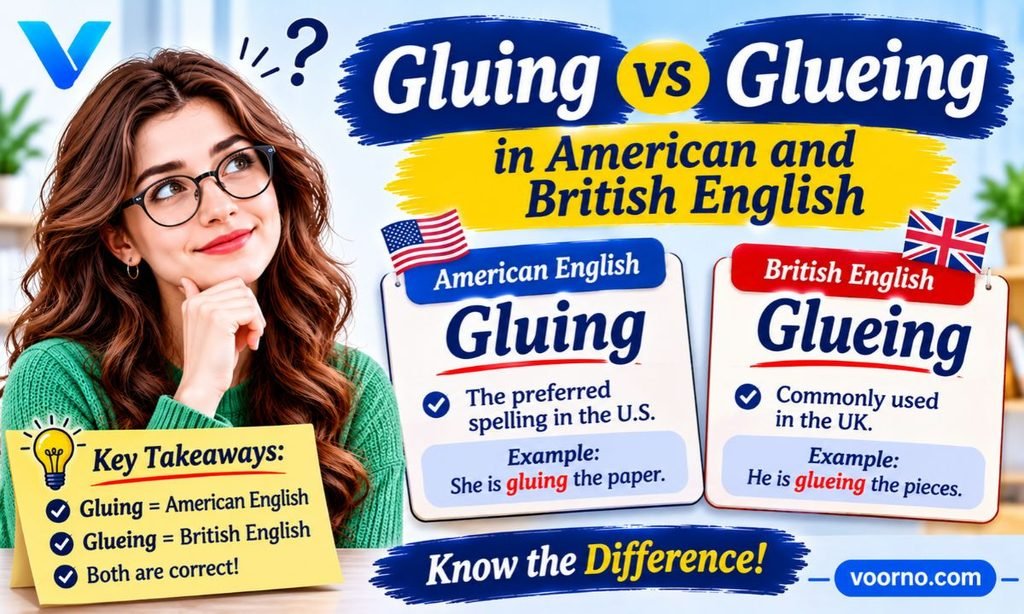
In American English, “gluing” is the standard. In British English, it is also the standard and by far the most common form, although you may still spot “glueing” occasionally.
Some websites claim “glueing” is a British spelling. That is an oversimplification. Usage data shows “gluing” leading in both regions, with the variant remaining marginal.
Regional Usage Table
| Region | Standard spelling | Is “glueing” accepted? |
| United States | gluing | Rarely; usually marked as an error |
| United Kingdom | gluing | Occasionally seen, but uncommon |
| Canada | gluing | Rarely |
| Australia / New Zealand | gluing | Rarely |
Rule of thumb: if you want one spelling that works everywhere, choose “gluing.”
What Dictionaries Say
Dictionaries record how people actually write, so they are the best place to settle a spelling debate.
- Merriam-Webster lists the verb forms as glued; gluing, and adds “also glueing” as a minor variant.
- Oxford and Cambridge style resources present “gluing” as the main form for the present participle.
- Usage sites and grammar guides overwhelmingly label “glueing” as nonstandard.
The pattern is consistent: “gluing” comes first, and “glueing” is, at most, a footnote. If a dictionary mentions the variant, it still puts “gluing” ahead.
Where the Rule Comes From: A Short Etymology of “Gluing”

The word “glue” entered English in the 14th century. It came from Middle English glu, which came through Anglo-French from Late Latin glus, a relative of the Latin gluten, meaning glue.
The verb form followed the same path as many English verbs ending in a silent “e”:
| Base verb | Add -ing | Result |
| make | making | e dropped |
| argue | arguing | e dropped |
| continue | continuing | e dropped |
| rescue | rescuing | e dropped |
| glue | gluing | e dropped |
The Silent-E Rule
When a verb ends in a silent “e,” drop the “e” before adding “-ing.” Glue follows this rule. That is the whole story.
Exceptions exist for verbs ending in “-ee,” “-ye” or “-oe” (seeing, dyeing, hoeing). The “e” stays there to avoid confusion with other words or awkward letter clusters. “Glue” does not fall into any of those groups.
What “Gluing” Actually Means in Real-Life Language
In everyday speech, “gluing” covers more than craft projects. It describes:
- Attaching two surfaces with adhesive
- Repairing broken objects
- Assembling models, furniture or packaging
- Holding attention firmly (“eyes glued to the screen”)
Where You’ll See “Gluing” in Real Life
- Schools and kindergartens: cutting and gluing worksheets
- Woodworking: gluing boards, joints and veneers
- Packaging and printing: automated gluing of boxes and labels
- DIY and repairs: gluing tiles, shoes or ceramics
- Crafts and scrapbooking: gluing photos, paper and decorations
- Manufacturing: industrial gluing lines in furniture and packaging
Gluing or Glueing Synonym
Looking for another way to say it? Try one of these:
- sticking
- bonding
- cementing
- adhering
- fastening
- attaching
- pasting
- sealing
Pick the one that fits the material. “Bonding” suits technical writing, while “sticking” sounds natural in casual speech.
Examples of Correct Usage of “Gluing”

Here are sample sentences you can borrow:
- The kids are gluing colorful paper onto the poster.
- He spent the afternoon gluing the chair leg back in place.
- We are gluing the tiles before the grout goes on.
- Gluing the pieces together took longer than expected.
- Stop gluing your eyes to your phone and join the conversation.
- The factory has a machine dedicated to gluing cartons.
Notice how “gluing” works as a verb in some sentences (1, 2, 3, 5) and as a noun-like gerund in others (4, 6).
Past Tense and Other Forms
The verb glue is regular, so its forms are easy.
| Form | Spelling | Example |
| Base form | glue | I glue the edges. |
| Third person singular | glues | She glues the labels. |
| Past tense | glued | We glued the frame yesterday. |
| Past participle | glued | The sign was glued to the wall. |
| Present participle / gerund | gluing | They are gluing the cover. |
| Adjective | gluey | The table felt gluey. |
Notice that the “e” in “glue” is silent in “glued” too. The past tense simply adds “-d.”
Why “Glueing” Is Not Standard, and Why Using It Hurts Your Writing
Using a nonstandard spelling can cost you more than you think.
- It looks like a typo. Readers may assume you did not proofread.
- It weakens credibility. In resumes, product pages, school work and professional emails, small errors stand out.
- It can hurt SEO. Search engines and readers both favor the dominant spelling, which is “gluing.”
- It breaks consistency. If you write “making” and “arguing,” the same rule should give you “gluing.”
One small spelling choice will not ruin a piece of writing, but a clean version always reads better.
Gluing or Glueing Examples
| Correct ✅ | Incorrect ❌ |
| I am gluing the label on. | I am glueing the label on. |
| Gluing wood takes patience. | Glueing wood takes patience. |
| They finished gluing the model. | They finished glueing the model. |
Memory Tricks to Always Spell “Gluing” Correctly

Try one of these quick tricks:
- Same as “making.” You do not write “makeing,” so you do not write “glueing.”
- Say it out loud. “GLOO-ing” has just one “oo” sound before “-ing.” No extra “e” is needed.
- Picture the crossed-out e. Imagine the “e” of “glue” falling off as the “-ing” arrives.
- Link it to “arguing.” Same ending, same pattern. If “arguing” feels right, “gluing” does too.
- When in doubt, check the past tense. “Glued” has no extra “e,” and neither does “gluing.”
Gluing or Glueing Oxford Dictionary
Oxford-style references list “gluing” as the primary participle form of “glue.” Where “glueing” appears at all, it is treated as a variant rather than the preferred spelling. If you follow Oxford house style, choose “gluing.”
Common Misspellings Related to Gluing
Besides “glueing,” watch for these slips:
- gluuing
- gluingg
- glueingg
- gluinge
- gloing
- glewing
Words People Often Get Wrong
Similar silent-e words trip people up too.
| Correct | Common mistake |
| arguing | argueing |
| continuing | continueing |
| rescuing | rescueing |
| issuing | issueing |
| pursuing | pursueing |
| queuing / queueing | (both accepted) |
“Queue” is one of the few “-ue” words where both versions are commonly seen. “Glue” is not one of them.
Gluing or Glueing Pronunciation
Gluing is pronounced GLOO-ing, or /ˈɡluːɪŋ/.
- Syllables: glu-ing (2)
- The “u” sounds like the “oo” in “moon.”
- American and British speakers say it almost the same way.
Because the sound does not change, spelling is the only place where the confusion lives.
Quick Reference Table: Gluing vs Glueing
| Feature | Gluing | Glueing |
| Standard spelling | Yes | No |
| Follows the silent-e rule | Yes | No |
| US English | Standard | Rarely used |
| UK English | Standard | Occasional variant |
| Listed first in dictionaries | Yes | Variant at most |
| Recommended for writing | ✅ | ❌ |
FAQs
Q:How do you spell glueing or gluing?
The correct spelling is gluing. Drop the silent “e” from “glue” before adding “-ing.”
Q:What does glueing mean?
“Glueing” is a rare, nonstandard spelling of “gluing,” meaning to stick things together with adhesive. It has the same meaning but should be avoided.
Q:What are two types of glue?
The two broad types are natural glue (such as animal hide glue) and synthetic glue (such as PVA white glue or super glue).
Q:What is another word for “gluing”?
Common alternatives are sticking, bonding, cementing, adhering, fastening and attaching.
Q:What is a fancy way to say “glue”?
Try “adhesive,” “bonding agent,” “cement” or “mucilage” for a more formal or technical tone.
Conclusion
So, is it gluing or glueing? Go with gluing. It follows the standard silent-e rule, matches dictionary preference in both American and British English, and keeps your writing polished.
Just remember to drop the “e” from “glue” before adding “-ing,” keep the past tense as “glued,” and treat “glueing” as nothing more than a rare variant. Use “gluing” everywhere for safe, consistent spelling, and the next time you reach for the glue, you will know exactly how to write it.










2 thoughts on “Is It Gluing or Glueing? Correct Spelling and Usage”