
You are typing a quick email. You want to say that rescheduling the meeting is a pain. Then you stop. Is it “hastle” or “hassle”?
That pause is common. Both versions look believable, and they sound identical when spoken. This guide gives you the answer, the meaning, the history, and a few tricks so you never second-guess the word again.
Why “Hastle or Hassle” Confuses So Many People
English spelling does not always follow sound. Many words hide letters you never pronounce, so writers often guess.
Here is why “hastle” keeps sneaking in:
- The word sounds like /ˈhæsl/, and other words with that ending, such as “castle,” are spelled with a “t.”
- “Hustle” and “bustle” contain a “t,” so the brain adds one to “hassle.”
- Autocorrect and speed typing let small errors slide.
- Once people see a misspelling online, it starts to look normal.
Read More:What Does “Rest Assured” Mean? Meaning, Usage & Examples
Quick Answer: “Hassle” Is Correct — “Hastle” Doesn’t Exist
“Hassle” is the only correct spelling. It has a double “s” and no “t.” “Hastle” is not listed in standard dictionaries, in American, British or Australian English.
- ✅ It was such a hassle to renew my passport.
- ❌ It was such a hastle to renew my passport.
What “Hassle” Actually Means
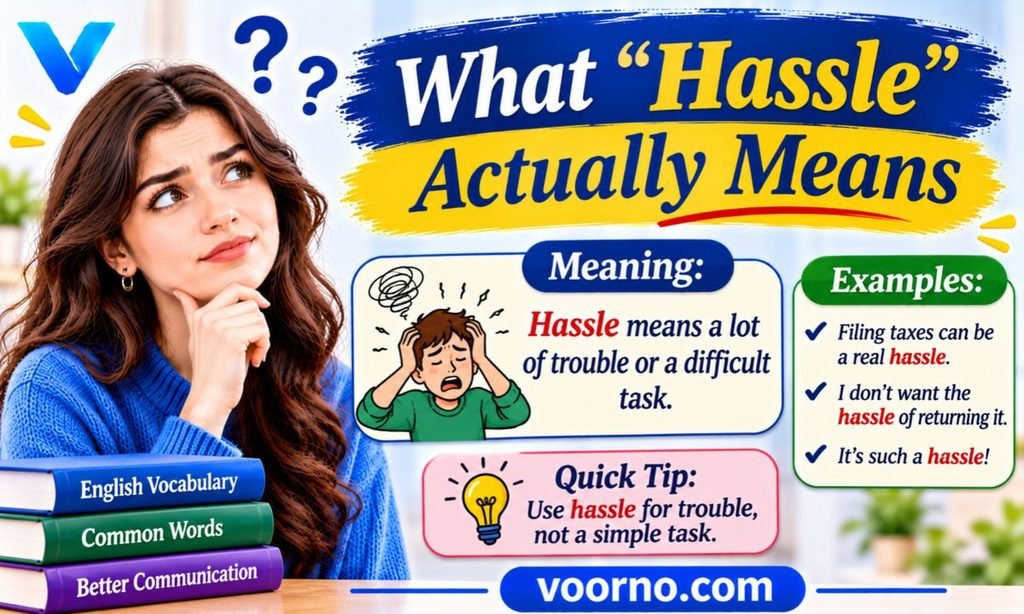
“Hassle” is an informal word for trouble, annoyance or inconvenience. It usually describes something that takes more time or effort than it should.
Think of long forms, slow queues, or a printer that refuses to connect. Each one is a hassle. The word works as both a noun and a verb.
Hassle as a Noun
As a noun, “hassle” names the annoying thing itself. It can be countable or uncountable.
- Countable: “Airport delays are one of the hassles of holiday travel.”
- Uncountable: “Online banking saves a lot of hassle.”
Common noun phrases include “a major hassle,” “no hassle,” “save the hassle of” and “hassle-free.”
Hassle as a Verb
As a verb, “hassle” means to bother or pester someone, often about something minor. Dictionaries also list an older sense: to argue or quarrel.
- “Stop hassling me about the report. I’ll send it today.”
- “Customers should not be hassled by pushy salespeople.”
The verb forms are hassle, hassles, hassled and hassling.
Noun vs. Verb: Understanding the Difference Clearly
| Feature | Noun | Verb |
| Meaning | An annoying problem or inconvenience | To bother, nag or pester someone |
| Needs an object? | No | Usually yes (hassle someone) |
| Example | “Parking downtown is a hassle.” | “Nobody likes being hassled by telemarketers.” |
| Forms | hassle, hassles | hassle, hassles, hassled, hassling |
A quick test: if you can put “a” or “the” in front of it, it is a noun. If someone is doing it to another person, it is a verb.
Why People Keep Spelling It “Hastle”
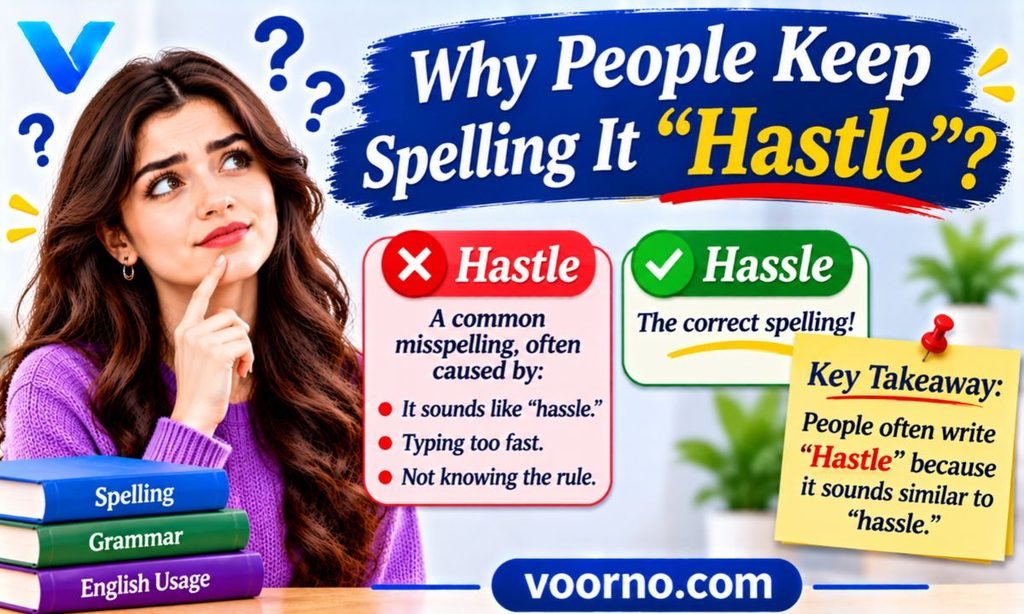
Four habits cause most errors:
- Spelling by sound. English learners and fast typists write what they hear.
- Look-alike words. “Hustle,” “bustle” and “castle” all carry a “t” in the same spot.
- Weak autocorrect. Some tools miss “hastle,” especially in mixed-language settings.
- Repetition. Seeing the error in ads or social posts makes it feel familiar.
The Origin of “Hassle”: A Surprisingly Modern Word
“Hassle” is younger than most people expect. Etymology sources trace the noun to American English in 1945, with the verb appearing around 1951.
Where it came from is still debated:
- Oxford Learner’s Dictionaries suggests a blend of “haggle” and “tussle.”
- Merriam-Webster proposes a possible blend of “harass” and “hustle.”
- Etymonline points to a Southern U.S. dialect word meaning to pant or breathe noisily.
No one has settled it. What is certain is that no version of the story includes a “t” in “hassle.”
How “Hassle” Functions in Everyday English
“Hassle” fits casual speech, workplace chat and marketing copy. It is friendly and direct, but it can feel too informal for legal or academic writing.
You will see it in fixed phrases:
- Hassle-free: a process that is easy
- Hassle factor: how much effort something demands
- Hassle of + verb-ing: “the hassle of moving house”
- Hassle out (informal): to work something out through debate
Hastle or Hassle Pronunciation
“Hassle” is pronounced HAS-uhl, written /ˈhæsl/ in phonetic script. It has two syllables, and the stress falls on the first.
Both US and UK speakers say it the same way. Because “hastle” would sound identical, your ears cannot help you here. Spelling is the only thing that separates the two.
Memory Tricks to Remember the Correct Spelling

Try any of these:
- Rhyme trick: “Hassle” rhymes with tassel and vassal. Both have a double “s.”
- Stress trick: A hassle causes stress, and both words have double “s.”
- Two-S rule: Picture two S’s sitting side by side, like two people crammed into a small elevator.
- Delete the T: If you typed “hastle,” remove the “t” and add another “s.”
Silent “t” Words Have a Clear Pattern
Part of the confusion comes from a real English pattern. Words ending in -stle often drop the “t” sound:
| Word | Sounds like | Silent “t”? |
| castle | KAS-uhl | Yes |
| whistle | WIS-uhl | Yes |
| bristle | BRIS-uhl | Yes |
| wrestle | RES-uhl | Yes |
| nestle | NES-uhl | Yes |
| hassle | HAS-uhl | No, it is a double “s” |
So your instinct is not silly. “Hassle” is simply an exception to the -stle group. It belongs with “tassel” and “vassal,” not “castle.”
Synonyms and Alternatives for “Hassle”

Depending on the tone you want, you can swap “hassle” for a more precise word.
- Everyday: bother, trouble, nuisance, pain
- Formal: inconvenience, difficulty, complication, burden
- As a verb: annoy, pester, harass, badger, nag
“Bother” is milder than “hassle,” while “nuisance” focuses on the irritation rather than the effort involved.
Hastle or Hassle Examples
Noun examples
- “Returning the package was a hassle.”
- “Working from home saves me the hassle of commuting.”
- “We offer hassle-free refunds.”
Verb examples
- “My landlord keeps hassling me about the deposit.”
- “Please don’t hassle the staff.”
- “He got hassled at the border.”
Incorrect examples to avoid
- ❌ “What a hastle!”
- ❌ “A hastle-free checkout.”
- ❌ “Stop hastling me.”
“Hassle” in Pop Culture and Media
“Hassle” is everywhere. Product pages promise hassle-free returns. News headlines mention travel hassles. Slang dictionaries record the verb in novels, films and TV scripts from the 1960s onward.
Aviation slang even uses “hassling” to describe mock dogfights between pilots. That constant exposure in print helps keep the double-“s” spelling firmly in place.
Frequent Mistakes People Make with “Hassle”
- Spelling it “hastle.” Remember: two S’s, no T.
- Spelling it “hassel.” This is a common variant error. The word ends in -le.
- Confusing it with “hustle.” “Hustle” means to hurry or push energetically. It has a different meaning.
- Using it in very formal writing. In a legal brief or academic paper, choose “inconvenience” or “difficulty.”
- Misusing it for personal struggle. “I had a hassle to finish” is unnatural. Say “I had trouble finishing.”
Hastle or Hassle Synonym
If you want to avoid the word entirely, these options work in most sentences:
| Instead of… | Try… |
| “It’s a hassle.” | “It’s an inconvenience.” / “It’s a nuisance.” |
| “Don’t hassle me.” | “Don’t pester me.” / “Don’t bother me.” |
| “Hassle-free service” | “Effortless service” / “Trouble-free service” |
| “A legal hassle” | “A legal complication” |
Case Study: How One Company Boosted Conversions by Fixing Spelling Errors
This is an illustrative scenario, not a report on a real business.
Imagine an online software company whose landing page said, “Enjoy a hastle-free setup.” Visitors noticed. Some emailed to ask if the product was legitimate, and the sales team spent time answering.
The company took three simple steps:
- Corrected the headline to “hassle-free.”
- Ran a spell-check pass on every page and email template.
- Added a short proofreading step before publishing.
The lesson is practical. A small typo in a headline can weaken trust, and trust affects whether people click “buy.” Correct spelling costs nothing and protects your credibility.
Quick Reference Table: Everything You Need to Remember
| Question | Answer |
| Correct spelling | Hassle |
| Incorrect spelling | Hastle |
| Parts of speech | Noun and verb |
| Pronunciation | HAS-uhl (/ˈhæsl/) |
| Meaning | Annoyance, inconvenience, or to pester |
| Rhymes with | Tassel, vassal |
| Memory trick | Two S’s, like stress |
| Register | Informal |
| First recorded | 1945 (noun), American English |
FAQs
Q:Is it hastle or hassle?
It is hassle. “Hastle” is a misspelling and is not recognized in standard English dictionaries.
Q:What does hassel mean?
“Hassel” is a misspelling of “hassle,” which means an annoying problem or inconvenience. As a verb, it means to bother someone repeatedly.
Q:What is another word for “hassel”?
Use the correct spelling “hassle” and swap in synonyms such as bother, nuisance, trouble or inconvenience.
Q:What does hassling mean?
“Hassling” means bothering, pestering or harassing someone, usually over something minor. It is the -ing form of the verb “hassle.”
Q:What is a slang word for “hassle”?
Common informal alternatives include “drag,” “pain,” “headache” and “bother.” Each one describes something annoying or tiresome.
Conclusion
The debate is easy to settle. “Hassle” is correct, and “hastle” is not a word. It has two S’s, no T, and it works as both a noun and a verb.
Next time you feel unsure, remember the rhyme with tassel and vassal, or think of the double S in stress. Add a quick proofread before you hit send, and this spelling will never be a hassle again.










1 thought on “Hastle or Hassle: Which Spelling Is Correct?”