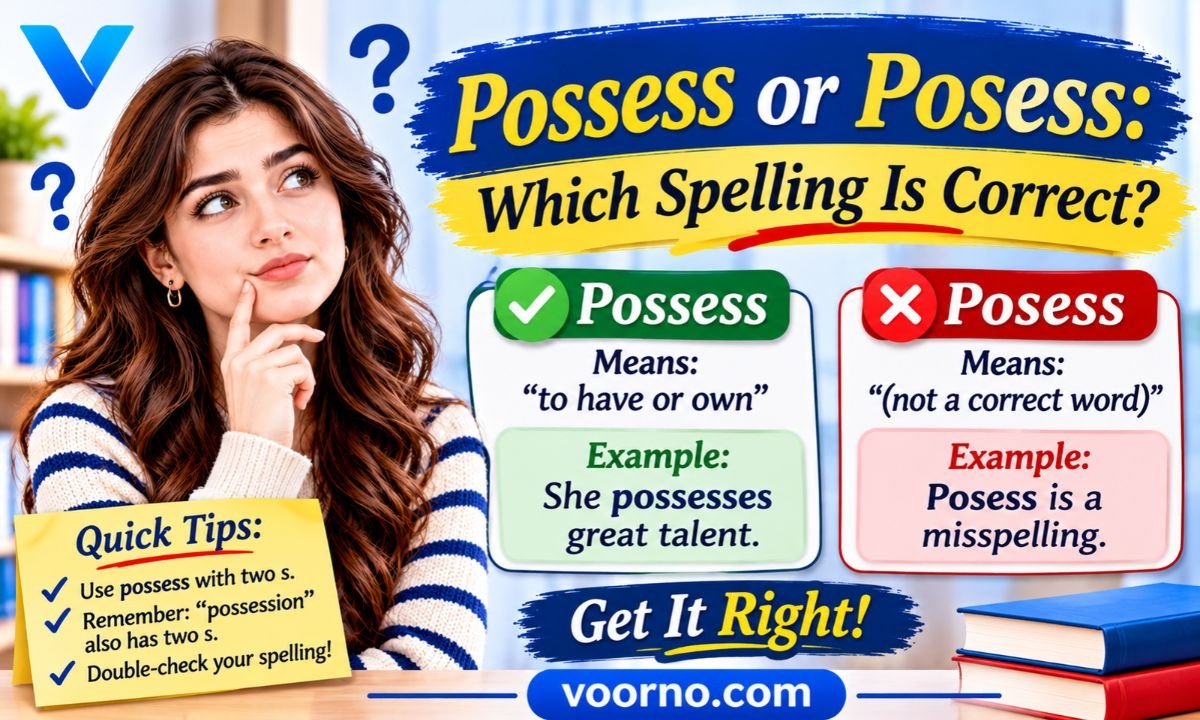
If you’ve ever paused mid-sentence wondering whether it’s “possess” or “posess,” you’re not alone. This is one of the most commonly misspelled words in English, and the confusion usually comes down to one small thing: how many S’s the word actually needs.
The short answer: “Possess” is correct. “Posess” is a misspelling and is never accepted in formal or informal English writing.
In this guide, you’ll learn exactly why “possess” carries a double “S” in two places, how to use it correctly in different contexts, and simple memory tricks so you never second-guess the spelling again.
Posess or Possess: Which One Is Correct?
There’s no debate here — possess is the only correct spelling. “Posess” doesn’t appear in any English dictionary, whether British or American. It’s a spelling error that happens because the word sounds shorter than it looks when spoken aloud.
| Spelling | Correct? | Notes |
| Possess | ✅ Yes | Standard spelling in all English dictionaries |
| Posess | ❌ No | Common misspelling; missing a double “s” |
| Posses | ❌ No | Also incorrect; sometimes confused with “posses” (plural of posse) |
| Possess | ✅ Yes | Used in US and UK English identically |
Read More:Per Se or Per Say? Meaning, Spelling & Examples
Possess or Posess Meaning
Before diving deeper into spelling rules, it helps to understand what the word actually means — since meaning and memory often go hand in hand.
What Does “Possess” Mean in English?
“Possess” is a verb that means to have, own, or hold something. It can refer to:
- Physical ownership — “She possesses a beautiful antique desk.”
- Skills or qualities — “He possesses excellent leadership skills.”
- Control or influence — “A strange calm seemed to possess her.”
It’s a formal word, often used in legal, academic, and professional writing rather than casual conversation, where “have” or “own” is more common.
Why “Posess” Is Always Incorrect
“Posess” fails because it drops one of the required “S” letters from the middle of the word. English spelling isn’t always phonetic, and this is a perfect example — the word is pronounced with a softer sound than its spelling suggests, which tricks writers into simplifying it.
There is no context, dialect, or regional spelling variation where “posess” is acceptable. Spellcheckers, style guides, and dictionaries all agree on this.
Why English Uses Double “S” in Possess
“Possess” comes from the Latin word possidere, which passed into English through Old French possesser. Latin-derived words frequently retain doubled consonants, and “possess” kept both sets — one after “pos” and one at the end of the word.
Breaking it down:
- Pos + sess = Possess
- Two syllables, each ending in a hard “s” sound reinforced by doubling
Other Words With Similar Patterns
Several English words follow the same “double consonant from Latin roots” pattern, which is why they’re often misspelled too:
- Necessary (not “neccessary” or “necesary”)
- Assess (not “asses”)
- Success (not “succes”)
- Possession (not “posession”)
- Embarrass (not “embarass”)
Recognizing this pattern makes it easier to spot when a word might need a doubled letter.
Read More:Aging vs Ageing: Definition, Spelling, and Usage Guide
Different Ways “Possess” Is Used

“Possess” adapts naturally across different writing styles and settings. Here’s how it shows up in real usage.
Possess in Everyday Conversation
In casual speech, “possess” is used sparingly since “have” or “own” feels more natural. But it still appears when emphasizing ownership or a notable trait:
- “She possesses a talent for painting.”
- “What possessed you to do that?”
Possess in Legal Language
Legal writing relies heavily on “possess” because it conveys formal, specific ownership or control:
- “The suspect was found to possess an unlicensed firearm.”
- “The tenant shall possess the property for the duration of the lease.”
Possess or Posess Examples
Here are a few side-by-side examples showing correct usage in context:
- ✅ “He possesses a rare collection of vintage coins.”
- ❌ “He posesses a rare collection of vintage coins.”
- ✅ “The company possesses the necessary licenses to operate.”
- ❌ “The company posesses the necessary licenses to operate.”
Verb Forms of Possess
| Form | Word |
| Base form | Possess |
| Third-person singular | Possesses |
| Past tense | Possessed |
| Past participle | Possessed |
| Present participle | Possessing |
Note that “possess” is not typically used in the progressive (-ing) tense in the sense of ownership — you wouldn’t usually say “I am possessing a house.”
Possess in Business Writing
Business and HR documents often use “possess” when listing qualifications:
- “Candidates must possess a bachelor’s degree and two years of relevant experience.”
- “The applicant should possess strong communication skills.”
Possess in Academic Writing
Academic papers favor “possess” for its formal tone when describing traits, findings, or characteristics:
- “The sample population possesses distinct genetic markers.”
- “This theory possesses several unresolved limitations.”
Common Mistakes Related to “Possess”

Writers commonly stumble in these ways:
- Dropping the middle “s” — writing “posess”
- Dropping the final “s” — writing “possess” as “posses”
- Confusing it with “posses” (plural of “posse,” a group of people)
- Misspelling the noun form as “posession” instead of “possession”
- Overusing “possess” in casual writing where “have” reads more naturally
Easy Tricks to Remember the Correct Spelling
Memory Trick: Ownership Needs Double Security
Think of it this way: when you truly own something, you protect it — you don’t leave it with just one lock, you use two. “Possess” mirrors that idea with two double S’s, almost like double security for something you own.
Another simple trick: break the word into “POS” + “SESS” and say each half slowly. Hearing the two segments makes the double letters more obvious.
Real-Life Examples of Possess in Action
Workplace Examples
- “She possesses the technical expertise the team needs.”
- “Employees must possess valid certification to operate this equipment.”
Educational Examples
- “The student possesses strong analytical skills.”
- “This university possesses one of the largest research libraries in the country.”
Daily Life Examples
- “He possesses an impressive vinyl record collection.”
- “Their new puppy possesses far too much energy.”
Literary Examples
Writers often use “possess” to describe emotional or supernatural control:
- “A quiet dread seemed to possess the entire room.”
- “Ambition possessed him completely.”
Possess vs Possession vs Possessive
These three related words are often mixed up, so here’s a clear breakdown:
| Word | Part of Speech | Meaning | Example |
| Possess | Verb | To own or have | “She possesses great patience.” |
| Possession | Noun | The state of owning something, or an owned item | “The car is now in his possession.” |
| Possessive | Adjective | Showing a strong desire to own or control | “He’s very possessive of his tools.” |
Why Correct Spelling Matters More Than You Think
First Impressions Matter
A misspelled word like “posess” in an email, resume, or proposal can undercut your credibility before your message is even read properly.
Academic Consequences
In essays and research papers, repeated spelling errors can lower grades and distract from otherwise strong arguments.
Business Communication Risks
In professional settings, spelling mistakes in contracts, reports, or client-facing content can appear careless and unprofessional, potentially affecting trust and business relationships.
How to Never Misspell “Possess” Again
Break the Word Into Syllables
Say it as “pos-sess” rather than rushing through it. Slowing down highlights both double letters.
Use Visual Memory
Write the word a few times, tracing the two identical “ss” pairs with your eyes. Visual repetition builds muscle memory for correct spelling.
Practice Through Repetition
Use “possess” in a few sentences daily until the spelling feels automatic rather than something you need to double-check.
Slow Down While Typing
Many “posess” typos happen from typing too quickly. Slowing down during the word specifically can prevent the error.
Read Your Writing Out Loud
Reading text aloud helps catch spelling errors your eyes might skip over while reading silently.
Build a Personal Confusing Words List
Keep a running list of words you frequently misspell, including “possess,” and review it periodically.
Use Spellcheck as Support, Not a Crutch
Spellcheck tools catch “posess” instantly, but relying on them entirely can prevent you from learning the correct spelling long-term.
Mini Case Study: A Small Spelling Error With Big Consequences
A small business once sent out a promotional email stating their product “posesses unique features no competitor can match.” The typo was shared and mocked across social media, drawing attention away from the actual promotion. It’s a reminder that even a single misspelled word — especially in marketing or professional communication — can shift focus from your message to your mistake.
Quick Comparison: Posess vs Possess
| Feature | Posess | Possess |
| Correct spelling | No | Yes |
| Found in dictionaries | No | Yes |
| Accepted in formal writing | No | Yes |
| Common cause of error | Missing double “s” | N/A |
FAQs
Q:Is it posess or possess?
“Possess” is the correct spelling. “Posess” is a common misspelling and should never be used in writing.
Q:Is “possess” singular or plural?
“Possess” is a verb, not a noun, so it doesn’t have singular or plural forms in that sense — but it does change to “possesses” for third-person singular subjects (he/she/it).
Q:What is another word for “possess”?
Common synonyms include own, have, hold, and retain, depending on the context.
Q:How do you use possess in a sentence?
Use it to describe ownership or a quality: “She possesses a natural talent for writing” or “He possesses a valid driver’s license.”
Q:What does possess mean?
It means to have, own, or hold something — whether that’s a physical item, a skill, or even an emotional state that takes control of someone.
Conclusion
Between “possess” and “posess,” only one is ever correct: possess, spelled with two sets of double S’s. The confusion is understandable given how the word sounds, but once you recognize its Latin roots and practice breaking it into “pos” + “sess,” the correct spelling becomes second nature.
Whether you’re writing a resume, a legal document, or a casual email, using “possess” correctly is a small but meaningful way to keep your writing polished and credible.










2 thoughts on “Possess or Posess: Which Spelling Is Correct?”