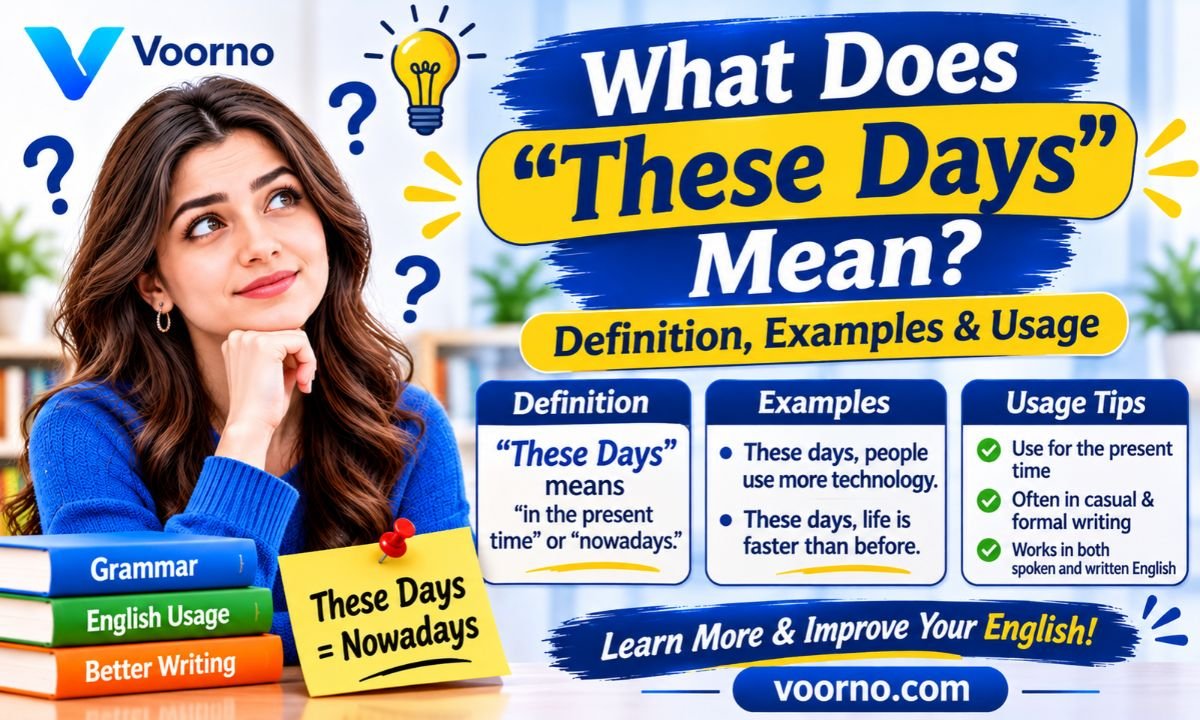
“These days” is one of the most common phrases in English. You hear it in casual chats, news headlines and pop songs. But what does it actually mean, and when should you use it?In short, “these days” means “at the present time” or “in the current period.” It describes how things are now, often in contrast to how they used to be.This guide covers the meaning, grammar, examples, common mistakes, better alternatives and the well-known songs that share the title.
The Real Meaning of “These Days”
“These days” refers to the present era. It doesn’t mean literally the last few days. It points to a broader stretch of time, such as the past few months or years, up to now.
Quick definition: these days (adverb phrase) = nowadays; currently; in the present period.
Think of it as a soft, conversational way of saying, “Here’s how life looks lately.”
- “Prices are so high these days.”
- “I barely watch TV these days.”
- “These days, most people shop online.”
The phrase often carries a light tone of comparison. It quietly suggests that things were different in the past.
Read More:Is It Gluing or Glueing? Correct Spelling and Usage
Is It Correct to Say “These Days” in American English?
Yes. “These days” is standard in American English, British English and every other major variety. It’s fully correct and widely understood.
The only real question is tone. It sits in the neutral-to-informal range. It works in emails, blogs, interviews and everyday speech. In strict academic writing, you may want a more formal option (see the alternatives below).
Where You Hear “These Days” Most Often
You’ll run into this phrase in many places:
- Casual conversation: “How’s work these days?”
- News and opinion writing: “These days, remote work is the norm for many teams.”
- Social media: Captions, tweets and short posts about trends or habits.
- TV and film dialogue: Often used for nostalgia or complaints.
- Music: Several well-known songs use it as a title (covered below).
Read More:Ingrained or Engrained: Which Spelling Is Correct?
Grammar Breakdown: How “These Days” Works

Part of Speech
“These days” works as an adverbial phrase of time. It tells the reader when something is true. It answers the question “when?” or “how are things right now?”
Inside the phrase, “days” is a plural noun. “These” is a demonstrative word. Together they act like a single time marker, similar to nowadays, currently or lately.
Where It Goes in a Sentence
You have three flexible positions:
| Position | Example |
| Start of sentence | “These days, I cook at home more often.” |
| Middle | “I, these days, prefer quiet evenings.” (less common) |
| End of sentence | “I cook at home more often these days.” |
Punctuation tip: Put a comma after “these days” when it opens a sentence. No comma is needed at the end.
When You Should Use “These Days”
Use it when you want to:
- Describe a current trend. “These days, many people work from home.”
- Compare past and present. “Kids learn to type before they learn to write these days.”
- Ask about someone’s life now. “What are you up to these days?”
- Add a conversational, friendly tone to blogs, emails and dialogue.
Situations Where You Should Avoid It

- Formal reports, legal documents and academic papers. The phrase can feel vague or too casual.
- When you need a precise time frame. “These days” doesn’t say whether you mean two months or ten years.
- For a single, specific event. Use an exact date instead.
Real-Life Context Examples
| Context | Example |
| Friends catching up | “You look great! What have you been doing these days?” |
| Workplace | “We rely on video calls more these days.” |
| Parenting | “Kids get their first phone so early these days.” |
| Health | “I’m trying to sleep earlier these days.” |
| Money | “Everything costs more these days.” |
“These Days” and Macklemore
Many people search for this phrase because of the hit single “These Days” by Rudimental, featuring Jess Glynne, Macklemore and Dan Caplen.
It was released on 19 January 2018 as the second single from Rudimental’s album Toast to Our Differences. After a record-tying seven weeks at number two, it reached number one in the UK on 30 March 2018. Macklemore also stars in the video as Glynne’s love interest and contributes a verse about a relationship that has ended.
Common Mistakes People Make with “These Days”
- Writing “this days.” The correct form is always plural: these days.
- Using it for one past event. “These days, I went to the store yesterday” is wrong. Use it only for ongoing or general situations.
- Overusing it. Repeating it in every paragraph makes writing feel weak and repetitive.
- Forgetting the comma at the start of a sentence. Write “These days, prices are rising.”
- Using it in very formal writing where “currently” or “at present” is a better fit.
Better Alternatives for Formal Use
When you want a more polished tone, swap in one of these:
- Currently
- At present
- In the current climate
- In recent years
- Presently
Example: “In recent years, remote work has become standard practice in many industries.”
Alternatives Based on Context
| Situation | Best alternative | Example |
| Casual chat | Lately | “I’ve been tired lately.” |
| Trend discussion | Nowadays | “Nowadays, people prefer streaming.” |
| Business writing | At present | “At present, we have three open roles.” |
| Data or reports | In recent years | “In recent years, sales have grown.” |
| Storytelling | Of late | “Of late, he’s been quiet.” |
“These Days” vs. Similar Phrases
Key Differences
| Phrase | Meaning | Tone | Time scope |
| These days | General present period | Neutral, casual | Broad, loosely defined |
| Nowadays | Contrast with the past | Neutral | Broad |
| Lately | Recent past up to now | Casual | Shorter, recent |
| Currently | Right now | Formal | Immediate |
| Presently | Now (or soon, in some usage) | Formal | Immediate |
| In this day and age | Modern era | Slightly dramatic | Very broad |
Rule of thumb: “Lately” looks back a short way. “These days” describes the general present. “Currently” is the most exact.
“These Days” Lyrics Meaning
The Rudimental track is a post-breakup song told with warmth. It isn’t bitter. The singers look back on a relationship with gratitude, wish the ex-partner well and hope that one day they can laugh about the hard times together.
Here’s the emotional arc:
- The verses reflect on what was lost and what the relationship meant.
- Macklemore’s rap adds personal detail about how the romance ended.
- The chorus expresses hope for reconciliation and a wish to someday return to the good times.
The song’s message is simple: even painful endings can be remembered with love. Songfacts describes it as an uplifting, gospel-tinged track with hand claps and a church choir.
Real Examples from Pop Culture, TV and Social Media
- Music: “These Days” is a popular song title. Jackson Browne wrote a song by that name in the 1960s. Singer Nico recorded it in 1967, and Browne released his own version in 1973. Rudimental’s 2018 hit is the best-known modern take.
- Everyday TV dialogue: Characters often use “these days” to complain about modern life or express nostalgia.
- Social media: Captions such as “Living my best life these days ✨” or “Coffee is a personality trait these days” use it playfully.
- News commentary: Writers use it to frame current trends, such as “These days, more shoppers compare prices online.”
Examples of “These Days” in Sentences
Statements
- These days, I prefer walking to driving.
- She works from home these days.
- Fresh vegetables cost a lot these days.
Questions
4. How are things going these days?
5. Do you still play guitar these days?
Negatives
6. I don’t read the newspaper these days.
7. They hardly call each other these days.
What Kind of Word Is “These” in “These Days”?
“These” is a demonstrative determiner (also called a demonstrative adjective). It points to something close in time or space and matches plural nouns.
| Word | Number | Distance | Example |
| This | Singular | Near | This day |
| These | Plural | Near | These days |
| That | Singular | Far | That day |
| Those | Plural | Far | Those days |
Compare “these days” (now) with “those days” (the past). This contrast is why the phrase so often signals a then-versus-now comparison.
Smart Alternatives to “These Days” (With Examples)
Alternatives Table
| Alternative | Example sentence |
| Nowadays | Nowadays, most people carry a smartphone. |
| Lately | I’ve been sleeping better lately. |
| Currently | She is currently studying abroad. |
| At the moment | We’re busy at the moment. |
| In recent times | In recent times, prices have climbed. |
| These times | Life is expensive in these times. |
| Right now | Right now, I’m focused on my health. |
| Of late | He’s been distant of late. |
Quick Summary: When and How to Use “These Days”
- Meaning: In the present period; nowadays.
- Type: Adverbial phrase of time.
- Position: Start or end of a sentence.
- Punctuation: Comma after it at the start of a sentence.
- Best for: Casual and neutral writing, trends, catching up.
- Avoid in: Highly formal or precise writing.
- Formal swaps: Currently, at present, in recent years.
FAQs
Q:What does “these days” mean?
“These days” means “at the present time” or “nowadays.” It describes how things are in the current period, often compared with the past.
Q:Who sang “These Days”?
The best-known modern hit is by Rudimental, featuring Jess Glynne, Macklemore and Dan Caplen (2018). Older versions include Nico’s 1967 recording and Jackson Browne’s 1973 release.
Q:What is another word for “these days”?
Common synonyms are “nowadays,” “currently,” “lately,” “at present” and “in recent times.”
Q:What can I say instead of “these days”?
For formal writing, try “at present” or “in recent years.” For casual talk, “lately” or “right now” works well.
Q:Who wrote the lyrics to “These Days”?
The 2018 Rudimental song lists nine writers, including Amir Amor, Kesi Dryden, Piers Aggett, Leon Rolle, Daniel Caplen, Jamie Scott, Julian Bunetta, John Ryan and Ben Haggerty (Macklemore). The earlier folk song of the same name was written by Jackson Browne.
Conclusion
“These days” is a simple, flexible phrase that signals the present and often hints at change over time. It’s correct, natural and widely used, so it fits most casual and neutral writing. For formal or precise contexts, choose a sharper alternative like “currently” or “in recent years.”
Keep the grammar rules in mind: use the plural “these,” add a comma when it opens a sentence, and avoid overusing it. Whether you’re chatting with a friend or humming along to Rudimental, you now know exactly what “these days” means and how to use it well.










2 thoughts on “What Does “These Days” Mean? Definition, Examples & Usage”