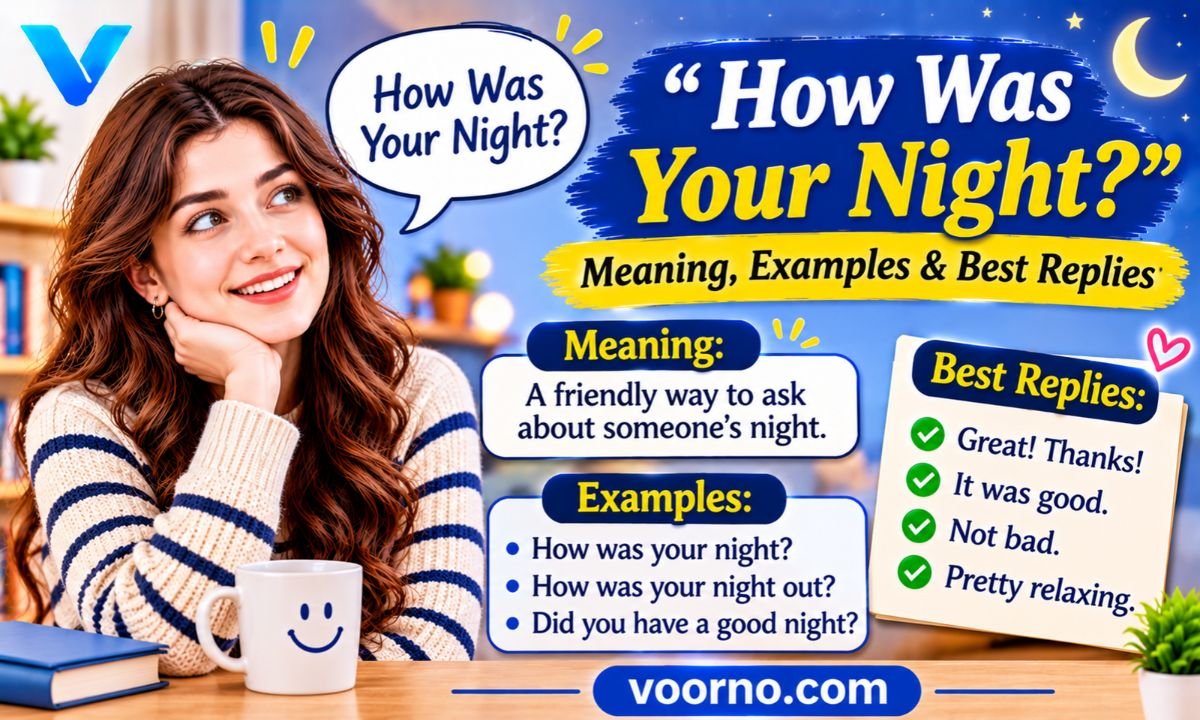
Few questions sound as simple — and feel as loaded — as “How was your night?” You hear it from a coworker at the coffee machine, a partner over breakfast, or a crush in a late-night text, and somehow the “right” answer never feels obvious. This guide breaks down what the phrase really means, when to use it, when to avoid it, and how to reply naturally in any situation.
Why This Simple Question Confuses So Many English Speakers
The confusion isn’t about grammar — it’s about context. “How was your night?” can mean “did you sleep well,” “did you have fun last night,” or, depending on tone and relationship, something more intimate. English learners and even native speakers often freeze because the same four words carry different weight depending on who’s asking, when, and why.
Non-native speakers in particular struggle because their own language may not have a direct, casual equivalent for checking in on someone’s evening. The result is a short phrase that’s easy to say but genuinely tricky to interpret without context clues like tone, timing, and relationship history.
Read More:Ingrained or Engrained: Which Spelling Is Correct?
How Was Your Night Meaning
At its core, “How was your night?” is a check-in question. It asks the listener to summarize their recent experience — usually covering one of three things:
- Sleep quality — Did you rest well?
- An evening event — Did you enjoy your date, party, or outing?
- General wellbeing — Are you okay after a hard day or a difficult situation?
The exact meaning shifts based on context. A boss asking this on Monday morning likely means “did you sleep okay,” while a friend texting at midnight after your date probably means “how did it go.”
Read More:Per Se or Per Say? Meaning, Spelling & Examples
What Does “How Was Your Night?” Really Mean in Modern English
In everyday modern English, this phrase functions as small talk — a polite, low-pressure way to open a conversation, similar to “how’s it going?” or “how was your day?” It doesn’t usually demand a detailed answer. A short, friendly reply is enough.
That said, modern usage has expanded the phrase beyond simple politeness. In texting and dating culture, it’s often used as a soft opener to check on someone’s mood, flirt casually, or continue a conversation that started the night before.
Is “How Was Your Night?” Grammatically Correct

Yes, it’s completely correct. It follows the standard English pattern for asking about a past experience: How + was + possessive pronoun + noun?
Grammar Breakdown
| Part | Word | Function |
| Question word | How | Asks about manner, quality, or condition |
| Verb | Was | Past tense of “to be,” referring to a completed period |
| Possessive pronoun | Your | Shows the night belongs to the listener |
| Noun | Night | The subject being asked about |
Because “night” refers to a completed time period, “was” (past tense) is correct. Using “is” (“How is your night?”) would only work if the night is still happening.
How “How Was Your Night?” Compares to Similar Questions
| Question | Typical Meaning | Best Used When |
| How was your night? | Sleep, evening activity, or general wellbeing | Morning greetings, after an outing |
| How was your day? | Daytime activities and events | Evenings, after work or school |
| How did you sleep? | Specifically about sleep quality | When sleep is the clear focus |
| How’s it going? | General, open-ended check-in | Any time, casual settings |
| Did you have fun last night? | Specific event or outing | When you know they went somewhere |
When You Should Use “How Was Your Night?”
- Greeting someone in the morning, especially after they’ve mentioned being tired, sick, or busy
- Following up after a friend’s date, party, or event
- Starting a casual conversation with a coworker, neighbor, or acquaintance
- Checking in with a partner or close friend as part of a daily routine
- Texting someone the morning after a late-night conversation
Real Example Dialogues: Natural vs Awkward Usage

Natural — casual friends
A: “How was your night? Did the concert go well?” B: “It was amazing! We didn’t get home until 2 a.m.”
Natural — morning greeting
A: “Morning! How was your night?” B: “Pretty restful, thanks. You?”
Awkward — too formal a setting
A (job interviewer): “So, how was your night?” B: (confused pause) “Um… fine, thank you?”
The difference isn’t the phrase itself — it’s whether the setting supports a personal question. Casual, familiar contexts make it feel warm; formal or unfamiliar ones make it feel out of place.
Cultural and Regional Nuances You Should Know
In the US and UK, “How was your night?” is common small talk between friends, coworkers, and family, and rarely carries hidden meaning unless the tone suggests otherwise. In more reserved cultures, asking this of someone you don’t know well can feel intrusive, since nighttime is considered private.
Regionally, some English speakers reserve the phrase almost exclusively for mornings after a known event (a party, date, or trip), while others use it as a generic daily greeting, similar to “how are you.” When in doubt, match the formality and warmth of the person you’re speaking to.
Better Alternatives to “How Was Your Night?”
If you want to avoid ambiguity or soften the question, try:
- “Did you sleep well?”
- “Hope you got some rest last night.”
- “How did your evening go?”
- “Did you have a good time last night?”
- “Everything okay? You seemed tired yesterday.”
Quick Usage Table: What to Say and When
| Situation | Suggested Phrase |
| Morning greeting (general) | “How was your night?” or “Sleep well?” |
| After a friend’s date | “How did last night go?” |
| Coworker, professional tone | “Hope you had a restful night.” |
| Someone who was sick | “How are you feeling this morning?” |
| Flirty or romantic context | “How was your night? Thinking about you.” |
When You Should Avoid Saying “How Was Your Night?”
Context matters more than the words themselves. There are a few settings where this question can land the wrong way.
Professional Settings
In formal meetings, interviews, or with senior colleagues you don’t know well, this question can feel too personal. Stick to neutral greetings like “Good morning” or “Hope you had a good weekend.”
Sensitive or Emotional Situations
If someone recently experienced a loss, illness, or hardship, “How was your night?” can feel dismissive of what they’re actually going through. A more thoughtful question — “How are you holding up?” — usually fits better.
How Was Your Night Quotes
Short, shareable lines people use to answer or caption this question include:
- “Some nights are for sleeping, some are for living — mine was the second kind.”
- “Quiet night, loud thoughts.”
- “Best kind of night: no plans, no alarms.”
- “My night was a plot twist I didn’t see coming.”
Common Mistakes People Make With This Phrase
- Using it with strangers or in formal settings where it feels too personal
- Overanalyzing a casual, throwaway greeting as if it has deeper meaning
- Replying with only one word (“Fine”) when a little detail keeps the conversation going
- Confusing tense — saying “How is your night?” for a night that’s already over
- Assuming it’s always flirty, when most of the time it’s simple small talk
Practical Scenarios That Show Real Usage
- Text the morning after a first date: “How was your night? I had a great time.”
- Roommate check-in: “How was your night? I heard you come in late.”
- Customer service or hospitality: “Good morning! How was your night with us?” (asking about a hotel stay)
- Parent to teenager: “How was your night out with your friends?”
- Coworkers on a Monday: “How was your night — well, weekend, really?”
How Was Your Night in English
For English learners, the key takeaway is that this phrase is standard, natural, and widely used — it’s not slang or informal shorthand. It fits comfortably in everyday conversation, texting, and casual speech, though it’s best avoided in strictly formal or professional writing.
Tips to Sound Natural When Saying “How Was Your Night?”
- Match your tone to the relationship — casual for friends, gentle for acquaintances
- Add a follow-up detail if you know something happened (“How was your night? Did the flight land okay?”)
- Avoid asking this of people you barely know, especially in professional contexts
- Use it as an opener, not an interrogation — one honest sentence back is enough
- Pair it with a return question so the conversation flows both ways
Expert Insight
Language and communication specialists note that check-in questions like this succeed or fail based on shared context, not wording. The phrase itself is neutral; what gives it warmth, humor, or awkwardness is the relationship between speaker and listener, plus the timing and tone used to ask it.
FAQs
Q:Is it correct to say “how was your night”?
Yes, it’s grammatically correct and commonly used as a casual, friendly greeting or check-in question.
Q:What to say instead of “how was your night”?
Try “Did you sleep well?”, “How did your evening go?”, or “Hope you got some rest.”
Q:How to answer “How was your night?”?
Give one honest detail, then ask the same question back — for example, “Pretty relaxing, thanks! How about yours?”
Q:How do you say “How was your night?” in a flirty way?
Add warmth or a personal touch, like “How was your night? Couldn’t stop thinking about ours.”
Q:Is it rude to ask how was your night?
Not usually, but it can feel intrusive with strangers, in formal settings, or with someone going through a hard time.
Conclusion
“How was your night?” is a small phrase that carries big context. In most situations, it’s simply friendly small talk — a way to connect, show care, and keep a conversation moving. The trick isn’t memorizing a perfect answer; it’s reading the room, matching the tone of whoever’s asking, and responding with a genuine detail or two.
Once you understand the context behind the question, you’ll never overthink it again.










2 thoughts on ““How Was Your Night?” Meaning, Examples & Best Replies”