You type “ageing,” and your spell checker underlines it. You switch to “aging,” and a British editor changes it back. So which one is right?
Both are. They are the same word with two accepted spellings. Which one you use depends on your audience.
This guide covers definitions, grammar, history, style guide rules, and real examples, so you can pick the right spelling every time.
Aging vs Ageing: The Core Difference Explained
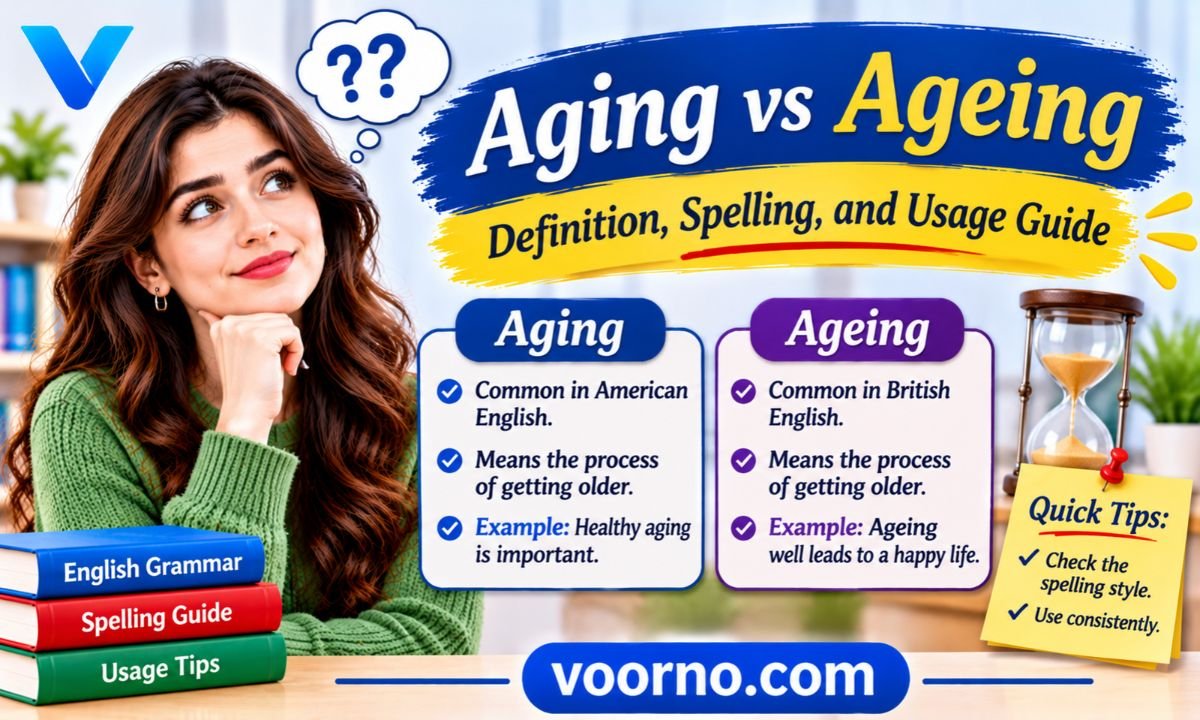
Aging and ageing mean exactly the same thing: the process of getting older. The only difference is spelling.
- Aging (no “e”) is standard in American and Canadian English.
- Ageing (with “e”) is standard in British, Australian, New Zealand, and most other Commonwealth English.
| Feature | Aging | Ageing |
| Meaning | Getting older | Getting older |
| Part of speech | Verb form, noun, adjective | Verb form, noun, adjective |
| Standard in | US, Canada | UK, Australia, NZ, Ireland |
| Pronunciation | Same | Same |
| Correct? | Yes | Yes |
Neither spelling is an error. Using the wrong one for your audience is a regional mismatch, not a mistake.
Read More:Possess or Posess: Which Spelling Is Correct?
Geography-Based Usage: Who Uses Which Spelling and Why

Spelling follows the reader’s location.
- United States: aging
- Canada: aging (Canadian English usually follows American patterns here, even though it keeps “colour” and “centre”)
- United Kingdom: ageing
- Australia and New Zealand: ageing
- Ireland, South Africa, India: mostly ageing
Global websites add a wrinkle. American media reaches everywhere, so “aging” now appears often in British and Australian writing too. Still, “ageing” remains the safer choice for local audiences in those countries.
Read More:Is vs Are: Grammar Rules, Examples & Common Mistakes
Linguistic and Historical Roots Behind the Split
The word “age” came into English from Old French (aage, eage), which traces back to Latin aetas. The verb “to age” followed in Middle English.
When you add -ing to a word ending in a silent “e,” the usual English rule is to drop the “e”: make → making, hope → hoping. Following that rule gives you aging.
British writers made an exception. They kept the “e” in ageing, partly for visual clarity and partly out of tradition. That split is what we see today.
Aging vs Ageing Grammar
Grammar works the same for both spellings. Only the letters change.
- Verb (present participle): She is aging well.
- Gerund (noun): Aging is natural.
- Adjective: The aging bridge needs repair.
- Noun: Ageing is a global challenge.
Note that “age” itself is the base verb: I age, he ages, they aged. The “-ing” form only appears in continuous tenses or as a noun or adjective.
Pronunciation tip: “Aged” changes sound by meaning. An aged man has two syllables (AY-jid). He aged five years has one (AYJD).
Noah Webster’s Influence: The Turning Point in the Debate

Noah Webster, the American lexicographer, pushed for simpler, more logical spelling in the early 1800s. His 1828 American Dictionary of the English Language helped standardize many differences between American and British English, such as color over colour and center over centre.
The “aging” spelling fits neatly into that simplifying spirit. Dropping a silent “e” before a suffix is the standard American rule, and Webster’s influence helped make American spelling more consistent. The result: US English settled on “aging,” while British English held on to “ageing.”
Which Spelling Is Correct in the United States?
“Aging” is correct in the United States. Major American dictionaries list it as the main spelling and treat “ageing” as a variant used mainly outside the US.
Using “ageing” in a US publication will usually be corrected by an editor. Use “aging” for American readers.
Style Guide Positions (Clear Reference Table)
| Style Guide / Reference | Preferred Spelling |
| AP Stylebook | Aging |
| Chicago Manual of Style (US) | Aging |
| APA (US) | Aging |
| Merriam-Webster | Aging |
| Oxford Dictionaries (UK) | Ageing |
| Cambridge Dictionary (UK entry) | Ageing |
| Guardian and Observer Style Guide | Ageing |
| Australian Government Style Manual | Ageing |
Style guides evolve, so check your publication’s current edition. When in doubt, follow your editor’s house style.
Ageing or Aging in Finance

Finance and accounting use the term for tracking how old unpaid balances are.
- US: accounts receivable aging report, aging schedule, debt aging
- UK/Commonwealth: debtor ageing report, ageing analysis
The meaning is identical. An aging schedule groups invoices by how overdue they are (30, 60, 90 days). Match the spelling to your company’s region and keep it consistent across reports, software labels, and audits.
Grammar Usage: How Each Form Functions in Sentences
Here is how the word behaves in different roles.
- Continuous verb: The population is aging/ageing quickly.
- Adjective before a noun: An aging/ageing infrastructure needs investment.
- Gerund as subject: Aging/Ageing brings both wisdom and challenges.
- In compounds: anti-aging/anti-ageing cream, aging/ageing population
Real-World Usage Examples That Show Why the Spelling Matters

Spelling signals whether you understand your audience. Here are some cases.
- Healthcare websites targeting US patients use “aging.”
- UK government reports on demographics use “ageing population.”
- Skincare brands switch between “anti-aging” and “anti-ageing” depending on the market.
- Academic journals follow their own house rules, so “Ageing Research Reviews” keeps the British form in its title.
A mismatch can look careless. It may also hurt search visibility, since people search using their local spelling.
Aging vs Ageing Examples
Aging (US/Canada):
- The aging workforce is changing hiring trends.
- She researches aging and memory loss.
- The winery is aging its cabernet in oak barrels.
Ageing (UK/Australia/NZ):
- Britain’s ageing population is putting pressure on the NHS.
- He wrote a book about healthy ageing.
- The ageing process affects skin elasticity.
Language Evolution: Is One Form Becoming More Dominant?
Global usage is shifting toward “aging.” American media, tech platforms, and social networks all push the shorter spelling worldwide. Many international brands now publish in “aging” for consistency.
Even so, “ageing” remains strong in British and Commonwealth publishing, government writing, and academic work. Expect both to coexist for a long time.
How to Choose the Right Spelling: Context, Audience, Consistency
Use three checks:
- Context: Where is the piece published?
- Audience: Where do most readers live?
- Consistency: Use one spelling throughout the whole document.
Never mix both in one piece, apart from quoting a source or citing a proper title.
When to Use “Aging” (US Context Rules)
Use aging when:
- Writing for American or Canadian readers
- Following AP, Chicago, or APA style
- Publishing on a US-based site or platform
- Writing US business or finance documents
When to Use “Ageing” (British/Commonwealth Context)
Use ageing when:
- Writing for readers in the UK, Australia, New Zealand, or Ireland
- Following Oxford, Guardian, or local government style
- Submitting to a British academic journal
- Quoting a source that uses this spelling
Quick Memory Hacks for Choosing Aging vs Ageing
- “E” for England: Ageing has an “e” like England.
- “A” for America: Aging is the shorter, American form.
- Suffix rule: Americans drop the silent “e” before “-ing” (making, hoping, aging).
- Spell-check trick: Set your language to en-US or en-GB before you write.
Commonly Confused Word Pairs to Watch For
Many words follow the same US/UK pattern:
| American | British |
| Judgment | Judgement |
| Likable | Likeable |
| Sizable | Sizeable |
| Acknowledgment | Acknowledgement |
| Color | Colour |
| Center | Centre |
Exception: Ageism keeps the “e” in both American and British English.
What Spell Checkers, Grammar Tools & AI Writing Tools Recommend
Most tools follow your language setting.
- Microsoft Word and Google Docs: Flag “ageing” under en-US and “aging” under en-GB, en-AU, and en-NZ.
- Grammarly: Suggests the spelling that matches your chosen English variant.
- AI writing tools: Often default to “aging,” so review the output for regional accuracy.
Always set your tool’s language before drafting. It saves editing time later.
Mistakes Writers Commonly Make (With Corrections)
| Mistake | Correction | Why |
| “Ageing population” in a US news article | “Aging population” | US audience |
| “Aging” in a UK government report | “Ageing” | UK style |
| Mixing both in one article | Pick one | Consistency |
| Writing “ageism” as “agism” | “Ageism” | Keeps the “e” everywhere |
| Assuming one spelling is a typo | Both are valid | Regional variants |
Aging vs Ageing Quiz
Test yourself. Answers are below.
- Which spelling would a Chicago-style editor prefer?
- You’re writing for a UK charity. Which do you use?
- Which spelling of “ageism” is correct in the US?
- True or false: “ageing” is a typo.
- An Australian bank writes a debtor report. Aging or ageing?
Answers: 1) Aging. 2) Ageing. 3) Ageism. 4) False. 5) Ageing.
FAQs
Q:Is it normal to feel depressed about aging?
Yes, many people feel sad or anxious about aging, especially during big life changes. If the feeling lasts or affects daily life, talking to a doctor or counselor can help.
Q:How can I accept my aging face?
Focus on skin health with sunscreen, hydration, and sleep, and shift your attention to what your face expresses rather than what it lacks. Acceptance grows when you value experience over youth.
Q:Which face shape is best for aging?
No face shape is “best.” Bone structure, skin care, and sun protection matter more than shape, and every shape ages differently.
Q:How to make peace with aging?
Stay active, keep social connections, and set goals that fit your current stage of life. Reframing aging as growth rather than loss makes it easier to accept.
Q:What are some normal signs of aging at age 90?
Common signs include thinner skin, reduced muscle mass, slower reflexes, hearing or vision changes, and lower energy. Sudden confusion or rapid decline is not normal and needs medical attention.
Conclusion
“Aging” and “ageing” are two spellings of one word. Use aging for American and Canadian readers, and ageing for British and Commonwealth readers. Stay consistent, follow your style guide, and set your spell checker to the right language.










2 thoughts on “Aging vs Ageing: Definition, Spelling, and Usage Guide”