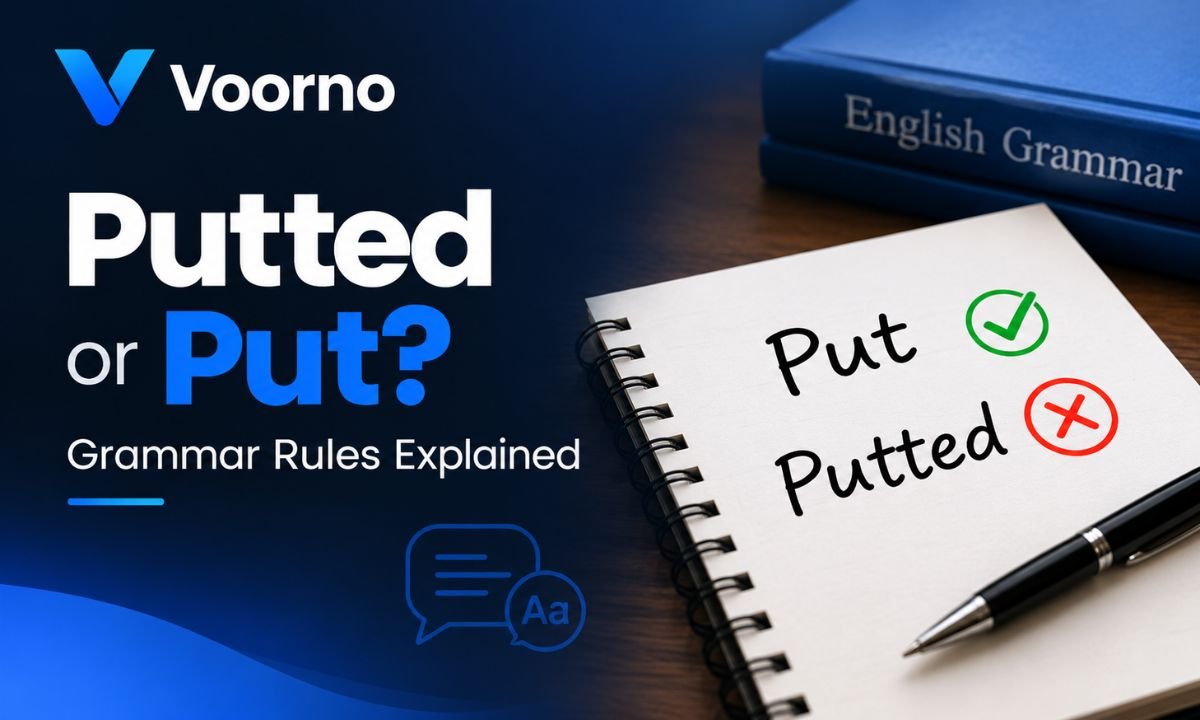
If you’ve ever typed the sentence “I putted the book on the table” and then paused, wondering if that even looks right — you’re not alone. This is one of the most common irregular verb mix-ups in English, and it trips up native speakers and learners alike.
The short version: in almost every everyday sentence, the word you want is “put,” not “putted.” But there’s one specific situation — golf — where “putted” is completely correct. Let’s break down exactly when to use each one, why English works this way, and how to never make the mistake again.
Is It “Putted” or “Put”? (Quick Answer You Can Trust)
“Put” is correct in nearly all cases. It’s an irregular verb, which means it doesn’t change form in the past tense or past participle. Whether you’re talking about today, yesterday, or something that happened years ago, the word stays the same: put, put, put.
“Putted” is only correct when talking about golf — specifically, the action of tapping a golf ball with a putter on the green.
| Word | When to Use It | Example |
| Put | Past tense/past participle of “to put” (place, set, position) | She put the keys on the counter. |
| Putted | Past tense of “to putt” (a golf stroke) | He putted the ball into the hole. |
If your sentence has nothing to do with golf clubs or greens, the answer is always put.
Why “Putted” Sounds Right (But Isn’t)
English speakers instinctively expect verbs to follow a predictable pattern: add “-ed” to form the past tense. Walk becomes walked. Jump becomes jumped. So the brain naturally wants to turn “put” into “putted.“
The problem is that “put” belongs to a small but important group of irregular verbs that refuse to follow this rule. Just like “cut,” “hit,” and “set,” the verb “put” keeps its base form no matter what tense you’re using.
Is it putted or put in a sentence
In a regular sentence — one describing an everyday action like placing, setting, or positioning something — the correct word is always “put.” For example:
- Correct: “Yesterday, I put my phone on the desk.”
- Incorrect: “Yesterday, I putted my phone on the desk.”
Is it putted or put grammar
Grammatically speaking, “put” is classified as an irregular verb with identical forms across the base, past tense, and past participle. There is no version of standard grammar in which “putted” replaces “put” outside of golf terminology.
Is “Putted” Ever Correct? Yes — But Only in Golf
Here’s where things get interesting. “Putt” and “put” are two completely different verbs that just happen to sound almost identical.
- Put = to place, set, or position something somewhere.
- Putt = to strike a golf ball gently, usually on the green, so it rolls toward or into the hole.
Because “putt” is a regular verb, it follows the standard “-ed” rule for past tense, giving us “putted.”
Key difference:
- “Put” never changes form.
- “Putt” changes to “putted” in the past tense and past participle, just like any regular verb.
Example:
- “He put the golf ball down on the tee.” (placed the ball — regular meaning of “put”)
- “He putted the ball into the hole from ten feet away.” (performed a putting stroke — golf-specific “putt”)
Why this matters
Mixing these two up doesn’t just look like a typo — it can genuinely confuse a reader about what action actually took place. In writing about sports, using the wrong word can make a sentence unclear or grammatically incorrect in front of an audience that knows the game well.
Understanding the Verb Forms of “Put”
To really lock this in, it helps to see the full picture of how “put” behaves across every tense.
Full Conjugation Table of “Put”
| Tense | Form | Example |
| Base form | put | I put my shoes by the door every day. |
| Present tense (3rd person) | puts | She puts her bag on the chair. |
| Past tense | put | I put my shoes by the door yesterday. |
| Past participle | put | I have put my shoes by the door already. |
| Present participle | putting | I am putting my shoes by the door now. |
Notice that only the present tense (with “he,” “she,” or “it”) and the present participle change form. The past tense and past participle stay exactly the same as the base verb.
Why Doesn’t “Put” Change in the Past Tense?

This comes down to the history of the English language. Many of today’s irregular verbs descend from Old English verb classes that formed their past tense through internal vowel changes or, in some cases, no change at all — rather than the “-ed” suffix that became standard later on.
“Put” is part of a small set of verbs where the base form, past tense, and past participle are identical. Linguists sometimes call these “zero-change” or “unmarked” verbs. There’s no deeper logical rule to memorize here — it’s simply a pattern that survived from earlier stages of English and never got regularized.
Other Verbs That Don’t Change in the Past Tense
You’ll recognize several other common verbs that behave the same way:
- Cut → cut → cut
- Hit → hit → hit
- Set → set → set
- Cost → cost → cost
- Hurt → hurt → hurt
- Shut → shut → shut
- Let → let → let
- Burst → burst → burst
If you can remember that “put” belongs to this same family as “cut” and “hit,” the correct form becomes much easier to recall — nobody says “cutted” or “hitted,” and “put” works exactly the same way.
Common Mistakes With “Put” (And How to Fix Them)
Here are the errors that show up most often in writing, along with the fix:
- Mistake: “I have putted the documents in the folder.” Fix: “I have put the documents in the folder.”
- Mistake: “She putted her trust in the wrong person.” Fix: “She put her trust in the wrong person.”
- Mistake: “They putted a lot of effort into the project.” Fix: “They put a lot of effort into the project.”
- Mistake: Using “put” when you mean the golf stroke. Fix: “He put the ball” (unclear/wrong) → “He putted the ball” (correct, golf context).
Real-World Examples of “Put” in Context
- “Please put your dishes in the sink before you leave.”
- “She put her whole heart into the performance.”
- “We put the meeting off until next week.”
- “He has put a lot of thought into this decision.”
- “They put the plan into action immediately.”
Quick Memory Trick to Avoid “Putted”
Here’s a simple test: ask yourself if the sentence is about golf. If it isn’t, cross out “putted” and write “put” instead.
A helpful phrase to remember: “Put stays put — unless you’re on the green.” If you’re not talking about a golf course, the verb never changes.
“Put” in Phrasal Verbs (Very Important for Fluency)
“Put” is one of the most flexible verbs in English because it combines with prepositions to form dozens of phrasal verbs, each with its own meaning.
Common Examples
| Phrasal Verb | Meaning | Example |
| Put off | To postpone | We put off the trip until summer. |
| Put up with | To tolerate | I can’t put up with this noise anymore. |
| Put down | To place something down / to belittle | He put the phone down and left. |
| Put on | To wear / to add | She put on her jacket before leaving. |
| Put away | To store something | Put away your toys before dinner. |
| Put out | To extinguish | Firefighters put out the blaze quickly. |
Why this matters
In every one of these phrasal verbs, the past tense form is still “put” — never “putted.” So “I putted off the meeting” is incorrect; “I put off the meeting” is correct.
Pronunciation Notes: “Put” vs “Putt”
Even though they’re spelled almost the same, “put” and “putt” are pronounced identically in most dialects — both rhyme with “foot.” This is exactly why writers confuse them so often; the words sound the same but mean different things and behave differently in grammar.
Key difference:
- Put: /pʊt/ — general verb meaning “to place.”
- Putt: /pʌt/ or /pʊt/ depending on dialect — golf-specific verb.
Why it matters
Since the words sound alike, the confusion usually shows up in writing rather than speech. Reading your sentence back and asking “Is this about golf?” is the fastest way to catch the error before it’s published.
Case Study: Why Learners Overcorrect “Put”
English learners are often taught the “-ed” rule early and thoroughly, which makes it a reflex. Once that rule feels automatic, learners tend to apply it everywhere, including to irregular verbs they haven’t fully memorized yet. This is called overregularization, and it’s actually a sign of learning progress — children acquiring English as a first language do the exact same thing with words like “goed” instead of “went.”
The fix isn’t to “unlearn” the rule; it’s to build a mental list of exception verbs like “put,” “cut,” and “hit” that simply don’t follow it.
Why English Still Has Irregular Verbs
English kept many irregular verbs from its Old English and Germanic roots even as the language evolved. Over centuries, most verbs shifted toward the simpler “-ed” pattern, but a core group of very common, frequently used verbs — including “put,” “go,” “be,” and “have” — resisted the change. Frequently used words tend to resist regularization because speakers use them so often that irregular forms stay memorized and don’t get “smoothed out” the way rarer words do.
Is it putted or put examples
To reinforce the rule, here are quick side-by-side examples:
- “I put the vase on the shelf.” ✅
- “I putted the vase on the shelf.” ❌
- “He putted from twenty feet and sank it.” ✅ (golf)
- “He put from twenty feet and sank it.” ❌ (should be “putted” in golf context)
Advanced Grammar Insight: Strong vs Weak Verbs (Simplified)
Grammarians sometimes describe verbs as “strong” or “weak.” Weak verbs form their past tense with a dental suffix like “-ed” or “-t” (walk/walked, burn/burnt). Strong verbs historically changed their internal vowel or stayed the same rather than adding a suffix (sing/sang, put/put). “Put” is technically a strong verb that happens to show no vowel change at all, which is why it looks identical across tenses.
Comparison: Put vs Similar Irregular Verbs
| Verb | Base Form | Past Tense | Past Participle |
| Put | put | put | put |
| Cut | cut | cut | cut |
| Hit | hit | hit | hit |
| Set | set | set | set |
| Cost | cost | cost | cost |
Practical Writing Tips to Master “Put”
- Read your sentence aloud and check if it’s about golf — if not, use “put.”
- Keep a short mental list of no-change verbs (put, cut, hit, set) to reinforce the pattern.
- When editing, search your document for “putted” and confirm each instance is genuinely about a golf stroke.
- Remember that phrasal verbs built on “put” (put off, put up with, put away) never take “-ed.”
- When in doubt, simplify your sentence and swap in a synonym like “placed” or “positioned” to double-check the tense feels natural.
FAQs
Is it “putted” or “put” examples?
Use “put” for everyday actions like placing or setting something down; use “putted” only for the golf stroke, as in “he putted the ball toward the hole.”
Is it “putt” or “put”?
“Putt” refers specifically to the golf stroke, while “put” means to place or position something. They’re different verbs that happen to sound alike.
Is it correct to say “putted”?
Yes, but only when describing a golf shot. In every other context, “put” is the correct past tense and past participle.
How do you say “I put” in past tense?
The past tense is the same word: “put.” For example, “I put the box down yesterday.”
Is it correct to say “she puts” or “she put”?
“She puts” is present tense, used for current or habitual actions. “She put” is past tense, used for something that already happened.
Conclusion
The rule behind “put” versus “putted” is simpler than it feels once you separate the two verbs involved. “Put” is irregular and never changes, no matter the tense, while “putted” belongs exclusively to the golf-specific verb “putt.” Outside the golf course, “put” is always your safe, correct choice. Keep that one distinction in mind, and you’ll never second-guess this word again.