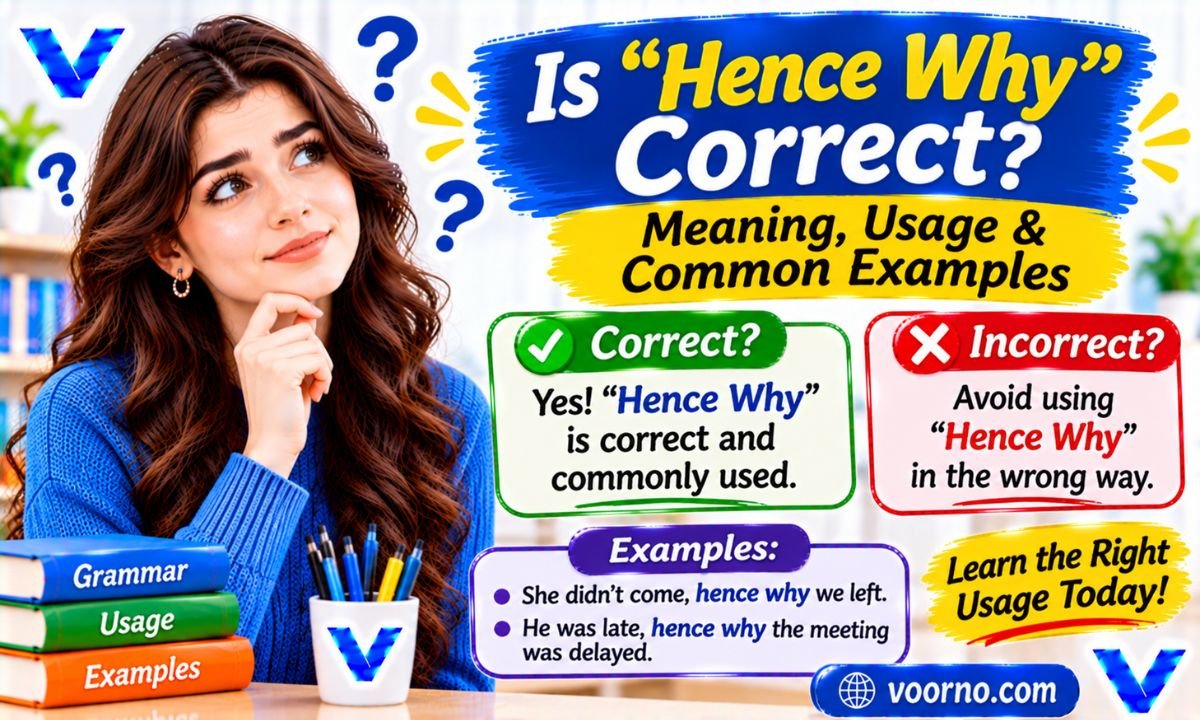
If you’ve ever typed the phrase “hence why” and then paused, wondering whether your English teacher would circle it in red ink, you’re not alone. It’s one of those expressions that sounds perfectly natural in casual conversation but raises eyebrows in formal writing. This guide breaks down exactly what “hence why” means, whether it’s grammatically correct, and what to use instead when you want your writing to sound polished and professional.
By the end, you’ll know precisely how to use “hence,” when “hence why” slips into redundancy, and which alternatives work best in academic papers, business emails, and everyday speech.
Hence Why Meaning
“Hence why” is a phrase that combines two words that each already mean “for this reason.” When people say “hence why,” they’re typically trying to connect a cause to its effect — for example, “It started raining, hence why we left early.”
The intended meaning is clear: something happened, and as a result, something else followed. The problem isn’t that people misunderstand the phrase — it’s that “hence” and “why” are doing the exact same grammatical job at the same time.
Read More: She Has or She Have? Grammar Rules, Examples & Common Mistakes
Understanding Why “Hence Why” Confuses So Many Writers
The confusion around “hence why” comes from a simple source: both words independently signal causation.
- “Hence” means “for this reason” or “therefore.”
- “Why” is often used in phrases like “that’s why” or “which is why” to explain a reason.
When you put them together, you’re essentially saying “for this reason why,” which repeats the same idea twice. Because both words feel natural on their own, writers rarely notice they’re stacking them until someone points it out.
Add to this the fact that “hence why” appears frequently in spoken English, social media, and even some published articles, and it’s easy to see why so many people assume it’s standard. Frequency of use, however, isn’t the same as grammatical correctness.
Read More: Hisself vs Himself: Difference, Correct Usage & Examples
Is “Hence Why” Grammatically Correct? The Direct Answer

No — “hence why” is considered grammatically redundant in standard and formal English. Style guides and grammar authorities generally agree that pairing “hence” with “why” duplicates meaning that a single word already conveys.
That said, “hence why” isn’t a criminal offense in casual speech. It shows up often enough in everyday conversation that most listeners won’t blink. But in essays, resumes, business reports, or any writing meant to be taken seriously, it’s best avoided.
Quick takeaway: Use “hence” alone, or use “that’s why” — never both together.
Understanding the Redundancy in “Hence Why”
To see the redundancy clearly, look at what each word does in a sentence:
| Word | Function | Example |
| Hence | Introduces a result or conclusion | “The bridge was closed; hence, we took a detour.” |
| Why | Introduces a reason or explanation | “That’s why we took a detour.” |
| Hence why | Combines both unnecessarily | “The bridge was closed, hence why we took a detour.” |
When “hence” already means “for this reason,” adding “why” restates that same reasoning link a second time. Grammatically, it’s similar to saying “the reason is because” — another commonly flagged redundancy where two causal markers are stacked on top of each other.
Hence Why Examples
Here are a few sentences where “hence why” appears in everyday use, alongside how they should be corrected:
- “I forgot my umbrella, hence why I got soaked.” → “I forgot my umbrella, hence I got soaked.”
- “She missed the deadline, hence why the project was delayed.” → “She missed the deadline, hence the project was delayed.”
- “The store was closed, hence why we ordered online.” → “The store was closed; that’s why we ordered online.”
Notice that in each case, removing either “hence” or “why” doesn’t change the meaning at all — it simply removes the repetition.
How “Hence” Is Correctly Used in American English

“Hence” is a formal adverb that typically appears at the beginning of a clause to introduce a conclusion, result, or consequence. It can also be used to mean “from this time” (as in “ten years hence”) or “from this place,” though these older meanings are far less common today.
In modern American and British English, “hence” is mostly used in its causal sense — as a more formal substitute for “so,” “therefore,” or “as a result.”
Key points on correct usage:
- “Hence” can start a new sentence or clause, usually following a semicolon or period.
- “Hence” can be followed directly by a noun phrase without a verb (e.g., “hence the delay”).
- “Hence” should not be paired with “why,” “therefore,” or “so” in the same clause, since that repeats the causal meaning.
Table: Correct vs. Incorrect Usage
| Incorrect | Correct |
| Hence why I left early | Hence, I left early |
| Hence why the results changed | Hence the results changed |
| It rained, hence why we stayed in | It rained; hence we stayed in |
| The team lost, hence why morale dropped | The team lost, hence the drop in morale |
Examples of Proper “Hence” Usage
- “The company lost its top client; hence, quarterly revenue declined.”
- “Traffic was unusually heavy, hence the late arrival.”
- “The experiment failed twice, hence the need for a new approach.”
- “He studied every night, hence his excellent exam results.”
Incorrect → Correct Transformations
| Incorrect Sentence | Corrected Sentence |
| The road was flooded, hence why we turned back. | The road was flooded, hence we turned back. |
| She was late, hence why she missed the meeting. | She was late; that’s why she missed the meeting. |
| Costs rose sharply, hence why prices increased. | Costs rose sharply, hence the price increase. |
Replacing “Hence Why” with Clearer Alternatives

Once you spot “hence why” in your writing, replacing it is simple. You have two main routes: drop “why” and keep “hence,” or drop “hence” and keep a “why”-based phrase.
Replacing “Hence Why” with “Hence”
Simply remove “why” and let “hence” carry the causal meaning on its own:
- “The store closed early, hence why we left.” → “The store closed early, hence we left.”
This works especially well in formal or academic contexts where “hence” fits the tone.
Hence Why Sentence
If you want a grammatically clean sentence that still sounds natural in conversation, swap “hence why” for “that’s why” or “which is why”:
- “The Wi-Fi went down, that’s why the meeting got postponed.”
- “He forgot his notes, which is why the presentation felt disorganized.”
Both options preserve the original meaning without doubling up on causal words.
“Hence Why” vs. “That’s Why”: Choosing the Right Conjunction
“Hence” tends to sound more formal, while “that’s why” feels conversational. Neither is inherently better — the right choice depends on your audience and context.
H3: Table: When to Use Each One
| Context | Recommended Phrase |
| Academic writing, reports | Hence |
| Business emails | Hence / Therefore |
| Casual conversation | That’s why |
| Blog posts, informal articles | That’s why / Which is why |
| Public speaking | That’s why (sounds more natural aloud) |
Using “Therefore,” “Thus,” and “As a Result” Instead of “Hence Why”
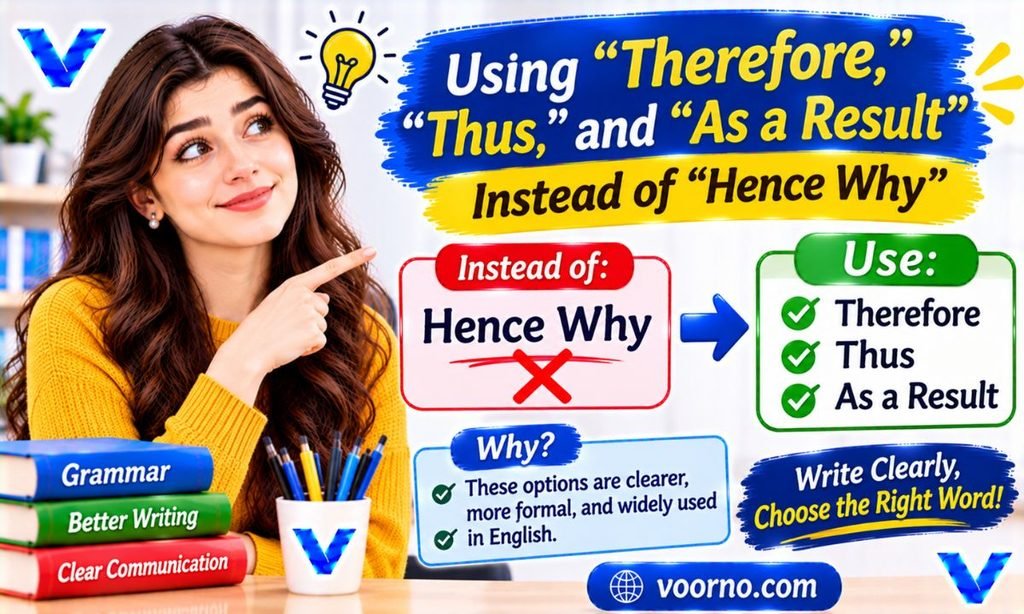
English offers several strong alternatives to “hence why” that carry the same causal meaning without redundancy:
- Therefore — a slightly more common formal connector than “hence.”
- Thus — concise and often used in academic or technical writing.
- As a result — a more conversational way to introduce a consequence.
- Consequently — emphasizes a direct outcome of a prior action.
- Accordingly — common in legal, business, or procedural writing.
Comparison Table
| Word/Phrase | Tone | Best Used In |
| Hence | Formal | Academic, technical writing |
| Therefore | Formal | Essays, reports, arguments |
| Thus | Formal | Research papers, formal essays |
| As a result | Neutral | Business writing, general use |
| Consequently | Formal | Legal, journalistic writing |
| That’s why | Informal | Everyday conversation |
Hence Why Synonym
If you’re looking for single-word or short-phrase alternatives to replace “hence why” entirely, consider:
- Therefore
- Thus
- Consequently
- As a result
- For this reason
- That’s why
- Which explains why
Any of these can substitute for “hence why” without the built-in redundancy.
Historical Perspective: Where “Hence Why” Came From
“Hence” is an old word, dating back to Middle English, originally meaning “from this place” or “from this time.” Over centuries, its meaning expanded to include the causal sense we use most often today — “for this reason.”
“Hence why” likely emerged as a spoken shortcut, blending the formal “hence” with the more familiar “why” that people use constantly in casual explanations. Because spoken language often prioritizes emphasis and rhythm over strict grammar, the phrase caught on informally, even though it duplicates meaning.
How Language Evolution Impacts Grammar Rules
Language changes constantly, and some redundant phrases eventually become accepted through sheer repetition. However, “hence why” hasn’t reached that level of acceptance in formal style guides. Grammar authorities still classify it as redundant, meaning it’s best treated as an informal habit rather than a rule-approved structure — at least for now.
Similar Redundant Expressions You Might Be Using
“Hence why” isn’t the only phrase that doubles up on meaning. Others include:
- “The reason is because” (should be “the reason is that”)
- “Return back” (should be “return”)
- “Repeat again” (should be “repeat”)
- “Advance planning” (should be “planning”)
- “Past history” (should be “history”)
Quick Fixes
| Redundant Phrase | Fixed Version |
| Hence why | Hence / That’s why |
| The reason is because | The reason is that |
| Return back | Return |
| Repeat again | Repeat |
| Past history | History |
Frequent Grammar Mistakes Related to Cause-and-Effect Words
Cause-and-effect connectors are easy to misuse because so many of them overlap in meaning. Common mistakes include:
- Using “hence” and “therefore” in the same sentence.
- Starting a sentence with “so hence,” which repeats causation.
- Confusing “thus” (result) with “this” (reference) in fast typing.
- Overusing “as such” to mean “therefore,” when it should refer back to a previously named noun.
Table: When to Use What
| Situation | Best Word Choice |
| Formal cause-effect statement | Hence / Therefore |
| Casual explanation | That’s why |
| Academic conclusion | Thus |
| Business consequence | As a result / Consequently |
| Legal or procedural writing | Accordingly |
Expert Guidance: How to Choose the Right Connector Every Time
When deciding how to link a cause to its effect, ask yourself three questions:
- Is this formal or casual writing? Formal contexts favor “hence,” “therefore,” or “thus.” Casual contexts favor “that’s why.”
- Am I already using a causal word earlier in the sentence? If so, don’t add a second one.
- Does the sentence read smoothly without one of the two words? If removing “hence” or “why” doesn’t change the meaning, you’ve found your redundancy.
Use This Quick Decision Chart
| Question | If Yes | If No |
| Is it a formal document? | Use “hence” or “therefore” | Use “that’s why” |
| Are two causal words already present? | Remove one | Keep as is |
| Is the sentence long or complex? | Use a semicolon before “hence” | Use a comma |
FAQs
Q:Is it proper to say “hence why”?
No, “hence why” is considered redundant in formal English since both words already express causation on their own.
Q:How do you use hence correctly?
Use “hence” to introduce a result or conclusion, typically at the start of a clause, without pairing it with “why” or “therefore.”
Q:Is saying “hence” why redundant?
Yes, because “hence” already means “for this reason,” adding “why” repeats the same causal meaning unnecessarily.
Q:What is meant by hence?
“Hence” means “for this reason,” “therefore,” or, in older usage, “from this place or time.”
Q:What are other words for “hence why”?
Alternatives include “therefore,” “thus,” “consequently,” “as a result,” and “that’s why.”
Conclusion
“Hence why” is a common phrase, but it’s grammatically redundant because “hence” and “why” both signal cause and effect on their own. In casual speech, it rarely causes confusion, but in formal writing — essays, reports, or professional communication — it’s best replaced with a single connector like “hence,” “therefore,” or “that’s why.”
Once you start noticing the overlap, correcting it becomes second nature, and your writing will read as clearer, tighter, and more polished.










2 thoughts on “Is “Hence Why” Correct? Meaning, Usage & Common Examples”