If you’ve ever paused mid-sentence wondering whether to write “she has” or “she have,” you’re in good company. This mix-up is one of the most common grammar stumbles in English, tripping up native speakers and learners alike. The good news? The rule is simple once it clicks — and by the end of this guide, you’ll never second-guess it again.
She Has or She Have Meaning
Both “has” and “have” come from the same base verb — “to have.” The difference is all about who’s doing the having. “Has” pairs with singular third-person subjects (he, she, it), while “have” pairs with plural subjects (we, they) and with “I” and “you.” So when “she” is your subject, “has” is the only correct choice in standard, present-tense English.
Why “She Has or She Have” Creates Confusion
This confusion isn’t really about intelligence — it’s about patterns. Most subjects in English pair with “have”: I have, you have, we have, they have. “She” is one of the few exceptions that takes “has” instead. Because your brain naturally leans on the more common pattern, “she have” can slip out, especially in fast speech or casual writing.
There’s also a sound factor. In spoken English, “she has” often blends into something that sounds like “she’z,” which makes the correct ending less obvious. Add in translation habits from other languages (many of which don’t conjugate verbs by subject at all), and it’s easy to see why this mix-up is so widespread.
Read More: There Have Been vs. Has Been: Which Is Correct?
She Has Is Always Correct: The Core Rule Explained
Here’s the rule in its simplest form: “she” is always followed by “has” in standard present-tense English. There’s no exception in formal writing or standard grammar. Whether you’re describing possession, an action, an experience, or an obligation, “has” is the verb form that agrees with “she.”
- ✅ She has a new phone.
- ❌ She have a new phone.
- ✅ She has finished her homework.
- ❌ She have finished her homework.
Understanding “Has” vs “Have” in a Clear, Practical Way
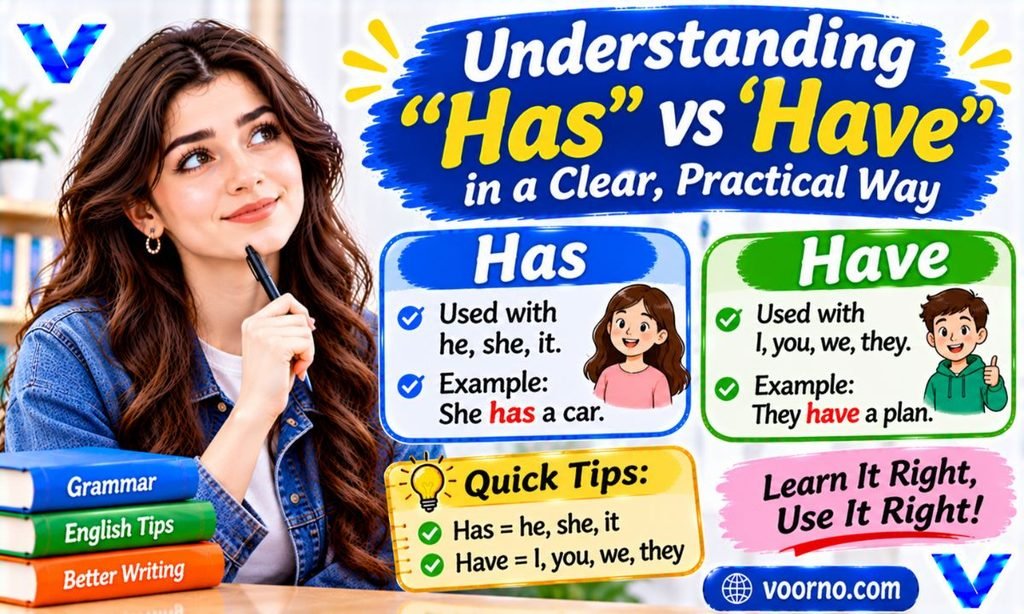
Both words express possession, action, or experience — the difference is purely grammatical, not about meaning. Think of it this way:
| Word | Used With | Example |
| Has | He, She, It, singular nouns | She has a car. |
| Have | I, You, We, They, plural nouns | They have a car. |
Once you memorize this short list, you’ll never confuse the two again.
Read More: Is “Hence Why” Correct? Meaning, Usage & Common Examples
Has or Have: Singular or Plural?
A simple way to remember this: “has” goes with one person or thing (except I/you); “have” goes with more than one, plus I and you.
- Singular (he, she, it) → has
- Plural (we, they) → have
- Special cases (I, you) → have, even though “you” can refer to one person
This is why “you have” is correct even when you’re speaking to a single person — “you” behaves like a plural pronoun grammatically.
Subject–Verb Agreement Essentials for “She Has or She Have”
Subject-verb agreement is the grammatical rule requiring that a verb match its subject in number and person. For third-person singular subjects in the present tense, English typically adds an -s or -es to the verb (she walks, she runs, she has). “Have” is one of the few irregular verbs that changes its spelling entirely, becoming “has” instead of “haves.”
Quick checklist for agreement:
- Identify the subject of the sentence.
- Check if it’s singular third-person (he, she, it, or a singular noun).
- If yes, use “has.” If the subject is plural or “I/you,” use “have.”
Using “She Has” Correctly: Practical Examples
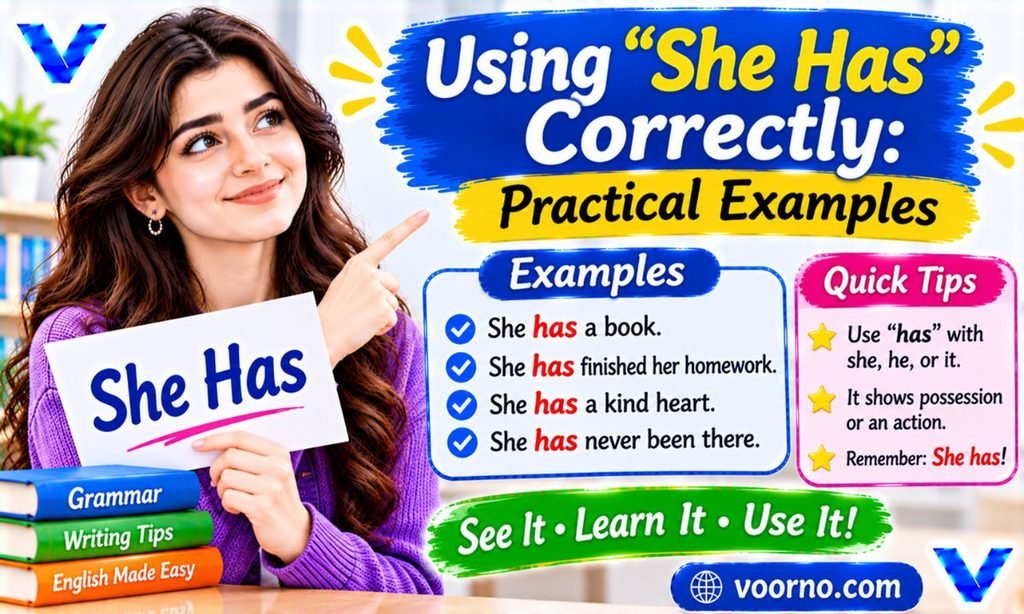
“She has” works across many contexts — possession, present perfect tense, and everyday statements.
- She has two siblings.
- She has a meeting at noon.
- She has already eaten lunch.
- She has been working here for five years.
- She has a strong opinion about this.
Has and Have Example
Seeing both forms side by side makes the pattern click faster.
| Sentence with “Has” | Sentence with “Have” |
| She has a dog. | They have a dog. |
| He has finished his work. | We have finished our work. |
| It has rained all day. | I have seen this movie. |
| The teacher has graded the tests. | The teachers have graded the tests. |
Using “Have” Correctly (and Why “She Have” Does Not Work)
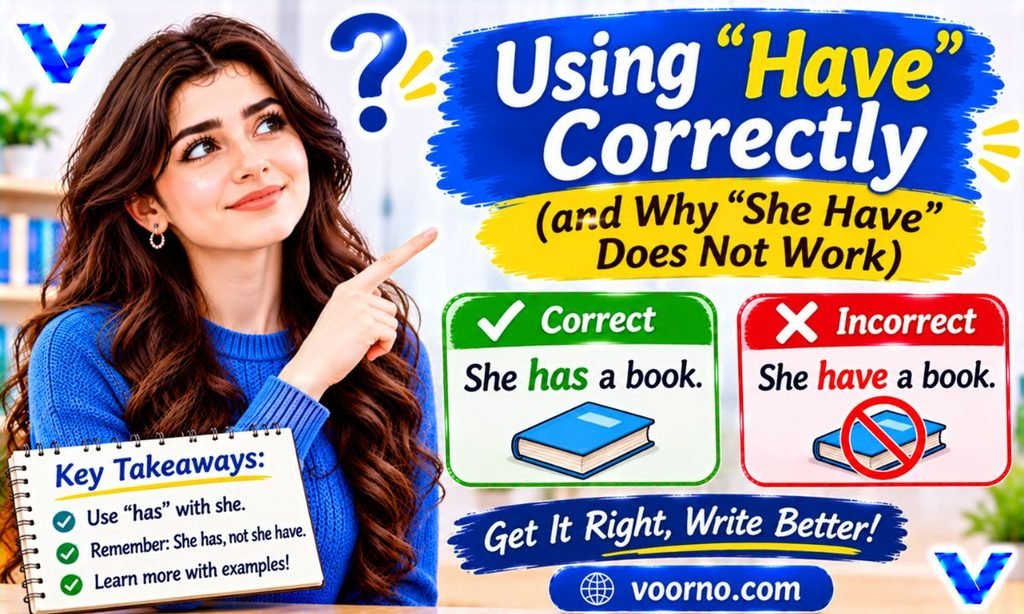
“Have” is correct with I, you, we, they, and plural nouns — but never with “she” in a standard present-tense statement. “She have” fails because it violates subject-verb agreement: a singular third-person subject requires the singular verb form.
- ✅ I have a question.
- ✅ They have arrived.
- ❌ She have a question.
The only time “have” legitimately follows “she” is in specific grammatical structures covered in the next few sections — not in a plain present-tense sentence.
Special Cases: Collective Nouns, Names, and Indefinite Pronouns
Some subjects look tricky but still follow the “has” rule because they’re treated as singular:
- Names: Sarah has a new job. (Names take “has,” just like “she.”)
- Collective nouns (team, family, group) treated as a single unit: The team has won the championship.
- Indefinite pronouns like everyone, someone, nobody: Everyone has a story to tell.
These all function as singular subjects, even though they might not look like it at first glance.
She Has or She Have Exercises
Test yourself with these quick fill-in-the-blank sentences:
- She ___ a beautiful garden. (has/have)
- They ___ finished the project. (has/have)
- My sister ___ two cats. (has/have)
- I ___ never been to Paris. (has/have)
- The company ___ announced new policies. (has/have)
Answers: 1. has, 2. have, 3. has, 4. have, 5. has
When “Have” Appears After “She”: The Exception Zone
There are a few structures where “have” legitimately follows “she” — and these are the exceptions that confuse people most.
- Subjunctive mood: “I suggest that she have more time to prepare.” (Used to express recommendations, demands, or hypotheticals.)
- Modal verb constructions: “She might have left already.” (Covered in detail below.)
- Questions with auxiliary “do”: “Does she have a car?” (Here “does” carries the third-person agreement, so “have” stays in its base form.)
These are the only standard situations where “she have” is grammatically valid.
Modal Verbs With “She”: A Different Grammar Rule Entirely
Modal verbs (can, could, should, would, might, must, will) always pair with the base form of the following verb — regardless of the subject. That’s why “have” appears after “she” in these cases without breaking any rule.
- She can have dessert after dinner.
- She should have called earlier.
- She might have forgotten her keys.
- She must have left already.
Notice: it’s never “she can has” or “she should has.” Modals override the usual has/have agreement rule entirely.
Perfect Tenses: Navigating “Has” and “Have” With Ease
In the present perfect tense, “has” pairs with third-person singular subjects, while “have” pairs with everyone else.
| Subject | Present Perfect Example |
| She | She has completed the report. |
| They | They have completed the report. |
| I | I have completed the report. |
| He | He has completed the report. |
This is one of the most common real-world places this rule appears — in emails, reports, and everyday updates.
Common Errors Learners Make (and How to Fix Them)

- Mistake: “She have a lot of work today.”
Fix: She has a lot of work today. - Mistake: “She don’t have time.”
Fix: She doesn’t have time. (Third-person singular needs “doesn’t,” not “don’t.”) - Mistake: Mixing “has” with plural subjects: “The students has finished.”
Fix: The students have finished. - Mistake: Forgetting the auxiliary shift in questions: “Has she has a car?”
Fix: Does she have a car?
She Has or She Have Answer
To settle it once and for all: “she has” is the correct, standard form in present-tense statements. “She have” is only acceptable in narrow grammatical contexts like the subjunctive mood — never as a general substitute.
Quick Diagnostics: How to Instantly Choose Between Has and Have
Here’s a fast mental checklist you can run through in seconds:
- Is the subject singular (he/she/it)? → Use has.
- Is the subject plural, “I,” or “you”? → Use have.
- Is there a modal verb (can, should, might) before it? → Use have, regardless of subject.
- Is there an auxiliary “do/does/did” in a question or negative? → Use have with “does,” and had with “did.”
Step-by-Step Test
- Find the subject of the sentence.
- Ask: is it singular third-person?
- Check for modals or auxiliaries nearby.
- Apply has (no modal, singular) or have (plural, modal, or with do/does).
Decision Chart
| Condition | Correct Verb |
| Subject is she/he/it, no modal | has |
| Subject is I/you/we/they | have |
| Modal verb present (can, should, etc.) | have |
| “Does” already used in the sentence | have |
Practical Tips to Master “She Has or She Have”
- Read your sentence aloud slowly — mistakes are easier to catch when you’re not rushing.
- Replace “she” with “he” mentally; if “he has” sounds right, “she has” is correct too.
- Practice with real sentences from emails or articles you read daily.
- Keep a small notebook of sentences you’ve corrected — repetition builds instinct faster than rules alone.
Table of Sample Practice Sentences
| Incorrect | Correct |
| She have a new laptop. | She has a new laptop. |
| She have been sick since Monday. | She has been sick since Monday. |
| She don’t have any plans. | She doesn’t have any plans. |
| She have to leave now. | She has to leave now. |
| She have finished the exam. | She has finished the exam. |
FAQs
Q:Is it correct to say she has or she have?
“She has” is correct in standard present-tense English; “she have” is incorrect except in specific structures like the subjunctive mood.
Q:Why do we use “I have not has”?
Because “I” always pairs with “have,” never “has” — the has/have distinction depends on the subject, and “I” simply doesn’t take “has.”
Q:When should I use have or has?
Use “has” with he, she, it, or singular nouns, and “have” with I, you, we, they, or plural nouns.
Q:What is the 3rd form of have?
The three forms are have (base), had (past), and had (past participle) — “has” is simply the present-tense form used with third-person singular subjects.
Q:Is “I have a headache” correct?
Yes, this is correct because “I” always takes “have,” not “has,” regardless of tense.
Conclusion
The “she has or she have” debate comes down to one simple, unshakable rule: singular third-person subjects like “she” always take “has” in standard present-tense English. “Have” only follows “she” in special cases like modal verbs, questions with “does,” or the subjunctive mood. Once you internalize this pattern, you’ll write and speak with more confidence — no more pausing mid-sentence to second-guess yourself.










2 thoughts on “She Has or She Have? Grammar Rules, Examples & Common Mistakes”