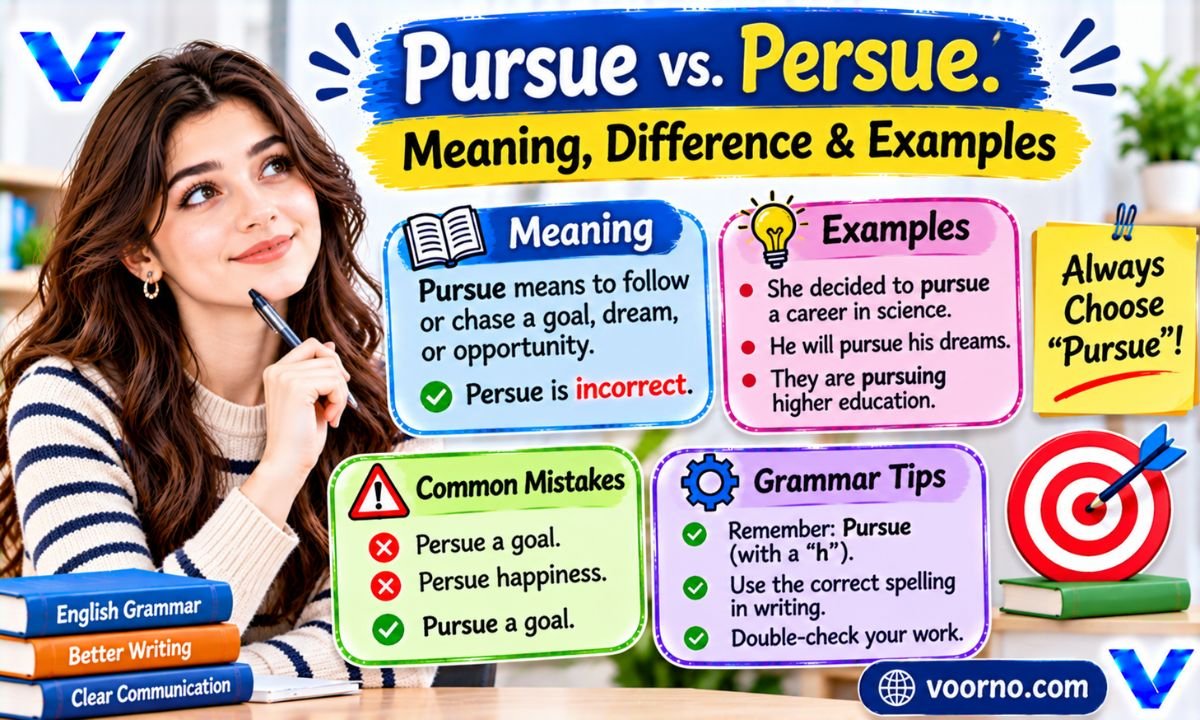
If you’ve ever paused mid-sentence wondering whether to write “persue” or “pursue,” you’re in good company. This is one of the most common spelling mix-ups in English, and it trips up native speakers and learners alike. The short answer: pursue is correct, and persue is a spelling mistake. But there’s more to this word than just its correct spelling — its history, pronunciation, and real-world usage all matter if you want to use it with total confidence.
This guide breaks down everything you need to know, from grammar rules to memory tricks, so you never second-guess yourself again.
Why the Persue vs. Pursue Confusion Happens
The confusion isn’t random — it comes down to how English sounds versus how it’s spelled.
- Phonetic mismatch: When spoken aloud, “pursue” sounds like it could easily be written with an “er” instead of “ur,” leading to the “persue” guess.
- Unfamiliar vowel pattern: The double “u” pattern (p-u-r-s-u-e) isn’t intuitive for many writers, especially those learning English as a second language.
- Autocorrect gaps: Some basic spell-checkers or quick typing on mobile keyboards don’t always flag the error immediately.
- Visual similarity to other words: Words like “persuade” and “pursuit” share some letters with “persue,” which can blur the correct spelling in a writer’s memory.
Once you understand why the mistake happens, it becomes much easier to catch yourself before hitting publish or send.
Read More: Zeros vs. Zeroes: Which Spelling Is Correct? Meaning & Usage
Persue vs. Pursue: The Final Verdict
There’s no ambiguity here. Only one of these two spellings exists in the English language.
| Word | Status | Meaning |
| Pursue | Correct spelling | To follow, chase, or work toward a goal |
| Persue | Incorrect spelling | Has no meaning; not found in standard dictionaries |
Whether you’re writing a college essay, a business email, or a text to a friend, “pursue” is the only acceptable choice.
Read More: Better Than or Better Then: How to Use Them Correctly
Persue vs Pursue Pronunciation
Both words, if “persue” were real, would sound nearly identical when spoken. “Pursue” is pronounced per-SOO (/pərˈsuː/), with the stress on the second syllable. This close pronunciation match is exactly why so many people misspell it — the ear hears “per,” so the hand writes “per.”
Breaking Down the Correct Spelling: Pursue

The word breaks down as p-u-r-s-u-e. A simple way to remember it is to notice that the word “sue” is hiding right inside it: pur-sue. Think of pursuing a goal the way a lawyer pursues, or “sues,” a case — with determination and follow-through.
Key spelling facts:
- It has two Us — one in the first syllable, one in the second.
- It ends in -sue, not -sue with an “r” before it.
- The noun form is pursuit, and the adjective form is pursuant (mostly used in legal writing).
Pursue Meaning in Relationship
Outside of careers and goals, “pursue” also shows up often in the context of relationships. To “pursue someone” or “pursue a relationship” means to actively show romantic interest and make an effort to build a connection. For example:
- “He decided to pursue her after their first conversation at the coffee shop.”
- “They chose to pursue a long-distance relationship despite the challenges.”
In this context, “pursue” carries a sense of intention and effort — it’s not passive interest, but active courtship or relationship-building.
How to Pronounce “Pursue” in American English
In American English, “pursue” is pronounced per-SOO, with a soft “er” sound at the start (similar to “her”) and emphasis landing on the second syllable. There’s no hard “r” sound emphasized, and the ending rhymes with words like “true” and “blue.”
Meaning of “Pursue” in Modern American English
In everyday modern usage, “pursue” means to:
- Follow or chase something, often with effort or urgency.
- Continue working toward a goal, plan, or ambition over time.
- Engage in an activity, career path, or course of study.
Merriam-Webster and other major dictionaries define it as a verb involving continuous action and intent — you don’t “pursue” something accidentally. There’s always a sense of purpose behind it.
How “Pursue” Is Used in Real-Life Contexts

“Pursue” shows up across nearly every area of life:
- Career: “She plans to pursue a career in data science.”
- Education: “He wants to pursue a master’s degree next year.”
- Law: “The prosecutor decided to pursue the case further.”
- Sports: “The runner pursued the leader for the final stretch.”
- Personal goals: “They continue to pursue their passion for painting.”
Persue vs Pursue Examples
Seeing the correct and incorrect versions side by side makes the difference crystal clear.
| Incorrect (Persue) | Correct (Pursue) |
| I want to persue my dreams. | I want to pursue my dreams. |
| She will persue a new job opportunity. | She will pursue a new job opportunity. |
| They plan to persue legal action. | They plan to pursue legal action. |
| He continues to persue his hobbies. | He continues to pursue his hobbies. |
Literal vs. Figurative Uses of “Pursue”
“Pursue” works in two main ways:
- Literal use: Physically chasing or following something. Example: “The police pursued the getaway car through downtown.”
- Figurative use: Working toward an abstract goal. Example: “She pursued happiness through simple daily habits.”
Both uses share the same core idea — sustained effort directed at a target, whether that target is physical or conceptual.
Common Sentences Using “Pursue” Correctly
- “I will pursue every opportunity that comes my way.”
- “The company decided to pursue expansion into international markets.”
- “Students often pursue internships to gain real-world experience.”
- “He chose to pursue his passion instead of playing it safe.”
- “The detective pursued every lead in the case.”
Memory Tricks That Actually Work
If spelling this word correctly hasn’t become second nature yet, try these tricks:
- Spot the “sue”: Remember that pur-sue contains the word “sue,” just like taking legal pursuit.
- Double U rule: Say the word slowly and picture two U’s — one early, one late.
- Pair it with “pursuit”: If you can spell “pursuit” correctly, “pursue” follows the same pattern minus the “-it.”
- Visualize the chase: Picture someone literally chasing (pursuing) a goal — the mental image reinforces the correct spelling with repeated use.
The Historical Evolution of “Pursue”
“Pursue” traces back to the Old French word poursuir (also seen as pursuer), which itself descended from the Latin prosequi, meaning “to follow after” or “to chase.” Over centuries of English evolution, the spelling settled into “pursue,” while “persue” never became a recognized variant — it simply persists today as a common typo rather than a historical spelling.
Persue vs Pursue Grammar
Grammatically, “pursue” is a regular transitive verb, meaning it requires a direct object. Its forms are:
- Base form: pursue
- Past tense: pursued
- Past participle: pursued
- Present participle: pursuing
- Third-person singular: pursues
“Persue” doesn’t have any grammatical forms because it isn’t a real word — there’s no “persued” or “persuing” in standard English.
“Pursue” in Literature and Famous Quotes
Writers and public figures have long used “pursue” to express ambition and determination. It frequently appears in quotes about chasing dreams, adventure, and purpose — often paired with words like “passion,” “happiness,” or “goals.” This popularity in inspirational and literary writing is part of why the word appears so often in everyday conversation about ambition and self-improvement.
Common Mistakes Writers Still Make
- Writing “persue” instead of “pursue” out of habit.
- Confusing “pursue” with “persuade” (explained below).
- Overusing “pursue” when a simpler word like “try” or “seek” would sound more natural.
- Forgetting the correct past tense (“persued” instead of “pursued”).
Quick Fixes to Avoid This Error Forever
- Turn on spell-check and grammar tools in your writing apps.
- Proofread career-related documents (resumes, cover letters) twice — this is where the mistake shows up most and matters most.
- Use the “sue” memory trick every time you’re unsure.
- Read your sentence aloud; if it sounds like “per-SOO,” double-check you’ve typed “pursue.”
Pursue vs Persuade
These two words are often confused simply because they share several letters and a similar sound at the start.
| Word | Meaning | Example |
| Pursue | To follow, chase, or work toward something | “She will pursue a nursing degree.” |
| Persuade | To convince someone to do or believe something | “He tried to persuade her to join the team.” |
Even though they look alike, they serve completely different grammatical and contextual purposes.
Practical Writing Guide: When and How to Use “Pursue”
When “Pursue” Is the Best Choice
Use “pursue” when you want to convey sustained, purposeful effort — such as chasing a career, degree, relationship, or long-term goal. It works well in both formal writing (resumes, academic papers, legal documents) and everyday conversation.
When Another Word Works Better
Sometimes a simpler or more specific word fits better:
- Chase – for short, immediate physical pursuit (“chase the ball”)
- Seek – for searching without necessarily long-term commitment (“seek advice”)
- Strive – for effort with obstacles (“strive for excellence”)
- Follow up on – for casual, less formal contexts (“follow up on a lead”)
Choosing the right synonym keeps your writing varied and prevents repetitive phrasing.
FAQs
Q:What does persue mean?
“Persue” has no meaning — it’s simply a common misspelling of “pursue” and doesn’t appear in standard dictionaries.
Q:What is the difference between pursue and persue?
“Pursue” is the correct, recognized English word meaning to follow or chase something; “persue” is an incorrect spelling with no accepted meaning.
Q:Can I say pursue a degree?
Yes, “pursue a degree” is a correct and commonly used phrase meaning to work toward earning an academic qualification.
Q:What are you pursuing?
This is a common question asking about someone’s current goal, career path, or area of study, such as a job, degree, or personal ambition.
Q:What is another word for “pursue”?
Common synonyms include chase, seek, strive for, follow, and go after, depending on the context.
Conclusion
The debate between persue and pursue really isn’t a debate at all — “pursue” is the only correct spelling, backed by dictionaries, grammar rules, and centuries of linguistic history. “Persue” is simply a phonetic slip that’s easy to make but just as easy to fix once you know the pattern.
Whether you’re chasing a career, a relationship, or a personal passion, remember the “sue” hidden inside the word, and you’ll never misspell it again. Keep this guide handy, apply the memory tricks, and you’ll write “pursue” correctly every single time.










2 thoughts on “Pursue vs. Persue: Meaning, Difference & Examples”