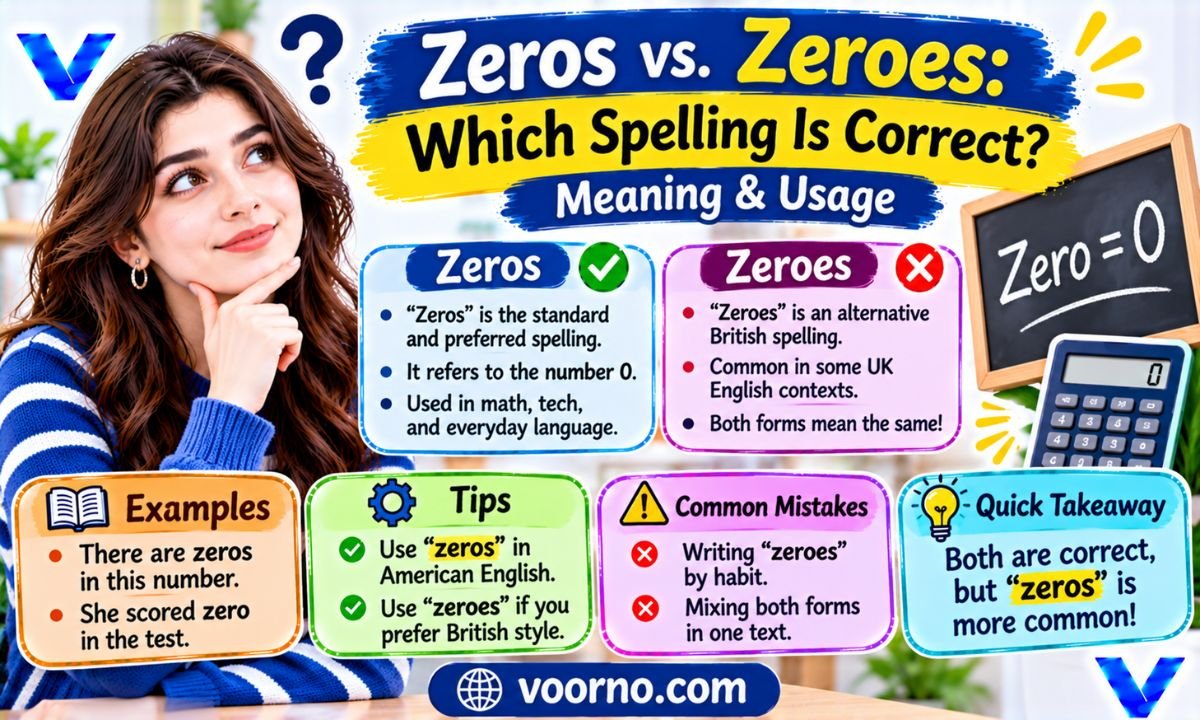
Type the plural of “zero” into any document, and there’s a good chance your spell-checker will flag one version or underline the other in red. It’s a small word causing a surprisingly big amount of confusion — and if you’ve ever paused mid-sentence wondering whether to write “zeros” or “zeroes,” you’re far from alone.
The short answer: both spellings are technically correct, but they aren’t used the same way anymore. This guide breaks down exactly when to use each one, why the confusion exists in the first place, and how to make the right call every single time — in writing, in coding, and even on the Scrabble board.
Why This Matters: The Big Deal About Zeros and Zeroes
At first glance, this looks like a trivial spelling quirk. But get it wrong in the wrong context, and it can quietly undermine your credibility.
- Business reports and resumes read as sloppy when spelling is inconsistent.
- Technical documentation needs one standard so code comments, manuals, and specs don’t contradict each other.
- Academic and professional editors will flag inconsistency even when both forms are “allowed.”
In short, this isn’t about grammar pedantry — it’s about writing with confidence and consistency.
Zeros or Zeroes Grammar
Grammatically, “zero” is a noun (and sometimes a verb). As a noun referring to the number 0, its plural can be formed two ways: zeros or zeroes. As a verb meaning “to adjust to a starting point” or “to focus intently,” the correct conjugated form is always zeroes (as in “she zeroes in on the target”).
Read More: Unselect or Deselect: Meaning, Differences & Correct Usage
The Core Rule You Need Right Now
Here’s the rule stripped down to its essentials:
- As a plural noun (more than one zero, the digit 0): use zeros. This is the standard in modern American and British English alike.
- As a verb (present tense, third-person singular): use zeroes — for example, “the sniper zeroes in” or “he zeroes the scale before weighing.”
That’s really the whole rule. If you remember nothing else from this article, remember this distinction.
Zeros or Zeroes Scrabble
Good news for word-game players: both zeros and zeroes are valid, playable words in Scrabble dictionaries (including the official Scrabble word lists used in North America and internationally). So you don’t need to worry about a challenge — either spelling scores fair and square.
Read More: Pursue vs. Persue: Meaning, Difference & Examples
Quick Practice Rule You Can Use Today
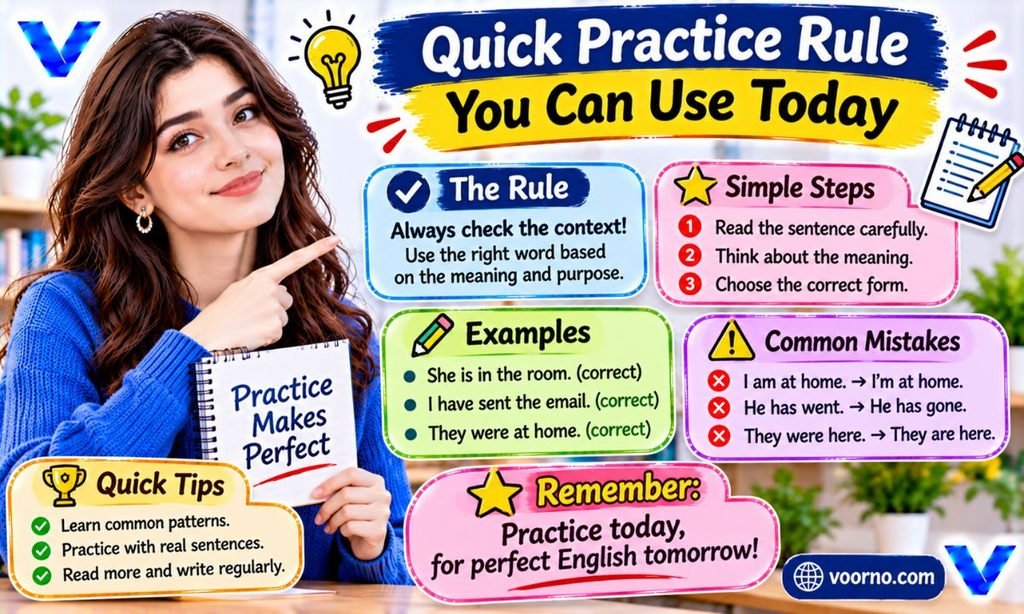
Ask yourself one question: Am I counting things, or describing an action?
- Counting digits, scores, or values → zeros
- Describing someone doing something (zeroing in, zeroing out) → zeroes
A simple trick: if you can replace the word with “focuses” or “adjusts” and the sentence still makes sense, you need the verb form, zeroes.
Historical Background: Where “Zeroes” Came From
English has a messy history with words that end in “-o.” Some take a plain “-s” in the plural (pianos, photos, kilos), while others take “-es” (heroes, potatoes, tomatoes). There’s no single rule that predicts which pattern a word will follow — it largely comes down to how the word entered English and how it was used over time.
“Zero” traces back to the Italian zero, itself derived from the Arabic ṣifr, meaning “empty” or “nothing.” When the word settled into English usage, writers initially leaned toward the “-oes” pattern seen in similar imported nouns, which is how “zeroes” gained early traction as the plural form.
Modern American English Standard
Fast forward to today, and American English has largely settled the debate. Major style guides — including Microsoft’s own writing standards used across its technical documentation — explicitly recommend zeros over zeroes as the plural form. Corpus data backs this up: large collections of real-world American writing show “zeros” appearing roughly three times more often than “zeroes.”
In practice, if you’re writing for an American audience, business, or publication, zeros is the safe, standard, professional choice.
British English: Still Flexible But Leaning Toward Zeros

British English has historically been more tolerant of “zeroes” than American English, and some traditional dictionaries even list it as the primary form. But actual usage tells a different story.
Historical UK Usage
Older British texts and some traditional dictionary entries treated “zeroes” as the standard, dictionary-first plural, following the same “-oes” pattern found in words like “heroes” and “potatoes.”
Modern UK Usage
Despite that traditional preference, real usage data — pulled from large British text corpora — shows “zeros” far outpacing “zeroes” in everyday and professional British writing, by a wide margin. In other words, British English has quietly drifted the same direction as American English, even if some dictionaries haven’t fully caught up.
Why “Zeros” Wins in Modern English
A few forces are pushing “zeros” ahead as the global standard:
- Simplicity. Shorter, more phonetically straightforward plurals tend to win out over time in English.
- Technology’s influence. Software, coding, and data documentation overwhelmingly use “zeros,” and that consistency spreads outward into everyday writing.
- Style guide alignment. Major publishers, tech companies, and grammar authorities increasingly converge on one recommended form, reducing ambiguity.
- Avoiding confusion with the verb. Since “zeroes” is also the verb form, using “zeros” for the plural noun keeps the two meanings visually distinct.
Technology, Coding, and Data — Where Clarity Counts
In programming, engineering, and data science, precision is everything, and “zeros” is the near-universal standard. You’ll see it in:
- Variable and array naming conventions (“array of zeros”)
- Statistical and mathematical writing (“leading zeros,” “trailing zeros”)
- Technical documentation and API references
- Financial and scientific reporting, where miscounting zeros can change a value by orders of magnitude
Because clarity is non-negotiable in technical writing, “zeros” has become the default — and using “zeroes” in this context can look like an inconsistency or a typo to technical readers.
Linguistic Patterns: How English Plurals Evolve
English pluralization isn’t governed by one tidy rule — it evolves through usage, frequency, and analogy. Words ending in “-o” split into three loose categories:
| Pattern | Examples | Plural Form |
| Always “-s” | photo, piano, kilo | photos, pianos, kilos |
| Always “-es” | hero, potato, tomato | heroes, potatoes, tomatoes |
| Mixed/flexible | zero, volcano, mosquito | zeros/zeroes, volcanos/volcanoes, mosquitos/mosquitoes |
“Zero” sits in that flexible middle category, alongside other words that have historically wobbled between spellings before usage settled toward one dominant form.
When “Zeroes” Is Correct (Verb Only)
Don’t write off “zeroes” completely — it has one clear, correct job: functioning as the third-person singular present tense of the verb “to zero.”
Examples:
- The technician zeroes the scale before each measurement.
- She zeroes in on the exact source of the error.
- He zeroes out his bank balance every month before payday.
In every one of these cases, “zeroes” describes an action, not a quantity — and swapping in “zeros” here would be a clear grammatical error.
Common Mistakes to Avoid
- ❌ Using “zeroes” as the plural noun in formal or technical writing (“the invoice had three zeroes”)
- ❌ Using “zeros” as a verb (“she zeros in on the answer”)
- ❌ Switching between spellings within the same document
- ❌ Assuming British English requires “zeroes” — modern usage doesn’t support that assumption
- ❌ Confusing “zeros” (plural noun) with “zero’s” (possessive form, rarely needed)
Case Study: Academic Writing vs. Popular Media
Academic journals, especially in mathematics, statistics, and computer science, almost universally use “zeros” — consistency and clarity matter more than tradition in technical publishing. Popular media and casual writing show slightly more variation, occasionally using “zeroes” for stylistic or old-fashioned flavor, but even here, “zeros” remains the dominant choice in edited, professionally published content.
International English Snapshot
| Region | Preferred Plural Noun | Notes |
| United States | Zeros | Standard in style guides and tech writing |
| United Kingdom | Zeros | Increasingly dominant despite older dictionary entries |
| Canada | Zeros | Follows US conventions closely |
| Australia | Zeros | Aligns with broader Commonwealth trend |
Linguistic Evidence: Data and Usage Trends
Large-scale text analysis tools, such as language corpora and historical text trackers, consistently show the same pattern: “zeros” has been the more frequently used plural for decades, and the gap has widened rather than narrowed in recent usage. This kind of real-world frequency data is exactly what modern dictionaries and style guides rely on when updating their recommendations.
Practical Tips You Can Use Today
- Default to zeros for anything you write — emails, reports, code comments, essays.
- Reserve zeroes exclusively for verb usage.
- Set your word processor’s autocorrect/style checker to flag the “wrong” one if you tend to slip.
- When editing someone else’s work, check for consistency first — flip-flopping is worse than picking the “less common” option and sticking with it.
Plural of Zero
To directly answer the core question: the standard, modern plural of “zero” is zeros. “Zeroes” is a recognized alternate spelling for the plural noun in some dictionaries, but it is far less common and is best reserved for the verb form.
Quotes From Language Experts
Style authorities and technical writing guides — including Microsoft’s official documentation standards — explicitly instruct writers to use “zeros” rather than “zeroes” as the plural form. Meanwhile, general dictionaries such as Merriam-Webster list both spellings as acceptable, reflecting how usage has shifted even as older reference entries retain both options.
Comparison at a Glance
| Feature | Zeros | Zeroes |
| Part of speech | Plural noun | Verb (present tense) |
| American English | Preferred | Rare, dated |
| British English | Preferred | Occasionally seen |
| Technical/coding use | Standard | Avoided |
| Scrabble-valid | Yes | Yes |
| Example | “The score had two zeros.” | “He zeroes his rifle scope.” |
Summary: The Simple, Practical Rule
If you’re naming multiple instances of the digit 0, write zeros. If you’re describing the action of zeroing something, write zeroes. That’s the entire rule, and it holds true across American English, British English, and virtually every professional style guide in use today.
Zeros or Zeroes Examples
- Correct (noun): “The check had way too many zeros for my liking.”
- Correct (verb): “The engineer zeroes the instrument before testing.”
- Incorrect: “The password contains three zeroes.” (should be “zeros”)
- Incorrect: “She zeros in on the problem.” (should be “zeroes”)
Your Go-To Cheat Sheet
- Counting zeros? → Zeros
- Someone zeroing in/out? → Zeroes
- Writing for American readers? → Zeros
- Writing for British readers? → Zeros (despite older dictionary entries)
- Playing Scrabble? → Either works
Closing Thoughts
Language evolves, and “zeros” vs. “zeroes” is a small but perfect example of that evolution in action. What was once a genuinely split decision has settled, in practice, into a clear modern standard: use “zeros” for the plural noun, and save “zeroes” for its life as a verb. Keep that distinction in mind, and you’ll never second-guess this one again.
FAQs
Q:Is “zeroes” a word?
Yes. It’s a recognized word — mainly correct as the verb form (“he zeroes in”), and accepted by some dictionaries as an alternate plural noun.
Q:Is zeroes or zeros correct?
Both are technically correct, but “zeros” is the modern standard for the plural noun in both American and British English.
Q:What does “zeros” mean?
“Zeros” is the plural of the number 0 — used to describe more than one instance of the digit zero.
Q:What is the difference between “zero” and “zeros”?
“Zero” is singular (one instance of the digit 0), while “zeros” is plural (more than one).
Q:How do you say zero in a different way?
Common alternatives include “nil,” “nought,” “naught,” “zilch,” and “goose egg,” depending on the context and region.
Conclusion
The debate between “zeros” and “zeroes” isn’t really a debate anymore — modern usage has a clear winner for the plural noun, and a clear, separate role for the verb form. Use “zeros” when counting, use “zeroes” when describing an action, and you’ll always be on solid grammatical ground.










2 thoughts on “Zeros vs. Zeroes: Which Spelling Is Correct? Meaning & Usage”