If you’ve ever paused mid-sentence wondering whether to write “unselect” or “deselect,” you’re not alone. Both words show up everywhere — from Excel tutorials to app settings menus — and most people use them without a second thought. But when you’re writing documentation, UI copy, or a professional email, that split-second doubt matters.
Here’s the good news: this isn’t a complicated grammar rule. It’s a question of formality, dictionary recognition, and industry convention. This guide breaks down exactly what each word means, where they came from, how real companies and style guides treat them, and which one you should use in any given situation.
Unselect or Deselect: The Short Answer
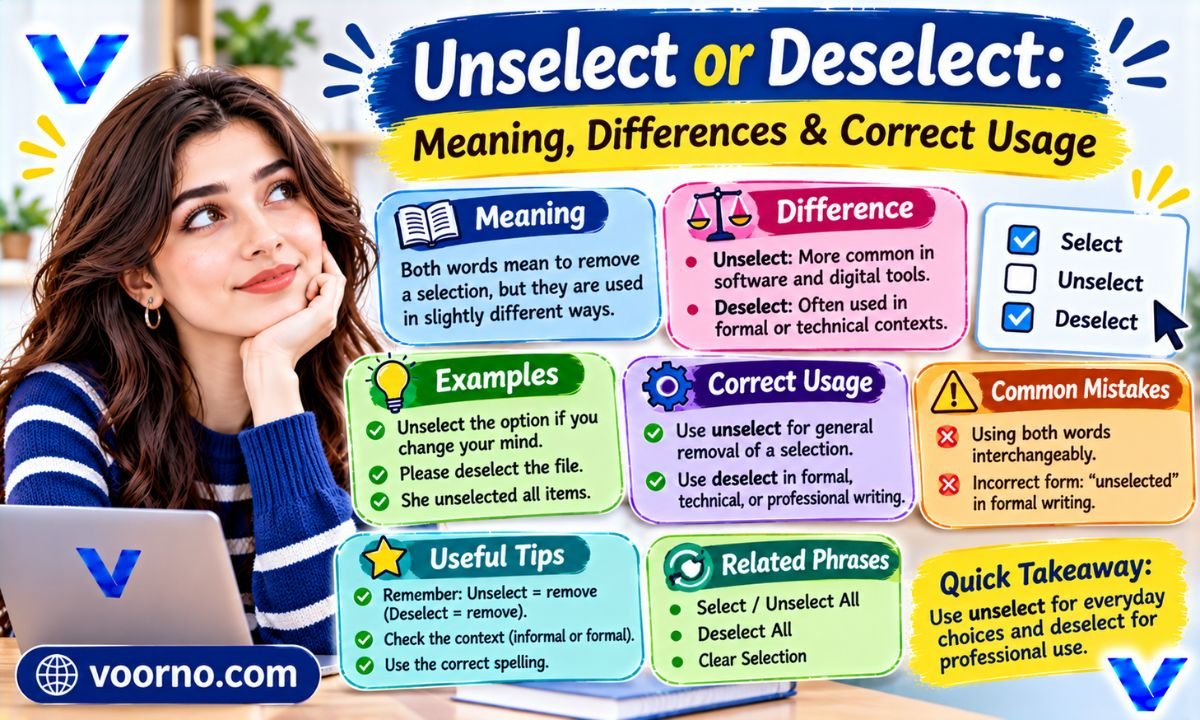
Deselect is the correct, dictionary-recognized, and professionally preferred term. Unselect is widely understood and commonly used, but it’s considered informal and is absent from most major dictionaries.
Both words mean the same thing: reversing or canceling a previous selection. The difference isn’t about meaning — it’s about formality and standardization.
| Quick Fact | Deselect | Unselect |
| Dictionary status | Recognized in most modern dictionaries | Mostly absent from major dictionaries |
| Formality | Formal, professional | Informal, conversational |
| Prefix | de- (reverse an action) | un- (undo a state) |
| Best used in | Documentation, UI/UX, technical writing | Casual speech, informal apps |
| Industry preference | Preferred by Microsoft, Apple, Google | Occasionally used, less standard |
What “Deselect” Really Means
Deselect is a verb that means to remove the selected status from an item, checkbox, file, or element. If something was previously highlighted, checked, or chosen, deselecting it cancels that state without deleting the item itself.
For example:
- Click the checkbox again to deselect it.
- The user deselected three files before starting the upload.
- Press Escape to deselect all objects on the canvas.
The word gained popularity alongside the rise of graphical user interfaces in the 1980s and 1990s, when “select” and “deselect” became a natural verb pair for describing on-screen actions.
Read More: “Let’s Blow This Popsicle Stand” Meaning: Origin, Definition & Examples
What “Unselect” Really Means
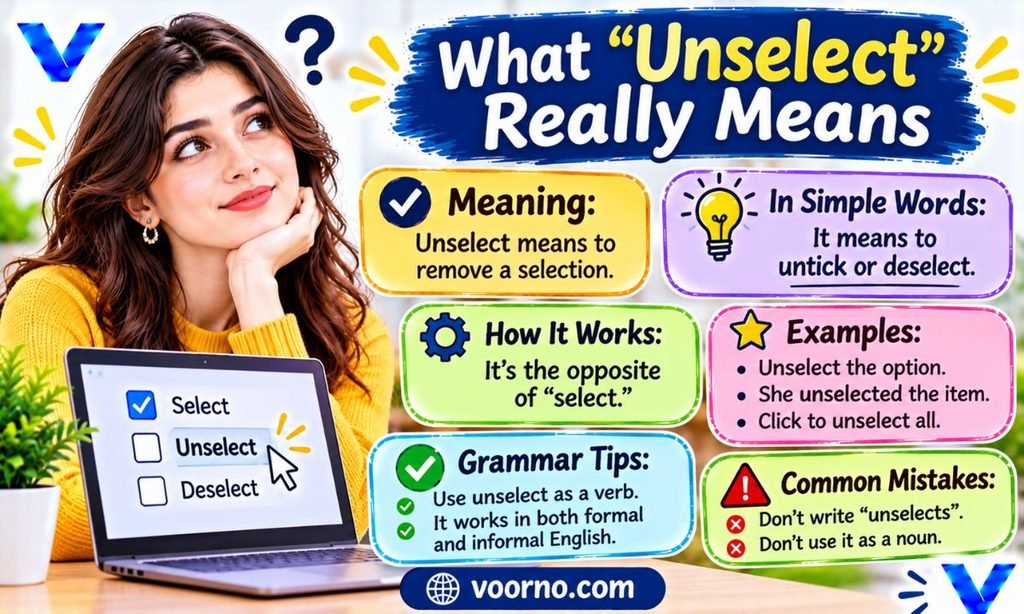
Unselect carries the exact same functional meaning as deselect — removing or reversing a selection. It’s built by attaching the prefix “un-” directly to “select,” and it reads intuitively: the opposite of “select” is “unselect.”
Example sentences:
- Click the item again to unselect it.
- If you change your mind, just unselect the option.
Unselect isn’t wrong in the sense of being nonsensical — people understand it instantly. It’s simply less standardized, appears less frequently in formal writing, and isn’t listed in as many dictionaries.
Unselect or Deselect Dictionaries
This is where the two words really part ways. Deselect appears in a number of modern and tech-focused dictionaries and is frequently tagged as computing terminology. Unselect, by contrast, is largely absent from major dictionary databases like Merriam-Webster and Oxford. That doesn’t make unselect “incorrect” English — plenty of commonly used words haven’t been formally catalogued — but it does mean deselect carries more linguistic authority when precision matters.
Read More: Zeros vs. Zeroes: Which Spelling Is Correct? Meaning & Usage
Grammar and Prefix Rules: Why “Deselect” Is Correct
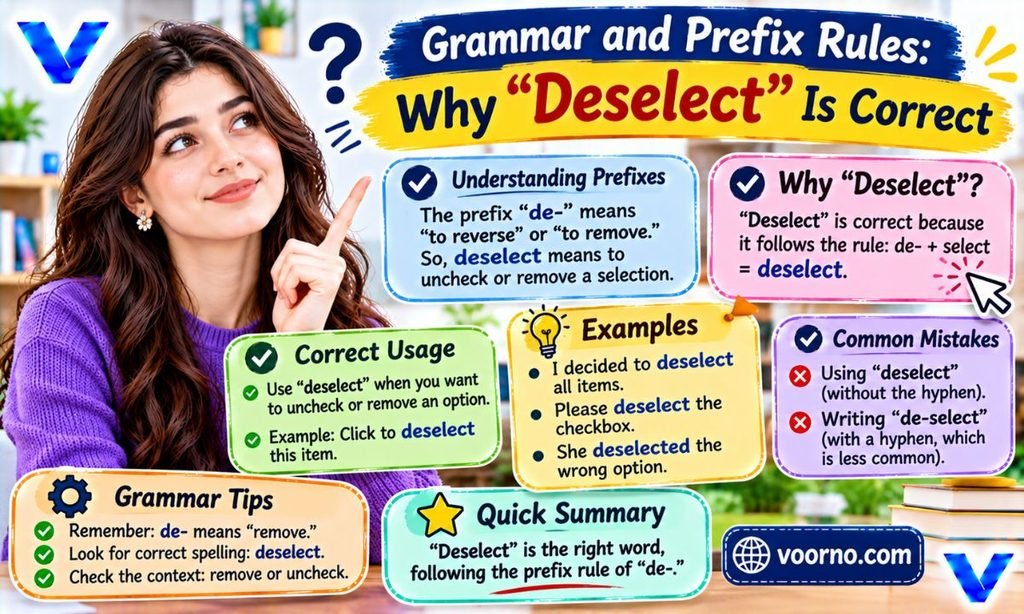
The real distinction between these two words comes down to prefixes, and English treats “de-” and “un-” differently depending on the base verb.
Prefix “De-“
The prefix “de-” typically means “to reverse,” “to remove,” or “to undo an action that was deliberately performed.” It’s the same prefix found in:
- deactivate
- deregister
- detach
- decommission
These words all describe undoing a specific, intentional action — which is exactly what happens when you deselect something you previously selected on purpose. Because “select” is an intentional action, “de-” is the grammatically fitting prefix.
Prefix “Un-“
The prefix “un-” generally reverses a state rather than an action. It’s common in words like:
- unhappy
- unlocked
- uncover
- unwrap
“Un-” tends to attach to adjectives or describe a change in condition. Applying it to an action verb like “select” is grammatically looser — understandable, but less precise than the “de-” construction. This is why linguists and style guides generally favor deselect: it follows the more consistent pattern of pairing “de-” with verbs describing reversed actions.
Unselect or Deselect Synonym
If you want alternatives that sidestep the debate entirely, plain-language options work well in user-facing copy:
- Clear selection
- Remove checkmark
- Uncheck the box
- Turn off this option
- Cancel selection
These synonyms are useful in UX writing when you want maximum clarity for a general audience, regardless of which grammatical camp you fall into.
Real-World Usage Data
Numbers don’t lie, and when you look at actual usage across the internet, a clear pattern shows up.
Google Ngram Viewer
Ngram data tracking word frequency across millions of published books shows “deselect” appearing more consistently in technical and professional literature, particularly from the 1990s onward, as computing terminology became standardized in print. “Unselect” shows up too, but at a noticeably lower and less consistent frequency.
Google Search Frequency
Search interest for both terms spikes around software troubleshooting queries — think “how to deselect cells in Excel” or “unselect all in Photoshop.” Deselect tends to dominate in searches tied to established software (Excel, Adobe products, Windows), while unselect appears more often in casual, conversational searches and mobile app contexts.
Developer Documentation and Popular Platforms
Major technology companies overwhelmingly standardize on “deselect” in their official documentation and interface copy. Microsoft, Apple, and Google all default to deselect in help articles, accessibility guides, and UI labels.
Usage in Software, UI/UX, and Technology

Because both words originated largely to describe digital actions, it makes sense to look at how software companies and interface designers actually apply them.
Unselect or Deselect Stack Exchange
On developer forums like Stack Exchange and Stack Overflow, “deselect” is the term most frequently used in accepted answers and official API references, especially for describing element states in code (checkboxes, list items, table rows). “Unselect” does appear in some code comments, variable names, and older discussion threads, but it’s treated as a casual variant rather than a standard.
Systems, Apps, and Platforms That Use “Deselect”
- Microsoft Excel and Office 365 (“Deselect a selection” tool)
- Adobe Photoshop and Illustrator (Select > Deselect menu)
- Apple’s macOS and iOS accessibility documentation
- Most professional design and CAD software
Systems That Use or Allow “Unselect”
- Some third-party mobile apps and games
- Certain open-source software interfaces
- Casual settings menus prioritizing simple, everyday language
- Legacy code where “unselect” was already implemented and left unchanged for consistency
Developer and Designer Evidence
Ask any UX writer, and most will tell you the same thing: deselect is the safer default for professional products, but unselect isn’t a dealbreaker if it’s already baked into a codebase or design system. Consistency across a single product matters more than which word wins the broader debate — switching between the two terms within the same app creates confusion.
Unselect or Deselect Shortcut
Regardless of terminology, here’s how the action typically works across common platforms:
| Platform | Shortcut / Method |
| Excel (Windows) | Hold Ctrl and click a selected cell |
| Excel (Mac) | Hold Cmd and click a selected cell |
| Adobe Photoshop | Ctrl+D (Windows) / Cmd+D (Mac) |
| Windows File Explorer | Ctrl+click a selected file |
| macOS Finder | Cmd+click a selected file |
| General web forms | Click the checkbox or option again |
Style Guide Recommendations

Most professional and technical style guides — including internal UX writing standards at large tech companies — recommend deselect for:
- Software documentation and help centers
- User interface labels and buttons
- Technical writing and API references
- Formal business communication
The reasoning is consistent: deselect pairs naturally with “select” (select/deselect), follows established prefix conventions, and carries dictionary backing that unselect lacks.
When “Unselect” Might Still Be Acceptable
Unselect isn’t banned from good writing — it just has a narrower lane.
- Existing codebases: If your software already uses “unselect” as a function name or label, keep it for consistency rather than introducing mismatched terminology.
- Casual or conversational products: Mobile games, social apps, or products with a playful brand voice sometimes prefer unselect because it feels lighter and less technical.
- Everyday spoken English: In conversation, nobody will blink if you say “unselect” instead of “deselect.”
The rule of thumb: match the word to the context. Formal and technical settings lean deselect; casual and legacy settings can tolerate unselect.
Summary Comparison Table
| Feature | Deselect | Unselect |
| Meaning | Remove a previous selection | Remove a previous selection |
| Prefix | de- (reverse an action) | un- (reverse a state) |
| Dictionary recognition | Common | Rare |
| Formal writing | Preferred | Avoid |
| Software/UI standard | Yes (Microsoft, Adobe, Apple) | Occasional, legacy use |
| Tone | Professional, precise | Casual, conversational |
| Grammatical structure | More linguistically consistent | Less standardized |
Key Takeaways
- Deselect and unselect mean the same thing: reversing a selection.
- Deselect is the dictionary-recognized, professionally preferred term.
- The prefix “de-” fits action verbs more precisely than “un-” in this case.
- Major tech companies and style guides default to deselect in documentation and UI copy.
- Unselect remains acceptable in casual contexts or existing code where it’s already standard.
- Consistency within a single document or product matters more than winning the broader debate.
FAQs
Q:Which is correct: “unselect” or “deselect”?
Deselect is the grammatically preferred and dictionary-recognized term, though unselect is widely understood and commonly used informally.
Q:How do I unselect all shortcuts?
Click on an empty area outside your selection, or use a dedicated shortcut like Ctrl+D in Photoshop or Escape in many applications.
Q:How to deselect with keyboard?
Hold Ctrl (Windows) or Cmd (Mac) and click the selected item again, or press Escape depending on the software.
Q:How do I unselect all?
Click any blank space outside the selected items, or use your software’s “Deselect All” or “Clear Selection” command.
Q:How do I unselect a table in Excel?
Click any single cell outside the table, or press the Escape key to clear the entire selection instantly.
Conclusion
The unselect vs. deselect debate isn’t really about right and wrong English — it’s about formality and convention. Deselect wins on dictionary recognition, grammatical consistency, and adoption by major tech platforms, making it the safer choice for documentation, UI copy, and professional writing.
Unselect isn’t incorrect, but it belongs in more casual, conversational, or legacy contexts.When in doubt, default to deselect — your readers, users, and style guide will thank you.










2 thoughts on “Unselect or Deselect: Meaning, Differences & Correct Usage”