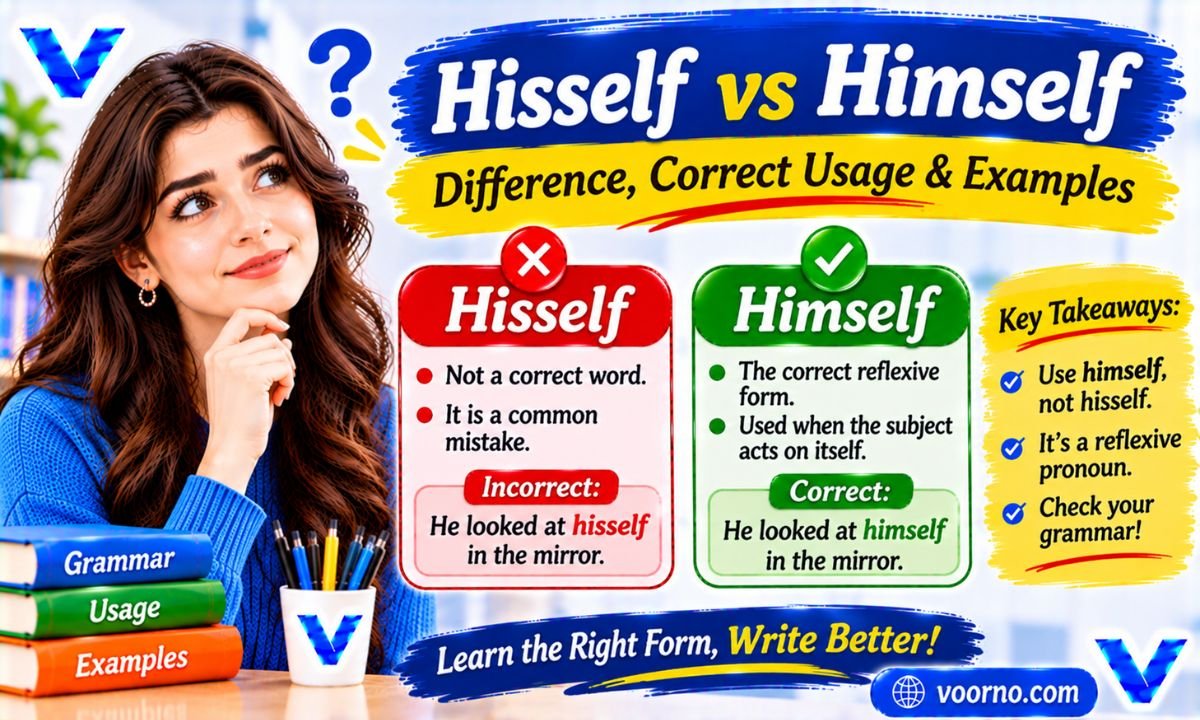
Is it “hisself” or “himself”? The correct word in standard English is himself. “Hisself” is a nonstandard dialect form. You will hear it in casual speech and see it in dialogue, but it doesn’t belong in essays, emails, or professional writing.
This guide explains why, shows you how to use “himself” correctly, and gives you simple tricks so you never second-guess it again.
Quick Answer for Busy Readers
- Correct: himself
- Incorrect in standard English: hisself
- Why: “Himself” is the accepted reflexive pronoun for a singular male subject. “Hisself” is a spoken variant that never entered standard grammar.
- Only exception: Writing dialogue or quoting someone to capture how they actually speak.
Example: He taught himself to code. ✅ He taught hisself to code. ❌
Read More: Is “Hence Why” Correct? Meaning, Usage & Common Examples
What Reflexive Pronouns Really Do in English
A reflexive pronoun points back to the subject of the sentence. The person doing the action is also the person receiving it.
Reflexive pronouns have two main jobs:
- Reflexive use: The action returns to the subject. She hurt herself.
- Emphatic use: They add emphasis. The mayor himself answered the phone.
If you can remove the pronoun and the sentence still makes sense, it is usually emphatic. If removing it breaks the sentence, it is reflexive.
Common Reflexive Pronouns in English
| Subject | Reflexive pronoun |
| I | myself |
| you (singular) | yourself |
| he | himself |
| she | herself |
| it | itself |
| we | ourselves |
| you (plural) | yourselves |
| they | themselves |
Notice that “hisself” appears nowhere in this table. It is not part of the standard set.
Hisself vs Himself Examples
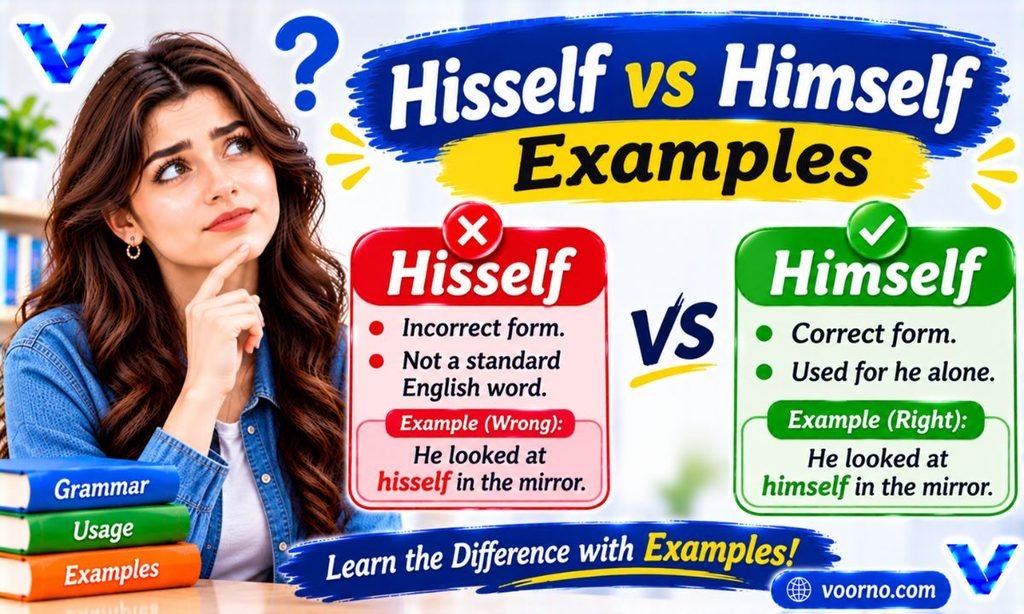
Correct sentences with “himself”:
- Marcus fixed the bike himself.
- The actor introduced himself to the crowd.
- He reminded himself to breathe.
- My uncle built the shed all by himself.
- The coach blamed himself for the loss.
Nonstandard sentences with “hisself”:
- ❌ Marcus fixed the bike hisself.
- ❌ The actor introduced hisself to the crowd.
- ❌ He reminded hisself to breathe.
Every “hisself” sentence above becomes correct the moment you swap in “himself.”
Where “Himself” Fits in Standard English
“Himself” works in three common patterns:
- As an object that refers back to the subject: He saw himself in the mirror.
- After a preposition: He talked to himself. She left him by himself.
- For emphasis: The chef himself served the dish.
It can’t stand in for “he” or “him” as an ordinary subject or object. Himself and Sam went home is wrong. Use Sam and he went home.
Why People Say “Hisself” in Real Life

There is a logical reason behind the mistake. Look at the pattern:
- my + self = myself
- your + self = yourself
- our + self = ourselves
Those three use possessive words. So a speaker’s brain reasons that “his” + self should give “hisself.” That is a natural, rule-following instinct.
Standard English broke the pattern. “Himself” comes from the object form him plus self. The same goes for “themselves” (them + selves) and “itself.” So “himself” is the odd one out, and “hisself” is what you get when speakers smooth out that irregularity.
The form also survives in some regional and community dialects, mainly through spoken use. Language experts generally treat it as a dialect feature rather than a sign of low intelligence. It just isn’t the accepted form in standard writing.
Speech vs Writing
| Setting | Use “himself”? | Use “hisself”? |
| Academic essay | Yes | No |
| Business email | Yes | No |
| Resume or cover letter | Yes | No |
| Casual conversation | Yes | Heard, but nonstandard |
| Fiction dialogue | Yes | Only to portray a character’s speech |
| News quote | Yes | Only if quoting exactly |
The rule of thumb: if you are speaking as yourself to a wide audience, choose “himself.” If you are portraying someone’s voice, “hisself” can add realism.
Hisself vs Himself Quiz
Test yourself. Pick the correct option.
- The child dressed ______ this morning. (himself / hisself)
- Ben promised ______ he would finish early. (himself / hisself)
- The author ______ signed my copy. (himself / hisself)
- He did it all by ______. (himself / hisself)
Answers: 1) himself, 2) himself, 3) himself, 4) himself. If you chose “himself” every time, you’re set.
Why “Hisself” Is Incorrect in Standard English
There are three solid reasons:
- Dictionaries and style guides list it as nonstandard. Editors will correct it.
- It isn’t part of the accepted reflexive set. Standard grammar uses “himself,” full stop.
- It can hurt credibility. In formal writing, it may distract readers from your message.
None of this makes the form “wrong” as a piece of spoken dialect. It simply means it isn’t the right choice for standard written English.
Correct Usage of “Himself” With Clear Examples
Reflexive use (action returns to the subject)
- He cut himself while cooking.
- The player pushed himself to the limit.
- Tom taught himself Spanish.
Emphatic use (adds emphasis)
- The principal himself called the parents.
- He himself admitted the error.
After prepositions
- He kept the secret to himself.
- He lives by himself in the city.
- She left him to fend for himself.
Common idioms
- Be himself (act naturally)
- By himself (alone)
- Beside himself (overcome with emotion)
- Pleased with himself (proud)
Side-by-Side Comparison
| Feature | Himself | Hisself |
| Status | Standard | Nonstandard/dialect |
| Accepted in formal writing | Yes | No |
| Listed in major dictionaries as standard | Yes | No |
| Works in dialogue | Yes | Yes, for effect |
| Pattern origin | him + self | his + self (by analogy) |
| Safe for exams and work | Yes | No |
Hisself vs Himself Grammar
Here is the grammar in simple terms:
- Part of speech: Both are attempts at a reflexive pronoun.
- Person and number: Third person, singular, masculine.
- Antecedent: A reflexive pronoun needs a clear subject earlier in the sentence to point back to.
Correct: The driver blamed himself. (Driver → himself) Unclear: Himself blamed the driver. (No antecedent, so it fails.)
A reflexive pronoun can never be the subject of a sentence on its own.
An Analogy That Makes It Instantly Clear
Think of reflexive pronouns as a mirror. When Jake looks at a mirror, he sees himself. The reflection belongs to Jake, but it doesn’t own anything. That’s the whole point: “himself” reflects the subject back, and it says nothing about possession.
“His” is the opposite. It is the word for ownership: his book, his car. Since “himself” is about reflection and not ownership, the possessive “his” has no business in it. That’s a quick way to remember why “hisself” doesn’t fit.
Common Situations Where This Mistake Happens
- Fast typing or texting: Autopilot spelling slips through.
- Writing dialogue: Authors sometimes use “hisself” without meaning to portray dialect.
- Speaking habits carried into writing: People write what they hear at home.
- Non-native learners: They notice the “my/your/his + self” pattern and apply it.
- Hypercorrection: Speakers overthink and swap forms unnecessarily.
Practical Tips to Always Get It Right
- Use the mirror test. Ask whether the pronoun reflects the subject. If yes, use “himself.”
- Compare with “herself.” Nobody writes “hers self.” The male form follows the same object-based pattern.
- Check for “his” as a possessive. If you can’t say “his own” naturally, it isn’t “hisself.”
- Read it aloud, then write it out. Speech habits can mislead you, so trust the written rule.
- Run a spell-check pass. Most editors flag “hisself.”
- Save “hisself” for dialogue only, and only when the character’s voice calls for it.
Hisself vs Himself Reddit
Grammar forums and Q&A threads keep returning to the same debates:
- Is “hisself” just a dialect, and does that make it acceptable?
- Why does English use “myself” but not “hisself”?
- Should writers use it in fiction dialogue?
The consensus in these discussions is fairly steady: dialect speakers aren’t “wrong” in their own communities, but standard written English calls for “himself.” That balance of respect for dialect and clarity about standard usage is the sensible position.
Common Grammar Myths to Ignore
- Myth: “Hisself” is just as correct because people say it. Being common in speech doesn’t make a form standard in writing.
- Myth: “Himself” is a fancy word for formal use only. It is used in everyday speech and writing alike.
- Myth: People who say “hisself” are uneducated. It is a dialect feature. It reflects where and how someone learned to speak, not their intelligence.
- Myth: “Himself” can replace “he” or “him” anywhere. It only works with a matching subject. Me and himself went is wrong.
- Myth: “Hisself” is a new mistake. Forms like it have appeared in English dialects for centuries.
FAQs
Q:Is himself grammatically correct?
Yes. “Himself” is the standard reflexive pronoun for a singular male subject.
Q:What to say instead of himself?
Use “himself” for a male subject. For a general or unknown subject, you can use “themselves,” “oneself,” or “himself or herself.”
Q:Is hisself a proper word?
No. It is a nonstandard dialect form and isn’t accepted in formal English.
Q:How to use himself and hisself?
Use “himself” in all standard writing and speech. Use “hisself” only when quoting someone or writing dialect dialogue.
Q:Why isn’t it hisself?
Standard “himself” is built from “him” + “self,” not “his” + “self.” Speakers who say “hisself” are following the “myself/yourself” pattern.
Conclusion
The difference is simple. “Himself” is correct; “hisself” is not. People say “hisself” because it matches the pattern of “myself” and “yourself,” but standard English built “himself” from the object form “him.”
Use “himself” in essays, emails, reports, and everyday conversation. Keep “hisself” for dialogue when you want to show how a character actually talks. Remember the mirror idea: “himself” reflects the subject, and “his” shows ownership. Keep them apart, and you’ll get it right every time.










1 thought on “Hisself vs Himself: Difference, Correct Usage & Examples”