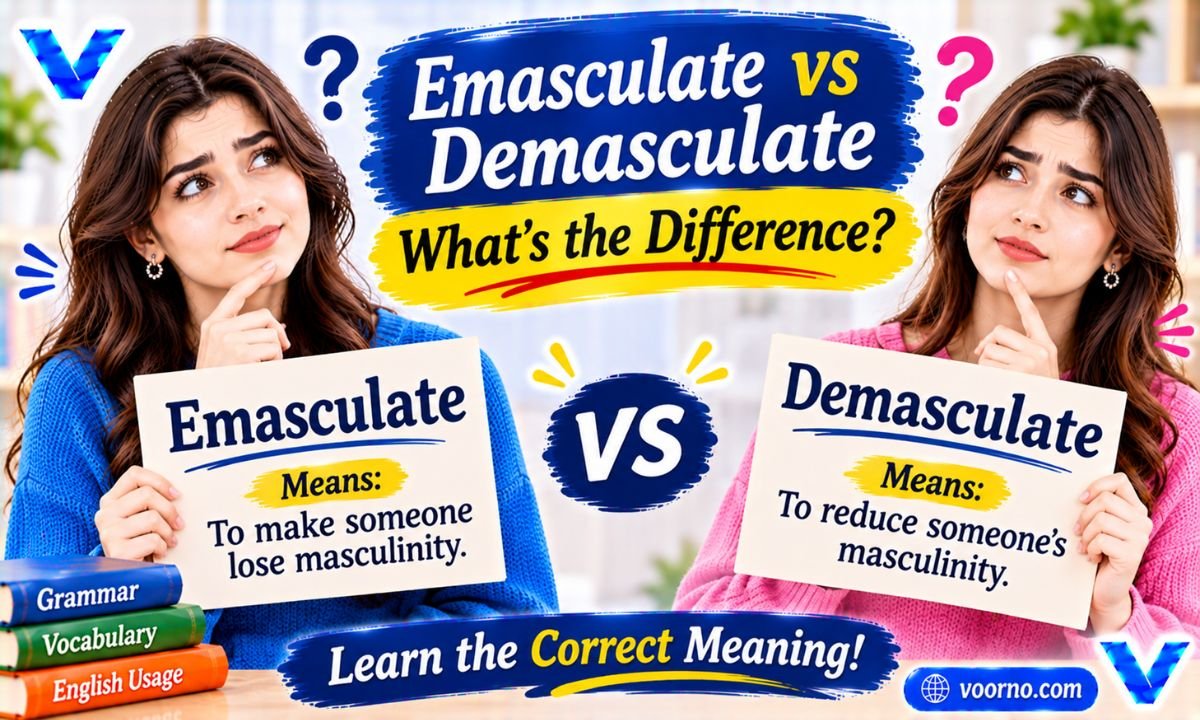
If you’ve ever paused mid-sentence wondering whether to write “emasculate” or “demasculate,” you’re not alone. These two words look almost identical, sound similar when spoken quickly, and both seem to relate to taking away masculinity. But only one of them actually exists in standard English.
This guide breaks down the real meaning of “emasculate,” explains why “demasculate” trips people up, and gives you clear examples so you never second-guess the spelling again.
Emasculate vs Demasculate Meaning
In short:
- Emasculate is a real, dictionary-recognized verb meaning to deprive someone or something of strength, power, or masculine identity — and, in a literal biological sense, to castrate.
- Demasculate is not a standard English word. It doesn’t appear in Merriam-Webster, Oxford, or any major dictionary. It’s a natural-sounding but incorrect variation that people invent because of how other “de-” words work.
So if you’re choosing between the two for an essay, article, or everyday conversation, “emasculate” is always the correct choice.
Read More: Hisself vs Himself: Difference, Correct Usage & Examples
Why the Words “Emasculate” and “Demasculate” Create Confusion
English is full of words where the prefix “de-” reverses or removes something:
- Deactivate (turn off)
- Demote (lower in rank)
- Deconstruct (take apart)
- Dehumidify (remove moisture)
- Detox (remove toxins)
Because “de-” so reliably signals “removal” or “reversal,” it’s easy to assume the opposite of “masculine” should logically be “demasculate.” The problem is that “emasculate” was never built on the word “masculine” plus “de-.” It has its own separate Latin origin, which is where the “e-” actually comes from.
Emasculate vs Demasculate Examples
| Sentence | Correct? | Why |
| “The new policy emasculated the union’s bargaining power.” | ✅ Correct | Standard usage meaning “weakened” |
| “The new policy demasculated the union’s bargaining power.” | ❌ Incorrect | “Demasculate” isn’t a real word |
| “He felt emasculated after being passed over for the promotion.” | ✅ Correct | Common figurative use |
| “He felt demasculated after being passed over for the promotion.” | ❌ Incorrect | Should be “emasculated” |
| “Veterinarians emasculate male livestock during routine procedures.” | ✅ Correct | Literal/technical usage |
The Linguistic Roots of “Emasculate”: A Word with Real History

“Emasculate” comes from the Latin verb emasculare, formed from the prefix e- (meaning “out” or “thoroughly”) plus masculus (“male”). Put together, the word literally means “to remove the male element from.”
The word entered English in the early 1600s and has kept largely the same meaning for over 400 years. Its “e-” prefix links it to other words that carry a sense of “out” or “completely,” such as:
- Evade — to get out of or avoid
- Exit — a way out
- Excavate — to dig out
- Eject — to force out
- Emit — to send out
This is different from words built with “de-,” which typically reverse an action rather than signal removal from within.
Correct Definition of “Emasculate”
According to Merriam-Webster and other major dictionaries, “emasculate” (verb) means:
- To deprive of strength, vigor, or spirit — to weaken.
- To deprive of virility or procreative power — to castrate.
- In botany, to remove the male reproductive parts (stamens) of a flower during cross-pollination.
It can also function as an adjective, meaning “lacking vigor” or “unmanly,” though this usage is far less common today.
Emasculate Synonym
Depending on the context, you can substitute “emasculate” with:
- Weaken
- Undermine
- Debilitate
- Neuter
- Unman
- Enervate
- Demoralize
- Devitalize
Choosing the right synonym depends on whether you mean the literal (castrate, neuter) or figurative (weaken, undermine) sense.
Technical and Scientific Fields Where “Emasculate” Is Common

“Emasculate” isn’t just a dramatic word for arguments or headlines — it has precise technical uses:
- Veterinary medicine and animal husbandry: Referring to the surgical removal of an animal’s testicles.
- Botany and plant breeding: Describing the removal of a flower’s anthers to prevent self-pollination during controlled cross-breeding.
- Legal and political writing: Describing a law, bill, or judicial opinion that has been stripped of its original force (e.g., “the amendment emasculated the original bill”).
- Psychology and sociology: Discussing perceived loss of masculine identity or authority.
Emasculation vs Castration: A Clear Difference
These two terms are often used interchangeably, but they are not identical.
| Term | Definition |
| Castration | The removal of the testicles only |
| Emasculation | The removal of both the penis and the testicles (external genitalia), or, figuratively, the loss of masculine traits like power, confidence, or authority |
Because emasculation involves more extensive removal in its literal medical sense, its potential complications are broader than those of castration alone. In everyday and figurative language, though, most people use “emasculate” to describe a psychological or social loss of masculine identity rather than anything surgical.
The Problem With “Demasculate”: A Word That Doesn’t Exist
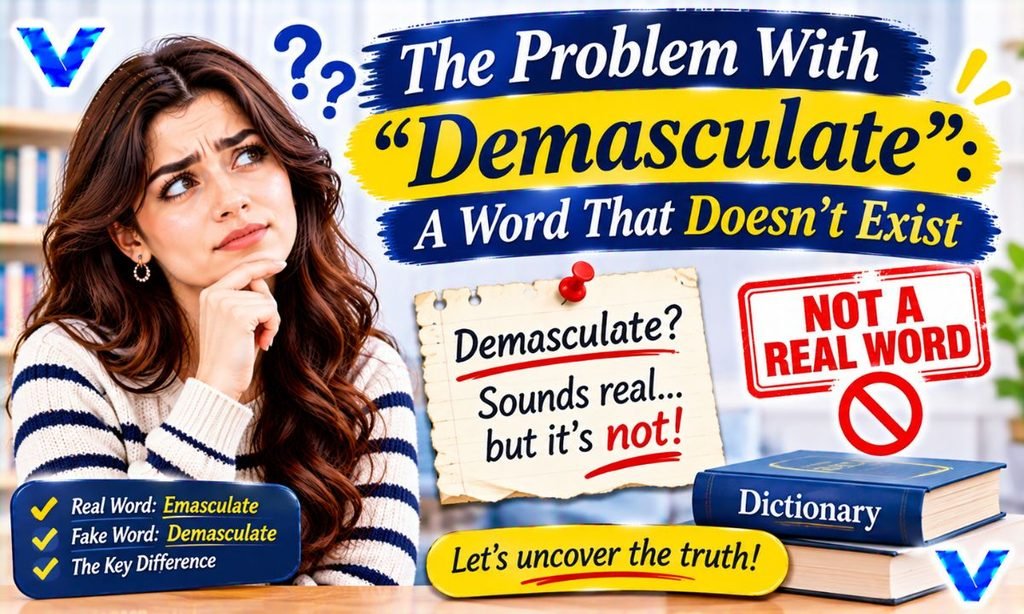
No major dictionary — not Merriam-Webster, not Oxford, not Cambridge — lists “demasculate” as a word. It shows up occasionally in casual writing, forum posts, and even some low-quality online content, but it has no linguistic history, no formal definition, and no accepted usage.
If you search for it, you’ll typically land on pages explaining that it’s a common misspelling of “emasculate” — which is exactly what’s happening here. There’s no such verb form, no accepted noun form, and no dictionary entry to reference.
Bottom line: if you’re tempted to write “demasculate,” replace it with “emasculate” every time.
Demasculate Pronunciation
Since “demasculate” isn’t a real word, there’s no official pronunciation. However, if people do say it aloud, it’s typically pronounced the way it looks: dee-MASS-kyuh-leyt.
For comparison, the correct word “emasculate” is pronounced: ih-MASS-kyuh-leyt.
Notice the difference is really just the first syllable — “ee” vs. “dee” — which is likely why the mix-up happens so often in speech before it ever gets written down.
Cultural Weight: Why “Emasculate” Sparks Emotional Reactions
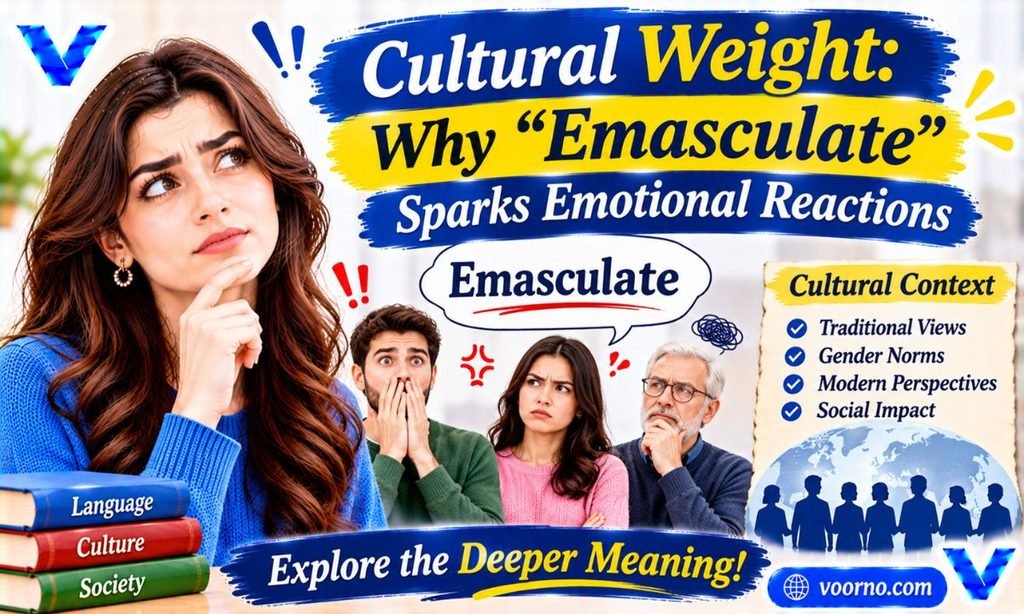
Beyond grammar, “emasculate” carries real cultural and emotional weight. It’s frequently used in conversations about:
- Gender roles and identity
- Workplace dynamics (e.g., a man feeling emasculated by a higher-earning partner)
- Relationships and household dynamics
- Media, film, and literature criticism
Because the word touches on masculinity, self-worth, and social expectations, it tends to generate stronger reactions than a purely neutral synonym like “weaken.” Writers often choose “emasculate” specifically because of this charged connotation.
Common Misuses and How to Avoid Them
The most frequent mistake is simply spelling the word with a “de-” prefix instead of an “e-” prefix. Other common errors include:
- Using “emasculate” when “castrate” is the more precise literal term (and vice versa)
- Overusing the word in casual writing where “weaken” or “undermine” would read more naturally
- Treating “emasculate” as if it only applies to men, when it can technically describe the weakening of laws, institutions, or arguments too
Incorrect Usage Examples
- “The critics said the sequel demasculated the franchise’s tone.”
- “She felt he was trying to demasculate her authority in meetings.”
- “The board’s decision demasculated the CEO’s power.”
Correct Usage Examples
- “The critics said the sequel emasculated the franchise’s tone.”
- “She felt he was trying to emasculate her authority in meetings.”
- “The board’s decision emasculated the CEO’s power.”
Quick Reference Table: Emasculate vs Demasculate
| Feature | Emasculate | Demasculate |
| Real word? | Yes | No |
| Found in dictionaries? | Yes (Merriam-Webster, Oxford, etc.) | No |
| Origin | Latin emasculare (e- + masculus) | Not applicable — informal error |
| Correct usage | Weaken, castrate, strip of masculine power | None — always replace with “emasculate” |
| First recorded use | Early 1600s | N/A |
FAQs
Q:Is the word demasculate or emasculate?
“Emasculate” is the correct English word. “Demasculate” is a common misspelling that doesn’t appear in any standard dictionary.
Q:Is there a female version of emasculation?
Not in formal dictionaries, though “defeminize” or “defeminization” is sometimes used informally to describe a loss of traditionally feminine traits.
Q:What is the opposite of emasculating?
Words like “empower,” “strengthen,” or “embolden” work as opposites, since they describe adding rather than removing strength or confidence.
Q:What are emasculating behaviors?
These typically include public criticism, controlling finances, mocking a partner’s abilities, or undermining someone’s authority or independence.
Q:What are some examples of emasculation?
Examples include a law being stripped of its enforcement power, a man feeling belittled after job loss, or the literal veterinary castration of livestock.
Conclusion
The choice between “emasculate” and “demasculate” isn’t really a choice at all — only “emasculate” exists as a legitimate English word, rooted in Latin and used consistently since the 1600s across literature, law, science, and everyday speech. “Demasculate” is simply a misspelling that happens because of how common “de-” prefixed words are in English.
The next time you’re writing about weakened authority, stripped confidence, or literal castration in a biological or veterinary context, reach for “emasculate.” It’s precise, well-documented, and instantly understood — no guesswork required.










1 thought on “Emasculate vs Demasculate: What’s the Difference?”