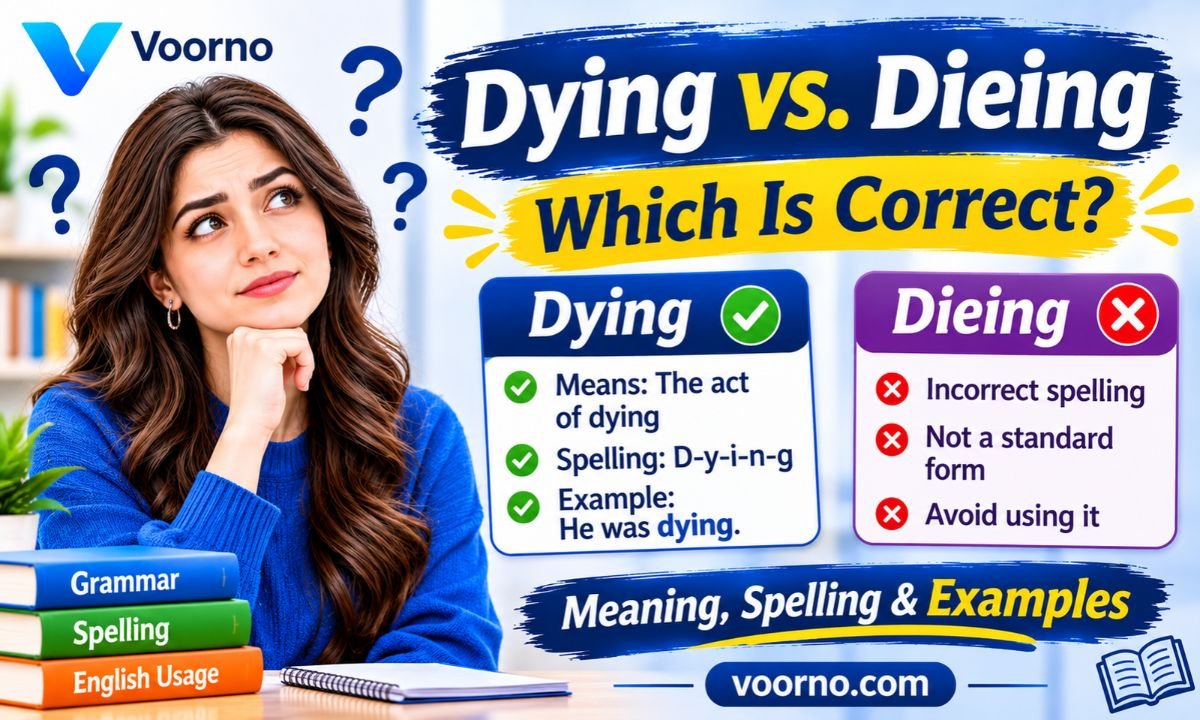
Dying is the correct spelling for anything to do with death or fading away. Dieing is almost always a misspelling.You type “my phone is dieing” and your spell checker underlines it in red. You retype it as “dying,” and the line disappears. But why does “die” lose its e and change ie to y? And is there a third spelling, dyeing, that you should worry about?This guide answers all of that, with examples, a comparison table, and a test you can use any time you’re unsure.
Dieing vs. Dying: The Core Difference
Both words look like they come from the verb die. Only one of them does.
- Dying is the present participle (the -ing form) of the verb die. It means to stop living or to fade away.
- Dieing is not the -ing form of die in everyday English. It shows up as an error, or in a rare technical sense (covered below).
If you’re writing about death, decline, or something losing power, use dying.
- ✅ The plant is dying because it gets no sunlight.
- ❌ The plant is dieing because it gets no sunlight.
Read More:Currently vs Currently: What’s the Difference? Meaning, Usage & Examples
Is Dieing Ever a Real Word?
Sometimes, but you will almost never need it.
In manufacturing, a die is a tool that cuts, stamps, or shapes material such as metal, paper, or leather. Someone who shapes a part with a die could technically be “dieing” it. Even in that trade, the standard terms are die-cutting, die-casting, and die-stamping. Sources also disagree on whether “dieing” is a legitimate word at all.
For everyday and professional writing, treat dieing as a spelling mistake.
Read More:Interested In or Interested On: Which Is Correct?
What Dying Actually Means
Dying has several uses, and it works as both a verb form and an adjective.
1. As a verb (present participle): an action in progress.
- Bees are dying in large numbers in some regions.
2. As an adjective: describing something close to the end.
- Her dying wish was to see the ocean once more.
3. As a noun (gerund): the act itself.
- Dying is a part of life, though few people like to discuss it.
4. In figurative speech: eagerness or fading.
- I’m dying to hear how the interview went.
- The town’s once-busy market is a dying business.
Notice that “dying” doesn’t always involve death. It can also describe a strong desire or something on its way out.
The Grammar Rule That Explains Everything

The -ie to -y Rule
English has a simple spelling rule for verbs that end in -ie. Before adding -ing, change the ie to y.
| Base Verb | Add -ing (Correct) | Wrong Spelling |
| die | dying | dieing |
| lie | lying | lieing |
| tie | tying | tieing |
| vie | vying | vieing |
Why the change? Without it, you’d get an awkward vowel pile-up: i-e-i-n-g. Swapping ie for y keeps the word readable and easy to say.
Memory trick: Two “i” sounds in a row look strange. English avoids that by turning the first pair into a y.
Parts of Speech Explained Simply
Here is how each word behaves in a sentence.
- Die (verb): to stop living. Old batteries die quickly.
- Dying (present participle, adjective, or gerund): The fire is dying. / a dying art.
- Died (past tense): The tree died last winter.
- Dies (third-person singular): The signal dies near the tunnel.
- Dieing (rare technical form): shaping material with a die.
Here is the full conjugation of die at a glance:
- Base form: die
- Third-person singular: dies
- Past tense and past participle: died
- Present participle: dying
Pronunciation Comparison
Here is where the confusion really starts. Dying and dyeing are homophones. They sound identical: /ˈdaɪ.ɪŋ/.
- Dying = DY-ing
- Dyeing = DY-ing (same sound)
- Dieing = would sound the same, which is why people guess at the spelling
Because you can’t hear the difference, spelling is the only way to tell them apart. That’s why the mistake is so common, even among native speakers.
Dieing or Dying Hair
This one trips up a lot of people, and neither of those spellings is right.
If you’re changing your hair color, the word is dyeing.
- ✅ She is dyeing her hair auburn this weekend.
- ❌ She is dying her hair auburn.
- ❌ She is dieing her hair auburn.
Dye (to color something) keeps its e when you add -ing. This is done on purpose, so that dyeing doesn’t look identical to dying.
The same applies to clothes, fabric, and food coloring. We’ll come back to this below.
Correct Usage: Dying in Real Sentences
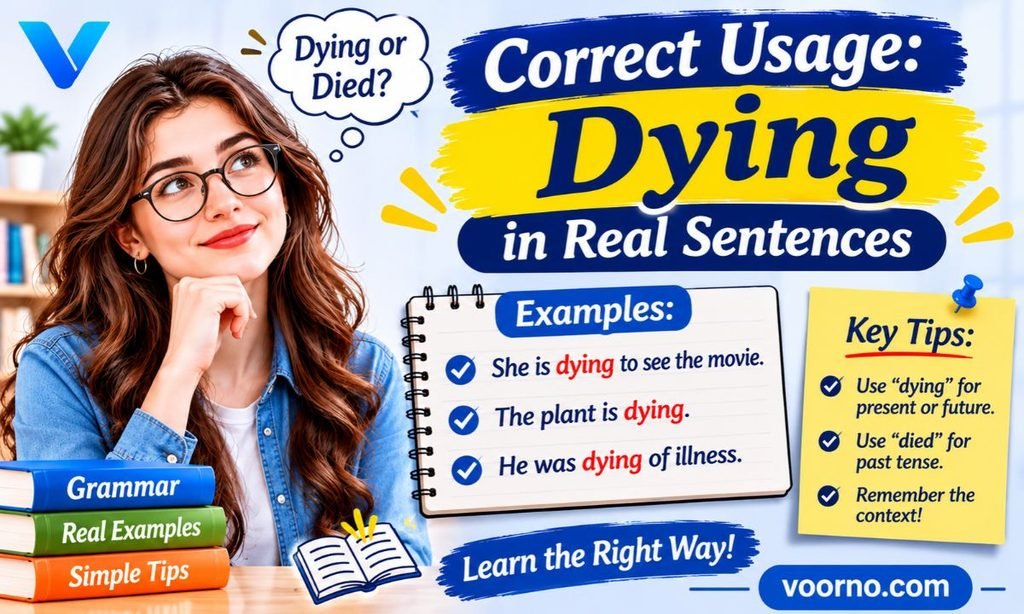
Here are clear examples of dying used correctly:
- The old oak tree is dying from root rot.
- He visited his dying grandfather every weekend.
- My phone is dying, so I need a charger.
- Local newspapers are a dying industry in many towns.
- I’m dying to try that new restaurant.
- The dying light of the sunset painted the sky orange.
- Without water, the crops began dying.
Rare but Correct Usage: Dieing in Sentences
Only use dieing if you’re writing about the metalworking or manufacturing process, and even then, check whether your industry prefers “die-cutting” or “die-stamping.”
- The workshop specializes in dieing thin brass sheets into decorative shapes.
- Older manuals sometimes mention dieing as part of the stamping process.
Most editors will still flag it, so unless you have a specific reason, skip it.
Side-by-Side Comparison Table
| Word | Base Verb | Meaning | Correct? | Example |
| Dying | die | Ceasing to live; fading; eager | ✅ Yes | The flowers are dying. |
| Dyeing | dye | Coloring with dye | ✅ Yes | I’m dyeing my scarf blue. |
| Dieing | die (tool) | Shaping with a die (rare) | ⚠️ Rare/technical | The shop is dieing metal plates. |
Quick rule:
- Talking about death, fading, or eagerness? → dying
- Talking about color? → dyeing
- Talking about a machine tool? → die-cutting (skip “dieing”)
How to Spell Dying as in Death
The safest way to spell dying is to break it into steps:
- Start with the base verb: die
- Drop the ie
- Replace it with y
- Add -ing
die → dy → dying
That’s it. Every time you write about death, decline, or fading, this sequence gives you the right spelling.
Common Mistakes Writers Make
Here are the errors that show up most often:
- Writing “dieing” out of habit. People see die and just add -ing. It feels logical, but it breaks the -ie rule.
- Mixing up dying and dyeing. Since they sound identical, writers pick the wrong one, especially in beauty and fashion content.
- Trusting only their ear. Homophones can’t be solved by sound.
- Ignoring the red squiggle. Spell checkers usually catch dieing, but they often miss dying used where dyeing was meant, because both are real words.
- Over-correcting. Some writers add an e to dying (writing “dyeing” for death) after learning that dye keeps its e.
Dying vs. Dieing Reddit
Language forums and Reddit threads on this topic tend to land in the same place. Users regularly ask whether “dieing” is ever acceptable, and the consensus is a firm no for anything related to death. Many commenters point out that the confusion comes from thinking -ing is simply attached to the end of the base verb.
A few other common questions from community discussions:
- Why does “die” change but “dye” doesn’t?
- Is “dieing” a British spelling? (No. It isn’t correct in any major English variety.)
- Can you say “dying to know”? (Yes, it’s a standard idiom.)
The takeaway is that even native speakers stumble on this, so there’s no shame in double-checking.
A Quick Test That Always Works
When you’re stuck, run this three-second check:
Ask: “Is this about color?”
- Yes → use dyeing
- No → go to the next question
Ask: “Is this about death, fading, or strong desire?”
- Yes → use dying
- No → you probably don’t need either word
Bonus check: If you typed dieing, replace it with dying unless you’re writing about tool-and-die work.
Why This Mistake Hurts Credibility
A single spelling error won’t ruin your career. But it can quietly weaken trust, especially in these situations:
- Blog posts and articles: Readers may doubt your expertise if basic spelling slips through.
- Resumes and cover letters: Hiring managers notice small errors.
- Business emails: Typos can make a message look rushed.
- Academic work: Errors can cost marks.
- SEO content: Misspellings can hurt readability and search performance.
Correct spelling signals care and professionalism. It’s a small detail that makes your writing feel polished.
Dieing or Dying Clothes
Here is the rule again for fabric and fashion. If you’re changing the color of clothes, the correct word is dyeing.
- ✅ We spent the afternoon dyeing old T-shirts with natural pigments.
- ❌ We spent the afternoon dying old T-shirts.
- ❌ We spent the afternoon dieing old T-shirts.
The only time “dying” appears near clothes is when something is literally fading or failing:
- His dying jacket zipper finally gave out. (It’s a joke, but “dying” works here as an adjective meaning failing.)
Related Confusing Word Pairs You Should Know
If you found this useful, these pairs cause similar trouble:
| Confusing Pair | Quick Fix |
| Lying / Lieing | Correct is lying (same -ie rule) |
| Tying / Tieing | Correct is tying |
| Dyeing / Dying | Dyeing = color; dying = death |
| Singeing / Singing | Singeing = burning slightly; singing = music |
| Swingeing / Swinging | Swingeing = severe; swinging = moving back and forth |
| Hoeing / Hoing | Hoeing keeps the e (garden tool) |
| Died / Dyed | Died = stopped living; dyed = colored |
Pattern to remember: Verbs ending in -ie change to -y (die, lie, tie). Verbs ending in -ye or -oe usually keep the e (dye, hoe) so they aren’t mistaken for other words.
Final Verdict on Dieing vs. Dying
Here’s the summary:
- ✅ Dying is correct for death, fading, and strong desire.
- ✅ Dyeing is correct for coloring hair, fabric, or food.
- ⚠️ Dieing is a rare technical term that most writers should avoid.
When in doubt, apply the -ie to -y rule, and check whether your sentence is about color. Those two steps solve nearly every case.
FAQs
Q:What is meant by dying?
Dying means in the process of ceasing to live or exist. It can also describe something fading, or a strong wish, as in “I’m dying to know.”
Q:Which is correct, dieing or dying?
Dying is correct. Dieing is a common misspelling, apart from a rare technical use in metalworking.
Q:Is it “dyeing” or “dying” fabric?
It’s dyeing fabric. Dyeing refers to adding color, while dying refers to death or fading.
Q:Is it correct to say “dying to know” or “dieing to know”?
“Dying to know” is correct. It’s an idiom meaning you’re very eager to find something out.
Q:Is it dying or dyeing my hair?
It’s dyeing your hair. Use dyeing whenever you’re talking about changing color.
Conclusion
The difference between dying and dieing comes down to one simple spelling rule: change ie to y before adding -ing. That gives you dying, lying, and tying. Add the color-related dyeing to the mix, and you have three lookalike words with only one correct choice for each meaning.










2 thoughts on “Dying vs. Dieing: Which Is Correct? Meaning, Spelling & Examples”