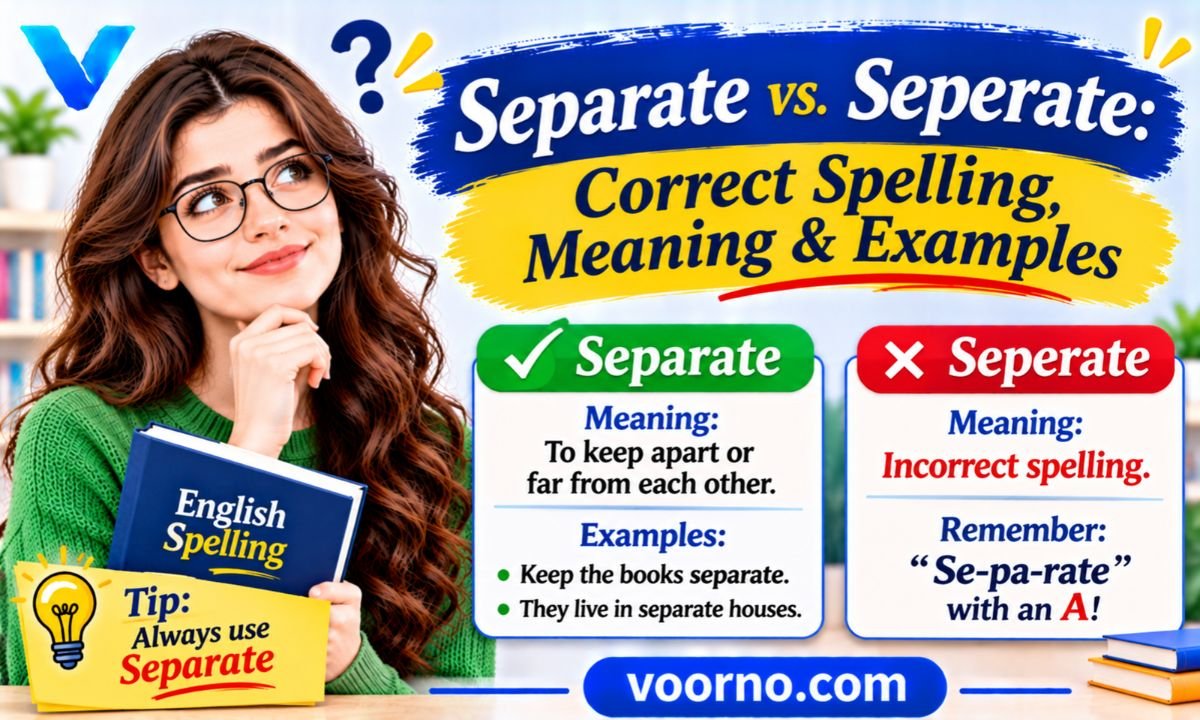
You are typing an email, and your fingers stop halfway through a word. Is it “separate” or “seperate”? The red squiggle appears, and you wonder if you have been spelling it wrong for years.
The short answer: “separate” is the only correct spelling. “Seperate” is a common misspelling. There is no British version, no American version, and no acceptable alternative. This guide explains why the word is so tricky, what it means, how to use it, and how to remember the spelling for good.
Separate vs. Seperate: What’s the Correct Spelling?
The correct spelling is s-e-p-a-r-a-t-e. Notice the letter a right after the p.
| Spelling | Status | Verdict |
| separate | Correct | Use it everywhere |
| seperate | Incorrect | Common spelling error |
The same rule applies to the whole word family: separated, separating, separately, and separation all keep that middle “a.”
Read More:Hastle or Hassle: Which Spelling Is Correct?
Understanding the Core Difference (Separate vs. Seperate)
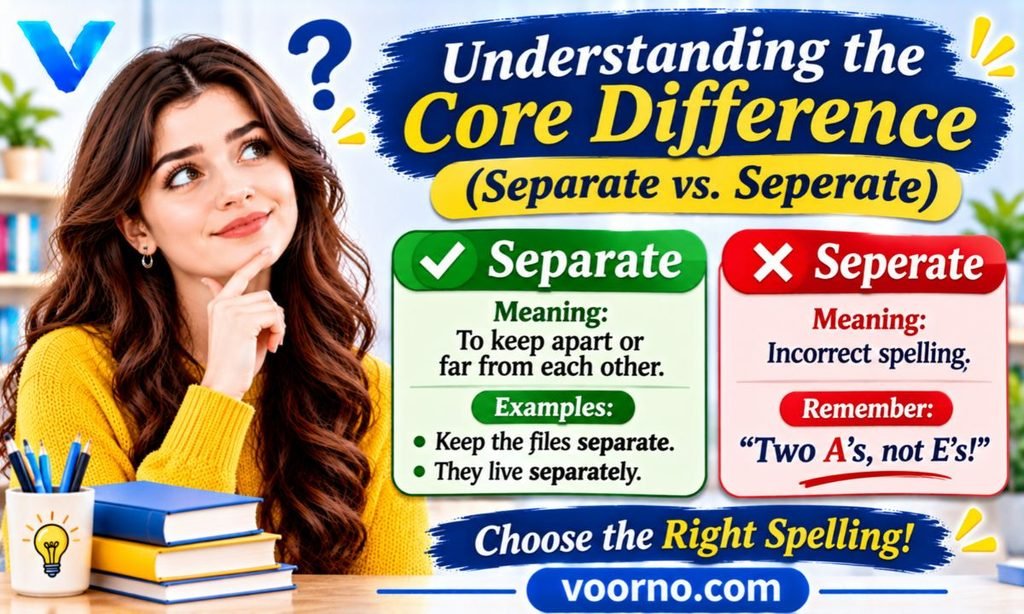
Many writers assume two spellings mean two meanings. Here, they do not. “Seperate” is not a different word. It is simply “separate” with one wrong vowel.
Some people guess it is a regional variation, the way “color” and “colour” differ. That is not the case. Every major dictionary lists only one form, and no English-speaking country treats “seperate” as standard.
Why “Separate” Is Difficult to Spell
This word trips up students, professionals, and even confident writers. There are a few clear reasons.
- The sound hides the letter. In everyday speech, the middle vowel is soft and unstressed, so “sep-uh-rit” can sound like it has an “e” or an “a.”
- The vowels look alike. Two e’s and two a’s sit in a short word, so it is easy to swap them.
- Other words pull you off track. “Desperate” sounds similar and has “per” inside it, which nudges your brain toward the wrong letter.
- Pronunciation varies. Some speakers say it with three syllables, others squeeze it into two.
The word comes from the Latin separare, built from se- (apart) and parare (to prepare or arrange). That “par” in the Latin root is exactly where the correct spelling hides.
Correct Meaning and Uses of “Separate”
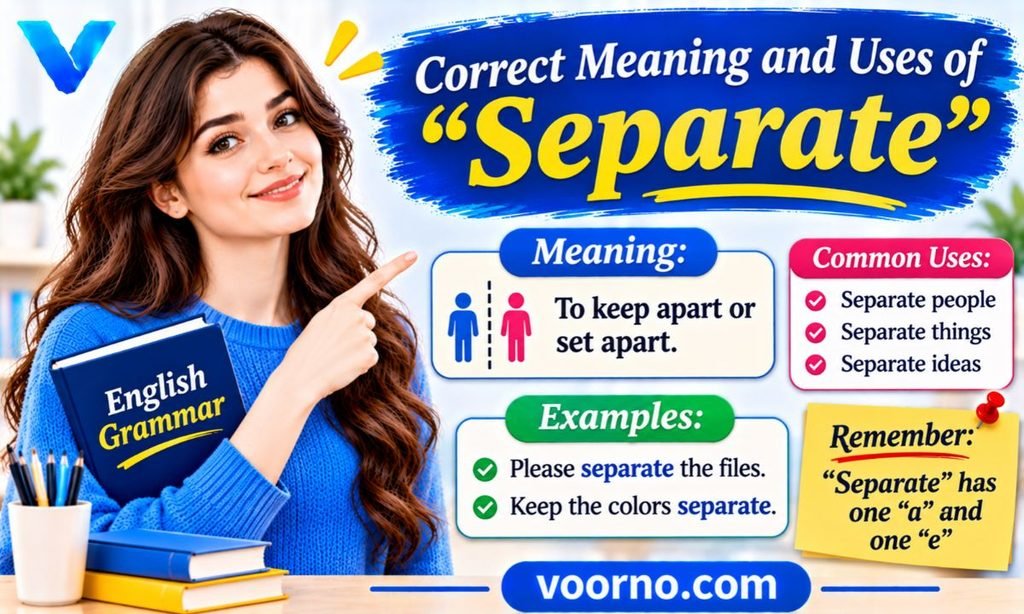
“Separate” works as a verb, an adjective, and, less often, a noun. The core idea never changes: things are apart, distinct, or divided.
“Separate” as a Verb (Correct Use Explained)
As a verb, it means to divide, pull apart, or keep things from touching. It is pronounced with a clear final “-rate” sound.
Common verb forms:
- separate (base form)
- separates (third person singular)
- separated (past tense)
- separating (present participle)
“Separate” as an Adjective
As an adjective, it describes something distinct, individual, or not joined to anything else. The ending sounds softer here, closer to “-rit.”
It is also not comparable in most cases. Something is either separate or it is not, so “more separate” sounds awkward in formal writing.
“Separate” as a Noun
As a noun, “separates” usually refers to clothing items sold individually, such as a skirt or a jacket you can mix and match.
Examples of “Separate” in Sentences (Verb and Adjective)

Verb examples:
- Please separate the recyclables from the regular trash.
- The teacher had to separate the two chatty students.
- A river separates the old town from the new district.
- Let’s separate the eggs before we start baking.
- The couple decided to separate last spring.
Adjective examples:
- Each guest received a separate invoice.
- That is a separate issue, so let’s discuss it later.
- We keep our work and personal phones on separate plans.
- The twins sleep in separate rooms.
- She opened a separate account for her travel savings.
“Seperate” — Why It’s Incorrect
“Seperate” is wrong because it breaks the spelling of the Latin root. The vowel after “p” must be “a,” not “e.”
Here is how the error looks in real writing:
- ❌ We need to seperate these files.
- ✅ We need to separate these files.
- ❌ They live in seperate houses.
- ✅ They live in separate houses.
Spell checkers usually catch it, but not always. In a rushed message, an uncorrected “seperate” can make a polished document look careless.
Separate vs. Seperate in the Oxford Dictionary

Major references agree: Oxford, Merriam-Webster, Collins, and Dictionary.com all list “separate” as the standard form. None of them offers “seperate” as an accepted variant.
They also agree on its history. The word entered English in the 15th century, via Latin separatus, which came from separare. Dictionaries commonly note that “seperate” is a frequent misspelling, which is a good sign of how often people get it wrong.
Separation vs. Seperation (Correct vs. Incorrect)
The noun form follows the same rule.
| Correct | Incorrect |
| separation | seperation |
| separately | seperately |
| separated | seperated |
| separating | seperating |
| separator | seperator |
Why “Seperation” Is Incorrect
The noun “separation” is built directly from the verb “separate.” If the verb keeps its “a,” the noun must too. Changing the vowel breaks the connection to the root, and no dictionary supports it.
Examples of “Separation” in Sentences
- The separation of church and state is a core principle in many countries.
- Long separation from family can be hard on soldiers.
- The lab uses a filter for oil and water separation.
- Her separation from the company was friendly.
- There is a clear separation between work hours and personal time.
Separate vs. Seperate: Grammar Notes
The grammar is simple once you know the pattern.
- Verb: “We will separate the paperwork.”
- Adjective: “This is a separate folder.”
- Adverb: “They traveled separately.”
- Noun: “The separation took months.”
Two useful reminders:
- Use “separate from” when you mean apart from something: “Keep raw meat separate from vegetables.”
- Use “separate into” when you divide a group: “Separate the class into four teams.”
Pronunciation Guide for Separate and Separation
The verb and the adjective sound different. This is one reason the spelling feels slippery.
| Word | Part of speech | Approximate sound |
| separate | verb | SEP-uh-rayt |
| separate | adjective | SEP-uh-rit or SEP-rit |
| separately | adverb | SEP-uh-rit-lee |
| separation | noun | sep-uh-RAY-shun |
If you say the verb slowly, “rayt” gives you a clue that an “a” is nearby. For the adjective, do not trust your ear. Trust the spelling rule instead.
Memory Tools to Avoid Spelling Errors
Pick the trick that sticks best for you.
- “There’s a rat in separate.” Look for the letters “a-r-a-t-e” in the middle: separate. Picture a small rat hiding in the word.
- Two A’s, split by an R. The two “a” letters are kept apart by the letter “r.” That fits the meaning perfectly.
- “Par” is in “apart.” The word “apart” contains “par,” and so does “separate.” Things that are apart are separate.
- Not desperate. “Desperate” has “per” inside it. “Separate” has “par.” Keep them in different mental boxes.
- Say it out loud, wrongly, on purpose. Pronounce it “sep-ah-rate” while you write it. Many learners find this locks in the “a.”
- Write it five times. Plain repetition still works.
Separate vs. Seperate: More Examples
Here are everyday sentences, each shown with the right and wrong version.
| Wrong | Right |
| I need a seperate room. | I need a separate room. |
| They seperated last year. | They separated last year. |
| Please pay seperately. | Please pay separately. |
| The seperation was painful. | The separation was painful. |
| Keep the files seperate. | Keep the files separate. |
Common Phrases Using “Separate” and “Separation”
These expressions appear often in speech, news, and business writing.
With “separate”:
- separate ways (“They went their separate ways.”)
- separate entity
- separate bedrooms
- separate checks or bills
- separate but equal
- separate the wheat from the chaff
- separate the facts from the fiction
- a separate matter
With “separation”:
- separation anxiety
- legal separation
- separation of powers
- separation of duties
- separation of church and state
- separation agreement
- degrees of separation
- trial separation
Related words, all spelled with “a”: separately, separated, separating, separator, separatist, separable, inseparable, separateness.
Separate vs. Seperate on Reddit and Online Forums
Spelling threads on Reddit and other forums tend to repeat the same points. People ask whether “seperate” is a British spelling, and the answer is always no. Others share personal tricks, with the “rat” memory aid being among the most popular. Many users also admit that it is the word they misspell most often, which shows you are far from alone.
The takeaway from these discussions is practical: you do not need to feel embarrassed. Learn one trick, and use a spell checker as a safety net.
Quick Reference Table
| Question | Answer |
| Correct spelling | separate |
| Common misspelling | seperate |
| Noun form | separation |
| Adverb form | separately |
| Past tense | separated |
| Verb pronunciation | SEP-uh-rayt |
| Adjective pronunciation | SEP-uh-rit |
| Origin | Latin separare |
| Regional variant? | None |
| Best memory trick | “A rat” in sep-arat-e |
Separate vs. Seperate Quiz
Test yourself. Pick the correct spelling in each sentence.
- We should keep the sauces (separate / seperate).
- Their (separation / seperation) was announced on Monday.
- Please send the documents (separately / seperately).
- The kids were (separated / seperated) at the airport.
- That is a (separate / seperate) problem.
- The (separator / seperator) cleans the cream from the milk.
- She felt (inseparable / inseperable) from her best friend.
- Can you (separate / seperate) the laundry by color?
Answer key: All eight answers use the “a” spelling: separate, separation, separately, separated, separate, separator, inseparable, separate.
FAQs
Does “separate” have two meanings?
It has several related meanings across parts of speech. As a verb it means to divide or move apart, and as an adjective it means distinct or not joined.
Why is it separate and not seperate?
Because the word comes from the Latin separare, which has an “a” after the “p.” English kept that vowel in the spelling.
How do you spell “separate” in Canada?
The same way as everywhere else: s-e-p-a-r-a-t-e. Canadian, British, American, and Australian English all agree.
Is there a word “seperate”?
No. It is only a misspelling of “separate” and does not appear as a valid entry in standard dictionaries.
When to use seperate and separate?
Always use “separate.” There is no situation where “seperate” is correct.
Conclusion
The debate is short: separate is correct, and seperate is not. The same goes for separation, separately, and separated. Keep the “a” after the “p” and the problem disappears.
Use the “rat in separate” trick, remember that “par” lives in “apart,” and double-check the word when you are writing fast. A small spelling habit like this makes your emails, essays, and reports look sharper and more professional.
Bookmark this guide, share it with a friend who keeps typing “seperate,” and you will never second-guess this word again.










1 thought on “Separate vs. Seperate: Correct Spelling, Meaning & Examples”