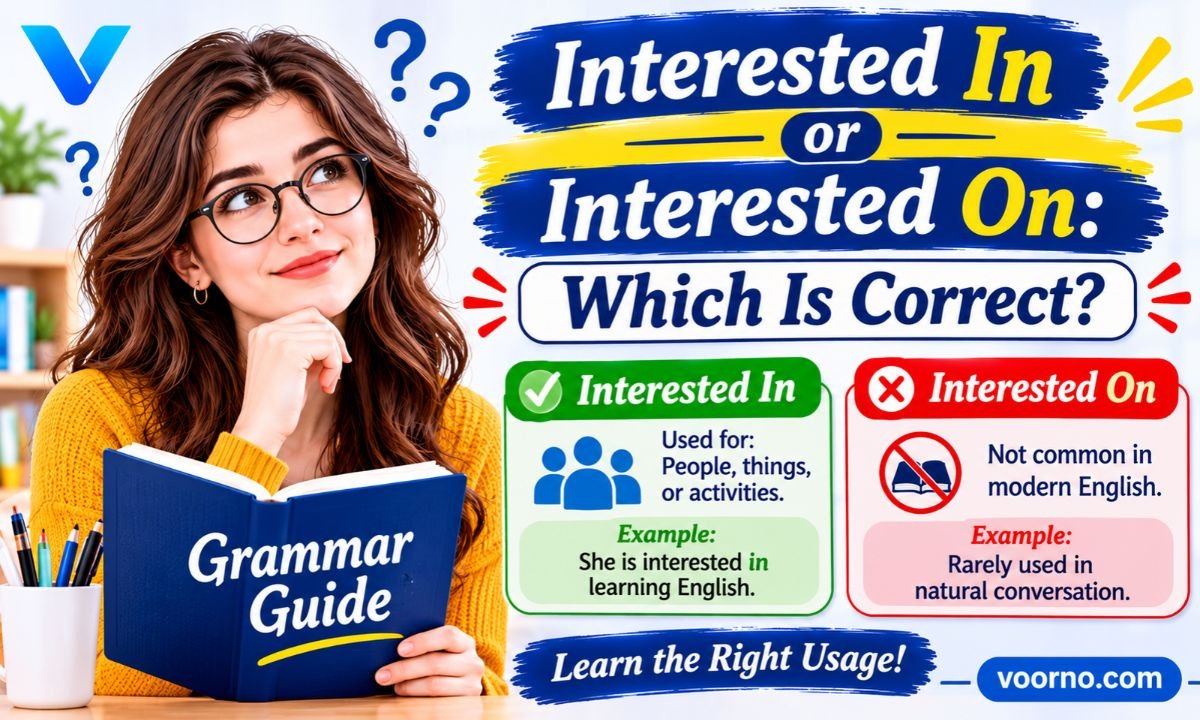
You are writing an email, a CV, or a quick text. You type “I’m interested…” and stop. Is the next word in or on?
It’s a small question, but prepositions trip up native speakers and learners alike. This guide gives you the answer, the reason behind it, and simple ways to remember it.
The Quick Answer: Interested In or Interested On?
“Interested in” is correct. “Interested on” is not standard English.
- ✅ I am interested in photography.
- ❌ I am interested on photography.
Use in whenever you mean that something catches your attention, curiosity, or enthusiasm. This holds in both British and American English.
Read More:Dying vs. Dieing: Which Is Correct? Meaning, Spelling & Examples
Correct vs Incorrect Usage
| Incorrect | Correct |
| She is interested on music. | She is interested in music. |
| I’m interested on this job. | I’m interested in this job. |
| They are interested on buying a house. | They are interested in buying a house. |
| Are you interested on me? | Are you interested in me? |
What Does “Interested In” Mean?
“Interested in” describes a state of curiosity or attention toward a person, topic, activity, or opportunity. It answers the question, “What grabs your attention?”
The word interested is an adjective. Adjectives like this often need a fixed preposition to link them to the thing they describe. For interested, that link is in.
Situations Where “Interested In” Is Used
- Hobbies and passions: She is interested in painting.
- School and career: He is interested in a career in law.
- Business and shopping: We are interested in your services.
- Personal or romantic attention: Is he interested in her?
- Job applications: I am interested in the marketing role.
Examples of “Interested In” in Real Sentences
- My brother is interested in astronomy.
- Are you interested in joining our book club?
- The company is interested in hiring two designers.
- I was never interested in football.
- Thank you for your email. I’m very interested in the offer.
Read More:Is It Gluing or Glueing? Correct Spelling and Usage
Why “Interested On” Is Grammatically Incorrect
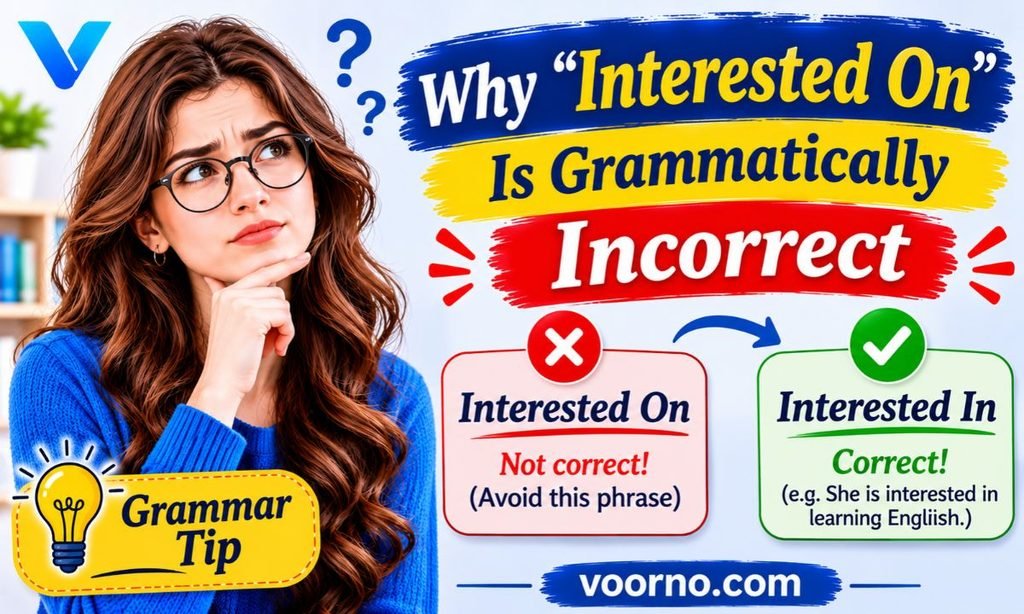
English does not use on after the adjective interested. There is no grammar rule that explains it, and that’s the point: this is a collocation, meaning a pair of words that native speakers habitually use together. “Interested in” sounds natural. “Interested on” sounds off, even if the meaning is guessable.
Many learners make this mistake because of their first language. In some languages the equivalent adjective takes a preposition that translates to “on” or “about,” so the pattern gets carried over into English.
The one place “on” does appear
The word interest used as a noun about money can take on:
- The bank pays 4% interest on savings.
- You’ll owe interest on the loan.
That’s a different word use entirely. When you mean “curious about” or “keen on,” it’s always interested in.
How Prepositions Work with the Word “Interested”
A preposition shows the relationship between two ideas. With interested, the relationship is that your attention is “inside” a subject, almost like being absorbed in it. That mental image can help you remember in.
Common Preposition Combinations
| Phrase | Meaning | Example |
| interested in | curious about / attracted to | I’m interested in history. |
| interested to + verb | curious to learn or see | I’d be interested to hear your view. |
| interested by | attracted because of a cause | She was interested by his talk. (less common) |
| interest in (noun) | a feeling of curiosity | He has a strong interest in art. |
| interest on (noun) | money charged or earned | Interest on the loan is high. |
Interested In vs Interested To
Both are correct, but they work differently.
- Interested in is followed by a noun or a gerund (a verb ending in -ing).
- Interested to is followed by the base form of a verb, usually a verb of perception like see, hear, know, or learn.
Comparison Table
| Feature | Interested in | Interested to |
| Followed by | Noun or -ing verb | Base verb (to + verb) |
| Common use | Ongoing interest or goal | Reaction to news or information |
| Example | I’m interested in learning Spanish. | I’m interested to learn what happened. |
| Typical verbs | buying, joining, studying | see, hear, know, find out |
A quick test: Say “I’m interested to buy a car” and it sounds wrong. Say “I’m interested in buying a car” and it sounds right. Use to only with verbs like see and hear.
Grammar Rule Behind “Interested In”
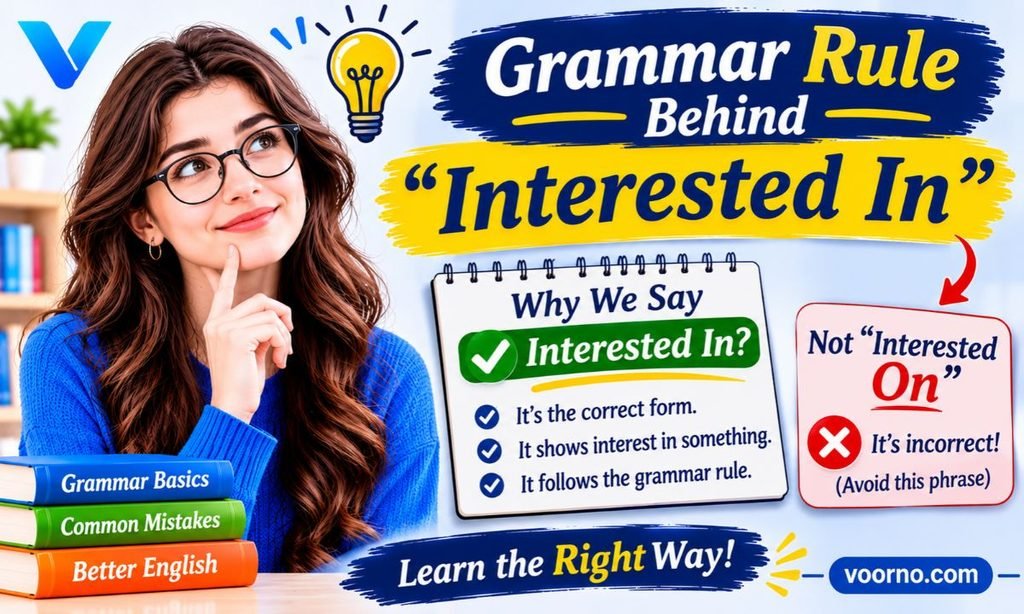
The rule is simple:
Interested + in + noun or gerund
Because in is a preposition, whatever follows must be a noun, a pronoun, or a verb in the -ing form. It can never be a bare infinitive (“to buy”).
Examples with Gerunds
- She is interested in learning to code.
- We’re interested in opening a second branch.
- Are you interested in taking a short course?
- He’s interested in becoming a pilot.
Wrong pattern: I’m interested to learning. Right pattern: I’m interested in learning.
Common Mistakes People Make
- Using “on” instead of “in.” “Interested on sports” should be “interested in sports.”
- Using “about.” “Interested about art” is also incorrect. Say “interested in art.”
- Mixing “to” with -ing. “Interested to learning” should be “interested in learning.”
- Leaving out the preposition. “I’m interested that course” needs in.
- Confusing the noun “interest on.” Money interest takes on. Personal interest takes in.
- Mixing “interested” and “interesting.” Interested describes how a person feels. Interesting describes what causes the feeling. “I find this book interesting. I’m interested in it.”
Easy Tips to Remember the Correct Preposition
- The “into” trick: If you’re into something, you’re interested in it. Both contain in.
- The “absorbed” image: Picture your attention sitting inside a topic.
- Chunk it: Memorize “interested in” as a single unit, not two separate words.
- Read aloud: If it sounds awkward, check the collocation.
- Swap test: Try “keen on” or “curious about.” If you can’t decide, interested in is always safe.
Real-Life Examples in Conversations
At work
- “Are you interested in leading the project?”
- “Yes, I’m very interested in it.”
On a first day at university
- “What are you interested in studying?”
- “I’m interested in marine biology.”
In a customer email
- “We’re interested in a bulk order. Could you share pricing?”
Between friends
- “Are you interested in seeing a movie tonight?”
- “Maybe. I’m more interested in getting dinner.”
Interested in or Interested on: Mini Practice Quiz
Choose the correct option.
- She is interested ___ jazz music. (in / on)
- I’m interested ___ hear your opinion. (in / to)
- Are you interested ___ joining us? (in / on)
- They’re interested ___ a career in medicine. (in / on)
- He was interested ___ see the final results. (in / to)
Answers: 1. in · 2. to · 3. in · 4. in · 5. to
Interested in or Interested on: Examples of Correct Sentences
- I’m interested in the vacancy you posted.
- The students are interested in robotics.
- She seemed interested in my story.
- Which topics are you most interested in?
- We’d be interested in a partnership.
Notice that in can also end a sentence, as in “Which topics are you most interested in?” This is natural in everyday English.
Case Study: Why Collocations Matter in English
Consider two job applicants writing to the same recruiter.
- Applicant A writes: “I am interested on the sales position.”
- Applicant B writes: “I am interested in the sales position.”
Both meanings are clear. But the first sentence signals a small language slip. In a competitive hiring process, small slips can shape a reader’s first impression, especially in written English.
This shows why collocations matter. Native speakers don’t consciously check grammar rules. They rely on familiar word pairings. Learning those pairings, such as interested in, good at, afraid of, and depend on, makes your English sound fluent and trustworthy.
What Language References Say
Major learner dictionaries consistently list in as the preposition that follows interested when it means “curious about.” ESL teachers also tend to describe interested in as a fixed pattern to memorize rather than a rule to reason out. And usage guides note that interested to is acceptable mainly with verbs like see, know, and hear.
Interested in or Interested on: Exercises
Exercise 1: Fill in the blank
- I’ve always been interested ___ languages.
- Is your sister interested ___ dancing?
- We were interested ___ learn how it ended.
Exercise 2: Correct the mistake
- He is interested on politics.
- I’m interested about your proposal.
- She’s interested to studying law.
Answers
- Exercise 1: 1. in · 2. in · 3. to
- Exercise 2: 1. He is interested in politics. 2. I’m interested in your proposal. 3. She’s interested in studying law.
FAQs
Q:Which preposition is used with interested?
The standard preposition is in, as in “interested in art.” To is used only before verbs like see or hear.
Q:Can you use “interested in” in a sentence?
Yes. For example: “I’m interested in learning photography.”
Q:Are you interested in me or on me?
The correct form is “interested in me.” “Interested on me” is incorrect.
Q:Which is correct: “interested in” or “interested on”?
“Interested in” is correct. “Interested on” is not used in standard English.
Q:Is “interested on” ever correct?
No, not when you mean curiosity. Only the noun interest takes on when it refers to money, as in “interest on a loan.”
Conclusion
The rule is easy to remember: always use “in” after “interested.” Save “on” for financial interest, and use “to” only before verbs like see, hear, and know.To lock it in, think of the “into” trick, read your sentences aloud, and treat interested in as one unit. With a little practice, the right choice will come without thinking.










2 thoughts on “Interested In or Interested On: Which Is Correct?”