You type a quick reply, hit send, and then notice it: “ofcourse.” Did you just make a spelling mistake, or is that a real word?
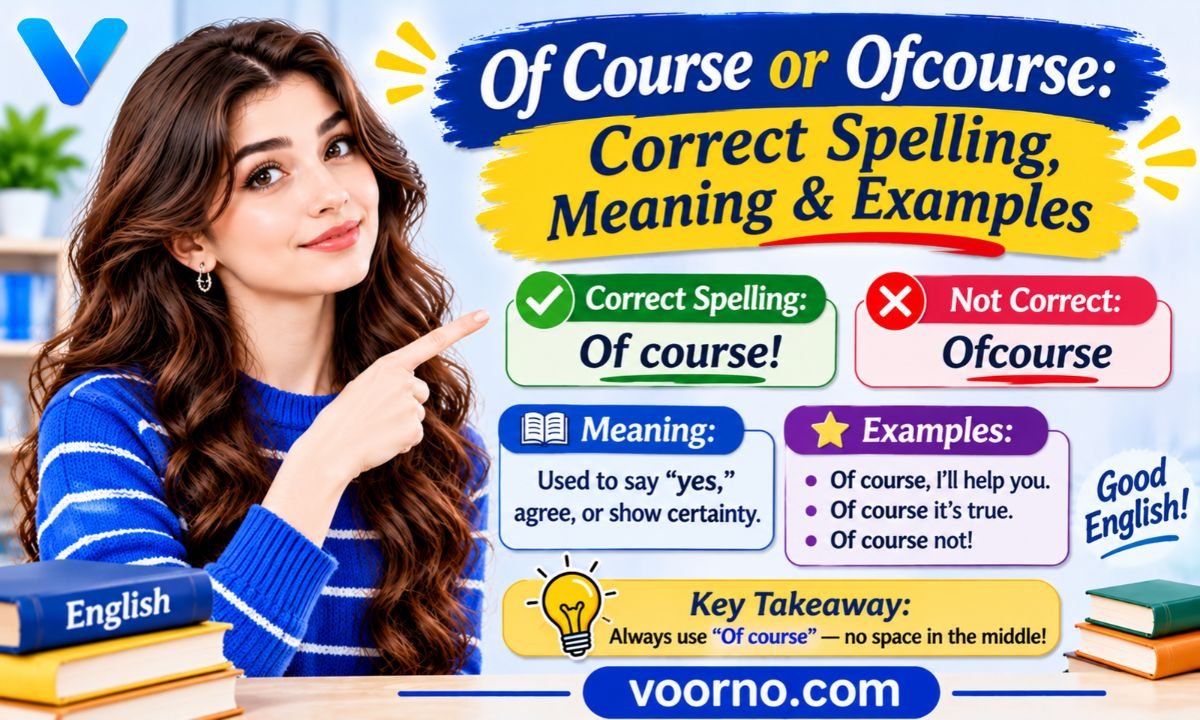
The short answer: “of course” is correct, and it is always two words. “Ofcourse” is a common misspelling that dictionaries do not recognize. This guide explains the meaning, the grammar, the reasons people slip up, and easy ways to get it right every time.
Of Course or Ofcourse: What Writers Should Know
Here is the quick version, in case you are in a hurry:
- Correct: of course (two words)
- Incorrect: ofcourse (one word)
- Part of speech: adverbial phrase
- Basic meaning: certainly, naturally, as expected
- Works in: formal and informal writing, with some care
That is the whole rule. The rest of this article shows you why it matters and how to use the phrase with confidence.
Read More:“Hi There” Meaning, Usage & Examples
Of Course or Ofcourse Meaning
“Of course” is an idiomatic expression. It tells the reader that something is obvious, expected, or accepted without question.
It has three main jobs:
- To agree. “Can you help me move on Saturday?” “Of course.”
- To show something is obvious. “Of course the shops are closed. It’s a public holiday.”
- To admit a point while adding another. “Of course, he’s new, but he learns fast.”
Add “not” and you get “of course not,” an emphatic way to say no. Dictionaries list it as a separate idiom for exactly that reason.
The phrase comes from the noun course, which traces back through Old French cours to the Latin cursus, meaning “a running.” Language historians connect “of course” to the older idea of things happening “in the normal course of events.” In other words, something that follows the natural path is, well, of course.
Why People Get Confused About “Of Course”
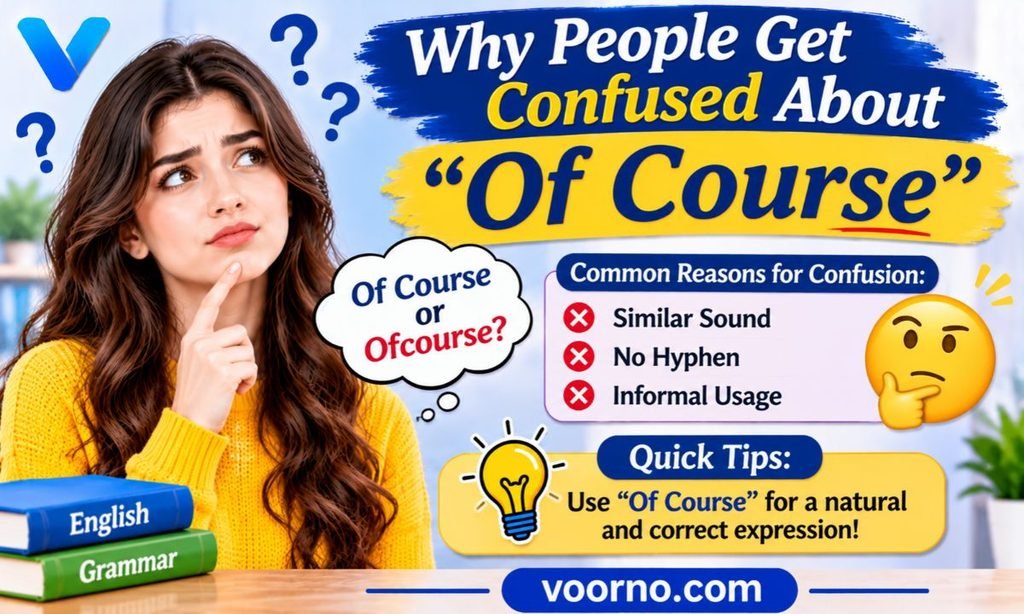
Spoken English is the main culprit. When you say the phrase aloud, the two words blend together. You hear “uv-course,” and there is no audible gap. Your brain records one word, and your fingers type it that way.
Other reasons add to the confusion:
- Fast typing. Texts, chats and social media posts reward speed, not accuracy.
- Similar compounds. English has real one-word terms like “ofttimes” or “whereof,” so a fused form can feel plausible.
- Non-native learners. Many languages write the equivalent phrase as a single word, so the habit carries over.
- Look-alike words. “Off course” and “of coarse” appear all the time, which blurs the picture further.
Autocorrect Influence
Autocorrect helps and hurts. Many phones fix “ofcourse” automatically, but some do not. Others quietly change “of course” into something odd, like “of coarse” or “off course,” because the software guesses the wrong context.
After a few unnoticed corrections, the wrong form starts to look normal. Always reread before you send anything important.
Of Course or Ofcourse Grammar

Grammatically, “of course” is made of a preposition (of) and a noun (course). Together they work as an adverbial phrase, which means they modify a verb, an adjective, or a whole sentence.
Because it is a phrase and not a single word, it cannot be fused. The same logic applies to “a lot,” “in fact” and “at least.” You would never write “alot” in formal work, and “ofcourse” deserves the same treatment.
The Correct Spelling: “Of Course”
Every major dictionary lists it as two words. There is no regional exception. British, American, Canadian and Australian English all agree.
Punctuation tips:
- At the start of a sentence, a comma usually follows: “Of course, we can reschedule.”
- In the middle, commas are optional but common: “We can, of course, reschedule.”
- As a one-word reply, use a period or exclamation mark: “Of course!”
When the Phrase Works Best
Use “of course” when you want to:
- Confirm a request quickly and warmly
- Point out a fact your reader already expects
- Acknowledge a counterpoint before making your own
- Sound friendly in customer service replies
Be careful with tone, though. Said the wrong way, “of course” can sound impatient, as if the question was silly. In email, pair it with a friendly follow-up to avoid that impression.
The Incorrect Spelling: “Ofcourse”
“Ofcourse” is not in standard dictionaries. Spellcheck tools flag it, teachers mark it down, and editors correct it. In a job application, a blog post or a business email, it can quietly hurt your credibility.
It appears constantly in text messages, forum comments and quick chats. That is common, but common does not make it correct.
Commonly Confused Variations of “Of Course”
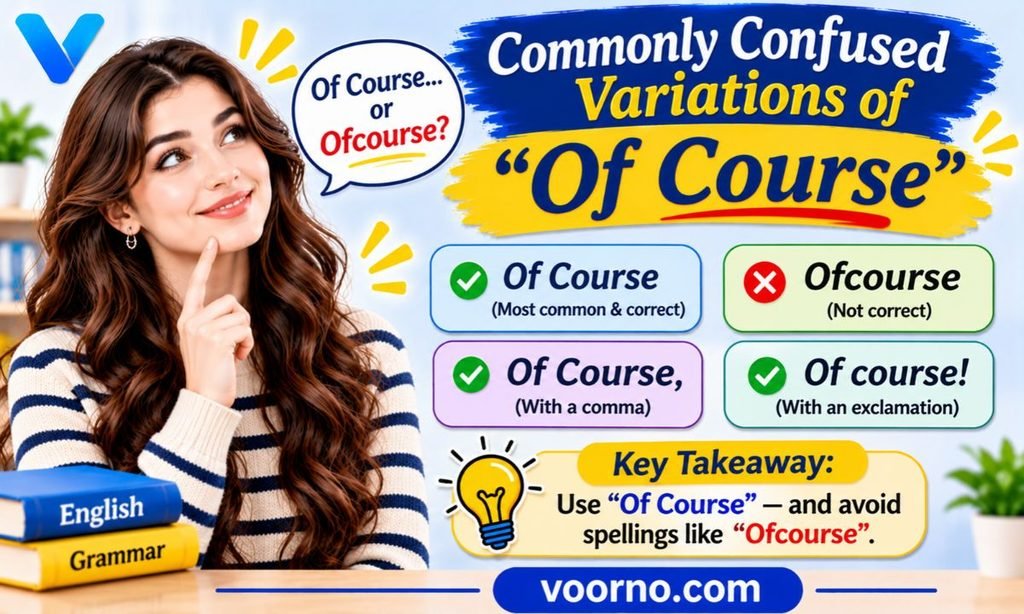
The fused spelling is not the only trap. Watch for these:
- Off course: means away from the planned path. “The ship drifted off course.”
- Of coarse: never correct. Coarse means rough in texture.
- Per course / ofcorse: spelling errors with no valid use.
- Of curse: a typo that changes the meaning completely.
- Of course not: correct, and means “absolutely not.”
- But of course: correct, and adds extra emphasis.
Side-by-Side Comparison Table
| Form | Correct? | Meaning | Example |
| of course | Yes | certainly, naturally | “Of course I’ll come.” |
| ofcourse | No | none (misspelling) | |
| off course | Yes, different meaning | away from the intended path | “The drone flew off course.” |
| of coarse | No | none (wrong word) | |
| of course not | Yes | definitely not | “Of course not. I’d never do that.” |
| but of course | Yes | emphatic agreement | “Coffee? But of course.” |
How to Remember the Correct Spelling
A few small tricks make the rule stick:
- Say it slowly. Pause between “of” and “course.” The gap shows you two words.
- Think of a golf course. A course is a real, separate noun. It does not need to attach itself to anything.
- Compare it to “of all” and “of late.” Nobody writes “ofall” or “oflate.”
- Replace it with “certainly.” If “certainly” fits, you are using the phrase correctly, and it takes a space.
- Read your message aloud before sending. Your eyes catch what your fingers missed.
Of Course or Ofcourse Examples

Seeing the phrase in context is the fastest way to learn it.
Correct examples:
- “Of course, I’ll send the report by noon.”
- “Do you mind if I open the window?” “Of course not.”
- “You will, of course, need a valid ID.”
- “Of course she won. She trained harder than anyone.”
- “Thanks for covering my shift!” “Of course!”
Incorrect examples (do not write these):
“Ofcourse I’ll send the report.”“He knows, ofcourse.”“Ofcourse not!”
Synonyms and Alternatives to “Of Course”
Sometimes you want a different word, either to avoid repetition or to match the tone. Good alternatives include:
- Certainly
- Absolutely
- Definitely
- Naturally
- Obviously
- Sure
- Without a doubt
- By all means
- Indeed
- Undoubtedly
- Needless to say
- With pleasure
Context Table for Synonyms
| Alternative | Best for | Tone | Example |
| Certainly | Business emails | Formal | “Certainly, I can arrange that.” |
| Absolutely | Strong agreement | Warm, confident | “Absolutely, count me in.” |
| Naturally | Stating the expected | Neutral | “Naturally, prices will vary.” |
| Obviously | Clear facts | Direct (can sound blunt) | “Obviously, we need a backup.” |
| Sure | Casual chat | Informal | “Sure, no problem.” |
| By all means | Giving permission | Polite, slightly formal | “By all means, take a seat.” |
| With pleasure | Customer service | Courteous | “With pleasure. One moment, please.” |
| Needless to say | Writing and speeches | Formal | “Needless to say, safety comes first.” |
Is Ofcourse a Word
No. “Ofcourse” is not a word in standard English. You will not find it in Merriam-Webster, Cambridge, Oxford or Collins as an entry. It is simply a spelling error caused by blending two words.
In very casual texting, people use it all the time, and nobody is likely to misunderstand you. But in anything professional, academic or published, stick with “of course.”
Examples of “Of Course” in Real Sentences
Here are everyday examples grouped by setting.
At work:
- “Of course, I can join the call at 3 p.m.”
- “We’ll, of course, share the draft before Friday.”
In customer service:
- “Of course. Let me check that order for you.”
- “Of course, we’re happy to issue a refund.”
In daily conversation:
- “Are you coming tonight?” “Of course!”
- “Did you remember the tickets?” “Of course I did.”
In academic or formal writing:
- “The results, of course, require further testing.”
- “Of course, this study has limitations.”
Quick Reference Summary Table
| Question | Answer |
| Correct spelling | of course |
| Number of words | Two |
| Part of speech | Adverbial phrase |
| Is “ofcourse” valid? | No |
| Common confusion | off course, of coarse |
| Formal-friendly alternative | certainly |
| Casual alternative | sure |
| Negative form | of course not |
FAQs
Is “of course” grammatically correct?
Yes. It is a standard adverbial phrase made of a preposition and a noun, and it is correct in both formal and informal English.
Where to use ofcourse?
Nowhere in standard writing. “Ofcourse” is a misspelling, so use “of course” in every context, including texts and social media.
What is another word for “of course”?
Common alternatives are certainly, absolutely, definitely, naturally, obviously and sure. Pick the one that matches your tone.
How do you say “of course” in a professional way?
Try “certainly,” “absolutely,” “with pleasure,” or “by all means.” These sound polished in emails and meetings.
Is it ofcourse or of course?
It is “of course,” written as two separate words. The one-word form is always wrong.
Conclusion
The rule is simple: write “of course” as two words, every time. “Ofcourse” may look harmless, but it is a spelling error that can weaken an otherwise strong message.Remember the pause between the words, watch out for “off course” and “of coarse,” and reread before you hit send.
If you want variety, swap in “certainly,” “absolutely” or “by all means.”Get this one small phrase right, and your writing instantly looks sharper and more trustworthy. Of course, that is exactly what you want.










1 thought on “Of Course or Ofcourse: Correct Spelling, Meaning & Examples”