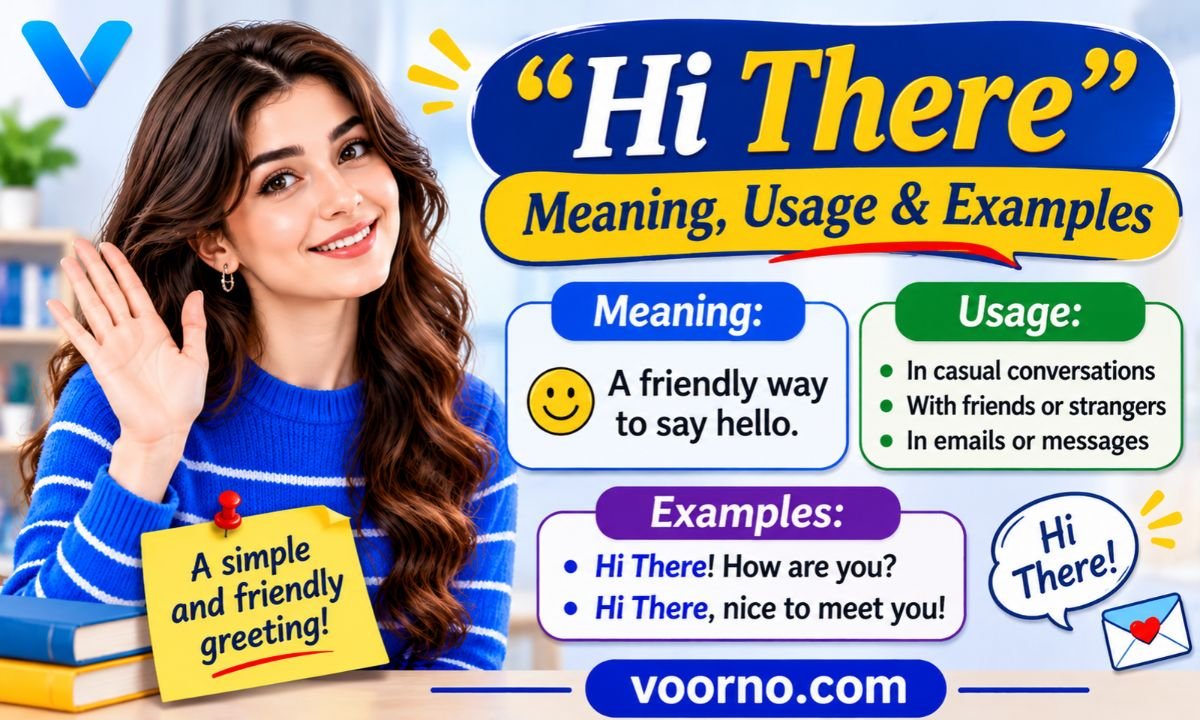
“Hi there” is an informal greeting that means “hello.” The word “there” makes it sound softer and more welcoming than a plain “hi,” which is why it works so well with strangers, customers, and new contacts.
It is a tiny phrase, yet people overthink it. Is it too casual for work? Does it sound flirty? Is “there” even necessary? This guide clears up each doubt with plain explanations, tables, and examples you can copy.
Why “Hi There” Causes So Much Confusion
The phrase sits in the gap between formal and casual English. It is warmer than “hello,” but less personal than using someone’s name. That in-between position creates three common worries:
- Is “there” a place? No, nobody is pointing at a spot.
- Is the tone safe? It depends on delivery, which is hard to judge in text.
- Is it professional? Sometimes yes, sometimes no, depending on the setting.
Here is where it sits among common greetings:
| Greeting | Tone | Typical feel |
| Greetings | Formal | Distant, official |
| Hello | Neutral | Polite, safe |
| Hi | Friendly | Quick, relaxed |
| Hi there | Warm, approachable | Welcoming, conversational |
| Hey | Casual | Easygoing, familiar |
The Real History Behind “Hi There”

“Hi” began as a call for attention in the 1400s and is a close relative of “hey.” As a greeting, it shows up in American English in the 1800s, and it spread through everyday speech in the early 1900s. A 1922 etiquette guide still called it a greeting for people who already know each other, even while noting that young people used it freely.
“Hello” followed its own path. It grew into a standard greeting in the late 1800s, helped along by the telephone. Thomas Edison pushed for it, while Alexander Graham Bell preferred “ahoy.”
The “there” part has no proven origin. One reasonable theory links it to calls like “ahoy there,” where “there” directs your voice toward someone nearby. Over time the word lost that pointing job and became a friendly marker.
Read More:Separate vs. Seperate: Correct Spelling, Meaning & Examples
“Hi There” Meaning
“Hi there” is a casual way to say hello and acknowledge another person. You can use it face to face, on the phone, in a chat window, or at the top of an email.
What “There” Really Adds to “Hi”
The word looks empty, but it does real work:
- It softens the greeting. “Hi.” can sound clipped. “Hi there” sounds relaxed.
- It lets you greet without a name. That is handy with strangers or large groups.
- It says “I see you.” It acknowledges the other person’s presence.
- It invites a reply. The rhythm feels like the start of a chat, not a closed statement.
What “Hi There” Signals Emotionally
Most listeners hear friendliness, openness, and low pressure. You come across as approachable. Use this scale as a rough guide:
| Greeting | Emotional warmth |
| Greetings | Low |
| Hello | Moderate |
| Hi | Moderate |
| Hi there | High |
| Hey buddy | Very high (and very familiar) |
Read More:Of Course or Ofcourse: Correct Spelling, Meaning & Examples
“Hi There” in a Sentence
The phrase normally opens the sentence, followed by a comma or exclamation mark.
- “Hi there, can I help you find something?”
- “Hi there! I’m Maya, the new designer on the team.”
- “Hi there, thanks for getting in touch.”
- “Hi there, Daniel! It has been ages.”
- She leaned over the fence and said, “Hi there.”
How People Use “Hi There” Across Cultures

The words are English, but comfort with them shifts by region and setting.
- United States and Canada: Very common in shops, support chats, and emails. Seen as friendly.
- United Kingdom and Ireland: Understood as polite and informal. Formal settings may still prefer “Good morning.”
- Australia and New Zealand: Fits the relaxed communication style.
- South Asia: Widely used in emails and online chats, and usually seen as friendly and modern. In first contact with a senior person, many writers still choose “Dear Sir” or “Hello.”
Formal European Cultures
In some business environments, such as parts of Germany, France, and Switzerland, written greetings can follow stricter rules. A first email may open with a title and surname. “Hi there” can feel a little too relaxed there, especially with senior contacts or in conservative industries. Switch to “Dear Mr. Weber” or “Good morning” and you will be safe.
Does Age Change How “Hi There” Feels?
A little. The word choice is the same, but the reaction varies.
| Age group | How it usually lands |
| Teens and young adults | Natural and friendly, often swapped with “hey” |
| Working adults | Standard and comfortable at work and online |
| Older adults | Pleasant, though some prefer “hello” or “good morning” |
When You SHOULD Use “Hi There”
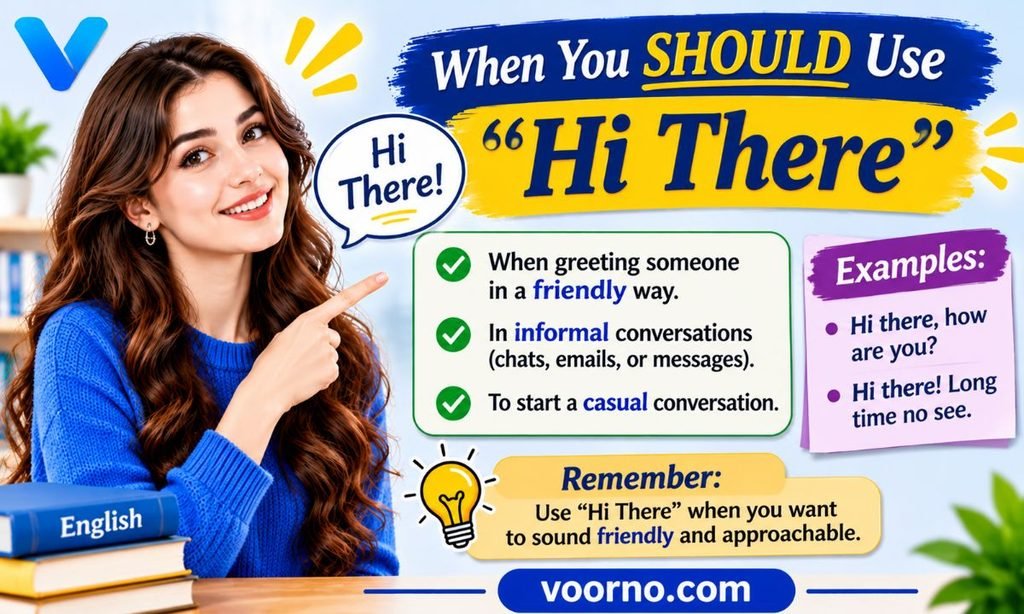
Reach for it when you want warmth without stiffness:
- Greeting a customer or visitor
- Opening a friendly or semi-formal email
- Starting a chat on a website or app
- Writing to a group or community
- Introducing yourself at an event
- Replying to a social media message
It works especially well when you don’t know the person’s name yet.
“Hi There” Pronunciation
- Phonetic: /haɪ ðɛr/ (US) or /haɪ ðeə/ (UK)
- Sounds like: “HIGH THAIR”
Give both words light stress and let your voice lift a little on “there.” A flat, falling voice makes it sound bored.
When You Should NOT Use “Hi There”

Skip it when the moment calls for formality or care.
- Formal letters and legal documents. Use “Dear Ms. Khan.”
- Job applications to traditional firms. “Dear Hiring Manager” is safer.
- Sensitive or sad news. It can feel too breezy.
- When you know the name. “Hi Sara” feels more personal than a generic “there.”
- Official government or court correspondence. Stay formal.
Is “Hi There” Professional or Casual?
It sits between the two. Think of it as casual-friendly but acceptable in most modern workplaces.
| Situation | Is “hi there” okay? |
| Chat with a coworker | Yes |
| Customer support reply | Yes |
| Email to a client you know | Yes |
| Cold outreach email | Often fine, but a name is better |
| First email to a senior executive | Use “Hello” or “Dear” |
| Cover letter or job application | No |
Simple rule: if you can use the person’s name, use it. If not, “Hi there” is a reasonable stand-in.
“Hi There” Meaning in Text
In a text or chat, “hi there” usually means “I’m starting a friendly conversation.” It is common when you message a seller, a new contact, or a group admin.
Small details change how it reads:
- “Hi there!” feels upbeat.
- “Hi there.” feels neutral, even a bit serious.
- “hi there…” can suggest hesitation or teasing.
- “Hi there 😊” feels warm and clearly friendly.
Companies also use it in automated messages when they have no first name on file. If a message says “Hi there” followed by a sales pitch, it is probably a template.
Does “Hi There” Sound Flirty, Cold, or Kind?
The words are neutral. Tone and context decide the rest.
| Tone | What gives it away |
| Kind | Smile, warm voice, exclamation mark, follow-up question |
| Flirty | Lingering eye contact, a wink or 😉, personal compliments, “Well, hi there” |
| Cold | Flat voice, very short reply, period at the end, no follow-up |
To avoid any flirty vibe, stay on topic and skip winking emojis.
Real Examples With Meaning
Text Messages
| Message | What it means |
| “Hi there! Is this still available?” | Polite opener to a seller |
| “Hi there, it’s Omar from the gym.” | Friendly self-introduction |
| “Hi there 😊 long time!” | Warm reconnection |
Email Openers
- “Hi there, thanks for your interest in our course.” (support or marketing)
- “Hi there, I’m following up on our call.” (light business follow-up)
- “Hi there, quick question about the invoice.” (casual work request)
In-Person Greetings
- A barista: “Hi there! What can I get started for you?”
- A neighbor: “Hi there, lovely weather today.”
- An event host: “Hi there, welcome! Are you here for the workshop?”
“Hi There” Synonym
| Synonym | Formality | Best for |
| Hello there | Slightly higher | Emails, new contacts |
| Hey there | Lower | Friends, social media |
| Hello | Neutral | Almost anywhere |
| Hi everyone | Casual, group | Teams, classes |
| Good morning | Formal | Meetings, customer service |
| Greetings | Very formal | Official notices |
A side note: “Hello there” is a famous movie line for many fans, so it can read as a playful joke.
How to Respond to “Hi There” Naturally
Match the energy you received, then add a short question to keep things moving.
| Setting | Reply |
| Friendly | “Hi! How are you?” or “Hey, good to see you.” |
| Professional | “Hello, thanks for getting in touch.” |
| Customer service | “Hi, how can I help you today?” |
| Playful | “Well, hi there yourself!” |
Avoid ignoring the greeting or answering with something far more formal than what you received.
Better Alternatives to “Hi There”
- “Hi [Name],” is the best choice when you know the name.
- “Hello [Name],” suits professional contacts.
- “Good morning/afternoon,” is polite and time-aware.
- “Dear [Name],” fits formal letters.
- “Hi team,” works for colleagues you collaborate with.
- “Hope you’re well,” is a warm, low-key opener.
Why “Hi There” Still Works Today
People want messages that feel human but quick. “Hi there” does both. It is short, kind, and flexible, and it fits a stranger, a group, or a person whose name you haven’t learned. That is why shops, schools, and support teams keep choosing it, and why it makes a decent first impression.
Common Myths About “Hi There”
- Myth: “There” replaces a name, so it is rude. Fact: Most people hear it as warm.
- Myth: It is always flirty. Fact: Delivery and context create flirtation, not the words.
- Myth: It is bad grammar. Fact: It is a fixed, widely accepted greeting.
- Myth: It never belongs at work. Fact: It is fine in many workplaces, just not in formal letters.
- Myth: It sounds robotic. Fact: Only when it is copied into every message without personalization.
What Does “Hi There” Really Mean? A Final Answer
“Hi there” means “hello,” said in a friendly, informal, welcoming way. The word “there” softens the greeting and lets you address someone without a name. It suits casual chats, support messages, and relaxed emails, while formal situations call for “Hello” or “Dear.”
FAQs
Is it right to say “hi there”?
Yes. It is a correct, widely used greeting that works best in casual and semi-formal settings.
Is “hi there” flirty?
Not by itself. Only tone, eye contact, or cues like a wink emoji can make it flirty.
What is the reply of “hi there”?
Answer with a similar greeting, such as “Hi! How are you?” or “Hey, what’s up?”
What can you say instead of “hi there”?
Try “hello,” “hey there,” “good morning,” or “Hi [Name],” depending on how formal the situation is.
Is saying “Hey you” rude?
It can be, especially with strangers or in serious settings. Among friends and said with a smile, it is usually playful.
Conclusion
“Hi there” is a simple, friendly greeting that has earned its place in everyday English. It means “hello,” the word “there” adds warmth, and its tone depends on how you say or write it. Use it for casual chats, customer service, and relaxed emails.
Switch to “Hello” or “Dear” when things get formal, and use a real name whenever you have one.Next time you start a message, you will know exactly what your greeting says about you.










2 thoughts on ““Hi There” Meaning, Usage & Examples”