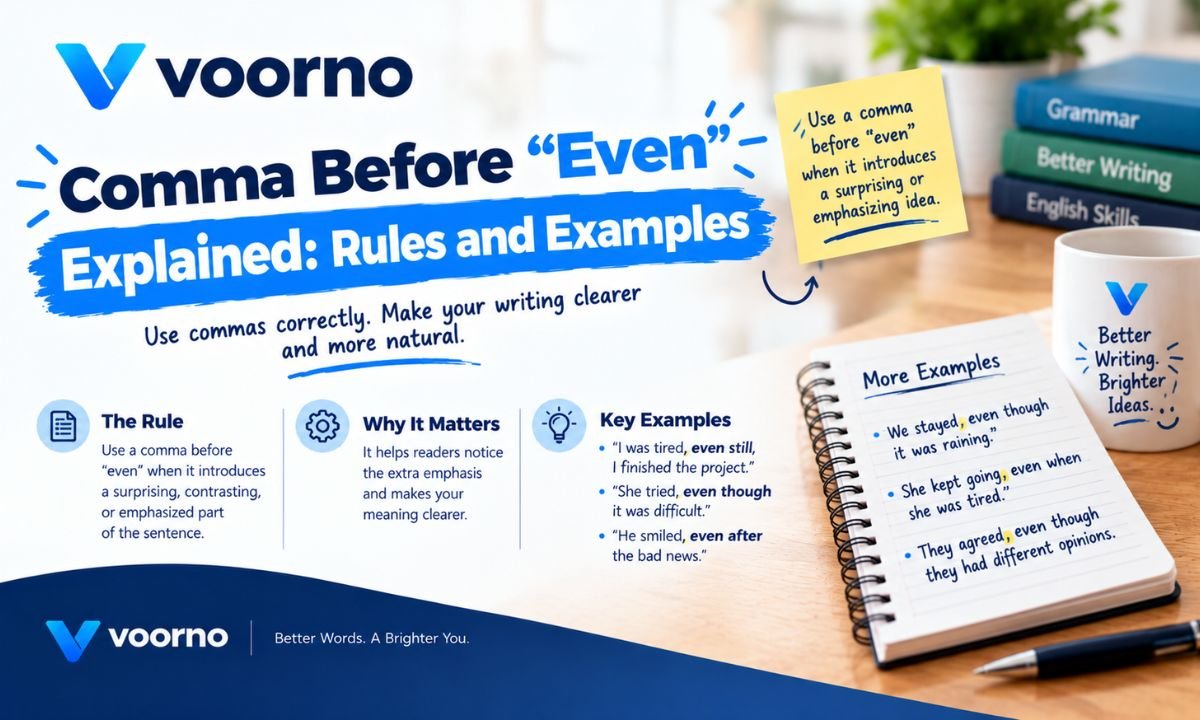
Few punctuation questions trip up writers as quietly as this one: do you need a comma before “even”? It looks like a small word, but it shows up everywhere — in emails, essays, social posts, and business writing — and getting it wrong can make a sentence feel clumsy even when the grammar is technically fine.
The short answer is that “even” usually does not need a comma before it. But there are real exceptions, and knowing them will make your writing cleaner, more confident, and easier to read. This guide breaks down the comma before “even” rule with clear explanations, real examples, a quick-reference table, and a checklist you can use every time you’re unsure.
The Golden Rule About Comma Before “Even”
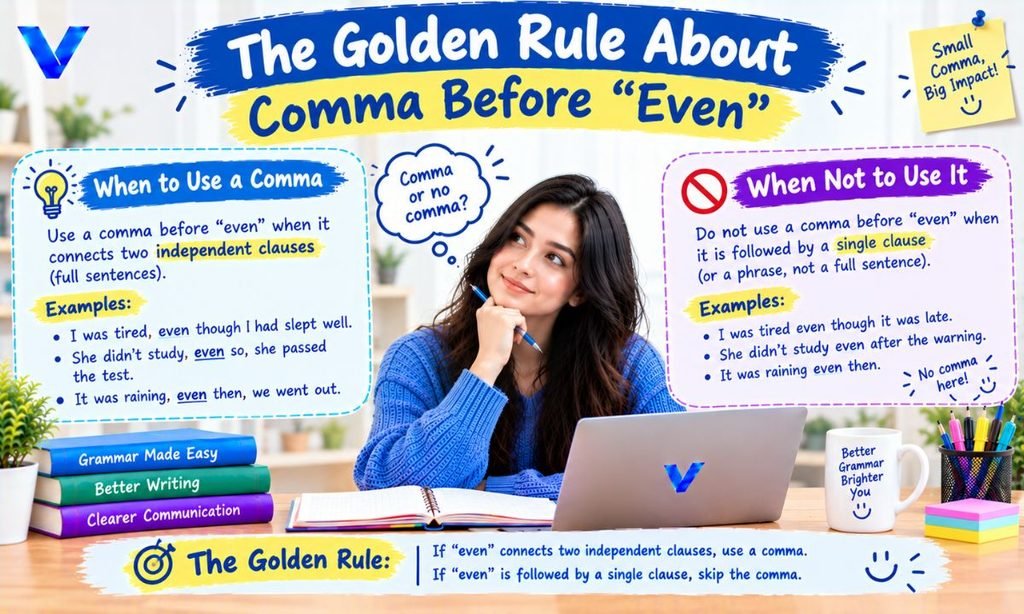
Here’s the rule in one sentence: you only add a comma before “even” when normal comma rules — not “even” itself — call for one.
“Even” doesn’t have a special punctuation rule of its own. It borrows the comma rules that already apply to adverbs, subordinate clauses, and parenthetical phrases. So instead of asking, “Does ‘even’ need a comma?” ask, “What job is ‘even’ doing in this sentence?” The answer to that question tells you whether a comma belongs.
Comma Before “Even” in a Sentence: The Quick Version
- If “even” is simply emphasizing a word or action, skip the comma.
- If “even” starts a subordinate clause like “even though” or “even if” that comes in the middle or end of a sentence, skip the comma in most cases.
- If that same clause comes at the start of a sentence, add a comma after the whole clause.
- If “even” introduces a parenthetical remark or trailing afterthought, a comma often fits.
Keep that framework in mind as we go through each situation in detail.
Read More : “Stick a Fork in It” Meaning: Definition, Origin & Examples
“Even” as an Adverb — The Most Common Use
Most of the time, “even” functions as an adverb that emphasizes the word or phrase right next to it. In this role, it behaves like other intensifiers such as “only,” “just,” or “really” — and none of those need a comma before them either.
Examples (No Comma Needed)
- She even remembered the small details from our first conversation.
- He didn’t even try to apologize.
- The manager approved the request even before the meeting started.
- I was surprised that even the youngest kids understood the instructions.
In every example above, removing the comma keeps the sentence natural. Adding one would break the flow for no grammatical reason.
Why Writers Get Confused
The confusion usually comes from three places:
- Rhythm mimics grammar. When we speak, we sometimes pause slightly before “even” for emphasis. Writers hear that pause and assume it needs a comma, even when the sentence structure doesn’t require one.
- “Even” looks similar to transitional words. Words like “however” and “therefore” almost always take a comma, so writers assume “even” follows the same pattern. It doesn’t.
- Subordinating conjunctions confuse the issue. “Even though” and “even if” do sometimes need commas — just not because of “even” itself, but because of where the clause sits in the sentence.
Understanding these three traps is the fastest way to stop second-guessing yourself.
Read More: Whole Day vs. All Day: Definitions, Examples & Grammar Rules
“Even” in the Middle of a Sentence
When “even” sits mid-sentence and modifies a nearby word, it should stay close to that word with no punctuation separating them.
Correct vs Incorrect
| Incorrect | Correct |
| She, even finished the report early. | She even finished the report early. |
| He didn’t, even notice the mistake. | He didn’t even notice the mistake. |
| The team even, surprised the coach. | The team even surprised the coach. |
Notice how the comma in each “incorrect” example creates an unnatural break. “Even” needs to sit directly beside the word it’s emphasizing for the sentence to read smoothly.
“Even” with Subordinating Conjunctions
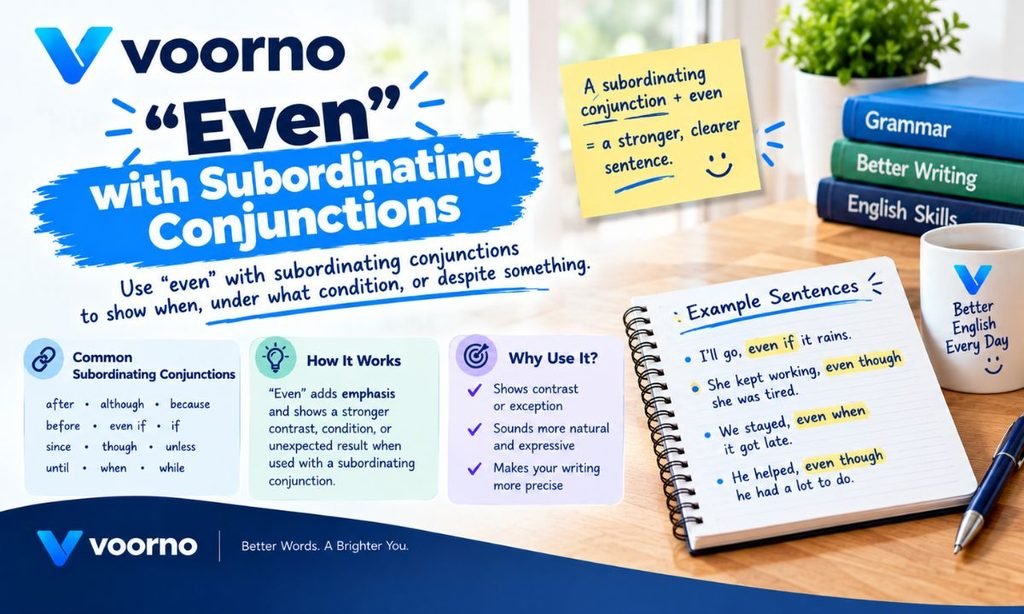
This is where the real exceptions live. “Even though,” “even if,” and “even when” act as subordinating conjunctions — they introduce a dependent clause that adds a condition or contrast to the main sentence.
The comma rule here follows standard clause punctuation, not anything special about “even”
- Dependent clause first → comma after the clause.
- Dependent clause second (after the main clause) → usually no comma.
Examples
- Even though it was raining, we went for a walk. (clause first, comma required)
- We went for a walk even though it was raining. (clause second, no comma)
- Even if you disagree, please hear me out. (clause first, comma required)
- Please hear me out even if you disagree. (clause second, no comma)
- Even when she’s exhausted, she still shows up early. (clause first, comma required)
This mirrors how you’d punctuate “although” or “because” — the position of the clause, not the presence of “even,” decides the comma.
When You Actually Use a Comma Before “Even”
There are a few legitimate situations where a comma does belong directly before “even.” These are the exceptions worth memorizing:
- Parenthetical or afterthought use — when “even” introduces an extra, almost surprising detail tacked onto the end of a sentence.
- Everyone showed up to the cleanup day, even the neighbors who never volunteer.
- Trailing emphasis after a complete thought — when the sentence could technically end before “even” adds one more point.
- The plan worked perfectly, even better than we expected.
- Compound or list-like structures — when “even” appears as the final, most extreme item in a sequence of examples.
- The festival drew tourists from nearby towns, distant cities, and even other countries.
In each case, you could pause naturally — or insert a period — right before “even,” which is a strong sign that a comma fits.
Comma Before “Even” in Lists
When “even” caps off a list to signal the most extreme or surprising example, a comma usually precedes it, much like a comma would precede any final list item that adds emphasis.
Example
- The recipe uses simple ingredients: flour, sugar, eggs, and even leftover coffee for depth of flavor.
- Volunteers came from schools, local businesses, retirement homes, and even out-of-town visitors.
In these sentences, “even” isn’t just modifying a nearby verb — it’s flagging the standout item in a list, and the comma helps that item land with the right emphasis.
“Even” in Comparisons and Emphasis
“Even” is also commonly used before comparative adjectives (“even better,” “even faster,” “even more difficult”) to intensify a comparison. In this use, it almost never takes a comma before it, because it’s directly modifying the comparative word.
Examples
- The second draft was even stronger than the first.
- Traffic was even worse than yesterday.
- This new plan is even more efficient than the old one.
Compare that to the earlier “trailing emphasis” example, where “even better” came after a completed sentence and a comma made sense. The difference is position: mid-sentence and attached to the comparison = no comma; trailing on after a full thought = comma often works.
Grammar vs Rhythm — Finding the Balance
Not every comma decision comes down to a hard rule. Sometimes it’s about how the sentence sounds when read aloud. Professional writers often use a simple test: read the sentence out loud and see if a natural pause occurs before “even.”
Example
- “She even finished early.” — read aloud, this flows in one breath. No comma needed.
- “The proposal impressed everyone, even the harshest critics on the panel.” — here, a natural pause happens before “even,” matching its role as a trailing, parenthetical detail. A comma fits.
When grammar rules feel ambiguous, rhythm can be a useful tiebreaker — but it should support the grammar, not override it.
Common Mistakes Writers Make
Frequent Errors
- Adding a comma before “even” purely out of habit, without checking the sentence structure.
- Treating “even though” and “even if” as always needing a comma, regardless of clause position.
- Isolating “even” with commas on both sides when it’s simply modifying the next word.
- Forgetting the comma when “even” starts a sentence as part of a subordinate clause.
Wrong vs Right
| Wrong | Right |
| Even though he apologized we still felt hurt. | Even though he apologized, we still felt hurt. |
| We still felt hurt, even though he apologized. | We still felt hurt even though he apologized. |
| She, even offered to help clean up. | She even offered to help clean up. |
| The award went to everyone even the substitutes. | The award went to everyone, even the substitutes. |
Quick Decision Checklist
Use this checklist any time you’re unsure whether a comma belongs before “even”:
- Is “even” directly modifying the next word (a verb, adjective, or noun)? → No comma.
- Is “even” part of “even though,” “even if,” or “even when” starting the sentence? → Comma after the clause.
- Is that same clause coming at the end of the sentence instead? → No comma, in most cases.
- Is “even” introducing a surprising afterthought or the final item in a list? → Comma usually works.
- Can you read the sentence aloud with a natural pause right before “even”? → That’s a good sign a comma belongs.
Real-World Examples You Can Use
- Even the most experienced pilots double-check their instruments before takeoff.
- He finished the marathon even after spraining his ankle at mile ten.
- The city looked beautiful, even under the gray winter sky.
- Even if the results disappoint us, we’ll learn something valuable.
- Sales improved across every region, even the ones that struggled last quarter.
Quick Reference Table
| Situation | Comma Before “Even”? | Example |
| “Even” modifies the next word | No | She even called to check in. |
| “Even though/if/when” starts the sentence | Yes (after the clause) | Even though it was late, they kept working. |
| “Even though/if/when” clause comes second | No | They kept working even though it was late. |
| “Even” introduces a trailing afterthought | Yes | The trip was fun, even relaxing. |
| “Even” caps off a list | Yes | We tried pizza, tacos, and even sushi. |
| “Even” before a comparative adjective | No | This version is even faster. |
Final Takeaway on Comma Before “Even”
The comma before “even” isn’t governed by a mysterious rule attached to that one word — it follows the same logic that governs commas everywhere else in English: clause position, parenthetical information, and natural pauses. Once you stop looking for an “even” rule and start looking at sentence structure, the punctuation choice becomes far easier.
Comma Before “But”
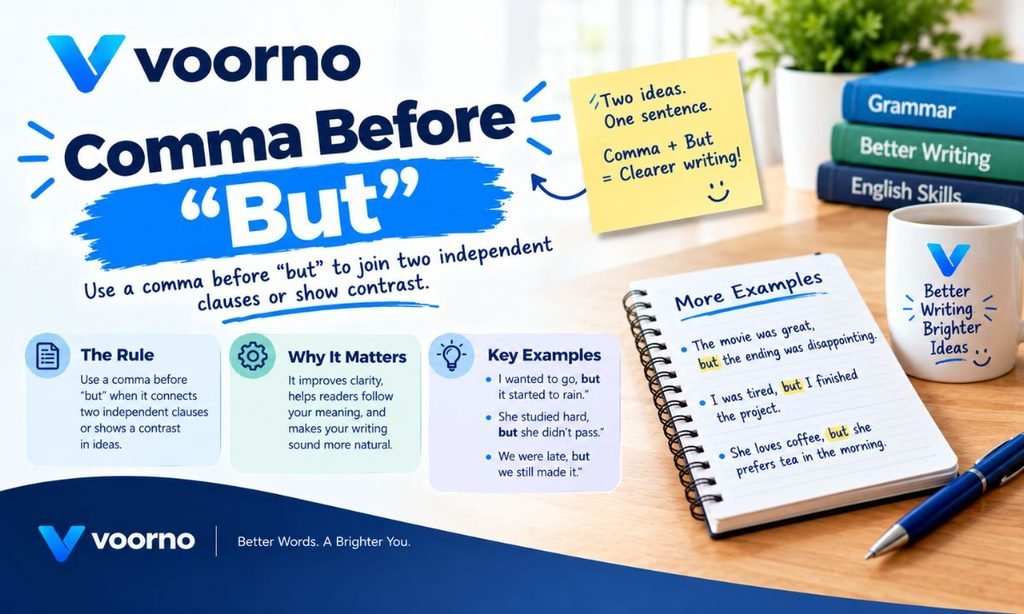
A related question writers often ask is whether “but” needs a comma before it. The short rule: use a comma before “but” when it joins two independent clauses (complete sentences), but skip the comma when “but” simply connects two words or phrases within one clause.
- We wanted to leave early, but the traffic had other plans. (comma — two full clauses)
- She was tired but happy. (no comma — connecting two adjectives)
FAQs
Is it grammatically correct to put a comma before “or”?
Yes, when “or” connects two independent clauses. Example: “You can call me, or I’ll reach out first.” No comma is needed when “or” links single words or short phrases.
What are the 5 comma rules?
The most common rules cover: separating items in a list, joining independent clauses with a conjunction, setting off introductory phrases, enclosing nonessential information, and separating coordinate adjectives.
What is the most common comma mistake?
The comma splice — joining two complete sentences with only a comma and no conjunction — is one of the most frequent errors writers make.
Is the Oxford comma British or American?
It’s more commonly used in American English style guides, though it’s optional in both British and American writing and depends on the publication’s style guide.
Should I put a comma before “but rather”?
Yes, in most cases, since “but rather” typically follows a negative statement and introduces a contrasting idea. Example: “It wasn’t about winning, but rather about trying.”
Conclusion
Punctuation rules can feel overwhelming when you focus on individual words instead of sentence structure. The comma before “even” is a perfect example: once you understand that “even” follows ordinary comma rules rather than a rule of its own, the guesswork disappears. Use the checklist and reference table above whenever you’re unsure, and your writing will come across as clean, confident, and professionally polished — even in your trickiest sentences.









2 thoughts on “Comma Before “Even” Explained: Rules and Examples”