If you’ve ever paused mid-sentence wondering whether to write “associated with” or “associated to,” you’re in good company. This tiny preposition choice trips up native speakers and English learners alike. The good news? The rule is much simpler than it feels.
This guide breaks down the grammar, shows you real examples, and gives you a foolproof method for picking the right phrase every time.
Associated With vs Associated To – The Quick Answer
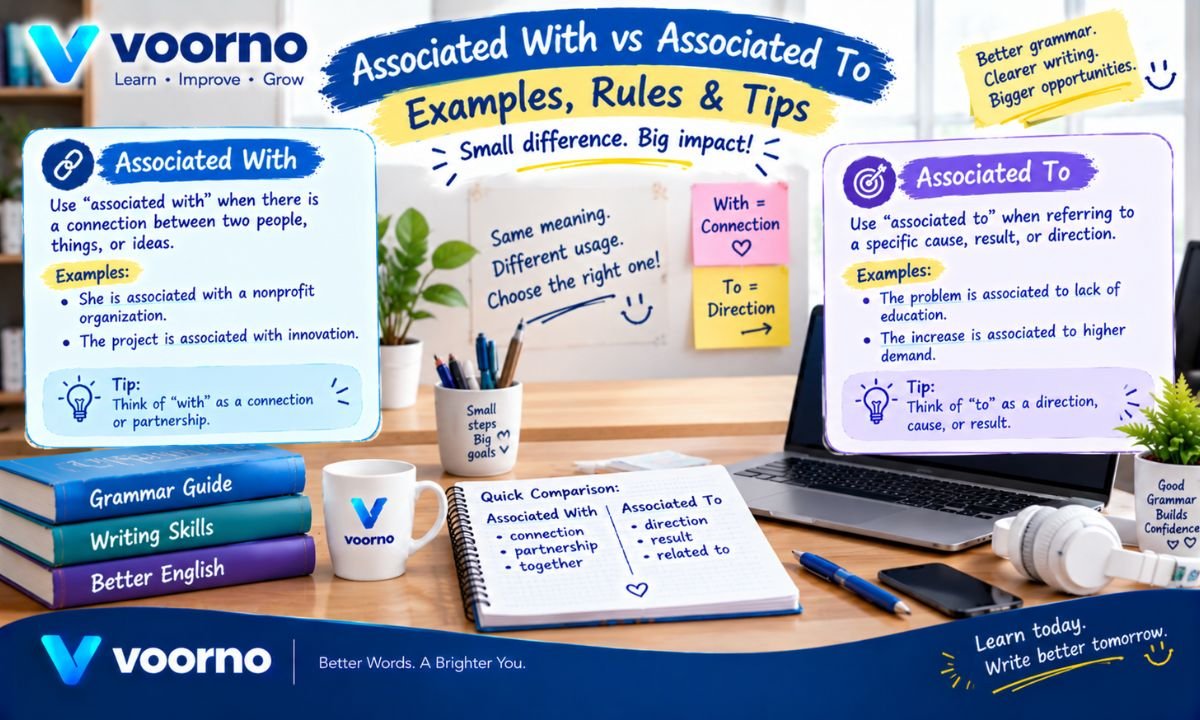
In modern English, “associated with” is the correct and standard phrase. “Associated to” is grammatically nonstandard and is rarely used, even though it occasionally pops up in casual speech or non-native writing.
- ✅ Correct: She is associated with a nonprofit organization.
- ❌ Incorrect: She is associated to a nonprofit organization.
If you remember nothing else from this article, remember this: always pair “associated” with “with.”
Read More:What Does “It Is How It Is” Mean? Meaning, Examples & Real-Life Usage
Understanding the Verb “Associate” in English Grammar
The word “associate” comes from the Latin associare, meaning “to join” or “to unite.” As a verb, it describes a mental or factual link between two people, ideas, objects, or events.
“Associated” is simply the past participle form, used in passive constructions like:
- X is associated with Y
- X was associated with Y
- X has been associated with Y
Because “associate” describes a relationship rather than movement or direction, it naturally pairs with “with” — a preposition used to show connection, accompaniment, or relation — instead of “to,” which usually signals direction or destination.
Common Grammar Structures With “Associate”
The verb “associate” appears in a few predictable sentence patterns. Recognizing them makes correct usage almost automatic.
| Structure | Example | Meaning |
| Be + associated + with | The brand is associated with luxury. | Shows identity or reputation |
| Associate + [someone] + with | People associate rain with sadness. | Shows a mental connection |
| Associated with + [cause/effect] | Smoking is associated with lung disease. | Shows a causal or statistical link |
| Associated with + [group] | He is associated with the research team. | Shows membership or affiliation |
Why “Associated With” Is the Standard Form
“Associated with” wins for three main reasons:
- Collocation strength – “Associate” and “with” have paired together for centuries in English, forming a fixed collocation that native speakers instinctively recognize.
- Semantic logic – “With” expresses togetherness and relationship, which is exactly what “associated” describes.
- Widespread reinforcement – Academic writing, journalism, business communication, and dictionaries consistently use “associated with,” which strengthens the pattern over time.
Usage Data: How Often Each Phrase Appears
Language corpora and search trends consistently show a massive gap between the two phrases.
Frequency Comparison
| Phrase | Typical Usage Level | Common Context |
| Associated with | Extremely common | Academic, business, everyday English |
| Associated to | Very rare | Occasional regional, technical, or translated text |
Across formal writing, news articles, and academic journals, “associated with” appears far more often — often by a ratio of dozens to one — confirming it as the dominant, accepted form.
Read More:“On This Matter” vs. “In This Matter”: Which One Is Correct?
Why “Associated To” Often Sounds Incorrect
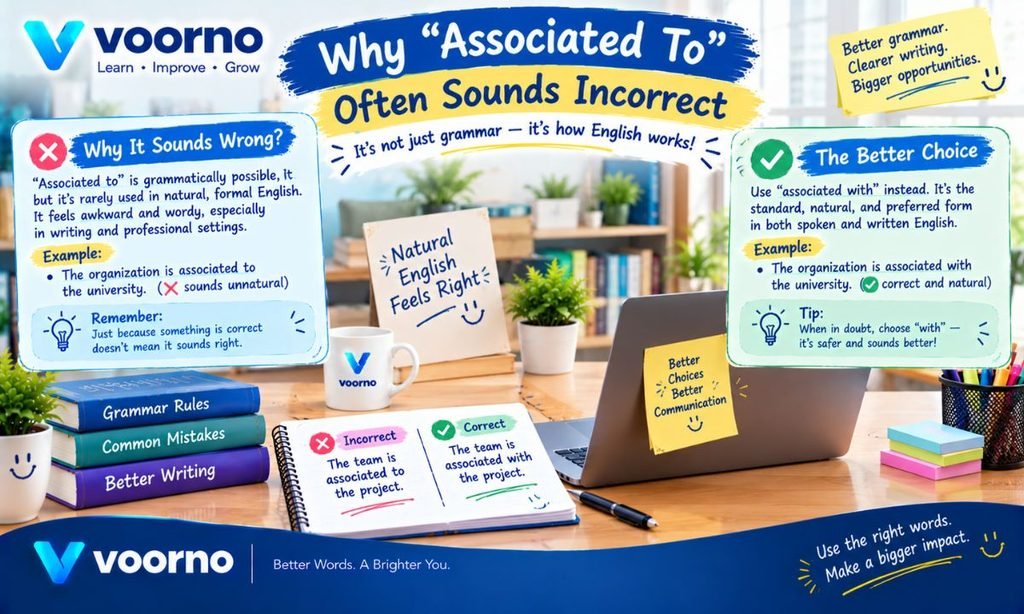
“Associated to” sounds off to native speakers because it breaks an established collocation pattern. English prepositions don’t always follow strict logic; they follow usage habits built up over generations. Since “associate” has always partnered with “with,” any deviation immediately sounds unnatural.
Preposition Logic in English
Prepositions like “to” typically indicate:
- Direction (“go to school”)
- Destination (“send it to her”)
- Recipient (“give it to me”)
Meanwhile, “with” typically indicates:
- Accompaniment (“come with me”)
- Connection or relationship (“associated with,” “linked with,” “connected with”)
Since “associated” describes a relationship rather than movement toward something, “with” fits the logic far better than “to.”
Incorrect Sentences vs Correct Versions
| ❌ Incorrect | ✅ Correct |
| He is associated to the club. | He is associated with the club. |
| This disease is associated to poor diet. | This disease is associated with poor diet. |
| The word is often associated to negativity. | The word is often associated with negativity. |
Associated with vs Associated to
The comparison ultimately comes down to convention. Even though “to” might feel logical to someone translating from another language, English usage strongly favors “with” in every standard context.
Be associated with synonym
If you want variety in your writing, try these alternatives:
- Linked with
- Connected with
- Related to
- Affiliated with
- Tied to
Note that “related” and “tied” naturally pair with “to,” while “linked,” “connected,” and “affiliated” typically pair with “with” — so always double-check the collocation for each specific verb.
Associated with in a sentence
- Curiosity is often associated with creativity.
- The scandal is associated with the former CEO.
- Blue is commonly associated with calmness.
Situations Where “Associated To” Might Appear
While rare, “associated to” occasionally shows up in:
- Highly technical or scientific fields, where it’s sometimes used loosely to describe mathematical or statistical associations.
- Non-native English writing, where direct translation from languages that use an equivalent of “to” influences word choice.
- Casual or regional speech, though this is not considered standard.
Even in these cases, most style guides and editors still recommend “associated with” for clarity and correctness.
Practical Rule for Choosing the Correct Phrase
Simple Grammar Rule
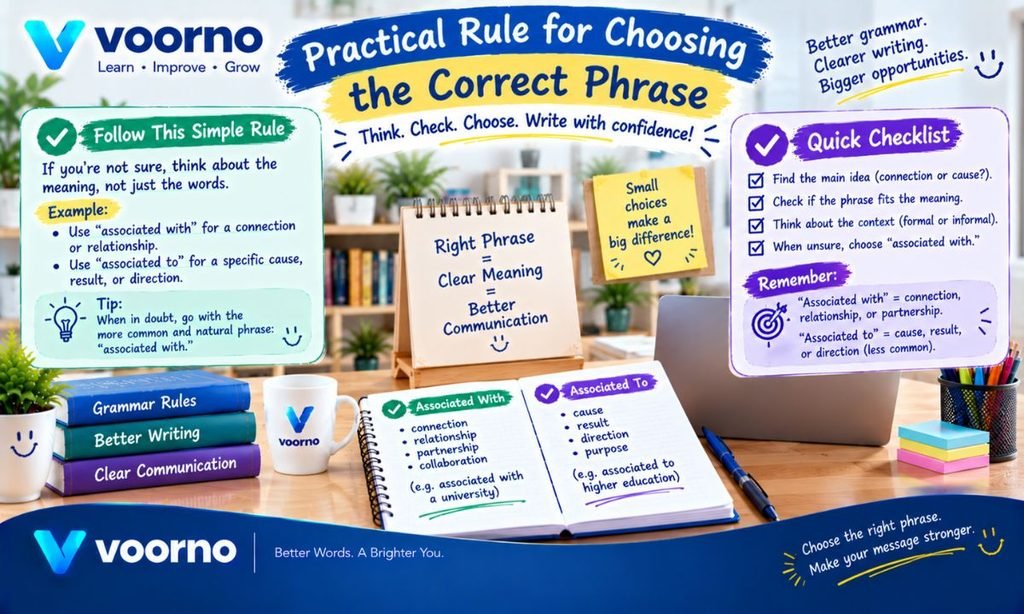
Use “associated with” whenever you’re describing a connection, relationship, reputation, or link between two things.
That’s it — no exceptions to memorize, no complicated logic charts. If you’re ever unsure, default to “with,” and you’ll be correct well over 99% of the time.
Associated with vs associated to grammar
Grammatically, “associated” functions as an adjective or past participle in these sentences, and adjectives describing relationships in English almost always take “with” (similar to “familiar with,” “compatible with,” “consistent with”).
Common Learner Mistakes and How to Avoid Them
- Overusing “to” out of habit – Many learners default to “to” because it’s taught early in prepositional phrases like “go to” or “listen to.”
- Direct translation from native language – This is the biggest culprit (see below).
- Mixing up “associated” with “related” – Remember: “related to” is correct, but “associated with” is correct. They are not interchangeable in preposition choice.
Direct Translation Mistakes
Many languages use a structure that translates literally to “associated to” in English. Learners who translate word-for-word from their native language often carry this pattern over, even though native English speakers don’t use it this way. The fix is simple: memorize “associated with” as a fixed phrase rather than translating each word separately.
Case Study: How Language Usage Shapes Grammar
English grammar isn’t always built on pure logic — it’s built on repeated usage. Over decades, “associated with” appeared so frequently in books, newspapers, and everyday speech that it became the fixed, expected form. “Associated to,” despite occasionally appearing, never gained enough traction to become standard. This is a great example of how frequency and habit, not strict rules, shape modern English collocations.
Examples of Correct Usage in Different Contexts
| Context | Example Sentence |
| Health | High blood pressure is associated with stress. |
| Business | The startup is associated with several tech investors. |
| Emotion | Nostalgia is often associated with old photographs. |
| Academic | The theory is associated with early 20th-century physicists. |
| Social | She is associated with several charitable causes. |
Related Grammar Comparisons
- Related to vs. Related with
- Associated to vs Associated with
- Familiar with vs. Familiar to
- Involved in vs. Involved with
Each of these preposition pairs follows its own collocation pattern, so it’s worth learning them individually rather than assuming one rule applies to all.
Quick Practice Quiz
Fill in the blank with “with” or “to”:
- The illness is associated ___ poor hygiene.
- He is closely associated ___ the marketing department.
- Red is often associated ___ passion.
- The award is associated ___ excellence in journalism.
FAQs
What can I say instead of “associated with”?
You can use “linked with,” “connected with,” “affiliated with,” or “related to,” depending on context.
What does “associated with” mean?
It means having a connection, relationship, or link with someone or something.
How to use associated in a sentence?
Pair it with “with” to show a relationship, such as: “Success is associated with hard work.”
Do we say “associated to” or “with”?
“Associated with” is correct; “associated to” is nonstandard in modern English.
Which preposition is used after “associated”?
The preposition “with” is used after “associated” in virtually all standard English contexts.
Conclusion
The debate between “associated with” and “associated to” has a clear winner: “associated with” is the grammatically correct, widely accepted, and natural choice in modern English. While “associated to” occasionally surfaces in technical writing or translated text, it isn’t standard and can make your writing sound off to native speakers.
The next time you’re unsure, skip the second-guessing — pair “associated” with “with,” and your sentence will always be correct.









2 thoughts on “Associated With vs Associated To: Examples, Rules & Tips”