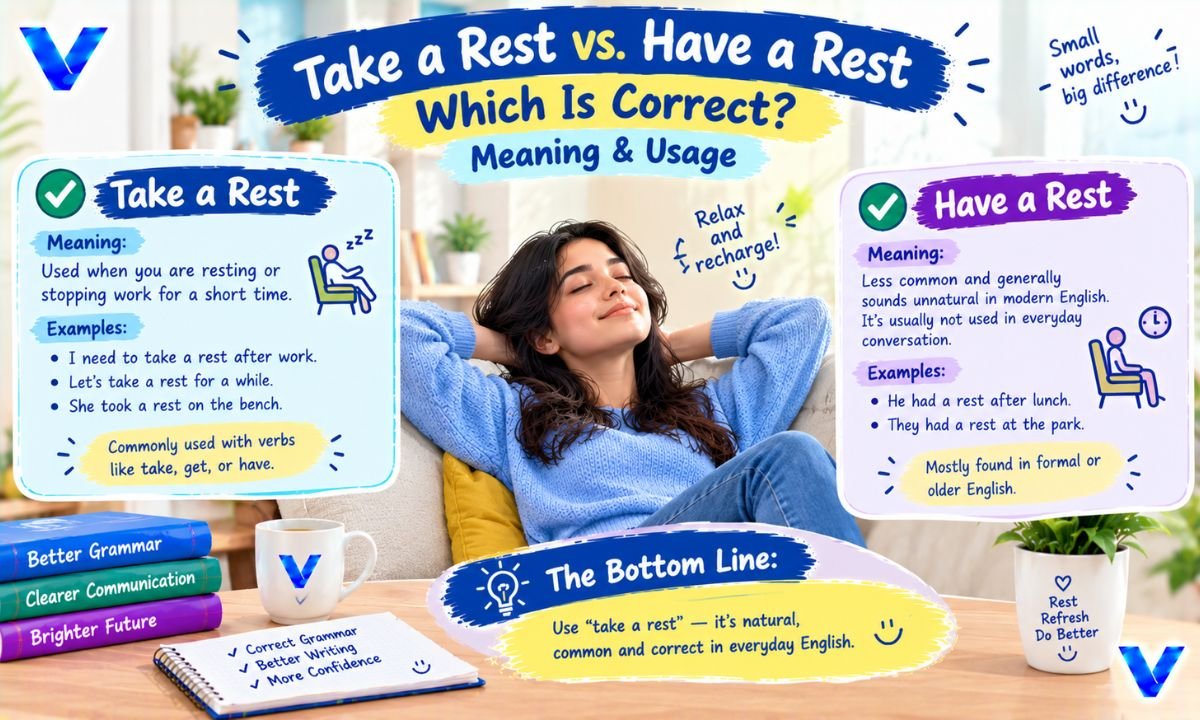
If you’ve ever paused mid-sentence wondering whether to say “take a rest” or “have a rest,” you’re not alone. Both phrases pop up constantly in everyday English, yet most learners — and even a few native speakers — can’t quite explain why one sounds more natural in certain situations.
The short answer: both are grammatically correct. The real difference comes down to region, tone, and how each verb pairs with the word “rest.” This guide breaks down the grammar, shows real examples, and gives you a clear rule of thumb so you never second-guess yourself again.
Core Difference Between Take a Rest and Have a Rest
At their core, “take a rest” and “have a rest” mean the same thing: pausing an activity to relax or recover energy. The distinction is subtle and lives mostly in tone and regional preference, not meaning.
- Take a rest leans slightly more active — it frames resting as a decision or action you’re choosing to make.
- Have a rest leans slightly more passive — it frames resting as an experience you’re settling into.
Neither phrase is “more correct” than the other. Think of it the same way you’d think about “take a shower” versus “have a shower” — both work, but one dominates in American English and the other in British English.
Read More: “You Are Always Welcomed” – Meaning, Grammar & Proper Usage
Grammar Breakdown: Why “Take” Sounds More Natural
English verbs often pair with specific nouns in fixed patterns called collocations. This is why native speakers say “take a break,” “take a nap,” and “take a shower” far more often than the “have” equivalents in American contexts.
Here’s the logic:
- “Take” implies initiating an action — you’re actively choosing to stop and recover.
- “Have” implies possessing or experiencing something — softer, more passive framing.
- Collocation habits, not strict grammar rules, decide which verb “feels” right in a given dialect.
So when someone says “have a rest” sounds slightly off to American ears, it’s not a grammar error — it’s a mismatch in expected word pairing (collocation), similar to saying “make a shower” instead of “take a shower.”
Read More: Based On vs. Based Off Of: Examples, Meaning & Usage
Take a Rest vs Have a Rest: Examples
Seeing both phrases in context makes the difference click faster than any rule ever could.
- “I’ve been on my feet all day — I need to take a rest.”
- “Sit down and have a rest, love; you look exhausted.”
- “The coach told the team to take a rest between sprints.”
- “Why don’t you have a rest before we head out for dinner?”
- “She stopped to take a rest halfway up the trail.”
- “Come in and have a rest — the kettle’s just boiled.”
Notice how both fit naturally into casual, spoken English. Context and speaker background — not grammar — determine which one comes out.
Real Usage Examples: Side-by-Side Comparison
| Situation | Take a Rest | Have a Rest |
| After a workout | “Take a rest between sets.” | “Have a rest before the next set.” |
| Talking to a tired friend | “You should take a rest.” | “You should have a rest.” |
| Giving instructions at work | “Take a rest and come back at 2.” | “Have a rest and we’ll continue later.” |
| Comforting someone who’s ill | “Take a rest, you’ll feel better.” | “Have a rest, dear, you’ll feel better.” |
Both columns are grammatically sound. The choice mostly reflects the speaker’s dialect and how directive or gentle they want to sound.
Regional Differences: US vs UK Usage

This is where the real pattern emerges. According to language data and corpus studies, usage splits fairly predictably along regional lines:
- American English favors “take a rest.” It sounds direct, practical, and slightly more instructional — the kind of phrase a coach, manager, or parent might use.
- British English favors “have a rest.” It carries a softer, more polite tone, often used when someone is showing concern for another person’s comfort.
Globally, “take a rest” edges out as the more universally recognized version, since American English media, education content, and business communication dominate international exposure. If you’re speaking to a mixed or unknown audience, “take a rest” is the safer default.
Quick Comparison Table
| Feature | Take a Rest | Have a Rest |
| Grammatical correctness | Correct | Correct |
| Dominant region | American English | British English |
| Tone | Direct, active | Gentle, passive |
| Common context | Instructions, advice, fitness | Comfort, hospitality, casual chat |
| Formality | Neutral | Slightly more polite |
Take a Rest vs Have a Rest: What Online Discussions Say
Search forums and language-learning communities, and you’ll find the same theme repeating: native speakers rarely think about this consciously. Most say both phrases sound natural, but when pressed, English speakers from the UK admit they’d more likely say “have a rest,” while Americans lean toward “take a rest” almost without exception.
A common thread in these discussions: many native speakers actually prefer simpler alternatives like “get some rest” or “take a break” in casual conversation, viewing both “take a rest” and “have a rest” as slightly more formal or textbook-sounding phrasing.
Formal vs Informal Context: What Should You Use?
Neither phrase is inherently formal, but small adjustments shift the tone:
- Formal writing or professional settings: Use “take a rest” or the more polished “take a break.” It reads as neutral and universally understood.
- Informal, caring conversations: “Have a rest” fits naturally, especially in British-influenced English, when comforting a friend or family member.
- Medical or wellness contexts: “Get some rest” is often preferred by professionals because it sounds instructional without being overly casual.
Quick rule: when writing for a global or professional audience, default to “take a rest.” When speaking casually with a British-English audience, “have a rest” fits right in.
Common Mistakes and Misunderstandings
A few errors show up again and again among learners:
- Dropping the article “a.” Saying “take rest” or “have rest” is not standard American or British English — though it is common and accepted in Indian English. Stick with “take a rest” or “have a rest” in international writing.
- Assuming one phrase is wrong. Both are correct; the mistake is treating this as a right-vs-wrong grammar issue rather than a regional style choice.
- Overusing either phrase. Repeating the same expression throughout a conversation or piece of writing sounds robotic. Mix in alternatives for natural variety.
- Using “take a rest” and “take a break” interchangeably without nuance. They’re close, but not identical — see the next section.
Better Alternatives You Should Actually Use

Native speakers often skip both phrases entirely in favor of more modern, flexible expressions. Here are strong alternatives worth learning:
- Take a break – a short pause from work or activity, often used in professional settings.
- Get some rest – implies a real need for recovery, common in caring or medical contexts.
- Catch some sleep – informal, used when someone is genuinely exhausted.
- Chill out / relax – casual, everyday alternatives with a lighter tone.
- Recharge – modern, often figurative, popular in wellness and workplace language.
- Unwind – suggests releasing tension after a stressful period.
Rotating between these keeps your English sounding natural instead of repetitive.
Practical Tips to Sound Like a Native Speaker
- Match the phrase to your audience. Use “take a rest” for American listeners, “have a rest” for British ones.
- Don’t overthink casual speech. Native speakers rarely notice which one you use — confidence matters more than precision here.
- Vary your vocabulary. Swap in “take a break” or “get some rest” occasionally so you don’t sound repetitive.
- Always keep the article “a.” “Take rest” and “have rest” read as non-standard in most English-speaking countries.
- Listen for context clues. Podcasts, shows, and interviews are the fastest way to absorb which phrase fits which situation.
Take a Rest vs Have a Rest: Grammar Explained
Grammatically, both phrases follow the same structure: verb + article + noun.
- Take (verb) + a (article) + rest (noun)
- Have (verb) + a (article) + rest (noun)
This is called a light verb construction, where a common verb (“take,” “have,” “make,” “do”) combines with a noun to form an action phrase. English allows multiple light verbs to pair with the same noun, which is exactly why both versions are valid. The “correctness” isn’t about grammar rules — it’s about which verb-noun pairing your dialect has settled on as the default.
Case Study: How Native Speakers Actually Use It
Picture two conversations:
Conversation 1 (American workplace):
“You’ve been on this report for six hours straight. Take a rest and grab some coffee.”
Conversation 2 (British household):
“You look shattered, love. Come and have a rest on the sofa for a bit.”
Both sentences sound completely natural to their respective audiences, and swapping the phrases wouldn’t make either one “wrong” — just slightly less typical for that region. This is the clearest illustration of how usage, not grammar, drives the choice.
Quick Comparison Table: Take a Rest vs. Have a Rest
| Category | Take a Rest | Have a Rest |
| Correctness | ✅ Correct | ✅ Correct |
| Popularity worldwide | Higher | Slightly lower |
| Best for | Global/neutral audiences | British-English contexts |
| Sounds like | Advice or instruction | Warmth or hospitality |
| Common pairing errors | “Take rest” (incorrect) | “Have rest” (incorrect) |
Final Verdict: Which One Should You Use?
If you want one safe, universally understood choice, go with “take a rest.” It’s the more globally recognized form, works well in writing, and rarely sounds out of place — even to British listeners. Save “have a rest” for conversations where a softer, more British-flavored tone fits naturally, such as comforting a friend or writing dialogue set in the UK.
Ultimately, this isn’t a case of correct versus incorrect. It’s a case of audience and tone, so choose based on who you’re talking to rather than searching for a single “rule” that doesn’t really exist.
Take Some Rest or Get Some Rest?
Both are used, but “get some rest” is the more natural and widely recommended phrase, especially in caring or medical contexts (“Get some rest, you’ll feel better tomorrow”). “Take some rest” is understood but sounds slightly less idiomatic to native ears compared to “take a rest” or “get some rest.” When in doubt, “get some rest” is the safest, warmest-sounding option.
FAQs
Q:Is it take a rest or have a rest?
Both are correct. “Take a rest” is more common in American English, while “have a rest” is more typical in British English.
Q:What to say instead of take rest?
Use “take a rest” (with the article), or alternatives like “take a break,” “get some rest,” or “relax.”
Q:What is another word for “take a rest”?
Common alternatives include “take a break,” “get some rest,” “unwind,” “recharge,” and “chill out.”
Q:What is a formal way to say “take a break”?
In formal writing, you can say “pause for a short recess,” “take a brief respite,” or simply “take a short break.”
Q:Is “take a break” an idiom?
Not quite an idiom — it’s a common collocation (a natural verb-noun pairing) rather than a phrase with a hidden or figurative meaning.
Conclusion
“Take a rest” and “have a rest” both describe the same simple act: pausing to recover. The choice between them isn’t about grammar rules — it’s about regional habits, tone, and audience. Use “take a rest” for a safer, globally understood option, and “have a rest” when you want a softer, British-leaning tone. And when either phrase starts to feel repetitive, alternatives like “take a break,” “get some rest,” or “recharge” will keep your English sounding fresh and natural.










2 thoughts on “Take a Rest vs. Have a Rest: Which Is Correct? Meaning & Usage”