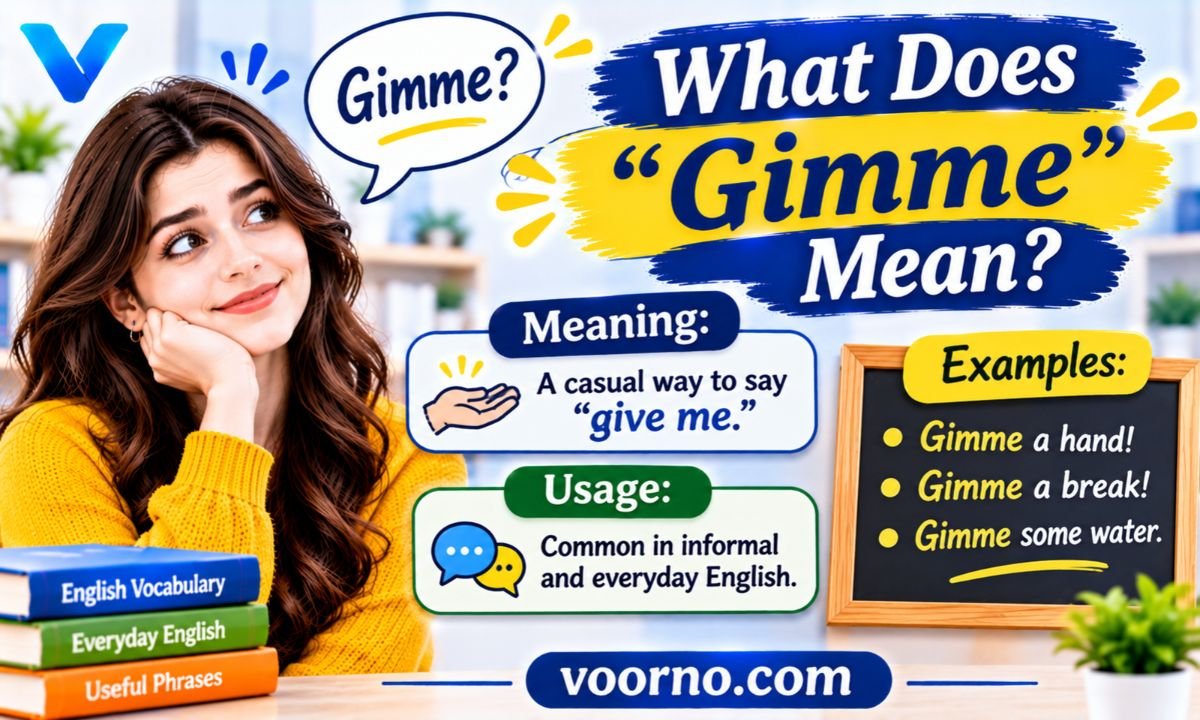
If you’ve ever heard someone say “gimme a second” or seen “GIMME MORE” flashing across a Britney Spears track, you already know the word — even if you’ve never stopped to define it. “Gimme” is one of the most common informal contractions in English, yet it carries more nuance than most people realize, from casual chat to the golf course.
This guide breaks down exactly what “gimme” means, where it came from, how to use it correctly, and why it’s not just lazy speech — it’s a real, dictionary-recognized part of English.
Quick Definition: What Does “Gimme” Mean?
At its core, “gimme” is an informal contraction of “give me.” It’s used in spoken and casual written English to make a request sound quicker, more natural, and less formal.
| Term | Meaning |
| Gimme (verb form) | Informal way of saying “give me” |
| Gimme (noun, general) | Something easy to achieve or obtain |
| Gimme (noun, golf) | A short putt conceded without being played |
| Gimmie | Alternate spelling, same meaning |
Merriam-Webster and Oxford Learner’s Dictionaries both list “gimme” as an accepted informal term, confirming it’s a legitimate part of English rather than mere slang invented online.
Read More: “At Your Convenience” Meaning: How and When to Use It
Etymology and How “Gimme” Evolved
“Gimme” isn’t a modern internet invention. According to Dictionary.com, the word was first recorded between 1925 and 1930 as a phonetic spelling of “give me” when spoken quickly in casual conversation. Merriam-Webster pinpoints its earliest documented use in print to 1929.
The word evolved naturally the way many English contractions do:
- “Give me” → spoken rapidly in everyday speech
- The two words blend together phonetically
- Writers began spelling it the way it sounded: “gimme”
This same pattern produced other familiar contractions like “gonna” (going to), “wanna” (want to), and “lemme” (let me). “Gimme” simply became common enough — especially in music, dialogue, and sports — that dictionaries formally recognized it.
Read More: Traveling or Travelling: Difference, Rules & Examples
How “Gimme” Works in Everyday English
“Gimme” functions primarily as a verb phrase substitute, replacing “give me” in relaxed conversation. It can also work as a noun, describing something so easy it barely requires effort.
As a verb (request):
- “Gimme the remote.”
- “Gimme a minute to think.”
As a noun (something easy):
- “That test was a total gimme.”
- “Getting that job was a gimme for her.”
The word is almost exclusively used in spoken or informal written English — think texting, dialogue, lyrics, or casual conversation — rather than professional or academic writing.
Informal vs Formal: When “Gimme” Works and When It Doesn’t
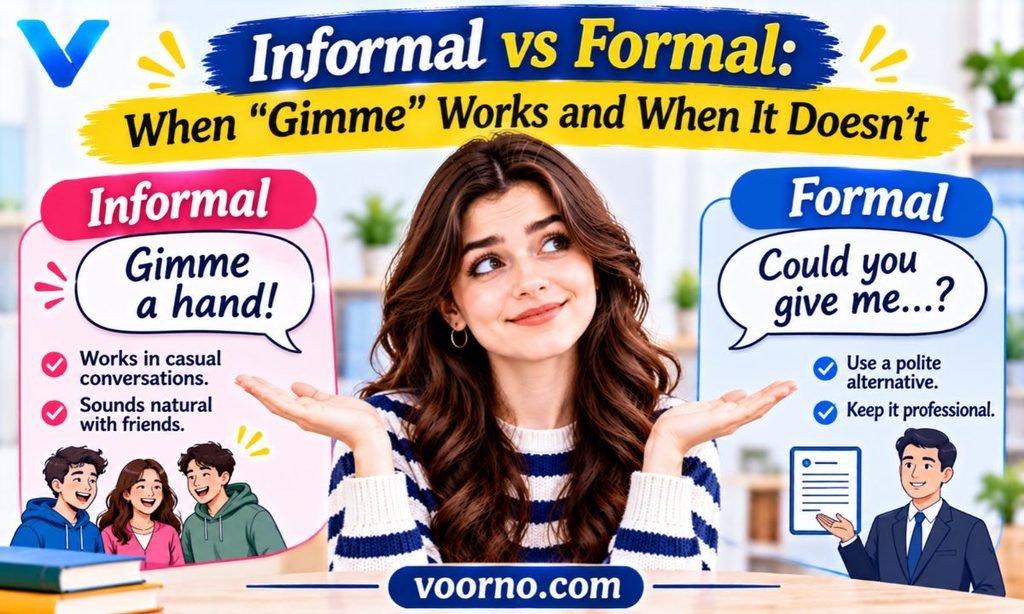
Knowing when to use “gimme” is just as important as knowing what it means.
| Context | Use “Gimme”? | Better Alternative |
| Texting a friend | ✅ Yes | — |
| Song lyrics/dialogue writing | ✅ Yes | — |
| Casual conversation | ✅ Yes | — |
| Work email | ❌ No | “Please give me” / “Could you send me” |
| Academic essay | ❌ No | “Provide” / “Grant” |
| Formal presentation | ❌ No | “Please share” |
Rule of thumb: If you wouldn’t say “ain’t” or “gonna” in the same setting, skip “gimme” too.
Examples of “Gimme” in Real Life
- “Gimme five minutes, I’m almost ready.”
- “Can you gimme a hand with these boxes?”
- “Gimme a break — that’s not fair.”
- “That interview question was a gimme.”
- “Gimme some sugar!” (affectionate, informal)
Pop Culture & Media — “Gimme” in Music, Movies, and TV
“Gimme” has been a staple of song titles and lyrics for decades because it captures raw, conversational emotion better than formal phrasing.
Notable examples include:
- The Rolling Stones’ “Gimme Shelter”
- Britney Spears’ “Gimme More”
- ABBA’s “Gimme! Gimme! Gimme! (A Man After Midnight)”
Screenwriters and novelists also use “gimme” in dialogue to make characters sound authentic and unscripted, rather than stiff or overly formal.
“Gimme” But Not Just Language — The Sports Term in Golf

What It Means
In golf, a “gimme” refers to a very short putt that other players agree counts automatically, without the player actually taking the shot. It’s a time-saving courtesy based on the assumption the putt would not have been missed — typically when the ball sits just a few inches from the hole.
Important Notes
- Gimmes are not permitted in official stroke play under the rules of golf.
- They are common in casual or recreational rounds.
- In match play, a player can formally concede a putt, hole, or match at any point, and that concession cannot be withdrawn.
Why “Gimme” Isn’t Just “Bad Grammar”
Many people assume contractions like “gimme” are simply incorrect English. In reality, linguists classify it as connected speech — a natural process where words blend together in fast, casual talk. English speakers do this constantly (“gonna,” “kinda,” “sorta”), and it reflects how language is actually spoken, not how it’s formally written.
Using “gimme” isn’t a grammar mistake; it’s a register choice — appropriate for informal settings and inappropriate for formal ones.
Spoken vs Written English
| Spoken English | Written (Formal) English |
| “Gimme the keys.” | “Give me the keys.” |
| “Gimme a sec.” | “Give me a second.” |
| “Gimme that back.” | “Give that back to me.” |
Gimme Meaning in Text
In texts and DMs, “gimme” is used exactly as in speech — a quick, casual way to ask for something. It often appears alongside other shortened forms like “lemme,” “gonna,” and “kinda” to keep messages fast and conversational.
Related Words and Natural Contractions
- Lemme — let me
- Gonna — going to
- Wanna — want to
- Kinda — kind of
- Sorta — sort of
- Gotta — got to / have got to
These words follow the same pattern: frequent, rapid speech eventually earns a written shorthand.
Common Mistakes and Misconceptions
- Mistake: Thinking “gimme” is only internet slang. (It predates the internet by decades.)
- Mistake: Using it in professional writing. (Reserve it for casual contexts.)
- Mistake: Assuming “gimmie” and “gimme” mean different things. (They don’t — same word, alternate spelling.)
How to Practice “Gimme” in Conversation
- Start by noticing it in songs, shows, or podcasts.
- Practice saying “give me” quickly until it naturally shortens.
- Use it in low-stakes texts with friends first.
- Avoid it in emails, interviews, or formal writing.
- Pair it with other contractions (“gimme a sec” / “gonna head out”) for natural flow.
Case Studies: “Gimme” in Real Use
- Music industry: Song titles using “gimme” often perform well because the phrase feels urgent and relatable, driving emotional connection with listeners.
- Golf terminology: Recreational golfers use “gimme” so frequently that it’s become an accepted part of the sport’s casual vocabulary, even though it has no place in official rulebooks.
- Everyday texting: Linguistic studies on digital communication consistently show contractions like “gimme” increase as message formality decreases, especially among younger speakers.
Synonyms of Gimme
- Give me
- Hand me
- Pass me
- Let me have
Top Quotes About Informal Language (And Why They Matter)
Linguists often note that informal contractions like “gimme” aren’t corruptions of English — they’re evidence of language evolving naturally through everyday use. Dictionaries such as Merriam-Webster and Oxford now formally recognize the word specifically because it reflects authentic, widely used speech patterns, not just casual slang.
Fun Facts About “Gimme”
- “Gimme” was first recorded in print nearly 100 years ago.
- It has two completely different meanings — everyday speech and a golf term.
- Major dictionaries including Merriam-Webster, Oxford, and Cambridge all list it as a valid entry.
Gimme Word
As a standalone word, “gimme” is classified as informal across every major dictionary, confirming it’s real English — just not formal English.
Understanding and Using “Gimme” Naturally
The key to using “gimme” well is matching it to the right setting. It thrives in music lyrics, texting, dialogue, and relaxed conversation — but should be swapped for “give me” in anything professional, academic, or formal. Used correctly, it makes speech sound natural rather than sloppy.
FAQs
Q:What does “gimmie” mean in slang?
“Gimmie” is an alternate spelling of “gimme,” meaning “give me.” Both spellings are used interchangeably in informal speech and text.
Q:Is it gimmie or gimme?
“Gimme” is the more standard spelling recognized by major dictionaries, though “gimmie” appears as an accepted variant.
Q:What is gimme in chat?
In texting or chat, “gimme” simply means “give me” — used to make a request sound quick and casual.
Q:Is gimme a real word?
Yes. “Gimme” is listed in Merriam-Webster, Oxford, Cambridge, and other major dictionaries as an informal contraction.
Q:What’s another word for gimme?
Common alternatives include “give me,” “hand me,” and “pass me.”
Conclusion
“Gimme” may look like slang, but it’s a legitimate, dictionary-recognized contraction with nearly a century of documented use. Whether you’re texting a friend, writing song lyrics, or calling a putt on the golf course, understanding when — and when not — to use “gimme” helps you sound natural without sounding careless.
Save it for casual moments, swap it for “give me” in formal ones, and you’ll always use it correctly.









2 thoughts on “What Does “Gimme” Mean? Meaning, Usage & Examples”