If you’ve ever typed “I will like to” in an email and then paused, wondering if it sounded off, you’re not alone. This mix-up is one of the most common grammar slips among English learners and even confident native speakers. The good news: the rule behind it is simple once you see it clearly.
In short, “I would like to” is the grammatically correct and polite form, while “I will like to” is almost always incorrect in modern English. This guide breaks down exactly why, when each phrase applies, and how to use them naturally in real conversations, emails, and interviews.
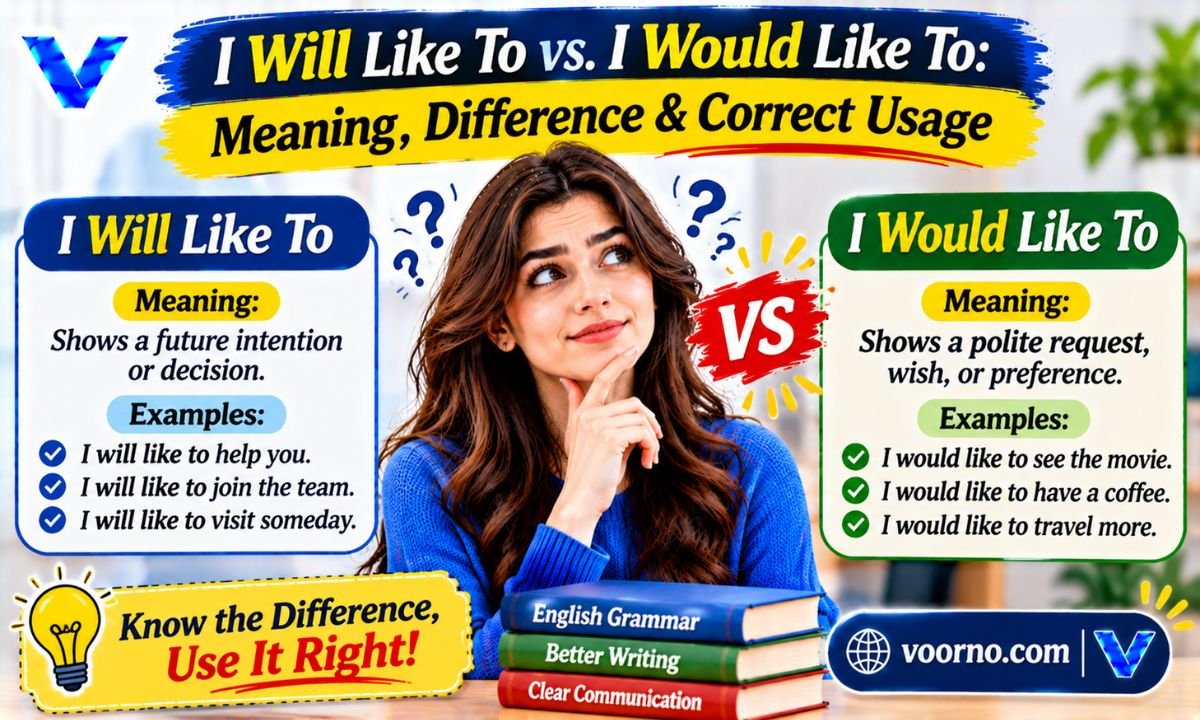
I Will Like To vs I Would Like To Meaning
At their core, both phrases try to express a desire or intention. But the modal verbs behind them — “will” and “would” — carry very different meanings.
- “Will” expresses certainty, a firm decision, or a prediction about the future.
- “Would” expresses politeness, a hypothetical wish, or a softened request.
Because “like” is a verb of preference (not a plain future action), pairing it with “will” creates an awkward, non-standard combination. Pairing it with “would” produces the polite, conventional phrase native speakers actually use.
Read More: By Which or In Which? Learn the Correct Usage with Examples
I Will Like To vs. I Would Like To – The Short, Clear Answer
Here’s the rule in one line: use “I would like to” whenever you’re expressing a wish, preference, or polite request. “I will like to” is a common error that usually comes from translating sentence patterns directly from another language, or from over-applying the “will = future” rule.
Quick Comparison Table
| Feature | I Will Like To | I Would Like To |
| Grammatical status | Incorrect in almost all contexts | Correct and standard |
| Tone | Sounds awkward, overly direct | Polite, respectful |
| Common use | Rarely used correctly | Requests, preferences, offers |
| Formality | Not suitable for formal writing | Ideal for formal and informal use |
| Example | “I will like to order” ❌ | “I would like to order” ✅ |
I Will Like To vs I Would Like To Examples
- ❌ I will like to speak with you tomorrow.
- ✅ I would like to speak with you tomorrow.
- ❌ I will like to know more about this course.
- ✅ I would like to know more about this course.
- ❌ I will like to apply for the position.
- ✅ I would like to apply for the position.
Read More: “Say Your Piece” vs. “Say Your Peace”: Which Is Correct? Meaning & Usage
Breaking Down the Grammar: Will vs. Would
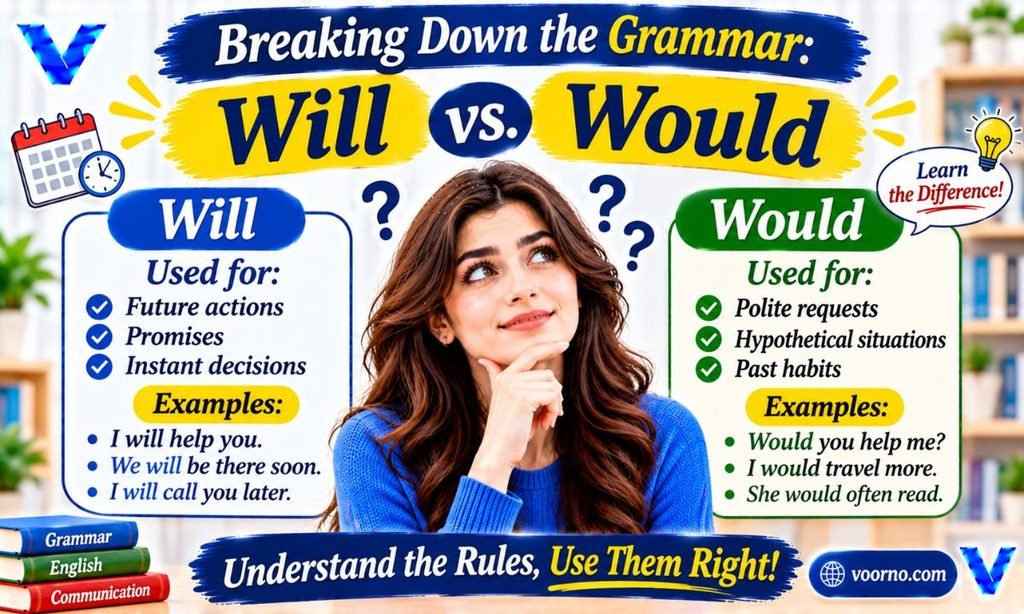
To fully understand the difference, look at how each modal verb functions in a sentence.
- Will is used for:
- Future facts and decisions (“I will call you later.”)
- Promises (“I will help you finish this.”)
- Predictions (“It will rain tomorrow.”)
- Would is used for:
- Polite requests (“Would you close the door?”)
- Hypothetical situations (“I would travel more if I had time.”)
- Softened preferences (“I would like a coffee, please.”)
“Like” describes a preference, not a future event, which is exactly why it pairs naturally with “would” and not “will.”
Why “I Will Like To” Sounds Wrong
When you say “I will like to,” you’re essentially predicting a future feeling — as if you’re not sure you like something yet but expect to in the future. That’s not what most speakers mean. They want to express a present desire politely, and that’s the job of “would,” not “will.”
When “I Will Like” Is Actually Correct
There is one narrow case where “will like” works: when you’re genuinely predicting someone’s future reaction.
- ✅ “You will like this restaurant.” (a prediction about a future reaction)
- ✅ “I think I will like this new job once I settle in.” (a genuine future prediction)
Notice these examples don’t use the infinitive “to” after “like” in the same request-forming way. This is the key difference from the incorrect “I will like to [verb]” pattern.
Why “I Would Like To” Is the Correct Form
“I would like to” works because “would” softens the request, turning a blunt statement into a courteous one. It’s the standard structure taught in grammar books and used across professional communication, customer service, and everyday conversation worldwide.
Examples in Real Context
- “I would like to schedule a meeting for next Tuesday.”
- “I would like to thank everyone for coming today.”
- “I would like to learn more about your services.”
- “I would like to take this opportunity to introduce myself.”
“Would Like To” vs. “Want To”
Both phrases express desire, but their tone differs sharply.
Comparison Table
| Phrase | Tone | Best Used In |
| I want to | Direct, casual | Friends, informal chats |
| I would like to | Polite, formal | Emails, interviews, customer service |
“I want to speak with the manager” sounds blunt. “I would like to speak with the manager” sounds courteous and professional — the same message, delivered with better tone.
Formal vs. Informal Speech Context
In casual conversation with friends or family, “want to” or even a contracted “I’d like to” feels perfectly natural. In formal writing — emails, cover letters, official requests, or academic contexts — “I would like to” is the safer, more polished choice. “I will like to,” on the other hand, has no comfortable home in either register; it simply reads as a mistake.
Regional and ESL Influences

Many English language learners pick up the “will like” pattern because their native language uses a future-tense structure to express desire. When translated word-for-word into English, this becomes “I will like to,” which feels logical in the learner’s head but doesn’t match standard English usage. Recognizing this pattern is the first step to correcting it permanently.
I Would Like To Sentences
- “I would like to visit Japan next year.”
- “I would like to make a reservation for two.”
- “I would like to discuss the project timeline.”
- “I would like to hear your thoughts on this.”
- “I would like to apologize for the delay.”
Politeness, Tone, and Audience Perception
Word choice shapes how people perceive your intentions. “I would like to” signals respect and consideration, which matters most when you’re speaking to a superior, a client, or someone you’ve just met. Using the correct form isn’t just about grammar — it’s about making a good impression and being taken seriously in professional settings.
Common Mistakes and How to Fix Them
Use your left or right arrow keys or drag and drop with the mouse to change the gradient position. Press the button to change the color or remove the control point.
| Mistake | Correction |
| I will like to help you. | I would like to help you. |
| I would like speak with you. | I would like to speak with you. |
| I will like to order a pizza. | I would like to order a pizza. |
| I would liked to go. | I would like to go. |
A quick tip: if you can mentally replace the phrase with “I’d like to” and it still sounds natural, you’re using the correct form.
I Will Like To vs I Would Like To – The Answer
To settle it once and for all: “I would like to” is correct, and “I will like to” should be avoided in nearly every situation, whether you’re writing a formal letter or chatting casually.
Case Study: Job Interview Language Impact
Imagine two candidates answering the same interview question, “Why do you want this role?”
- Candidate A says: “I will like to grow my career here.”
- Candidate B says: “I would like to grow my career here.”
Candidate B’s phrasing sounds more polished and confident, while Candidate A’s sentence subtly signals uncertainty with grammar, which can distract an interviewer from the actual message. Small language choices like this can shape first impressions in high-stakes conversations.
Quick Self-Test
Try correcting these on your own before checking the answers below:
- I will like to ask a question.
- I will like to join the meeting.
- I will like to try that dish.
Answers: All three should use “I would like to” instead of “I will like to.”
Final Rule to Remember
Use this simple memory trick: “Would” is for wishes; “will” is for certainty. Since expressing a preference is a wish, not a guaranteed future fact, “would like to” is almost always the right choice.
The Bottom Line
“I will like to” and “I would like to” might look nearly identical, but only one is grammatically standard for expressing desires and polite requests. Sticking with “I would like to” keeps your writing and speech accurate, professional, and easy to understand — whether you’re sending a business email, ordering at a restaurant, or answering interview questions.
FAQs
Q:When to use “I would like to”?
Use “I would like to” whenever you want to politely express a desire, preference, or request, such as in emails, interviews, or formal conversations.
Q:What can I say instead of “I would like to”?
You can say “I want to,” “I’d love to,” or “I wish to,” depending on how formal or casual the situation is.
Q:What is a formal synonym for “I would like to”?
“I wish to” or “I would appreciate the opportunity to” are more formal alternatives often used in official writing.
Q:Which is correct: “I would” or “I will”?
Both are correct, but they serve different purposes: “would” softens requests and wishes, while “will” states certainty or future facts.
Q:What is another word for “would like”?
“Wish,” “desire,” or “want” can all serve as alternatives to “would like,” depending on the tone you’re aiming for.
Conclusion
Mastering “I would like to” versus “I will like to” is a small grammar fix with a big impact on how polished and professional you sound. Once you internalize that “would” carries politeness while “will” carries certainty, you’ll never second-guess this phrase again — in writing, in interviews, or in everyday conversation.










2 thoughts on “I Will Like To vs. I Would Like To: Meaning, Difference & Correct Usage”