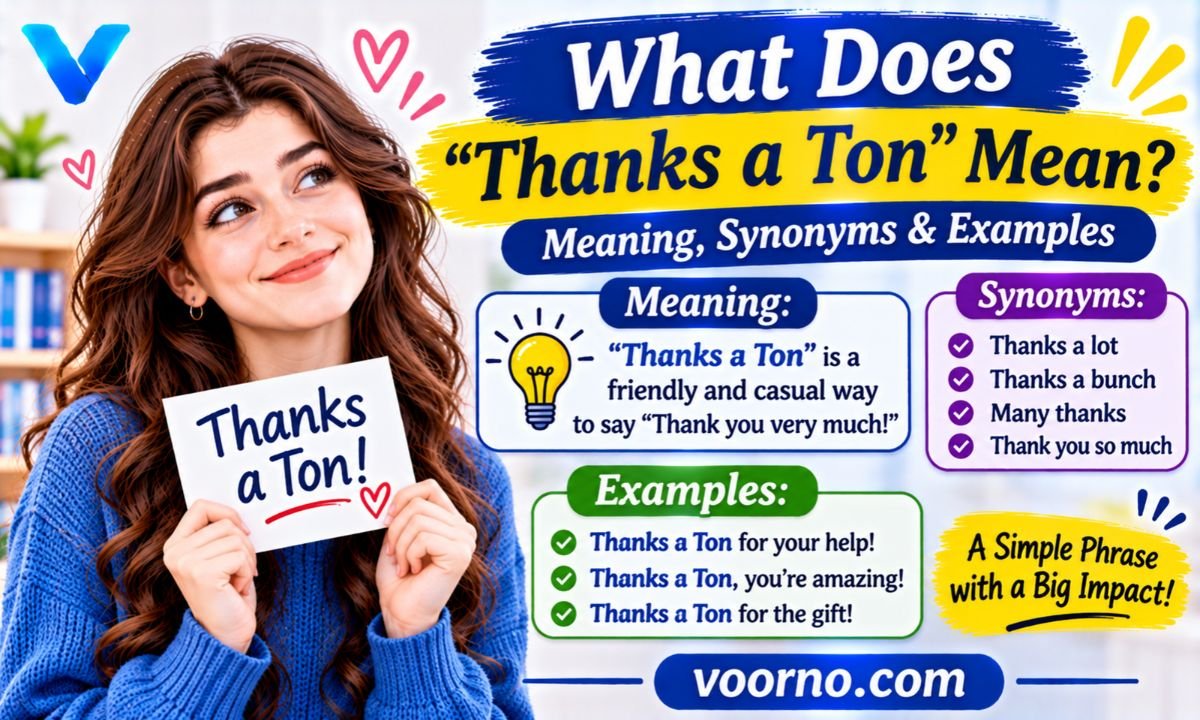
Ever typed “thanks a ton” in a text message and then paused, wondering if it actually makes sense? You’re not alone. This quirky little phrase shows up everywhere — in casual chats, emails, and even workplace Slack messages — yet most people have never stopped to ask where it comes from or whether it’s grammatically sound.
This guide breaks down the meaning, grammar, usage, and best alternatives for “thanks a ton,” so you’ll know exactly when (and when not) to use it.
Is It Correct to Say “Thanks a Ton”?
Yes, “thanks a ton” is grammatically correct and widely accepted in informal English. It’s an idiomatic expression, meaning its meaning isn’t literal — nobody is measuring gratitude in metric tons. Instead, “ton” acts as an exaggeration, similar to saying “thanks a lot” or “thanks a million.”
Because it’s idiomatic rather than literal, you won’t find a strict grammar rule governing it beyond standard sentence structure. It’s simply an established, informal way to intensify a thank-you.
Read More: Choose vs. Select: Meaning, Differences & Examples
What Does “Thanks a Ton” Really Mean?
At its core, “thanks a ton” means “thank you very much” or “I’m extremely grateful.” The word “ton” — a unit of weight — is used figuratively to represent a huge, almost immeasurable amount of appreciation.
Think of it as gratitude with volume turned up. Instead of a simple “thanks,” you’re signaling that the favor, gift, or help meant a lot to you. It’s casual, warm, and slightly playful — which is exactly why it’s popular in everyday conversation and text messaging.
Read More:Currently vs Currently: What’s the Difference? Meaning, Usage & Examples
Why Hyperbolic Gratitude Works Psychologically
Phrases like “thanks a ton,” “thanks a million,” or “thanks a bunch” all rely on hyperbole — deliberate exaggeration for emotional effect. Psychologically, this works because:
- Exaggeration signals sincerity. Overstating gratitude subconsciously tells the listener that ordinary words weren’t enough to express how you feel.
- It builds rapport. Casual, colorful language feels warmer and more personal than a flat “thank you.”
- It reduces social distance. Hyperbolic phrases are informal by nature, which makes the exchange feel friendlier and less transactional.
This is why gratitude researchers often note that the way thanks is expressed can matter as much as the fact that it was expressed at all.
Practical Tips for Using “Thanks a Ton” Effectively
- Use it with friends, family, classmates, or close colleagues.
- Pair it with a specific reason for extra impact: “Thanks a ton for covering my shift.”
- Avoid it in formal emails, legal documents, or first-time professional introductions.
- Don’t overuse it — repeating it in every message dilutes its impact.
- Match the tone of the conversation; if the exchange is formal, switch to a more polished alternative.
Is “Thanks a Ton” Better Than “Thank You”?
Neither is objectively “better” — they serve different purposes.
| Aspect | “Thank You” | “Thanks a Ton” |
| Tone | Neutral, polite | Casual, enthusiastic |
| Formality | Works everywhere | Informal contexts only |
| Emotional intensity | Standard | Heightened |
| Best used with | Anyone, including strangers | Friends, peers, casual colleagues |
If you need safe, universal politeness, “thank you” wins. If you want to convey extra warmth or excitement, “thanks a ton” does the job better.
When to Avoid Saying “Thanks a Ton”
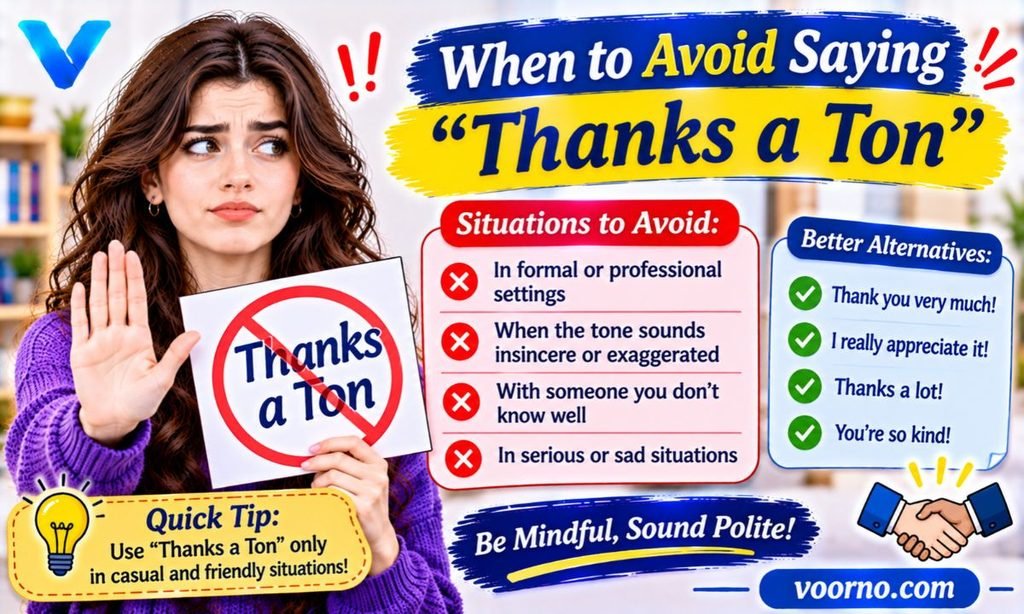
- In formal business emails or official correspondence
- When addressing senior executives, clients, or dignitaries
- In academic writing or professional reports
- During legal, medical, or government communications
- When the tone of the conversation is serious or somber
In these situations, hyperbolic phrases can come across as unprofessional or overly casual.
Grammar Breakdown of “Thanks a Ton”
Structurally, the phrase follows this pattern:
- Thanks — plural noun functioning as an interjection of gratitude
- a — indefinite article
- ton — noun used figuratively (not literally a unit of weight)
Together, they form a fixed idiomatic phrase. You generally can’t rearrange or modify the structure (e.g., “a thanks ton” is incorrect), because idioms follow set word order rather than standard grammatical flexibility.
Formal vs Informal: Where “Thanks a Ton” Fits
“Thanks a ton” sits firmly on the informal end of the gratitude spectrum. It belongs in:
- Text messages and DMs
- Social media comments
- Casual emails to friends or peers
- Everyday spoken conversation
It does not belong in cover letters, formal reports, client-facing emails, or any communication where professionalism is expected.
Appropriateness Table
| Context | Appropriate? | Better Alternative (if not) |
| Texting a friend | Yes | — |
| Casual work chat with peers | Yes | — |
| Email to your manager | Situational | “Thank you so much” |
| Client or vendor email | No | “I sincerely appreciate it” |
| Job application/cover letter | No | “Thank you for your consideration” |
| Public speech or presentation | No | “I am truly grateful” |
Thanks a Ton Synonyms
If you want variety without losing the enthusiastic tone, try:
- Thanks a lot
- Thanks a million
- Thanks a bunch
- Huge thanks
- Big thanks
- Massive thanks
- Thanks loads
- Thanks heaps
Each carries a similar informal warmth but can be swapped in for variety in casual writing or speech.
Better Professional Alternatives

When “thanks a ton” feels too casual, swap it for:
- “Thank you so much for your help.”
- “I truly appreciate your support.”
- “I’m very grateful for your assistance.”
- “Many thanks for taking the time.”
- “I sincerely appreciate your effort on this.”
These preserve warmth while sounding polished and workplace-appropriate.
Thanks a Tonne or Thanks a Ton
Both spellings exist, but the difference comes down to regional spelling conventions:
- “Ton” is standard in American English.
- “Tonne” refers to a metric ton and is more common in British and international contexts, though it’s less frequently used in this specific idiom.
For the gratitude expression, “thanks a ton” is the far more common and widely recognized spelling, regardless of region.
Cultural and Regional Use of “Thanks a Ton”
The phrase is especially popular in Indian English and South Asian English, where it’s used frequently in both spoken and written casual communication, including workplace chats. In American and British English, it’s understood and used, though phrases like “thanks a million” or “thanks a lot” may appear slightly more often in everyday speech.
Regardless of region, the phrase is universally understood as an informal, friendly way to say thank you.
Alternatives to “Thanks a Ton”
Beyond direct synonyms, consider these creative ways to express gratitude:
- “I owe you one.”
- “You’re a lifesaver.”
- “Couldn’t have done it without you.”
- “This means a lot to me.”
- “I can’t thank you enough.”
These alternatives add personality while still communicating sincere appreciation.
Thanks a Ton in Sentence
Here are some natural, real-world examples:
- “Thanks a ton for helping me move this weekend!”
- “You fixed my laptop in minutes — thanks a ton.”
- “Thanks a ton for the birthday gift, I love it.”
- “Really appreciate the quick response, thanks a ton.”
- “Thanks a ton for covering my class today.”
Quick Comparison: Gratitude Expression Strength Chart
| Phrase | Formality Level | Emotional Intensity |
| Thank you | High | Standard |
| Thanks | Medium | Standard |
| Thanks a lot | Low | Slightly elevated |
| Thanks a ton | Low | High |
| Thanks a million | Low | Very high |
| I am deeply grateful | High | Very high |
Politeness and Etiquette in Gratitude Expressions
Good etiquette isn’t about choosing the “fanciest” words — it’s about matching tone to context. A few etiquette basics:
- Always thank someone promptly; delayed gratitude can feel insincere.
- Be specific about what you’re thanking them for.
- Match your language formality to your relationship and setting.
- In professional settings, err on the side of slightly more formal phrasing.
- A handwritten or personal note carries more weight than a quick phrase, regardless of wording.
Real-World Case Studies
Case 1: Workplace Slack Message An employee thanked a colleague with “thanks a ton for jumping on that bug fix.” The casual tone matched the team’s relaxed Slack culture and was well received.
Case 2: Client Email A freelancer initially wrote “thanks a ton” in a client proposal email. After review, they replaced it with “I truly appreciate the opportunity,” which came across as more professional and client-appropriate.
Case 3: Customer Service Chat A support agent used “thanks a ton for your patience” in a live chat. Customers responded positively, noting the phrase felt warm and human rather than scripted.
These examples show that context — not the phrase itself — determines whether “thanks a ton” is the right choice.
Thanks a Ton Formal
There isn’t a “formal version” of the phrase itself, since its informality is baked into its structure. If you need a formal equivalent that conveys similar intensity, use:
- “I am extremely grateful for your assistance.”
- “Please accept my sincere thanks.”
- “I deeply appreciate your support in this matter.”
FAQs
Q:Is it correct to say “thanks a ton”?
Yes, it’s grammatically correct and commonly used, though it’s informal and best suited for casual conversations rather than formal writing.
Q:What is ton in chat?
In chat and texting, “ton” is used figuratively to mean “a lot,” turning “thanks a ton” into a casual way of saying “thank you very much.”
Q:How to reply thanks a ton?
You can respond with “You’re welcome,” “Anytime,” “No problem,” or “Happy to help” — all of which match its casual tone.
Q:What is a ton in slang?
In slang, “a ton” simply means a large amount or quantity of something, not a literal measurement of weight.
Q:What to say instead of “thanks a lot”?
Try “thanks a ton,” “thanks a million,” “many thanks,” or “I really appreciate it” as friendly alternatives.
Conclusion
“Thanks a ton” is a warm, informal way to express heightened gratitude, perfect for friends, casual colleagues, and everyday conversations. While it’s not suited for formal or professional writing, it adds personality and warmth wherever casual communication is welcome.
Knowing when to use it — and when to switch to a more polished alternative — helps you express genuine appreciation in any situation, without missing the mark on tone.










2 thoughts on “What Does “Thanks a Ton” Mean? Meaning, Synonyms & Examples”