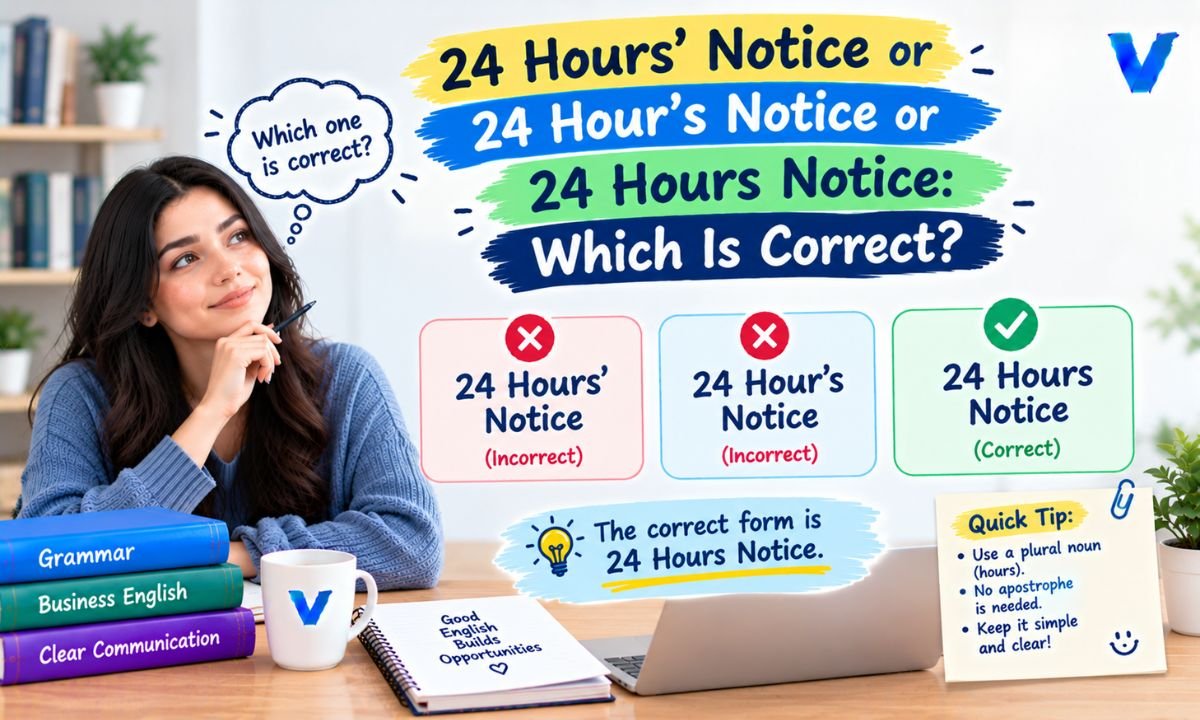
If you’ve ever paused mid-email wondering where that apostrophe goes, you’re not alone. “24 hours’ notice,” “24 hour’s notice,” and “24 hours notice” all show up in contracts, workplace policies, and lease agreements — but only one of them is grammatically correct.
The short answer: “24 hours’ notice” is correct. The apostrophe goes after the “s” because “hours” is plural, and the notice period belongs to that plural span of time.
But knowing the rule is only half the battle. In this guide, you’ll learn exactly why this form wins out, how the possessive rule works for duration phrases, and how to avoid the same mistake in contracts, emails, and everyday writing.
Why the Grammar Behind Notice Periods Matters
Grammar might seem like a minor detail, but in formal writing — especially legal and HR documents — a misplaced apostrophe can create real confusion. A lease clause, an employment contract, or a cancellation policy relies on precise wording to hold up in disputes.
24 hours notice meaning: the phrase simply refers to a requirement to inform someone at least a full day (24 hours) before an action takes place — think of resignation notices, appointment cancellations, or landlord entry requirements. The meaning stays the same across all three versions, but only one version is grammatically sound enough for professional use.
Using the wrong form doesn’t just look sloppy — it can make a document appear rushed or unedited, which matters when clarity and enforceability are on the line.
Read More:On the List or In the List? The Correct Usage Explained
The Grammar Behind Time-Based Phrases

English uses the possessive form for expressions of time, distance, and value even when there’s no literal “ownership” involved. This is why we say:
- A day’s work
- Two weeks’ notice
- Three months’ salary
- Ten dollars’ worth
The same rule applies to “24 hours’ notice.” The hours don’t literally “own” anything, but grammatically, the possessive apostrophe shows that the notice period is measured by that unit of time.
Hours notice apostrophe
The apostrophe in “hours’ notice” follows the standard rule for plural possessives: add an apostrophe after the final “s.” Since “24 hours” is already plural, you simply add the apostrophe — no extra “s” needed.
Read More:Master’s Student vs Masters Student vs MS Student: A Complete Guide
Understanding Apostrophes in Duration Expressions
Apostrophes in English serve two main jobs: showing possession and marking contractions. In time expressions like “24 hours’ notice,” the apostrophe is doing possessive work, treating the time period almost like an “owner” of the noun that follows.
Why Apostrophe Placement Matters
- Singular possessive: apostrophe + s (e.g., “one hour’s notice”)
- Plural possessive: s + apostrophe (e.g., “24 hours’ notice”)
- No apostrophe: implies no possession at all, which breaks the grammatical logic of the phrase
Getting this placement wrong changes what the sentence technically implies, even if most readers would still understand your intended meaning.
Breaking Down the Three Variants
Let’s look at each version individually.
- 24 hours’ notice — Correct. Plural possessive; the notice is measured in a 24-hour span.
- 24 hour’s notice — Incorrect. This wrongly treats “hour” as singular, implying only one hour owns the notice.
- 24 hours notice — Incorrect (in formal writing). This drops possession entirely, leaving “hours” and “notice” awkwardly stacked with no grammatical link.
Hours notice” or hours notice
Some writers mistakenly place the apostrophe outside the word entirely or skip it altogether. Neither approach reflects standard English usage. If you’re unsure, default to the plural possessive: hours’ notice.
Real Usage Examples in Everyday Writing

Here’s how the correct and incorrect forms appear in real-world contexts:
- ✅ “Please provide 24 hours’ notice before cancelling your appointment.”
- ❌ “Please provide 24 hour’s notice before cancelling your appointment.”
- ✅ “Tenants must give 24 hours’ notice before the landlord enters the property.”
- ❌ “Tenants must give 24 hours notice before the landlord enters the property.”
- ✅ “We require two weeks’ notice for resignation.”
Table: Correct vs Incorrect Usage
| Phrase | Correct? | Why |
| 24 hours’ notice | ✅ Yes | Plural possessive matches plural time unit |
| 24 hour’s notice | ❌ No | Implies singular possession (only one hour) |
| 24 hours notice | ❌ No | Missing possessive apostrophe entirely |
| 1 hour’s notice | ✅ Yes | Singular possessive is correct for one hour |
| Two weeks’ notice | ✅ Yes | Same plural possessive rule applies |
Alternative Phrasing to Avoid Apostrophe Confusion
If you’d rather sidestep the apostrophe question altogether, rephrase the sentence:
- “Notify us at least 24 hours in advance.”
- “A minimum of 24 hours’ advance notice is required.”
- “Provide notice 24 hours before the appointment.”
These alternatives keep your writing clear and professional without relying on the possessive structure.
24 hours notice landlord
This phrase comes up often in rental agreements. Most jurisdictions require landlords to give tenants advance warning — commonly 24 hours’ notice — before entering a rented unit for inspections or repairs. The correct written form in a lease should still read “24 hours’ notice,” since it’s a formal legal document.
Practical Writing Guidelines for Choosing the Right Form

Not sure which version fits your sentence? Use these quick guidelines.
Use “24 hours’ notice” when:
- You’re writing a formal document, contract, or policy
- The sentence describes a required notice period as a noun phrase
- You want grammatically accurate, professional wording
Use “a 24-hour notice” when:
- You’re describing the notice itself as an adjective-noun pair (e.g., “a 24-hour notice period”)
- The phrase functions as a compound modifier before another noun
Use “notify me 24 hours in advance” when:
- You want to avoid the apostrophe debate entirely
- You’re writing casual or conversational content
- Clarity matters more than formal structure
Fast Tests to Check Your Grammar
Here are three quick checks you can run before hitting send:
- The singular swap test — Replace “24 hours” with “one hour.” If it reads “one hour’s notice,” you know the plural version needs “hours’.”
- The ownership test — Ask: does the notice belong to a time period? If yes, use the possessive apostrophe.
- The rewrite test — Try rephrasing as “notice of 24 hours.” If that sounds correct, the possessive form “24 hours’ notice” is too.
Case Study: Employment Contract Clause

Grammar mistakes in contracts aren’t just cosmetic — they can create ambiguity in legally binding text.
Incorrect Clause
“Employees must provide 24 hours notice prior to taking unscheduled leave.”
This version omits the possessive apostrophe, which technically breaks the grammatical link between “hours” and “notice,” even though most readers would still understand the intent.
Correct Clause
“Employees must provide 24 hours’ notice prior to taking unscheduled leave.”
This version reads as polished, professional, and grammatically sound — exactly what you want in a document that may be reviewed by HR, legal teams, or courts.
FAQs
Q:Is “hour’s” or “hours” correct?
It depends on the number. Use “hour’s” for a singular hour (“one hour’s notice”) and “hours'” for plural hours (“24 hours’ notice”).
Q:Does 24 hour have a hyphen?
Yes, when used as a compound adjective before a noun, such as “a 24-hour notice period” or “24-hour service.”
Q:What does “within 24 hours” mean?
It means an action must happen before a full day (24 hours) has passed from a specific starting point, such as a request or event.
Q:Is “24 hours notice” correct grammar?
No. Formal grammar requires the possessive apostrophe: “24 hours’ notice.” Dropping it is common informally but considered incorrect in professional writing.
Q:Is 24 hours 2 days or 1 day?
24 hours equals exactly one full day, not two. It’s the standard length of a single calendar day.
Conclusion
The correct phrase is “24 hours’ notice” — plural possessive, apostrophe after the “s.” While “24 hour’s notice” and “24 hours notice” are common in casual writing, they don’t hold up to formal grammar rules.
Whether you’re drafting a lease, an employment policy, or a simple email, using the correct form signals attention to detail and professionalism. When in doubt, either apply the possessive rule correctly or sidestep it altogether with a rephrased sentence like “notify 24 hours in advance.”










2 thoughts on “24 Hours’ Notice or 24 Hour’s Notice or 24 Hours Notice: Which Is Correct?”