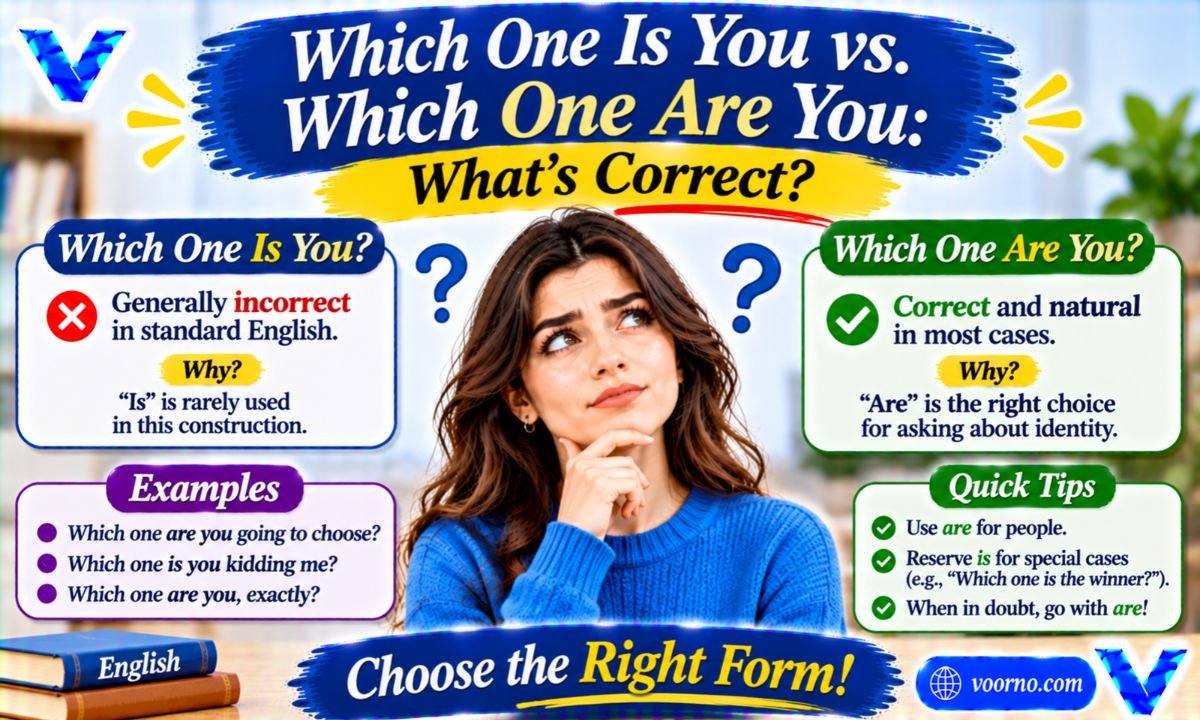
If you’ve ever paused mid-sentence wondering whether to say “which one is you” or “which one are you,” you’re not alone. This tiny grammar question trips up native speakers and English learners alike. The good news: the rule is simple once you see it clearly, and this guide breaks it down in plain English with examples you’ll actually use.
Quick answer: Which one is correct and why
“Which one are you?” is the grammatically correct form in standard English.
Here’s why: the pronoun you always pairs with are, whether you’re talking about one person or several. English doesn’t change “are” to “is” for singular “you” the way it does for “he,” “she,” or “it.” So even though “one” is singular and might tempt you toward “is,” the real subject you’re addressing is “you” — and “you” never takes “is.”
- ✅ Correct: Which one are you?
- ❌ Incorrect: Which one is you?
Why this question confuses so many people
The confusion isn’t random — it comes from a genuine grammatical illusion. “One” sits right next to the verb, so your brain wants to match them: “one is.” But “one” here isn’t the true subject of the question; it’s part of a noun phrase being pointed at, while “you” is the actual subject receiving the verb. Add in fast, casual speech where people often drop grammar precision, and the mix-up becomes common enough to search for.
Read More: Thank You Everyone or Thank You All: Meaning and Usage
Which one is you vs which one are you examples
| Sentence | Correct? | Notes |
| Which one are you in this photo? | ✅ Yes | Standard, natural English |
| Which one is you in this photo? | ❌ No | Common spoken slip |
| Which one are you — the cat or the dog? | ✅ Yes | Works in metaphorical questions too |
| Can you tell me which one you are? | ✅ Yes | Indirect question, same rule applies |
| Which one am I? | ✅ Yes | First-person version, “am” matches “I” |
The core rule you actually need
Subject-verb agreement in English pairs pronouns with fixed verb forms:
- I → am
- He / She / It → is
- You / We / They → are
Since “you” is the subject being asked about in this question, “are” is the only correct match — regardless of how singular “one” looks.
Read More: Chateaus vs. Chateaux Explained: Spelling, Meaning & Usage
Breaking down sentence structure: What’s really being asked

“Which one are you?” is an inverted question. In normal word order, it reads: “You are which one?” Flip it back, and the grammar becomes obvious — nobody would say “you is which one.” The inversion (placing the verb before the subject to form a question) is what hides the correct pairing and makes “is” feel tempting.
Subject-verb agreement table (clear and practical)
| Pronoun | Correct Verb | Example |
| I | am | Which one am I? |
| You | are | Which one are you? |
| He / She / It | is | Which one is she? |
| We | are | Which one are we? |
| They | are | Which one are they? |
Is “Which One Is You?” ever acceptable?
Not in standard written or formal spoken English. You might hear it in:
- Very casual or regional speech
- Fiction dialogue meant to capture a specific voice or dialect
- Direct translations by non-native speakers whose first language treats “you” as strictly singular
Even in these cases, most listeners will register it as an error rather than a stylistic choice.
Why “Which One Are You?” sounds natural to Americans
American English treats “you” identically whether it refers to one person or a group — there’s no separate singular form like some other languages use. Because “are” is drilled into this pattern from childhood (“you are,” never “you is”), the correct version simply sounds right to native ears, even before anyone explains the rule.
Real-life examples you’ll actually hear
- “Which one are you in the family photo?”
- “Which one are you rooting for tonight?”
- “In this lineup, which one are you?”
- “Which one are you playing in the game?”
- “Tell me which one you are so I can find you.”
Common mistakes and why they happen

- Matching “is” to “one” instead of “you” — the nearest noun wins attention over the true subject.
- Second-language transfer — some languages don’t distinguish singular/plural “you,” causing direct mistranslation.
- Speed and casual speech — spoken shortcuts often skip careful agreement.
- Visual/audio bias — “one” simply feels singular, pulling speakers toward “is.”
Quick decision chart: Choose “is” or “are” in two seconds
- Is the subject you? → Use are.
- Is the subject he, she, or it? → Use is.
- Is the subject I? → Use am.
- Still unsure? Flip the sentence: “You ___ which one?” If “are” fits, that’s your answer.
How Americans actually use these phrases in daily speech
In everyday conversation — identifying someone in a photo, a lineup, a video call, or a group chat — “which one are you?” is the default. It’s short, direct, and instantly understood. “Which one is you?” does slip out in fast or informal talk, but it’s widely recognized as nonstandard, even by people who use it casually.
Regional differences
Some dialects and informal regional speech patterns relax subject-verb agreement rules generally, not just with this phrase. These variations are social and regional markers of speech, not accepted standard grammar, and they should be avoided in writing, school, and professional settings.
Editing and proofreading: Spotting and fixing errors
When proofreading, isolate the question and reverse it mentally. If the reversed sentence sounds wrong (“you is”), the original needs fixing. Editors and writing tools commonly flag “which one is you” as a subject-verb agreement error for this exact reason.
Before-and-after examples
| Before (Incorrect) | After (Correct) |
| Which one is you in the group photo? | Which one are you in the group photo? |
| Which one is you playing tonight? | Which one are you playing tonight? |
| Can you tell me which one is you? | Can you tell me which one you are? |
Which one is you vs which one are you answer
To settle it plainly: “which one are you” is correct; “which one is you” is not, except as an informal, nonstandard variant you might hear but shouldn’t write. The rule never changes based on context — only the tone (casual vs. formal) shifts how strictly people follow it.
Practical alternatives that avoid the issue
If you want to sidestep the question entirely, try:
- “Point yourself out in this picture.”
- “Tell me which one you are.”
- “Which one represents you?”
- “Can you identify yourself in the lineup?”
When native speakers break the rules
Native speakers do occasionally use nonstandard grammar for effect — casual texting, song lyrics, dialogue meant to sound folksy or regional, or fast conversational shorthand. These are stylistic or social choices, not evidence that “which one is you” is standard grammar.
Case study: Classroom confusion and teacher fix
A middle-school English teacher noticed several students writing “which one is you” on a class worksheet about self-introductions. Instead of just correcting the answer, she had students reverse each sentence aloud (“you is which one?” vs. “you are which one?”). Hearing the wrong version out loud made the error obvious immediately, and the mistake dropped sharply on the next assignment — proof that the “reverse the sentence” trick works well for learners of any age.
Quotes about usage and clarity
Grammar guides consistently emphasize that clarity depends on consistent subject-verb agreement, especially in questions where word order is inverted. As many style resources put it, correct agreement isn’t just a rule for rule’s sake — it’s what keeps a sentence instantly understandable to the reader or listener.
Common pitfalls and how to correct them fast
- Pitfall: Matching the verb to “one” instead of “you.” Fix: Always trace the verb back to “you.”
- Pitfall: Assuming singular meaning requires “is.” Fix: Remember “you” is grammatically exceptional — it always takes “are.”
- Pitfall: Writing how you’d say it casually. Fix: Proofread formal writing separately from how it sounds in speech.
Quick reference: You and verb agreement
| Tense | Correct Form |
| Present | You are |
| Present (question) | Are you…? |
| Past | You were |
| Past (question) | Were you…? |
Examples showing the hidden subject in similar constructions
- “Who are you?” — not “who is you”
- “Where are you?” — not “where is you”
- “How are you?” — not “how is you”
Each follows the identical pattern: “you” always demands “are.”
More advanced notes: When “one” can control the verb
“One” does control the verb in other constructions — for example, “Which one is correct?” is right because here “one” (referring to a thing, not a person being addressed as “you”) is genuinely the subject. The distinction is what the sentence is asking about: a thing identified by “one” takes “is”; the pronoun “you” always takes “are,” no matter what surrounds it.
Practice drills you can use right now
- Fill in the blank: “Which one ___ you?” (Answer: are)
- Rewrite: “Which one is you in this lineup?” → correct version
- Reverse test: “You ___ which one?” then apply that verb to the original question
Common classroom error and solution table
| Student Error | Why It Happens | Correction Method |
| Which one is you? | Matching “is” to “one” | Reverse the sentence aloud |
| Which one is we? | Overgeneralizing singular pattern | Substitute a name: “which one is Sara?” vs “which one are we?” |
| Which one is they? | Confusing singular “one” with plural pronoun | Memorize: they/we/you always take “are” |
Editing tips for writers and editors
- Read questions aloud and listen for the “you is” mismatch.
- Use a grammar checker, but verify its suggestion against the reversal trick.
- When editing dialogue, decide deliberately whether nonstandard grammar serves the character’s voice — don’t let it slip in by accident.
Which one is you vs which one are you quiz
Test yourself: Which sentence is correct?
- “Which one ___ you in the video?” (is / are)
- “Which one ___ she in the photo?” (is / are)
- “Which one ___ I supposed to pick?” (am / is / are)
(Answers: 1. are, 2. is, 3. am)
FAQs
Q:Which is correct, is you or are you?
“Are you” is correct. The pronoun “you” always pairs with “are,” never “is,” in standard English.
Q:Which is correct, “which is” or “which are”?
It depends on the subject: use “which is” for a singular noun and “which are” for a plural noun or the pronoun “you.”
Q:Is or are which one is singular?
“Which one” refers to a singular item or person, but when the subject is “you,” the verb “are” is still used because “you” doesn’t follow standard singular agreement rules.
Q:Can you use “which one” in a sentence?
Yes — “which one” is a common phrase used to ask someone to identify or choose among options, as in “Which one do you like best?”
Q:Which one is the correct tense?
Both “is” and “are” are present tense; the choice depends on the subject, not the tense, so pick the verb that matches the pronoun you’re using.
Conclusion
The rule behind “which one is you” vs. “which one are you” comes down to one simple fact: “you” always takes “are.” No matter how singular “one” looks sitting next to the verb, the true subject of the question is “you,” and English never lets that pronoun pair with “is.”
Use the reversal trick — “you ___ which one?” — whenever you’re unsure, and you’ll get it right every time, in writing, in interviews, and in everyday conversation.










2 thoughts on “Which One Is You vs. Which One Are You: What’s Correct?”