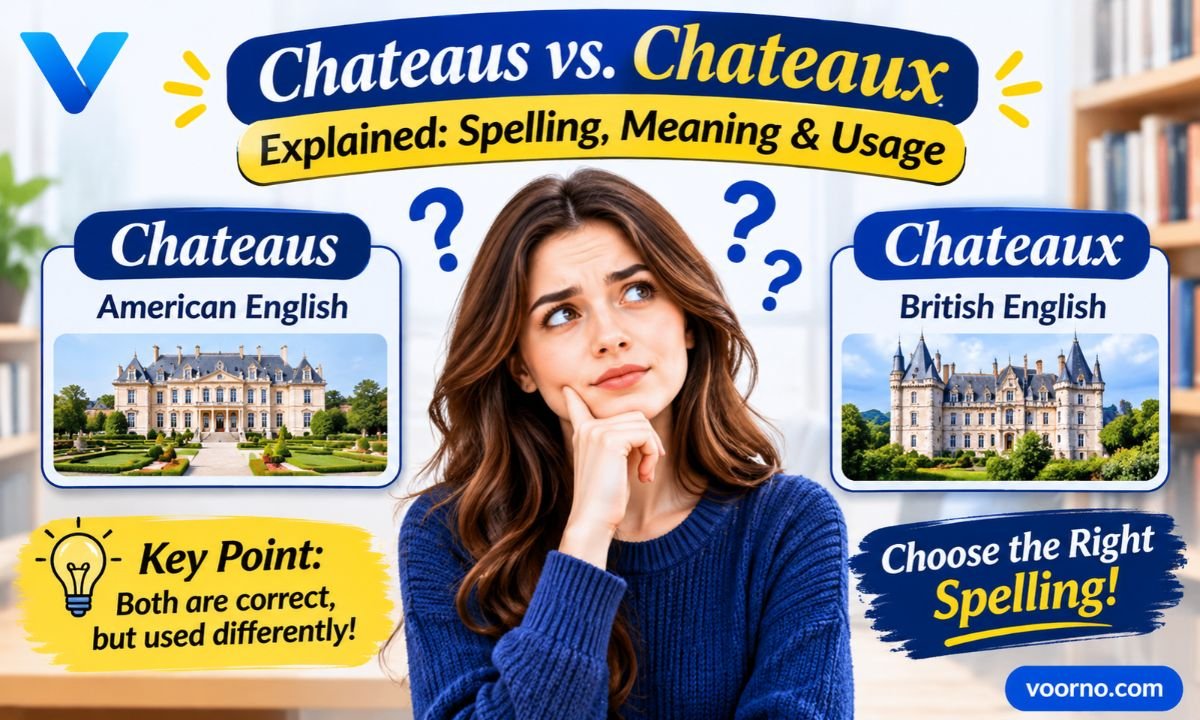
If you’ve ever paused mid-sentence wondering whether to write “chateaus” or “chateaux,” you’re not alone. This one small spelling choice trips up travel writers, wine lovers, real estate agents, and students alike. The good news: once you understand where the word comes from, the confusion disappears for good.
This guide breaks down the meaning, pronunciation, plural rules, and real-world usage of château — plus how it differs from a castle, palace, or manor.
Why “Chateaus vs. Chateaux” Confuses So Many Writers
The confusion exists because château is a French loanword living inside English. French and English pluralize words differently, and château sits right at that crossroads. Add in the fact that both spellings appear in newspapers, novels, and wine labels, and it’s easy to assume one of them must be a typo. Neither is — they simply serve different contexts.
What Does “Château” Actually Mean?
In French, château translates literally to “castle,” but its everyday meaning is much broader. It can refer to a fortified medieval structure, a Renaissance-era palace, a countryside manor, or even a wine estate with no castle-like building at all.
What does château mean in english
In English, château (or the anglicized “chateau”) usually describes a large, elegant French-style country house or estate — often associated with luxury, history, or vineyards, rather than military fortification.
Read More: Which One Is You vs. Which One Are You: What’s Correct?
Château vs. Castle vs. Palace vs. Manor
These four words overlap, but each carries a distinct connotation.
| Term | Primary Purpose | Fortified? | Typical Setting |
| Château | Noble residence, estate, or winery | Sometimes | French countryside |
| Castle | Military defense and lordship | Almost always | Hilltops, strategic borders |
| Palace | Royal or state residence | Rarely | Cities, capitals |
| Manor | Landed gentry’s home | Rarely | Rural estates |
Key takeaway: a castle is built to defend; a palace is built to impress a court; a manor is a working estate house; a château can be any — or none — of these, depending on era and region.
Read More: Is It “Envolved” or “Involved”? Learn the Correct Word
Chateaus vs. Chateaux — The Plural Debate Explained
This is the heart of the matter, so let’s settle it clearly.
The French Plural: Chateaux
In standard French grammar, nouns ending in “-eau” form their plural by adding an “-x,” not an “-s.” So château becomes châteaux, following the same pattern as gâteau/gâteaux and eau/eaux. This is the historically “correct” plural and the one most style guides, dictionaries, and academic writers prefer.
Clear Verdict on Chateaus vs. Chateaux
Both are acceptable in modern English, but they’re not interchangeable in tone:
- Chateaux — the traditional French plural; preferred in formal, historical, literary, and wine-industry writing.
- Chateaus — the anglicized plural; common in casual writing, American real estate listings, and everyday speech.
Neither is “wrong.” Style, audience, and context decide which one fits best — just stay consistent within a single piece of writing.
Chateau pronunciation
Château is pronounced roughly “sha-TOH” in both French and English (the final consonant is silent). The plural chateaux is pronounced the same way, since the French “-x” ending is also silent — only the spelling changes, not the sound.
How English Handles Foreign Plurals

English regularly borrows words from other languages and either keeps the original plural or “Anglicizes” it over time.
Common Examples
- Cactus → cacti (or cactuses)
- Bureau → bureaux (or bureaus)
- Criterion → criteria
- Chateau → chateaux (or chateaus)
This pattern shows that château isn’t unusual — it’s following a well-worn path that many borrowed nouns take as they settle into English.
Château names
Famous châteaux often carry the names of their noble owners or regions, such as Château de Chambord, Château de Versailles (historically), and Château Frontenac in Canada, which is actually a hotel rather than a private residence.
What Makes a Château Different from a Castle?
While English speakers often use the words interchangeably, the French distinction is more nuanced. A castle (château fort) was built primarily for defense, with thick walls, moats, and towers. A château, especially from the Renaissance onward, prioritized elegance, gardens, and comfort over military function.
Structural Characteristics
- Castles: thick stone walls, drawbridges, battlements, arrow slits
- Châteaux: large windows, symmetrical façades, ornamental gardens, decorative turrets (for style, not defense)
- Shared traits: grand scale, historical significance, association with nobility
The Historical Evolution of the Château
Medieval châteaux began as fortified strongholds, much like castles. As France stabilized politically, especially after the Middle Ages, nobility shifted their priorities from defense to display.
19th-Century Romantic Revival
The 1800s saw a resurgence of château-style architecture across France and beyond, blending medieval-inspired towers with modern comforts. Wealthy families — and later, American industrialists — built “chateauesque” mansions that borrowed turrets and steep rooflines purely for aesthetic charm.
Chateau in France for sale
Today, hundreds of historic châteaux across France are listed for sale, ranging from modest countryside manors to sprawling estates with vineyards, appealing to international buyers drawn to French heritage and lifestyle.
The Château in the Wine Industry

Few contexts use “château” more than the wine world, particularly in Bordeaux.
Legal Definition in Bordeaux
Under French law, the term château on a wine label indicates that the wine was made exclusively from grapes grown on that estate’s vineyards, with the winemaking process carried out on the property itself. It doesn’t require an actual castle-like building — some “châteaux” are little more than a modest cellar.
Case Study: Château Margaux
Château Margaux, one of Bordeaux’s most prestigious estates, exemplifies the term at its grandest — combining a historic building, extensive vineyards, and centuries-old winemaking tradition under one name. It remains part of the famous 1855 Bordeaux Classification, alongside estates like Château Lafite Rothschild and Château Latour.
Chateau mansion
Outside the wine trade, “chateau mansion” is a popular real estate phrase describing large, French-inspired homes with steep roofs, turrets, and stone or stucco façades — a style especially popular in parts of the United States.
American and Global Adoption of the Word
American builders and developers popularized “chateau-style” architecture throughout the 19th and 20th centuries, and the trend continues in luxury home listings today. In everyday American English, “chateaus” is frequently used for the plural, reflecting a general pattern of simplifying borrowed foreign words.
Cultural and Symbolic Meaning
Beyond architecture, château carries strong associations with elegance, heritage, wealth, and French culture. It’s often used metaphorically to suggest sophistication — “a chateau in the hills” evokes romance and prestige even when the building itself is modest.
Quick Reference Guide: Chateaus vs. Chateaux
| Situation | Recommended Plural |
| Academic or formal writing | Chateaux |
| Wine industry / French heritage topics | Chateaux |
| Casual blog or conversational tone | Chateaus |
| U.S. real estate listings | Chateaus |
| Travel writing about France | Chateaux |
Common Mistakes in the Chateaus vs. Chateaux Debate
- Assuming chateaux is always “more correct” — both are valid in English
- Mixing both spellings within the same article
- Pronouncing the “x” in chateaux (it’s silent)
- Confusing château (a building/estate) with a literal castle in every case
- Forgetting the circumflex (^) when writing “château” formally
FAQs
Q:How do you pronounce “Châteaux” in English?
It’s pronounced “sha-TOH,” identical to the singular “chateau” — the final “x” is silent in both French and English.
Q:What is the difference between “Chateau” and “Chateaux”?
Chateau is singular (one estate or building); chateaux is the plural, referring to two or more.
Q:Is “Château” a masculine or feminine word?
Château is a masculine noun in French, taking the article “le” (le château).
Q:What is the most famous château in France?
Château de Versailles and Château de Chambord are among the most internationally recognized, alongside wine estates like Château Margaux.
Q:What is another word for château?
Depending on context, synonyms include manor, mansion, estate, palace, or country house.
Conclusion
At the end of the day, chateaus vs. chateaux isn’t a battle with a single winner — it’s a choice shaped by tone and audience. Reach for chateaux when writing formally, historically, or about French wine estates; choose chateaus for casual, modern, or American contexts.
Either way, understanding the word’s French roots, its architectural meaning, and its cultural weight will help you use it with confidence — and write with the polish of someone who truly knows the difference.










2 thoughts on “Chateaus vs. Chateaux Explained: Spelling, Meaning & Usage”