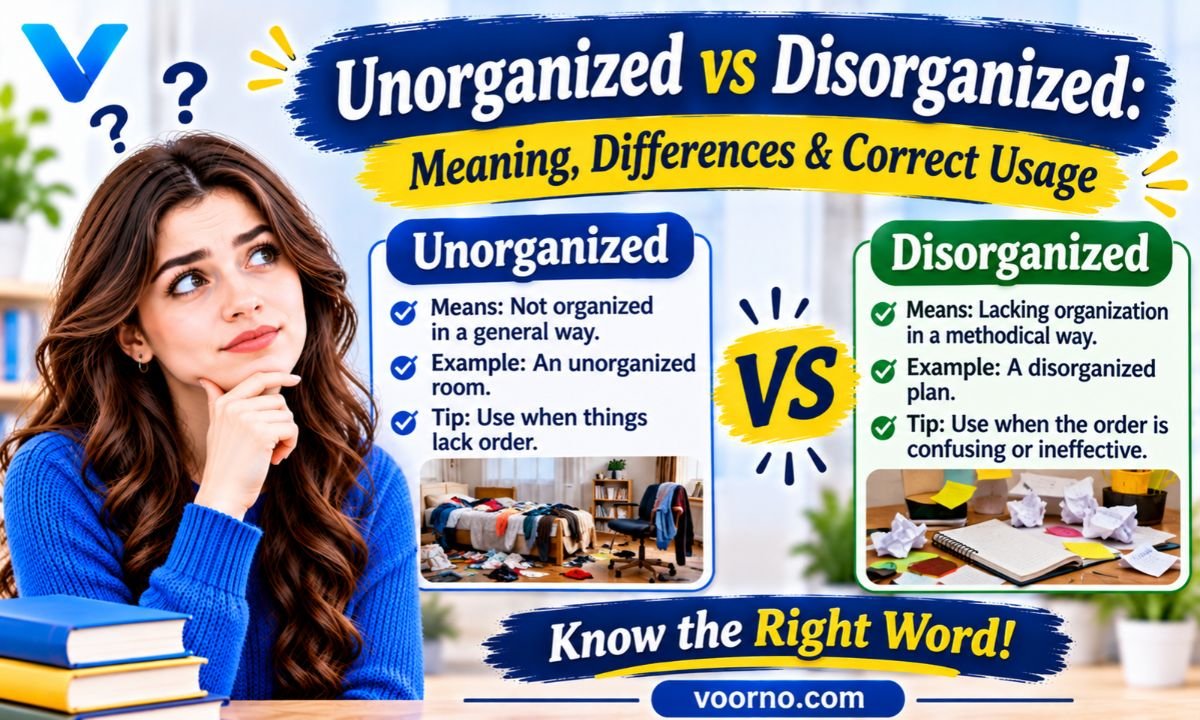
If you’ve ever paused mid-sentence wondering whether to call something “unorganized” or “disorganized,” you’re not alone. These two words look almost identical, sound similar, and get tossed around interchangeably in everyday speech. Yet English rarely creates two words for the exact same idea without a reason.
This guide breaks down the real meaning of unorganized vs disorganized, explains why their prefixes matter, and shows you — through examples, a comparison table, and a quick decision guide — exactly which word fits which situation.
Two Words That Seem Identical but Aren’t
At first glance, both words describe a lack of order. But the type of disorder they describe is different.
- Unorganized describes something that was never put into order in the first place.
- Disorganized describes something that used to have order but has since fallen apart.
That single distinction — never organized vs. no longer organized — is the key to using these words correctly. Keep it in mind as you read on, because it explains almost every rule and example that follows.
Read More: Is It “Envolved” or “Involved”? Learn the Correct Word
Core Definitions
Unorganized
Unorganized is an adjective used to describe a state of neutrality — things simply haven’t been arranged, categorized, or structured yet. There’s no judgment of failure baked into the word; it’s descriptive, not critical.
Common meanings include:
- Not arranged in a structured or systematic way
- Not sorted, labeled, or categorized
- Not unionized (used for workers or labor groups)
- Lacking the structure of a living organism (in biological or scientific contexts)
Example: “The new employee’s desk drawer was unorganized, with pens, cables, and sticky notes mixed together.”
Disorganized
Disorganized is also an adjective, but it carries a stronger, more negative connotation. It implies that order existed at some point and has since broken down — often due to neglect, chaos, or poor management.
Common meanings include:
- Thrown into disorder or confusion
- Lacking coordination or planning
- Inefficient, chaotic, or poorly managed (often describing people, teams, or systems)
Example: “After the move, the once-tidy office turned completely disorganized, with files scattered everywhere.”
Read More:“At Your Convenience” Meaning: How and When to Use It
Unorganized vs Disorganized Meaning
Here’s the simplest way to remember it:
| Concept | Unorganized | Disorganized |
| Starting point | Never had structure | Once had structure |
| Tone | Neutral | Negative |
| Implies | Absence of order | Breakdown of order |
| Common use | Items, data, materials | People, systems, processes |
In short, unorganized = “not yet organized,” while disorganized = “was organized, now isn’t.”
The Role of Prefixes: Why “Un-” and “Dis-” Are Not Interchangeable
The difference between these two words traces back to their prefixes, and understanding this makes the distinction much easier to remember.
- “Un-“ generally means “not.” It negates a quality without suggesting change over time. An unorganized closet simply hasn’t been sorted — there’s no story of decline attached to it.
- “Dis-“ typically implies reversal, removal, or a negative shift away from a prior state. A disorganized team was, at some point, functioning with structure that has since collapsed.
This is why native speakers instinctively reach for “disorganized” when describing chaos that resulted from a breakdown, and “unorganized” when describing something that’s simply raw, unsorted, or untouched.
Both words are grammatically correct and appear in major dictionaries, including Merriam-Webster and the Oxford English Dictionary — so this isn’t a case of one being “wrong.” It’s a case of nuance.
Unorganized vs Disorganized Examples
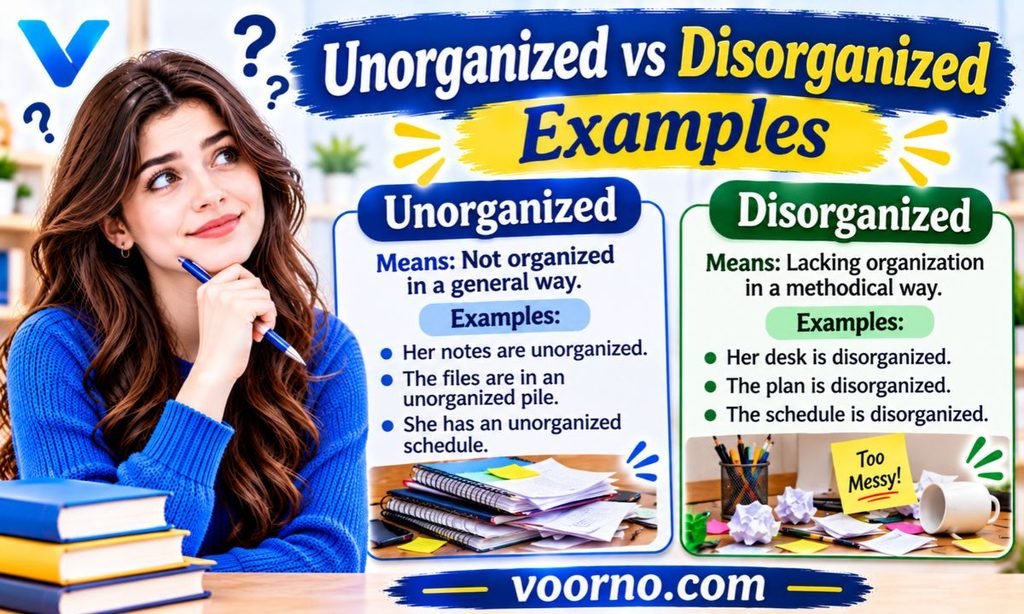
Seeing the words in context makes the difference click faster than any definition can.
Unorganized in a sentence:
- Our garage is still unorganized since we haven’t unpacked the moving boxes.
- The research notes were unorganized, so I had to sort them by topic before writing.
- Non-unionized labor is sometimes referred to as unorganized labor.
Disorganized in a sentence:
- The manager was criticized for running a disorganized meeting with no clear agenda.
- Her thoughts felt disorganized after the sudden bad news.
- The once-efficient warehouse became disorganized after key staff left.
Notice how “unorganized” fits neutral, factual descriptions, while “disorganized” fits situations involving frustration, failure, or a decline from a better state.
Key Conceptual Difference: Absence vs Breakdown
Think of it this way:
- Unorganized = Absence of structure. Nothing has been arranged yet. There’s no implication that things went wrong — it’s simply an unfinished state.
- Disorganized = Breakdown of structure. Order existed and has deteriorated, often due to poor planning, neglect, or mismanagement.
A helpful mental image: an empty toolbox with tools tossed in randomly is unorganized. A toolbox that was once neatly arranged but got messed up after weeks of careless use is disorganized.
Contextual Usage: When Each Word Is Correct
| Situation | Correct Word | Why |
| A new dataset with no categories yet | Unorganized | Never had structure |
| A team that missed deadlines after losing its manager | Disorganized | Structure broke down |
| Workers without union representation | Unorganized | Standard usage for non-unionized labor |
| A messy desk after a chaotic week | Disorganized | Was tidy, now isn’t |
| Files that were never sorted into folders | Unorganized | No prior order existed |
| A committee lacking coordination and clear roles | Disorganized | Implies dysfunction |
Unorganized vs Disorganized Grammar
Grammatically, both words function identically:
- Both are adjectives.
- Both can precede a noun (“a disorganized office,” “an unorganized shelf”) or follow a linking verb (“the office is disorganized,” “the shelf is unorganized”).
- Both have adverb forms: disorganizedly and unorganizedly (rare, and best avoided in formal writing — rephrasing is usually smoother).
- Neither word is hyphenated in standard usage.
The grammar isn’t where writers get tripped up — it’s the meaning and connotation that cause confusion.
Real-World Examples That Make the Difference Obvious
- Sports commentary: A team that plays “unorganized” might simply lack a game plan. A team that plays “disorganized” often looks like it fell apart under pressure — a stronger, more critical description.
- Workplace feedback: Calling a new hire’s filing system “unorganized” is a neutral observation. Calling a manager “disorganized” is a critique of their competence.
- Academic writing: An unorganized essay might just need a clearer outline. A disorganized essay suggests the writer had ideas but failed to control or structure them.
Sentence-Level Comparison Table
| Sentence with “Unorganized” | Sentence with “Disorganized” |
| The bookshelf is unorganized; I haven’t sorted the books by genre yet. | The bookshelf is disorganized; someone knocked it over and no one fixed it. |
| Her notes are unorganized because she just started jotting ideas down. | Her notes are disorganized because she lost her outline halfway through. |
| The startup’s early records were unorganized, typical for a brand-new company. | The company’s records became disorganized after the accounting team quit. |
Unorganised or Disorganised Oxford
In British English, both words are spelled with an “s” instead of a “z”: unorganised and disorganised. The meanings remain exactly the same as their American English counterparts — the spelling difference is purely regional, following the same pattern as “organize/organise.”
According to major dictionaries, including Oxford-based references, “disorganised” is defined around the idea of losing or lacking systematic arrangement, often implying confusion, while “unorganised” simply means not formed into an orderly or regulated whole — without the added implication of chaos.
So whether you’re writing for a UK or US audience, the underlying distinction between the two words doesn’t change — only the spelling does.
Tone and Perception: How Each Word Sounds to the Reader
Word choice shapes perception, and these two words send very different signals:
- Unorganized sounds neutral, even forgiving. It suggests a temporary or unfinished state — something that simply hasn’t been dealt with yet.
- Disorganized sounds more judgmental. It implies inefficiency, carelessness, or a lack of control, and is often used critically — especially when describing people or leadership.
If you’re giving feedback and want to soften your tone, “unorganized” is the gentler choice. If you’re making a stronger point about dysfunction, “disorganized” carries more weight.
Common Mistakes Writers Make (and How to Avoid Them)
- Using them as perfect synonyms. They overlap, but swapping them carelessly can change your intended tone. Reserve “disorganized” for breakdown-of-order situations.
- Describing people as “unorganized” when you mean chronic chaos. If someone consistently struggles with structure over time, “disorganized” usually fits better.
- Forgetting regional spelling. Writing “unorganized” for a British audience or “unorganised” for an American one can look like an inconsistency.
- Overusing either word. Both can get repetitive. Vary your language with the synonyms below to keep writing fresh.
- Ignoring context in professional writing. In performance reviews or reports, word choice matters — “disorganized” can read as a harsher judgment than intended.
Unorganized or Disorganized Synonym
If you want alternatives to avoid repetition, consider these options:
Synonyms closer to “unorganized”:
- Unsorted
- Uncategorized
- Unstructured
- Unarranged
Synonyms closer to “disorganized”:
- Chaotic
- Disordered
- Messy
- Haphazard
- In disarray
Choosing the right synonym depends on whether you’re describing a neutral lack of structure or an active state of confusion.
Quick Decision Guide: Choose the Right Word in Seconds
Ask yourself this one question: Did structure exist before, and did it break down?
- Yes → Use disorganized.
- No, it simply never had structure → Use unorganized.
Still unsure? Try this checklist:
- Talking about non-union workers? → Unorganized
- Describing a brand-new, unsorted pile of items? → Unorganized
- Describing a team, person, or system that used to function well? → Disorganized
- Want a stronger, more critical tone? → Disorganized
- Want a neutral, non-judgmental tone? → Unorganized
FAQs
Q:Which word is correct: “unorganised” or “disorganized”?
Both are correct, but they’re not the same word. “Unorganised” is the British spelling of “unorganized,” while “disorganized” is a different word entirely, describing a breakdown of prior order rather than an absence of it.
Q:Is there a word “unorganized”?
Yes, “unorganized” is a standard English adjective found in major dictionaries, meaning something that has not been arranged, sorted, or structured.
Q:What is the opposite of disorganized?
The most direct opposite of “disorganized” is “organized,” meaning arranged in a systematic, efficient, and orderly way.
Q:What is a better word for unorganized?
Depending on context, “unsorted,” “uncategorized,” or “unstructured” can work as alternatives to “unorganized.”
Q:Do we say disorganized or unorganized?
It depends on the situation: use “unorganized” for something that never had structure, and “disorganized” for something that had structure but has since fallen into disorder.
Conclusion
Unorganized and disorganized may look like twins, but they carry distinct meanings rooted in their prefixes. Unorganized describes a neutral absence of order — something that simply hasn’t been arranged yet. Disorganized describes a breakdown of order that once existed, often carrying a more critical, negative tone.
Next time you’re unsure which word fits, ask whether structure existed before and fell apart, or whether it never existed at all. That one question will guide you to the correct word — and sharpen your writing in the process.










2 thoughts on “Unorganized vs Disorganized: Meaning, Differences & Correct Usage”