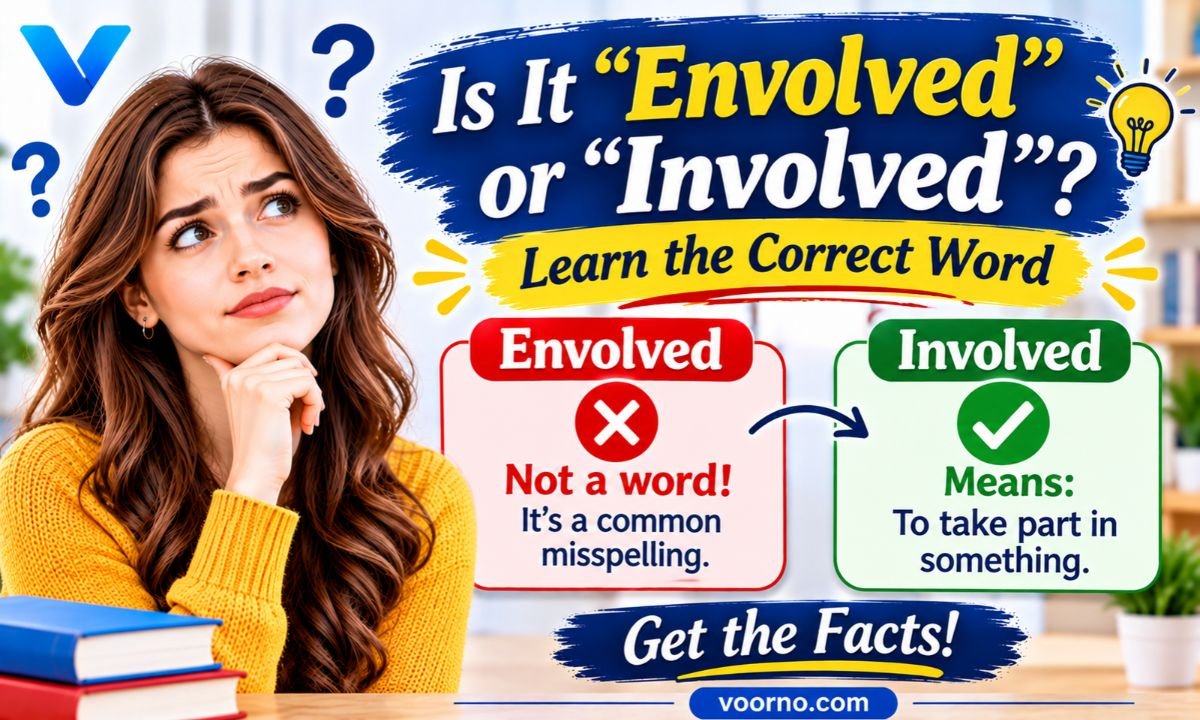
If you’ve ever paused mid-sentence wondering whether to type “envolved” or “involved,” you’re in good company. This is one of the most common spelling mix-ups in everyday English, and it trips up native speakers just as often as language learners.
The short answer: “involved” is correct. “Envolved” is not a real word. But understanding why so many people get this wrong — and how to make sure you never do — is worth a few minutes of your time.
Why “Envolved or Involved” Confuses So Many People
The confusion isn’t random. It happens because of how the word sounds, how it’s built, and how our brains process spelling.
A few reasons this mix-up keeps happening:
- Similar-sounding words like “evolved” and “enveloped” quietly influence how people spell “involved.”
- The prefix “en-“ is common in English (enable, enclose, engage), so “envolved” looks like it should follow the same pattern.
- Fast typing and autocorrect sometimes let the wrong spelling slip through unnoticed.
- Regional accents and casual speech blur the difference between the “in” and “en” sounds at the start of the word.
Once you see the pattern, the confusion makes a lot more sense — but it still doesn’t make “envolved” correct.
Read More: Chateaus vs. Chateaux Explained: Spelling, Meaning & Usage
The Correct Word: What “Involved” Actually Means
“Involved” is the past tense and past participle of the verb “involve.” It’s also frequently used as an adjective. Depending on context, it can mean:
- Participating in something — taking part in an activity, project, or event.
- Connected or associated — linked to a person, situation, or outcome.
- Complicated or complex — a plan, process, or story that’s hard to follow.
- Emotionally or personally connected — especially in relationships.
Because it covers so much ground, “involved” is one of those flexible, everyday words you’ll find in casual conversation, business writing, academic papers, and news articles alike.
Read More: Unorganized vs Disorganized: Meaning, Differences & Correct Usage
Envolved or Involved Examples
Seeing the word in real sentences makes the correct usage easier to remember. Here are some quick examples:
- She got involved in the school fundraiser.
- The negotiation was more involved than we expected.
- He didn’t want to get involved in the argument.
- Many volunteers were involved in the cleanup project.
- Their relationship became romantically involved over time.
None of these sentences would work with “envolved” — because that spelling simply doesn’t exist in standard English.
Real Usage Examples of “Involved” in Everyday English
You’ll spot “involved” across nearly every type of writing:
| Context | Example Sentence |
| Workplace | “She’s been closely involved in the product launch.” |
| Education | “Parents are encouraged to stay involved in school activities.” |
| Relationships | “They’ve been involved for almost two years.” |
| Legal/Formal | “The court found no evidence that he was involved in the fraud.” |
| Everyday speech | “I don’t want to get involved in office gossip.” |
Notice how the word shifts meaning slightly depending on context, but the spelling never changes.
Why “Envolved” Is Not a Word in Standard English

“Envolved” doesn’t appear in Merriam-Webster, Cambridge, Oxford, or Collins dictionaries. It has no accepted grammatical function, no formal definition, and no legitimate etymological root in modern English.
In short: it’s not an alternate spelling, a regional variation, or an old-fashioned form. It’s simply a spelling error — one that happens to look plausible because of how English prefixes and vowel sounds work.
The Hidden Reason People Believe “Envolved” Might Be Real
Beyond simple typos, there’s a deeper psychological explanation for why this mistake persists.
Phonetic Interference From Similar Verbs
Words like “evolved” (to develop gradually) and “enveloped” (to wrap or surround) share sounds with “involved.” When we speak quickly, the difference between “in-” and “en-” becomes almost inaudible, and that blurred pronunciation can carry over into writing.
The Brain’s Shortcut System
Our brains are wired to recognize patterns rather than process every letter individually. Since so many English words start with “en-,” the brain sometimes “auto-completes” an unfamiliar word using a familiar pattern — even when that pattern is wrong.
Envolved or Involved Meaning
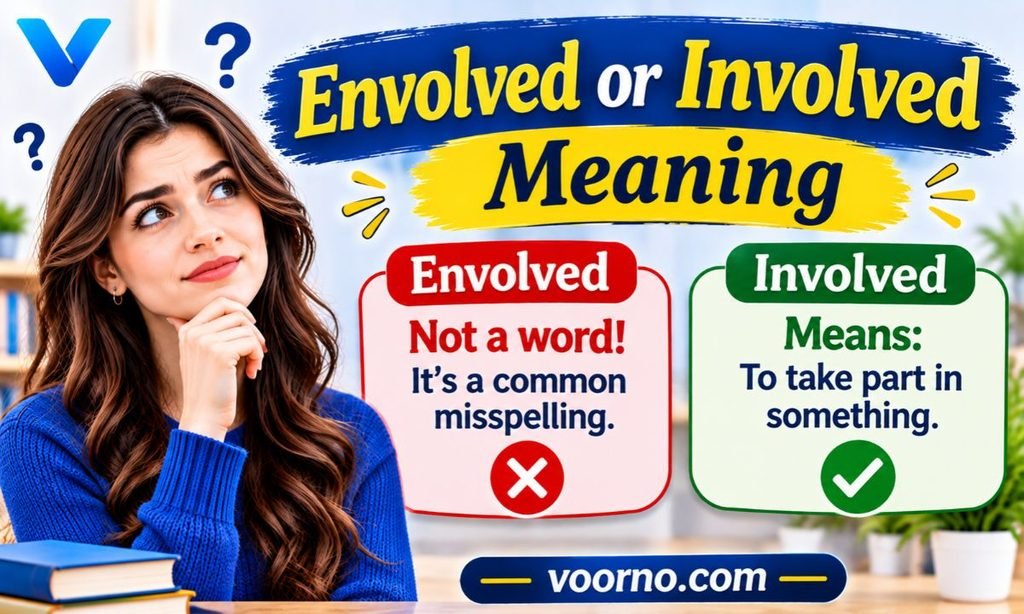
To be clear: only “involved” carries meaning in English. “Envolved” has no dictionary definition, no accepted usage, and no linguistic history. Any meaning someone assigns to it is simply borrowed from “involved” or “evolved” by mistake.
Involved or Envolved Pronunciation
Both are typically pronounced the same way in casual speech — something close to in-VOLVD. This shared pronunciation is a major reason the misspelling spreads: if it sounds the same, some writers assume it can be spelled either way. It can’t.
Are There Any Exceptions or Legitimate Uses of “Envolved”?
No. There are no formal, historical, or regional exceptions where “envolved” is considered acceptable. It doesn’t appear in:
- Standard or specialized dictionaries
- Academic or peer-reviewed writing
- Legal or professional documentation
- Style guides (AP, Chicago, MLA, APA)
If you see “envolved” used anywhere, treat it as a typo — not a valid alternative.
Comparison Table: “Involved” vs. “Envolved”
| Feature | Involved | Envolved |
| Correct spelling | ✅ Yes | ❌ No |
| Found in dictionaries | ✅ Yes | ❌ No |
| Used in formal writing | ✅ Yes | ❌ Never |
| Grammatical function | Verb (past tense/participle), adjective | None |
| Common cause of use | Standard English | Spelling mistake/typo |
Envolved or Involved Grammar
Grammatically, “involved” behaves in two main ways:
- As a verb (past tense/past participle of “involve”): “The project involved three departments.”
- As an adjective (describing complexity or connection): “It’s a fairly involved process.”
“Envolved” has no grammatical role because it isn’t a recognized word — there’s simply nothing to conjugate or apply grammar rules to.
Memory Tricks to Ensure You Always Spell “Involved” Correctly

If this mix-up has tripped you up before, these simple tricks can help lock in the correct spelling for good.
Use the “IN” Rule
Remember that “involved” starts with “IN,” just like the word “INclude” — and being involved usually means being included in something. If you can connect “in-” to “included,” you’ll rarely misspell it again.
Association Trick
Picture yourself literally stepping “IN” to a situation. That mental image reinforces the correct starting letters and makes the spelling easier to recall under pressure.
Envolved or Involved Synonym
If you want alternatives to “involved” depending on context, consider:
- Participating
- Engaged
- Connected
- Associated
- Implicated
- Complex (when referring to something complicated rather than participation)
There is no valid synonym for “envolved,” since it isn’t a word to begin with.
Common Sentences to Practice Using “Involved” Correctly
Practicing with real sentences helps the correct spelling stick:
- I got involved with a local charity last year.
- Please let me know how I can get involved.
- The investigation is still involved, with multiple parties.
- She stayed involved in her children’s education.
- The recipe looked more involved than I expected.
Tools That Help Catch This Error Automatically

If spelling mistakes like this one worry you, a few tools can help catch them before they reach your readers:
- Grammar checkers (built into most word processors and browsers)
- Browser spell-check extensions
- AI writing assistants that flag uncommon or invalid words
- Read-aloud tools, which can help you notice awkward or incorrect phrasing
These tools won’t replace careful proofreading, but they catch most instances of “envolved” instantly.
The Psychology Behind Spelling Errors Like “Envolved”
Spelling mistakes like this one aren’t a sign of poor intelligence — they’re a natural result of how the brain processes language. English spelling isn’t always phonetic, meaning words don’t always look the way they sound. Add in prefix confusion and quick typing, and small errors like “envolved” become almost inevitable at some point for most writers.
The good news: once you’re aware of the pattern, it’s easy to correct.
Quick Diagnostic Test: Do You Know When to Use “Involved”?
Fill in the Blank With the Correct Form (Involved or Envolved)
- She wasn’t ______ in the decision-making process.
- The story became more ______ as it went on.
- He didn’t want to get ______ in the drama.
- They’ve been romantically ______ for a year.
- The project ______ several teams across the company.
Answers
All five blanks should be filled with “involved.” If you wrote “envolved” for any of them, now’s a great time to bookmark this guide.
FAQs
Q:How do you pronounce this word “involved”?
It’s pronounced in-VOLVD, with the stress on the second syllable.
Q:Is it “involved” or “envolved”?
“Involved” is correct. “Envolved” is not a real English word.
Q:What is an involved person?
An involved person is someone who actively participates in or is closely connected to a situation, project, or relationship.
Q:What’s the difference between involved and evolved?
“Involved” means participating or connected; “evolved” means developed or changed gradually over time.
Q:What does “involve” mean in a relationship?
In a relationship, “involved” typically means being emotionally or romantically connected to someone.
Conclusion
The debate between “envolved or involved” has one clear winner: involved. It’s the only version recognized by dictionaries, style guides, and everyday usage, while “envolved” remains nothing more than a common spelling slip caused by sound-alike words and quick typing.
Now that you know the reasoning behind the mistake — and have a few memory tricks in your back pocket — you can write with confidence every time this word comes up.










2 thoughts on “Is It “Envolved” or “Involved”? Learn the Correct Word”