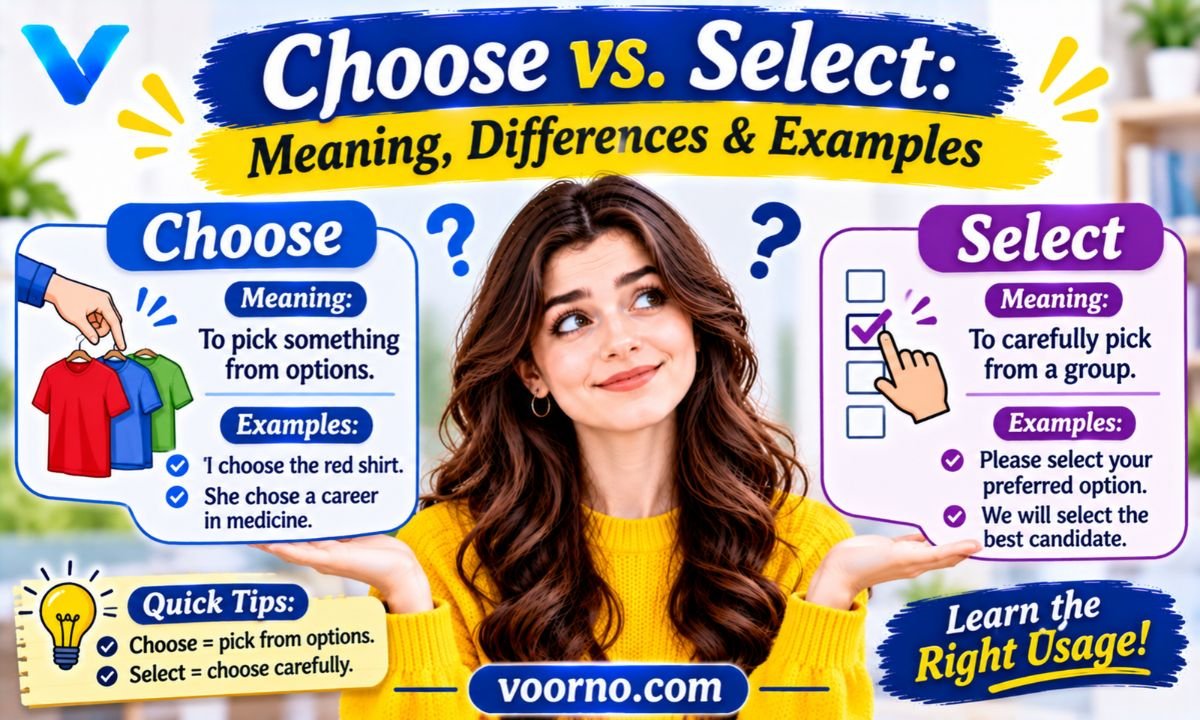
Most people use “choose” and “select” without a second thought — until they have to write an instruction, fill out a form, or explain the difference to someone learning English. Then a simple question shows up: are these words really the same?
They’re close, but not identical. Choose carries emotion and personal preference. Select carries process and precision. Once you see that one distinction, every other rule in this guide falls into place.
Quick Answer for Busy Readers
- Choose = a personal decision, often based on feeling, taste, or instinct.
- Select = a careful, criteria-based pick, often from a defined or limited set.
- Both are grammatically correct in almost every context — the difference is tone, not accuracy.
- “Select” sounds formal, technical, or procedural. “Choose” sounds natural, warm, and conversational.
If you’re deciding what to eat, you choose. If a hiring committee is picking a candidate against a scorecard, they select.
Read More:Traveling or Travelling: Difference, Rules & Examples
Definitions That Actually Clarify the Difference
Choose (verb): to decide on one option among two or more possibilities, usually based on preference, judgment, instinct, or desire. It’s the everyday word people reach for in speech and casual writing.
Select (verb): to pick something deliberately from a group, typically after comparing options against a standard, requirement, or set of criteria. It implies a more structured, evaluative process.
Both verbs describe the same basic action — picking one thing over another. What changes is why and how the pick is made, and how formal it sounds when you say it out loud.
Read More:What Does “Thanks a Ton” Mean? Meaning, Synonyms & Examples
Core Difference in One Concept: Emotion vs. Procedure
Think of it this way:
| Concept | Choose | Select |
| Driven by | Feeling, instinct, preference | Criteria, rules, evaluation |
| Tone | Casual, personal, warm | Formal, precise, detached |
| Typical setting | Conversation, storytelling, daily life | Instructions, forms, technical writing |
| Range of options | Often open-ended or unlimited | Often a defined, limited set |
A person chooses a career because it feels right. A recruiter selects a finalist because the résumé meets specific requirements. Same action — picking — but a different relationship between the person and the decision.
Context Rules Everything — When to Use Choose vs. Select
Use choose when:
- The decision is personal, emotional, or based on taste
- You’re writing dialogue, fiction, or casual content
- There’s no fixed list of criteria guiding the pick
Use select when:
- The decision follows rules, standards, or a formal process
- You’re writing instructions, manuals, or academic content
- The choice comes from a specific, limited, or curated set of options
Example:
- Choose a dessert from the menu. (personal preference)
- Select your payment method. (procedural, system-driven)
Choose vs. Select in Technology and UX Design

In apps, websites, and software, select dominates almost completely. Interface language favors precision and neutrality, which is exactly what “select” delivers.
- “Select a language.”
- “Select all.”
- “Select a file to upload.”
“Choose” occasionally appears in more conversational or consumer-facing copy — think of a food delivery app that says “Choose your meal” to sound friendlier — but formal system instructions almost always default to “select” because it removes any emotional framing and simply describes an action performed on an option.
Choose vs. Select Examples
| Sentence with Choose | Sentence with Select |
| She chose the blue dress because she loved the color. | The judges selected the winning design after scoring each entry. |
| I choose to spend my weekends outdoors. | Please select your preferred delivery time from the list. |
| He chose to stay quiet during the meeting. | The software selects the fastest available server automatically. |
| They chose honesty over convenience. | The committee selected three finalists for the scholarship. |
Notice how every “choose” example reflects a personal stance, and every “select” example reflects a system, standard, or evaluation.
Tone and Formality — How the Word Changes Your Voice
Swap the words in a sentence and you’ll immediately feel the shift:
- “Choose your favorite vacation spot.” → warm, inviting
- “Select your preferred vacation destination.” → neutral, almost robotic
Neither is wrong. But if you’re writing marketing copy meant to connect emotionally, “choose” will usually outperform “select.” If you’re writing a form, policy, or technical guide, “select” keeps the tone appropriately neutral.
Grammar and Sentence Patterns

Both verbs follow standard transitive verb patterns — they need an object (the thing being picked).
- Subject + choose/select + object
- “She chose the red car.”
- “They selected the top candidate.”
Both can also take an infinitive phrase after them:
- “I chose to leave early.”
- “The team selected a strategy to pursue.” (less common with “select,” which pairs more naturally with a direct object than an infinitive)
Verb Forms
| Base Form | Past Tense | Past Participle | Present Participle |
| choose | chose | chosen | choosing |
| select | selected | selected | selecting |
A common trap: choose is irregular. Many learners mistakenly write “choosed” instead of “chose.” Select is fully regular, which makes it far less error-prone.
Common Collocations
With choose:
- choose wisely
- choose freely
- choose a path
- choose sides
With select:
- select carefully
- select at random
- select a candidate
- select an option
Choose vs. Select vs. Pick
Add “pick” to the mix and you get a useful three-way comparison:
| Word | Formality | Typical Use |
| Pick | Very casual | Quick, low-effort decisions |
| Choose | Neutral to casual | Personal decisions with some thought |
| Select | Formal | Deliberate, criteria-based decisions |
“He picked a book off the shelf” suggests little deliberation. “He chose a book that matched his mood” suggests some reflection. “He selected a book based on the reading list” suggests a defined process. All three are correct — they simply sit at different points on the formality and deliberation scale.
Data Insight — Frequency and Trend Patterns
Language data consistently shows “choose” appearing far more often in everyday speech, fiction, and conversational writing, while “select” spikes in technical manuals, legal documents, UX copy, and academic writing. In short: choose dominates human conversation; select dominates structured, written instruction. Neither word is disappearing — they’ve simply settled into different lanes of English usage.
Regional Differences (US vs UK)
There’s no grammatical difference between American and British English here, but there are mild stylistic tendencies:
- UK English leans toward “choose” in general and narrative writing, reserving “select” mostly for formal or technical contexts.
- US English uses “select” more freely across professional, technical, and software contexts, while still favoring “choose” in everyday speech.
These are tendencies, not fixed rules — both words are understood and used correctly on either side of the Atlantic.
Common Mistakes People Make (and How to Fix Them)
- Using “choosed” instead of “chose.” ❌ She choosed the wrong option. ✅ She chose the wrong option.
- Overusing “select” in casual writing, making it feel stiff. ❌ Select your favorite ice cream flavor. ✅ Choose your favorite ice cream flavor.
- Using “choose” in formal instructions where “select” fits better. ❌ Choose an option from the dropdown menu. ✅ Select an option from the dropdown menu.
- Forgetting that “select” rarely takes “to + verb” the way “choose” does. ❌ She selected to leave the team. ✅ She chose to leave the team.
Idiomatic and Figurative Uses
“Choose” appears in idioms far more often than “select,” because idioms tend to carry emotional or narrative weight:
- “Choose your battles.”
- “Beggars can’t be choosers.”
- “The chosen one.”
“Select” rarely shows up in idiomatic expressions — its identity is tied to precision, not storytelling, which is exactly why it feels out of place in figurative language.
Choose vs. Select Synonym
Depending on context, useful synonyms include:
- For choose: pick, opt for, decide on, settle on, go with
- For select: pick out, single out, designate, screen, shortlist
Choosing the right synonym still depends on the same emotion-versus-procedure logic covered above.
Decision Psychology — Why the Brain Treats These Words Differently
Psychologically, “choosing” is associated with autonomy and identity — the choices we make often reflect who we are or what we value. “Selecting” is associated with evaluation and judgment — it implies weighing options against external standards rather than internal preference. This is part of why marketing, self-help, and personal storytelling gravitate toward “choose,” while HR, science, and technology gravitate toward “select.” The word itself signals whether a decision is about you or about the criteria.
When Either Word Works (And How to Decide)
Sometimes both words are genuinely acceptable, and the “right” one comes down to tone:
- “Choose/Select a topic for your essay.”
- “Choose/Select a seat before boarding.”
Ask yourself: Is this decision personal, or is it procedural? If personal, choose “choose.” If procedural, choose “select.” When in doubt, “choose” is the safer, more natural-sounding default in spoken and everyday written English.
Practical Tips for Mastery
- Read your sentence aloud — if “select” sounds stiff, switch to “choose.”
- In technical or instructional writing, default to “select” unless warmth is the goal.
- Remember the irregular past tense: chose, not choosed.
- When editing UX copy, match the tone of the rest of the interface — don’t mix “choose” and “select” inconsistently on the same screen.
FAQs
Q:What is the difference between “choose” and “select”?
“Choose” reflects a personal, preference-based decision, while “select” reflects a formal, criteria-based pick, usually from a defined set of options.
Q:How to use the word “choose”?
Use “choose” for everyday decisions involving personal taste, feelings, or free will, as in “I choose to work from home.”
Q:What does select mean?
“Select” means to pick something deliberately from a group, typically after comparing options against a standard or requirement.
Q:How to use select in a sentence?
Use “select” in formal or instructional contexts, such as “Select your preferred currency before checkout.”
Q:Is it “I chose you” or “I choose you”?
Both are correct in different tenses: “I choose you” is present tense (happening now), while “I chose you” is past tense (already decided).
Conclusion
“Choose” and “select” both mean to pick something, but they live in different emotional and stylistic worlds. Choose when the decision is personal and instinctive; select when it’s formal, structured, or criteria-driven.
Once you internalize that single distinction — emotion versus procedure — you’ll never second-guess which word fits your sentence again.










2 thoughts on “Choose vs. Select: Meaning, Differences & Examples”