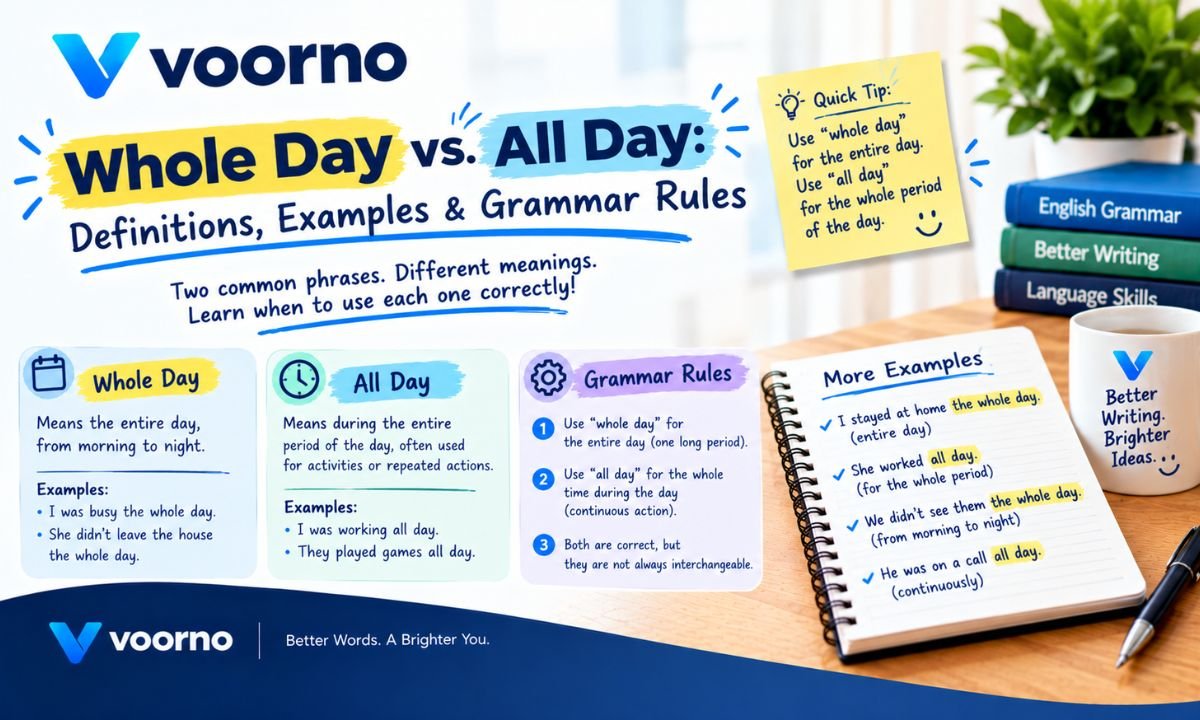
If you’ve ever paused mid-sentence wondering whether to write “I worked all day” or “I worked the whole day,” you’re not alone. These two phrases look almost identical, mean roughly the same thing, and yet native speakers instinctively pick one over the other depending on the situation. The catch is that most people can’t explain why.
This guide breaks down the real difference between “whole day” and “all day” — the grammar behind them, how they overlap, when each one is correct, and how to avoid the small mistakes that make non-native (and even native) speakers sound slightly off.
Understanding the Confusion Behind “Whole Day” vs. “All Day”
Both phrases describe a full 24-hour stretch, or at least a full working/waking period. Because they translate to the same idea in casual conversation, people assume they’re interchangeable. They aren’t — not grammatically, and not emotionally.
The confusion usually comes from three places:
- Both phrases can appear in nearly identical sentences.
- Both are technically “correct” English.
- The difference is more about tone and grammar structure than meaning.
Once you understand that “all day” describes duration and “whole day” describes completeness, the fog clears fast.
What “Whole Day” Actually Means
Core Definition
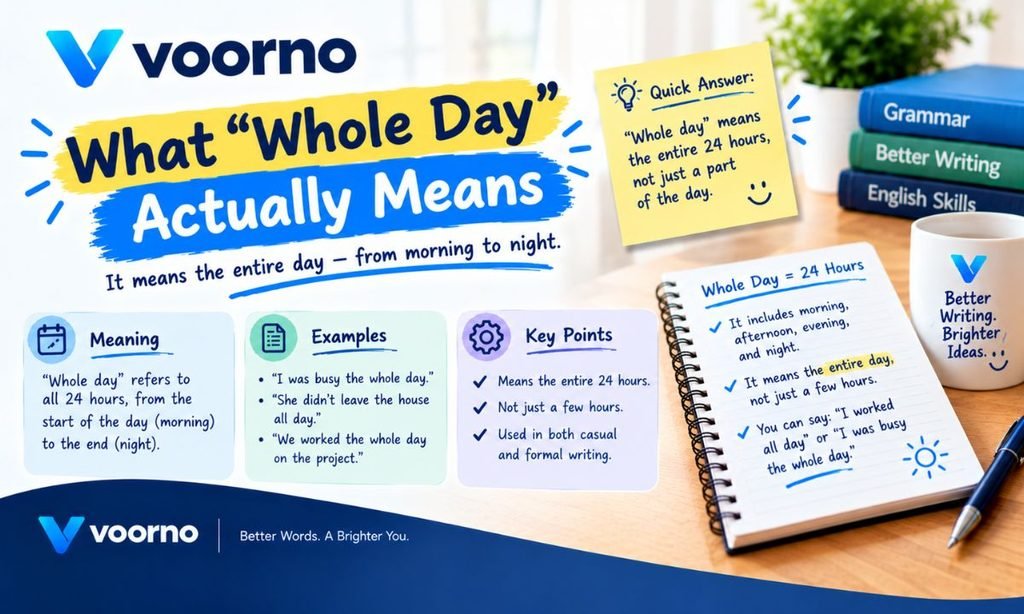
“Whole day” treats the day as a single, complete unit of time. It’s not just about how long something lasted — it’s about the day being used up, entirely, from start to finish. Because “whole” functions as an adjective, it almost always needs an article (“a” or “the”) in front of it.
Read More:”I Feel You” Slang Meaning, Origin & How to Use It
Examples of “Whole Day”
- I spent the whole day cleaning the garage.
- She was nervous the whole day before her interview.
- We need a whole day to finish this project properly.
- He wasted the whole day scrolling through his phone.
Notice how each sentence frames the day as a finished, complete block — not simply a period during which something happened.
What “All Day” Actually Means
Core Definition
“All day” is an adverbial phrase that shows continuous or repeated action stretching across the day. “All” acts as a determiner here, not an adjective, which is why it attaches directly to “day” with no article required.
Examples of “All Day”
- I worked all day and barely stopped for lunch.
- It rained all day yesterday.
- The kids played outside all day.
- She’s been on the phone all day.
These sentences emphasize the ongoing nature of the activity, not the day as a finished package.
Read More:If She Was vs. If She Were: Meaning, Rules & Examples
How “Whole Day” and “All Day” Overlap
In everyday speech, both phrases can often describe the same real-world event. “I studied all day” and “I studied the whole day” both tell the listener that studying took up the entire day. In casual conversation, swapping one for the other rarely causes confusion, and Whole day vs All day are grammatically valid when used correctly.
How “Whole Day” and “All Day” Differ
Completeness vs. Duration
This is the heart of the distinction:
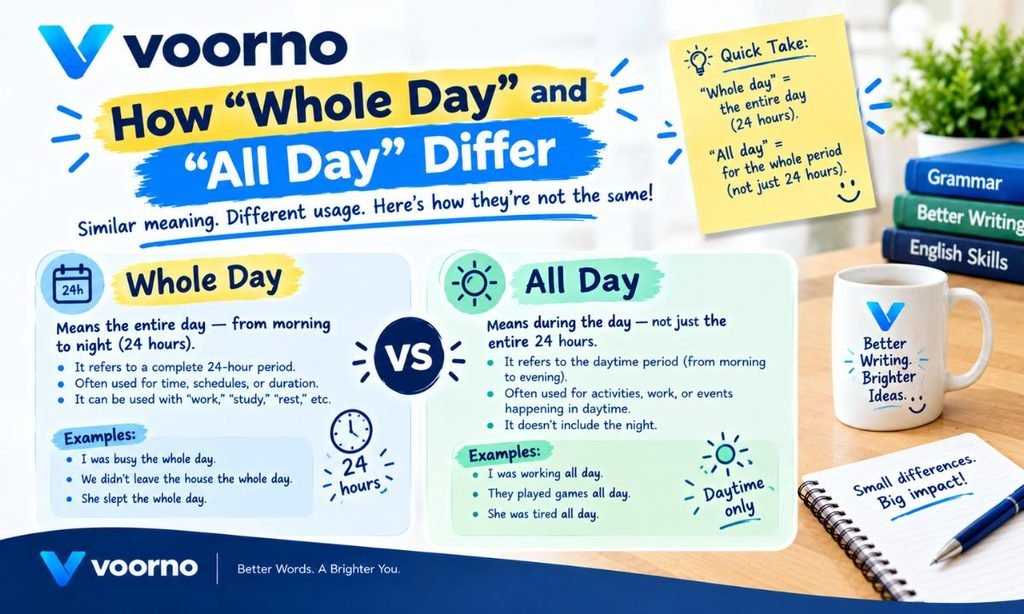
- Whole day = the day as a complete, whole unit — nothing left over.
- All day = an action or state continuing throughout the day.
“I waited all day” is a neutral statement about time passing. “I waited the whole day” carries more weight — it can sound frustrated, dramatic, or emphatic, even though the literal time span is the same.
Grammatical Behavior
| Feature | Whole Day | All Day |
| Part of speech | “Whole” = adjective | “All” = determiner |
| Needs an article? | Yes (“the whole day,” “a whole day”) | No |
| Sentence role | Noun phrase (subject/object) | Adverbial phrase (modifies verb) |
| Tone | Slightly formal, emphatic | Neutral, casual |
| Common in | Writing, formal speech | Everyday spoken English |
Whole Day vs All Day Quiz
Test yourself before reading further. Choose the phrase that fits best:
- It rained ___ during the festival. (all day / the whole day)
- He spent ___ preparing the report. (all day / the whole day)
- She was on call ___ during the holiday. (all day / the whole day)
Answers: 1) all day, 2) the whole day, 3) all day — because each one leans toward duration (1 and 3) or a complete, emphasized block of time (2).
Countable vs. Uncountable Concepts
Grammatically, “day” is a countable noun in both phrases. What changes is how each phrase treats that countable noun: “all day” uses “day” almost like a fixed adverbial unit (similar to “all night,” “all week”), while “whole day” treats “day” as an ordinary countable noun that requires a determiner, just like “a car” or “the book.”
When to Use “Whole Day” Correctly
When It is Used:
- When you want to emphasize that the entire day was consumed by one thing
- When writing formally — reports, essays, professional emails
- When you want to add emotional weight or emphasis
- When “day” functions as the subject or object of the sentence
Examples
- The whole day felt like it dragged on forever.
- I need a whole day off to recover.
- The power was out the whole day after the storm.
When to Use “All Day” Correctly
When It is Used:
- When describing a continuous or repeated action
- In casual, spoken, or informal written English
- When “day” functions adverbially, right after a verb
- When no article is needed or wanted
Examples
- We hiked all day without stopping.
- The store is open all day on weekends.
- I’ve been thinking about this all day.
Grammar and Usage Differences
Whole Day or All Day
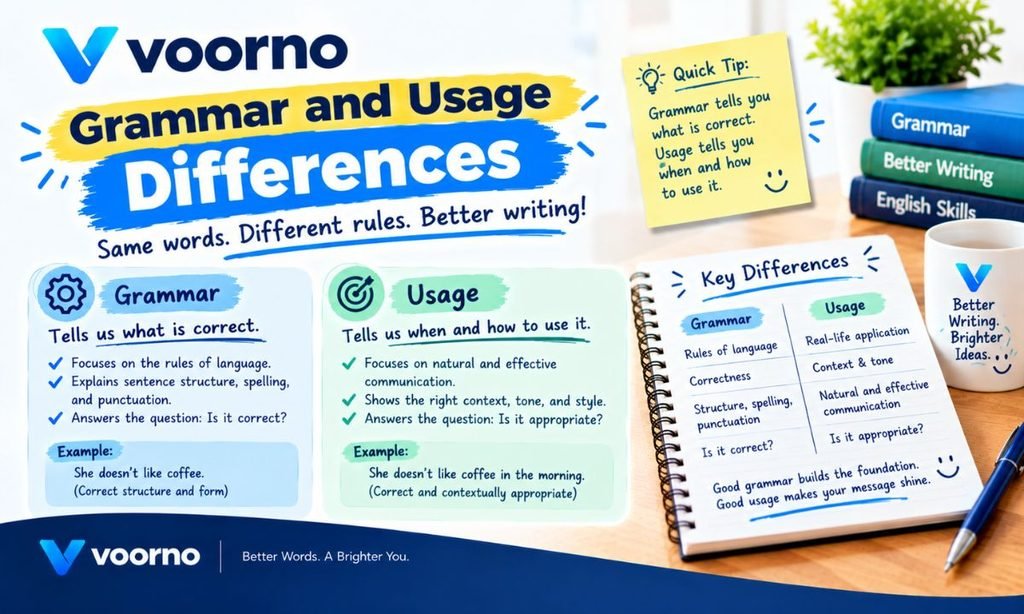
A simple test: if you can naturally insert “the” or “a” before the phrase without changing meaning, “whole day” is likely correct. If the phrase attaches directly to a verb describing ongoing action, “all day” is the natural fit.
Perfect for Casual Speech
“All day” wins in everyday, spoken English. It’s shorter, needs no article, and flows more naturally in fast conversation — which is exactly why it dominates in texting, social media, and informal writing.
Regional Preferences and Nuances
- American English: “All day” is overwhelmingly preferred in casual speech and writing.
- British English: “The whole day” appears more frequently, especially in slightly more traditional or formal contexts, though “all day” is still common in everyday conversation.
- Both forms are understood and accepted across English-speaking regions — the difference is frequency and tone, not correctness.
Idiomatic Expressions and Common Usage
Certain expressions only work with one phrase:
- All-day as a hyphenated compound adjective: “an all-day event,” “an all-day breakfast.”
- Whole day in emphatic or dramatic contexts: “What a waste of a whole day”.
You generally can’t say “an all day event” without the hyphen, and you can’t drop the article from “whole day” (“I worked whole day” is incorrect in standard English).
Exceptions and Special Cases

Phrases Where Only One Fits Naturally
- “All-day” (hyphenated) works as an adjective before a noun — “all-day parking,” “all-day meeting.”
- “Whole day” never works this way; you wouldn’t say “whole-day parking” in standard usage.
- “All day long” is a common intensified version of “all day,” with no equivalent using “whole.”
Quick Reference Table
| Situation | Best Choice | Why |
| Casual conversation | All day | Natural, no article needed |
| Formal writing | The whole day | Sounds polished and complete |
| Continuous action | All day | Emphasizes duration |
| Emphasizing a finished day | The whole day | Emphasizes completeness |
| Compound adjective before a noun | All-day (hyphenated) | Grammatically required form |
Practical Examples in Real Sentences
Using “Whole Day”
- The whole day was spent packing boxes for the move.
- I can’t believe I lost the whole day to that one meeting.
- She dedicated a whole day just to answering emails.
Using “All Day”
- I’ve had this song stuck in my head all day.
- The kids were outside playing all day.
- Traffic was backed up all day because of the accident.
FAQs
How long is a full day?
A full day generally refers to a full 24-hour period, though in everyday speech it often means the entire waking or working portion of the day, from morning to night.
Which is correct, whole day or all day?
Both are correct English. “All day” needs no article and shows duration, while “whole day” needs “a” or “the” and shows completeness.
What is the difference between “whole” and “all”?
“Whole” is an adjective meaning complete or entire, and it needs an article before a noun. “All” is a determiner meaning every part of something, and it doesn’t need an article.
How do you pronounce “whole day”?
“Whole day” is pronounced /hoʊl deɪ/, with a silent “w” at the start of “whole,” similar to how “hole” is pronounced.
Is it full day or fullday?
It is always written as two separate words, “full day,” never as one word.
Conclusion
“Whole day” and “all day” aren’t rival phrases fighting for the same job — they’re tools built for slightly different tasks. Reach for “all day” when you’re describing something continuous, casual, or ongoing.
Reach for “the whole day” when you want to frame the day as one complete, finished unit — especially when a little extra emphasis or formality is called for. Once you internalize that grammar rule, choosing between them stops being a guessing game and becomes second nature.










3 thoughts on “Whole Day vs. All Day: Definitions, Examples & Grammar Rules”