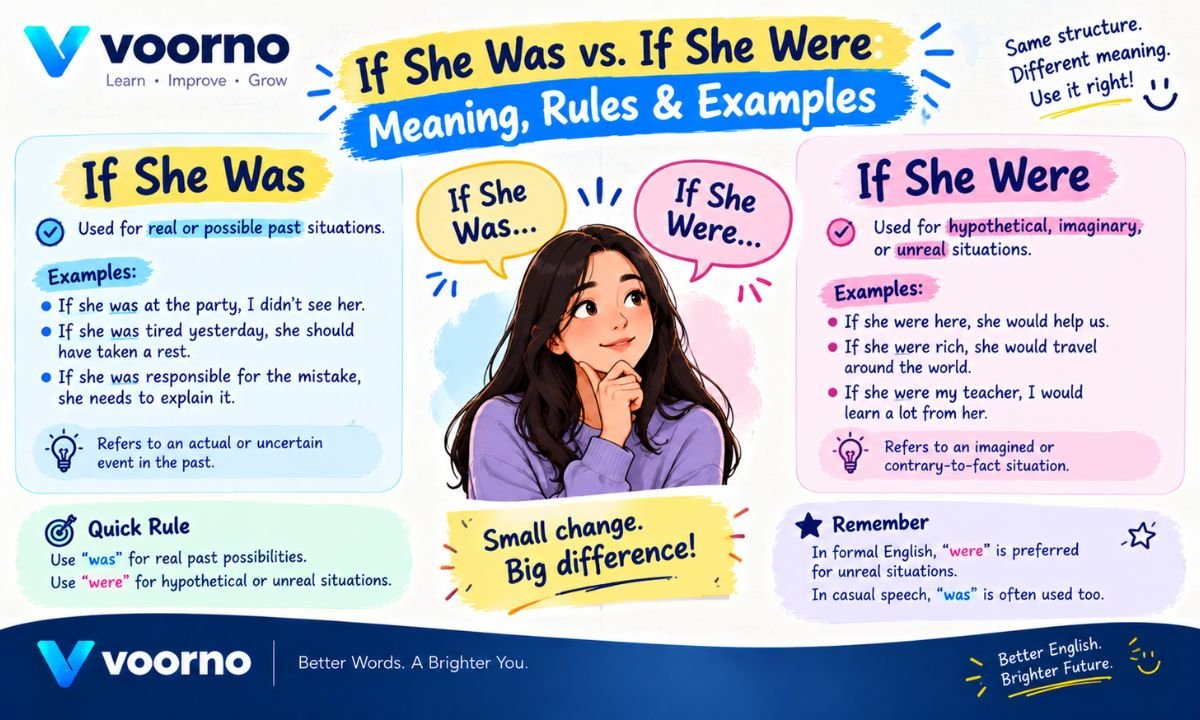
“If she was” and “if she were” are both used in English to talk about situations involving a female person. However, they have different grammatical uses. “If she was” generally refers to a real possibility or an actual situation in the past, while “if she were” is commonly used for hypothetical, imaginary, or unreal situations.Understanding the difference between these two phrases can help you improve your grammar, write more naturally, and avoid common English mistakes.
Quick Answer: If She Was vs If She Were
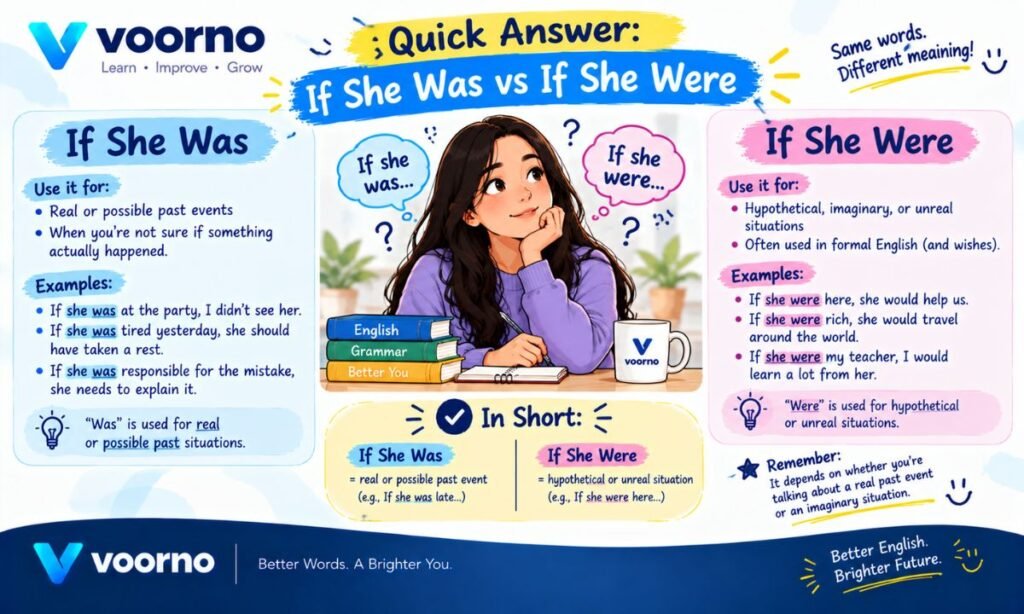
Here’s the short version: use “if she were” for hypothetical, imaginary, or clearly untrue situations (“If she were taller, she’d play basketball”). Use “if she was” for real or possible past situations (“If she was late, she didn’t tell me”).
The difference comes down to one question: is the situation real, or is it imagined? Once you can answer that, choosing between “was” and “were” becomes almost automatic.
Understanding the Subjunctive Mood in Real Human English
English has a special verb form called the subjunctive mood, and it shows up whenever you talk about something that isn’t factually true — a wish, a suggestion, or a hypothetical. In the subjunctive, “were” is used for all subjects, including “I,” “she,” “he,” and “it,” instead of the usual “was.”
That’s why native speakers say “If I were you” instead of “If I was you,” even though “was” would normally match “I” in every other sentence. The subjunctive breaks the normal subject-verb agreement rule on purpose, because the sentence isn’t describing reality — it’s describing a fantasy, a wish, or a condition contrary to fact.
Read More:Whole Day vs. All Day: Definitions, Examples & Grammar Rules
When to Use “If She Were” in Hypothetical or Unreal Conditions
Situations Where “If She Were” Fits Perfectly
Use “if she were” when the sentence describes something imaginary, impossible, or contrary to current fact:
- If she were a bird, she’d fly south for winter.
- If she were the manager, she’d change the whole schedule.
- If she were here right now, this problem would already be solved.
In each case, the speaker knows the condition isn’t true. She isn’t a bird. She isn’t the manager. She isn’t here. That’s the subjunctive at work.
Edge Cases That Confuse Writers
Some sentences look hypothetical but are actually just about uncertain past facts, which is where writers slip up. “If she were sick yesterday” sounds formal, but if you genuinely don’t know whether she was sick, “if she was sick yesterday” is technically more accurate, since the situation could be true.
Read More:Passerby vs Passersby or Passerbyers: Meaning, Plural Form & Correct Usage
When to Use “If She Was” for Real or Possible Past Events
Situations for “If She Was”
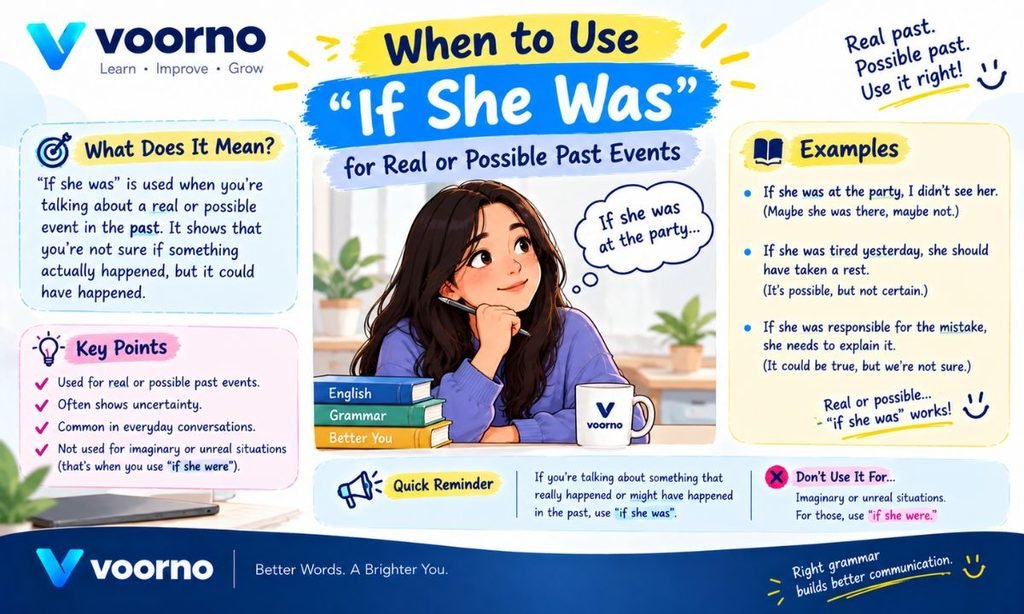
“If she was” belongs in sentences describing something that may have actually happened. You’re not imagining a fantasy — you’re expressing uncertainty about a real possibility:
- If she was at the party, I didn’t see her.
- If she was tired, that would explain why she left early.
- If she was telling the truth, we owe her an apology.
When Choosing “Was” Helps Clarify Meaning
Sometimes “was” versus “were” actually changes what you mean. “If she was upset, she didn’t show it” implies she may genuinely have been upset. Swapping in “were” would shift the sentence toward a hypothetical, unreal tone that doesn’t fit a real, unresolved situation.
Spoken vs Written English: Why People Mix Them Up
In casual conversation, many native English speakers say “if she was” even in clearly hypothetical sentences, and it’s rarely challenged. This is a well-documented pattern of everyday spoken English, where the subjunctive is fading. Formal writing, however, still holds the line: academic papers, legal documents, and professional emails generally expect “were” in unreal conditions.
How “Was” vs “Were” Changes Meaning in Subtle Ways
Example 1
“If she was rich, she never showed it.” — Real possibility; she may have been rich.
Example 2
“If she were rich, she’d travel the world.” — Pure hypothetical; she isn’t rich.
Example 3
“If she was late, traffic was probably the reason.” — A reasonable guess about something that may have actually occurred.
Common Pitfalls and Confusions
Misunderstanding the Subjunctive Mood
Many writers don’t realize the subjunctive exists at all, so they default to “was” everywhere, even in clearly imaginary sentences.
Using “Were” in Every Conditional
Overcorrecting is just as common — some writers use “were” even for real, possible past events, which sounds overly formal or simply incorrect.
Using “Was” in All Informal Writing
Casual writing tolerates “was,” but formal or academic writing still expects the subjunctive “were” in unreal conditions.
Thinking “Were” Is Old-Fashioned
“Were” isn’t outdated — it’s a specific grammatical tool. Standard style guides and grammar authorities still recommend it for hypotheticals.
A Simple 3-Step Test to Decide Instantly
Step 1: Ask if the situation is real
Could this actually be true or false in reality? If yes, lean toward “was.”
Step 2: Ask if the situation is unreal or imagined
Is the sentence describing something impossible, imaginary, or contrary to fact? If yes, use “were.”
Step 3: Replace “if” with “I wish”
Turn the sentence into a wish: “I wish she were here” sounds natural, confirming the subjunctive. “I wish she was here” sounds slightly off to careful ears — a signal that “were” is the better fit.
Formality Matters: Academic, Legal, and Professional Writing
When to Prefer “Were”
Formal writing — essays, reports, contracts, and official correspondence — should stick to “were” in hypothetical conditions. It signals grammatical precision and reads as more polished.
Which is correct: “if you were” or “if you was“?
“If you were” is always correct in standard English, whether the sentence is hypothetical or not, because “were” is the standard past-tense form for “you” in every context — not just the subjunctive.
When “Was” Is Acceptable
In dialogue, informal blog posts, texting, and everyday conversation, “was” is widely accepted, even in mildly hypothetical sentences, because it matches how people actually speak.
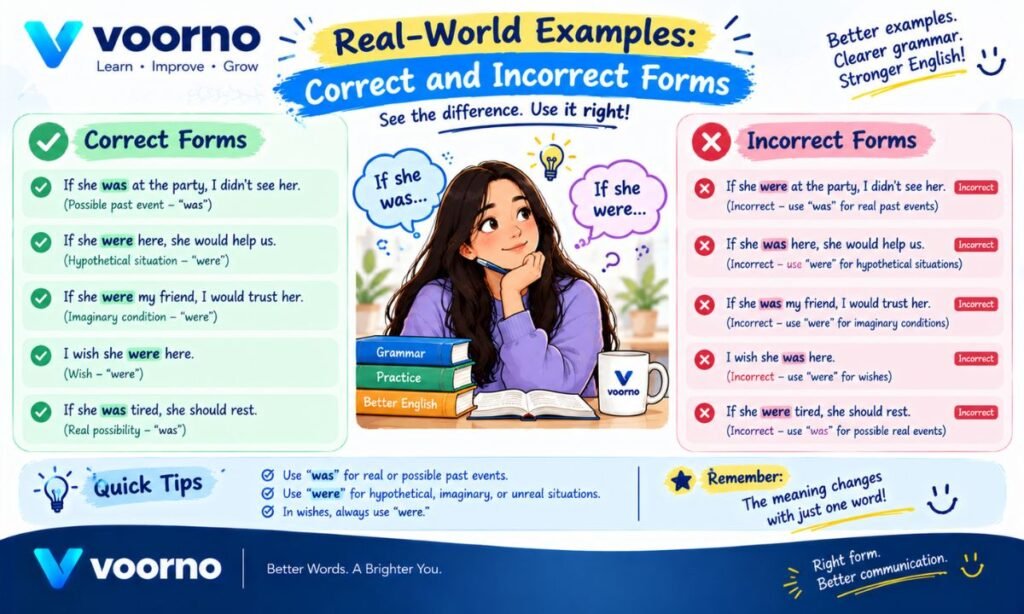
Real-World Examples: Correct and Incorrect Forms
Correct Uses of “If She Were”
- If she were president, taxes would look different.
- If she were an animal, she’d be an owl.
Incorrect Uses of “If She Were”
- If she were at work yesterday, she would have called me. (Better: “if she was,” since this is a real possibility.)
Correct Uses of “If She Was”
- If she was born in 1990, she’s in her mid-thirties now.
- If she was at the meeting, she’ll know the update.
Incorrect Uses of “If She Was”
- If she was a mermaid, she’d live in the ocean. (Should be “were” — clearly impossible.)
Grammar Authority Insights
What Major References Say
Standard grammar guides consistently describe the subjunctive “were” as the traditional and formally correct choice for hypothetical or contrary-to-fact conditions, while acknowledging that “was” is common and accepted in informal speech.
Quick Reference Table
| Situation | Correct Form | Example |
| Hypothetical / unreal | Were | If she were a queen, she’d rule fairly. |
| Real / possible past event | Was | If she was late, she didn’t mention it. |
| Wishes | Were | I wish she were here. |
| Formal/academic writing | Were | If the policy were changed, results would improve. |
| Casual speech or dialogue | Was (acceptable) | If she was tired, that explains it. |
| With “you” (any context) | Were | If you were in my position… |
Fast Memory Tricks That Actually Work

The Reality Trick
Ask: “Could this really happen or be true?” Real = was. Impossible or imaginary = were.
The Wish Swap
Turn the sentence into “I wish…” If it sounds natural with “were,” use “were” in the original sentence too.
The Fantasy Test
If the sentence involves magic, animals talking, or impossible scenarios, “were” almost always fits.
The Formality Anchor
When writing something formal — a resume, essay, or legal document — default to “were” for hypothetical conditions.
Practice Exercises With Answers
- If she ___ the CEO, she’d restructure the entire company. (were)
- If she ___ home earlier, she might have caught the delivery. (was)
- If she ___ a superhero, she’d choose invisibility. (were)
- If she ___ nervous during the interview, she hid it well. (was)
- I wish she ___ here to see this. (were)
FAQs
Can I say “she was”?
Yes. “She was” is the standard past-tense form used for real, factual statements, such as “she was tired” or “she was at school.”
What does “I were” mean?
“I were” is the subjunctive form used in hypothetical statements like “If I were you,” expressing something imaginary or contrary to fact.
Can I say “she was” in a conditional sentence?
Yes, when the condition describes a real or possible past event rather than a pure hypothetical, “she was” is correct.
How do I use “was” and “were” correctly?
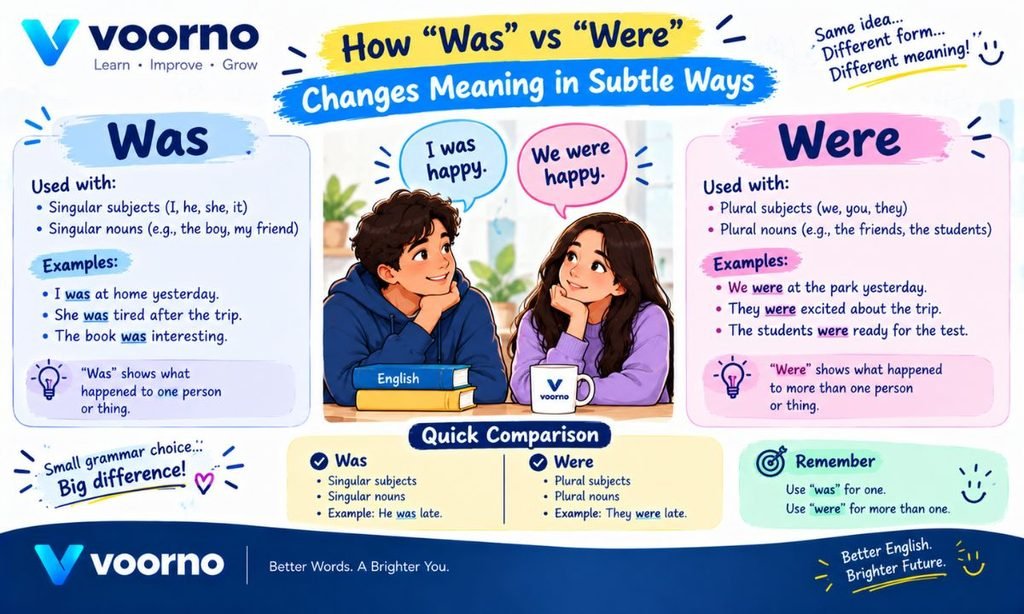
Use “was” for real past facts and singular subjects; use “were” for plural subjects and all subjunctive, hypothetical, or wishful statements.
What is the difference between “was” and “were”?
“Was” describes real past events, while “were” is used for plural subjects and for imaginary, hypothetical, or wished-for situations, regardless of subject.
Conclusion
The “if she was” versus “if she were” debate isn’t about strict rules alone — it’s about intention. If you’re describing something real or genuinely uncertain, “was” works fine.
If you’re imagining something impossible or expressing a wish, “were” is the grammatically precise choice. Keep the reality test in mind, and you’ll never second-guess this again.










2 thoughts on “If She Was vs. If She Were: Meaning, Rules & Examples”