If someone has ever texted you “I feel you” after you vented about a rough day, you already know it hits different than a plain “okay” or “that sucks.” It’s one of those small phrases that carries a surprising amount of emotional weight, and it’s everywhere — in texts, comments, song lyrics, and everyday conversation.
This guide breaks down exactly what “I feel you” means, where it came from, how it differs from similar phrases like “I feel for you,” and how to use it (or reply to it) the right way.
What “I Feel You” Actually Means in Real Conversations
At its core, “I feel you” means “I understand you” or “I relate to what you’re going through.” It’s a way of telling someone that their words, emotions, or experience have landed with you — that you’re not just hearing them, you’re connecting with them.
It’s commonly used to:
- Show empathy after someone shares a struggle
- Agree strongly with an opinion or complaint
- Signal solidarity (“me too, I get it”)
- Validate someone’s feelings without needing to fix the problem
Unlike a generic “I understand,” which can sound clinical, “I feel you” carries an emotional, almost physical sense of shared experience.
Meaning vs Nuance of “I Feel You”
The literal words suggest physically sensing someone, but that’s not what’s happening. The nuance is emotional, not literal — you’re saying you can sense the emotional tone behind what they said.
There are two shades of meaning, depending on context:
- Empathy shade – “I understand what you’re feeling, and I relate to it.”
- Agreement shade – “I completely agree with what you just said.”
Which one applies usually depends on tone, punctuation, and what came right before it. A slow, drawn-out “I feeeel you” after a sad story leans empathetic. A quick “I feel you” after someone states an opinion leans toward agreement.
Read More:Comma Before “Even” Explained: Rules and Examples
Origin and Linguistic Roots of “I Feel You”
The phrase is widely linked to African American Vernacular English (AAVE), where it grew out of hip-hop culture and everyday urban speech starting in the late 1980s and 1990s. Many language sources trace it back further to the related phrase “Do you feel me?” — a way of asking “Do you understand what I’m saying?” The natural response, “I feel you,” flipped that question into an affirmation.
By the early 2000s, the expression had moved firmly into mainstream American slang, showing up in movies, music, and casual conversation across cultures and age groups. Its emotional tone — and its brevity — made it easy for it to spread through texting and social media, where short, expressive phrases tend to thrive.
“I Feel You” vs “I Feel For You”
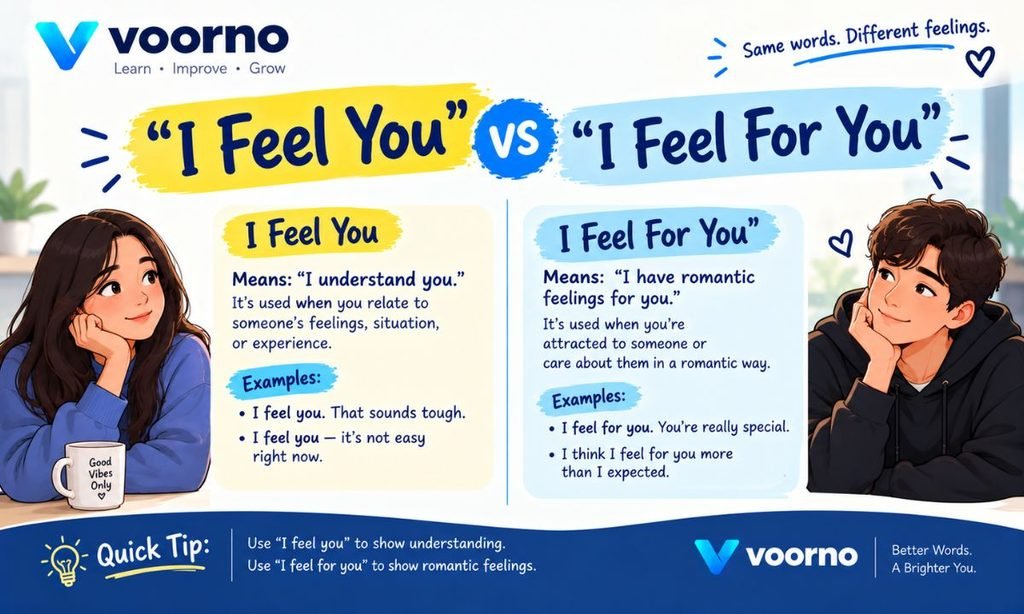
These two phrases look almost identical but mean very different things, and mixing them up can send the wrong message.
- “I feel you” means you relate to the experience — you’ve been there, or you understand it from the inside.
- “I feel for you” means you feel sympathy for someone’s situation, even if you haven’t personally experienced it.
One puts you inside the emotion with the other person. The other keeps you a step outside, offering compassion rather than shared experience.
Read More:Whole Day vs. All Day: Definitions, Examples & Grammar Rules
How Do I Reply to “I Feel You”
If someone says “I feel you” to you, they’re usually validating what you just shared. A good reply keeps the connection going rather than shutting the conversation down. A few natural options:
- “Thanks, that means a lot.”
- “Right? Glad someone gets it.”
- “Yeah, it’s been a lot lately.”
- A simple “🙏” or “same” in text conversations
There’s no single “correct” reply — the goal is to acknowledge that you were heard, not to overthink it.
Comparison Table
| Phrase | Meaning | Emotional Distance | Best Used When |
| I feel you | I understand/relate to your experience | Close, shared | Someone shares a struggle you’ve also been through |
| I feel for you | I sympathize with your situation | Slightly distant | You haven’t experienced it, but you care |
| I understand | I comprehend what you’re saying | Neutral/formal | Professional or clear-headed contexts |
| I hear you | I’m listening and acknowledging you | Neutral | Active listening without full agreement |
| Same here | I’ve experienced the same thing | Close, casual | Casual chats, texting |
Why “I Feel You” Works Psychologically
Human beings are wired to seek validation, and short empathetic phrases like this one do a lot of psychological work in very few words. When someone says “I feel you,” it signals:
- Recognition – your experience has been noticed
- Validation – your feelings are reasonable, not dismissed
- Connection – you’re not alone in what you’re going through
This taps into what psychologists call emotional attunement — the sense that another person is tracking your internal state. Even a two-word phrase can lower stress in a conversation because it tells the brain, “you’ve been understood.”
Real-Life Usage Examples of “I Feel You”
- “I’m so tired of these back-to-back meetings.” → “I feel you, my calendar is a mess too.”
- “I can’t believe rent went up again.” → “I feel you, it’s getting ridiculous everywhere.”
- “I just needed someone to listen tonight.” → “I feel you. I’m here.”
- “This traffic is insane today.” → “I feel you, took me an hour to get four miles.”
I Feel You Synonym
Looking for other ways to express the same sentiment? Try:
- I hear you
- I get it
- Same here
- Been there
- I know the feeling
- I relate to that
- That resonates with me
Each carries a slightly different tone, from casual (“been there”) to more thoughtful (“that resonates with me”).
Tone, Body Language, and Delivery Matter More Than Words

The same two words can sound completely different depending on how they’re delivered.
In Face-to-Face Communication:
- A soft tone, steady eye contact, and a slight nod usually signal genuine empathy.
- A flat or rushed delivery can make it sound dismissive, even if that’s not the intent.
- Pauses before responding often make the phrase feel more sincere.
In Texting:
- Lowercase and no punctuation (“i feel you”) often reads as casual and warm.
- All caps or exclamation points (“I FEEL YOU!”) usually signals strong agreement or excitement rather than quiet empathy.
- Adding an emoji (🤝, 🙏, 💯) can clarify tone that text alone can’t convey.
I Feel You Meaning in Love
In romantic contexts, “I feel you” often goes beyond simple understanding. It can express deep emotional intimacy — the sense that a partner truly “gets” you on a level words don’t always capture. When used romantically, it usually implies:
- A strong emotional bond
- Feeling deeply understood by that person
- Reassurance during a vulnerable or emotional moment
Context is everything here — the same phrase from a friend and from a partner can carry very different emotional depth.
When “I Feel You” Means Agreement Instead of Empathy
Sometimes “I feel you” isn’t about emotional connection at all — it’s simply a stronger, more casual way of saying “I agree.” For example:
- “This new phone update is so buggy.” → “I feel you, it’s been crashing on me too.”
Here, the speaker isn’t offering deep empathy; they’re just backing up the complaint. Context clues — like whether the topic is emotional or purely factual — usually make the intended meaning clear.
When Not to Use “I Feel You”
Because it’s casual slang, “I feel you” isn’t the right fit for every situation:
- Formal or professional settings — job interviews, business emails, official reports
- Serious emotional situations — grief, trauma, or major loss, where more specific, thoughtful language shows deeper care
- When you genuinely don’t relate — using it insincerely can come across as dismissive rather than supportive
In these cases, more precise or formal language tends to land better.
Alternatives to “I Feel You”
Depending on the setting, consider these swaps:
- Formal: “I understand your position” / “I appreciate what you’re saying”
- Empathetic and serious: “That sounds incredibly difficult” / “I’m so sorry you’re dealing with this”
- Casual: “Same” / “Big mood” / “Facts”
- Supportive: “I’m here for you” / “That makes total sense”
Psychological and Social Role of Empathetic Language
Phrases like “I feel you” aren’t just filler — they serve a real social function. They:
- Build rapport quickly in new or casual relationships
- Reduce emotional isolation by signaling shared experience
- Encourage people to keep sharing, strengthening trust over time
- Act as a social shortcut for empathy in fast-paced digital communication
In a world of quick texts and short attention spans, these compact empathetic phrases help conversations feel human rather than transactional.
Global and Cultural Interpretation of “I Feel You”
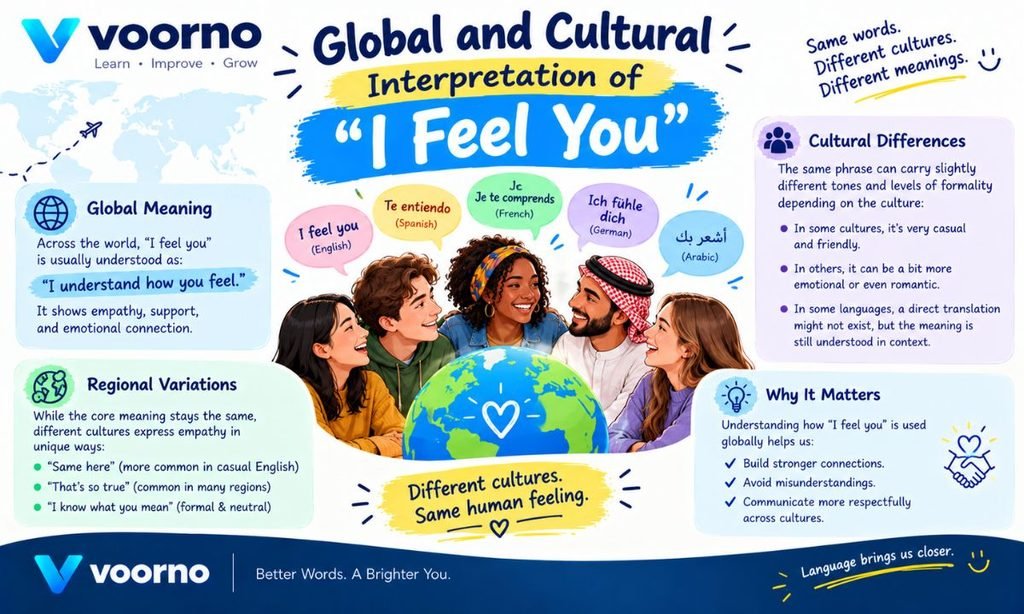
While the phrase originated in American English, its spread through music, film, and social media has made it recognizable well beyond the US. However, it doesn’t always translate directly into other languages, and many cultures rely on entirely different expressions to convey the same sentiment.
Cultural Difference Insight:
- In some cultures, indirect or formal expressions of empathy are preferred over casual slang.
- Non-native English speakers sometimes take the phrase literally, which can cause confusion.
- On global social platforms, the phrase is often understood contextually even by people unfamiliar with its slang origin, simply because it’s so widely used online.
The Evolution of “I Feel You” in Digital Culture
Social media accelerated this phrase from regional slang into global shorthand. As comment sections, captions, and DMs became key places for emotional expression, “I feel you” fit perfectly — short, warm, and easy to type on a phone. Over time, digital culture has also spawned shorter cousins like “feel you” or simply “felt,” used in comment sections to express instant relatability.
I Feel You Meaning From a Guy
When a guy says “I feel you,” context still decides the meaning:
- Platonic context: likely simple understanding or agreement between friends
- Emotional conversation: often a sign he’s genuinely listening and relating
- Romantic context: may signal emotional closeness or a desire to connect more deeply
As with any phrase, tone and the nature of the relationship matter more than the words themselves.
Case Study: How “I Feel You” Builds Connection Online
Consider a social media comment section under a post about job burnout. A single top comment reading “I feel you, this is literally my life right now” often gets hundreds of likes and replies — far more engagement than a longer, more formal comment might receive. That’s because the phrase instantly signals shared experience, inviting others to reply with their own version of “same” or “I feel https://dictionary.cambridge.org/you too.” This ripple effect is a big reason the phrase remains so common in online spaces: it’s short, relatable, and easy for others to echo.
Why “I Feel You” Still Matters Today
Despite decades of slang trends coming and going, “I feel you” has stuck around because it does something simple extremely well — it makes people feel heard in just two words. In an era of fast digital communication, that efficiency, combined with genuine emotional weight, is exactly why the phrase hasn’t faded out.
Key Takeaways
- “I feel you” means understanding, empathy, or strong agreement, depending on context.
- It has roots in AAVE and hip-hop culture, gaining mainstream popularity by the early 2000s.
- It’s different from “I feel for you,” which expresses sympathy rather than shared experience.
- Tone, punctuation, and delivery shape whether it reads as empathetic or simply agreeable.
- It’s best used in casual or emotionally supportive contexts, not formal ones.
FAQs
Is “I feel you” grammatically correct?
Yes, grammatically it’s a complete sentence, though it’s used idiomatically rather than literally — it doesn’t refer to physical touch.
What does “I feel you” mean?
It means you understand, relate to, or agree with what someone is expressing, often on an emotional level.
What’s another way to say “I feel you”?
Common alternatives include “I hear you,” “same here,” “I get it,” and “I relate to that.”
What does it mean when a girl says “I feel you”?
It typically means she understands or relates to what was said; in a romantic context, it can also signal emotional closeness.
What can I say instead of “I feel”?
Try “I think,” “I sense,” “I believe,” or “it seems to me,” depending on how formal or personal you want to sound.
Conclusion
“I feel you” is a small phrase that does a lot of emotional heavy lifting. Born from AAVE and hip-hop culture, it has grown into one of the most widely used empathetic expressions in modern English, spanning texts, social media, and everyday conversation.
Whether you’re using it to comfort a friend, agree with a complaint, or express closeness with a partner, understanding its nuance — and knowing when it fits — helps you use it authentically rather than as an empty filler. Used well, it remains one of the simplest ways to tell someone: you’re not alone in this.










1 thought on ““I Feel You” Slang Meaning, Origin & How to Use It”