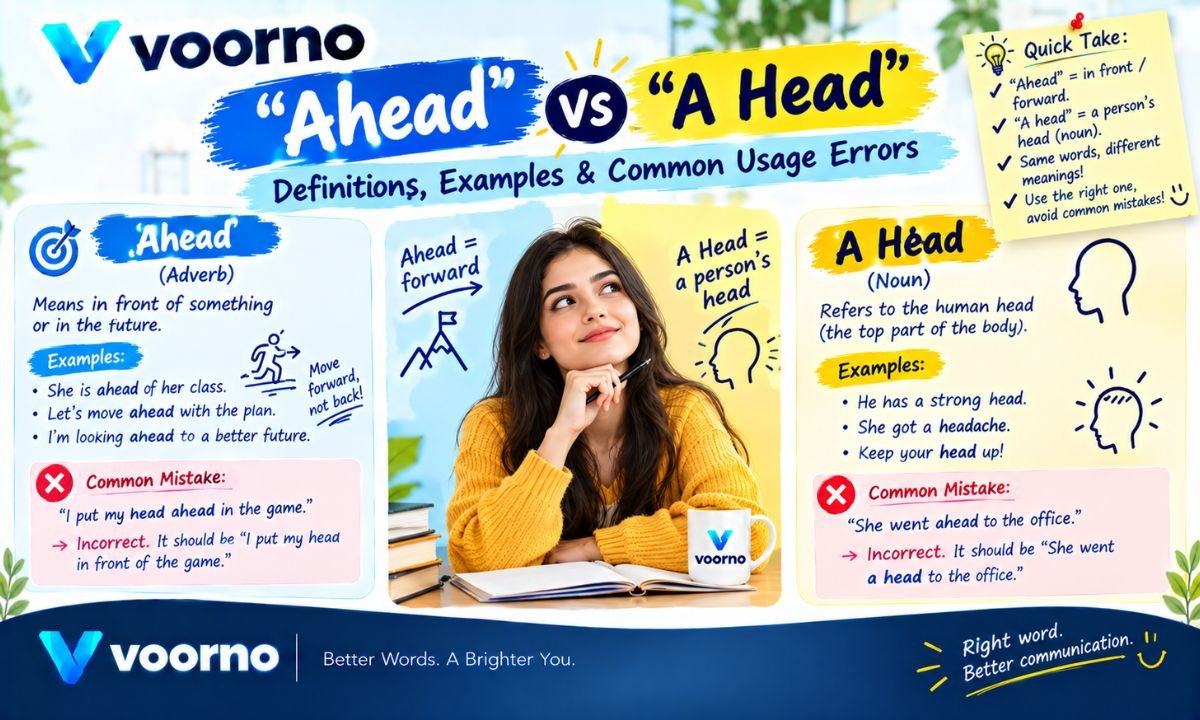
You’re typing a sentence, you pause, and suddenly you’re not sure: is it “she moved ahead” or “she moved a head”? One tiny space is standing between a sentence that makes perfect sense and one that sounds bizarre — or even a little unsettling.
This confusion is more common than most writers admit. “Ahead” and “a head” are homophones — they sound identical when spoken — but they belong to completely different grammatical categories and carry completely different meanings. Mixing them up in an email, an essay, or a business report can make your writing look careless, even if the rest of your grammar is flawless.
This guide breaks down everything you need to know: definitions, real-world examples, the grammar rules behind the confusion, common mistakes, memory tricks, and a quick practice section so you can test yourself.
Why One Space Changes Meaning in “Ahead” vs “A Head”
Spacing is not a cosmetic detail in English — it’s structural. Remove or add a single space, and you can shift a word from an adverb to a noun phrase, changing the entire meaning of a sentence.
- She moved ahead. → She made progress or took the lead.
- She moved a head. → She physically relocated someone’s (or something’s) head.
Same sounds, same letters almost, wildly different pictures in the reader’s mind. That’s why “ahead vs a head” isn’t a stylistic preference — it’s a grammar rule with real consequences for clarity.
Understanding “Ahead” vs “A Head” at a Glance
Before diving into the details, here’s a quick side-by-side comparison to anchor the rest of the article.
| Feature | Ahead | A Head |
| Word count | One word | Two words (article + noun) |
| Part of speech | Adverb (sometimes adjective) | Noun phrase |
| Meaning | In front, forward, in advance, in the future | One physical head, or “per person/unit” |
| Can stand alone as subject/object? | No | Yes |
| Example | We’re ahead of schedule. | She has a head for numbers. |
| Common collocations | go ahead, plan ahead, look ahead | a head of lettuce, a head of state |
Ahead vs a Head Examples
- Ahead: Please walk ahead; I’ll catch up.
- A head: A head appeared over the fence.
- Ahead: The team is two points ahead.
- A head: He bought a head of cabbage.
- Ahead: Think ahead before signing the contract.
- A head: The statue has a head made of marble.
Read More:Baptised vs. Baptized: British vs. American English Explained
What Does “A Head” Mean?
“A head” is simply the indefinite article “a” combined with the noun “head.” It is not a single grammatical unit — it’s two separate words that happen to function together as a noun phrase. Because “head” is a noun, “a head” always refers to something countable: a physical head, a leader, or a single unit within a group.
Literal and Figurative Uses of “A Head”
Literal uses refer to an actual physical head:
- I bumped a head on the low doorway.
- The doll has a head made of porcelain.
- The eagle statue has a head carved from stone.
Figurative or idiomatic uses extend the noun beyond the body part:
- She is a head of the finance department. (a leader)
- We paid ten dollars a head for the buffet. (per person)
- He has a head for business. (a natural talent)
- There’s a head of garlic in the pantry. (a unit of produce)
In every case, “head” behaves as a countable noun — you can say “one head,” “two heads,” or “several heads,” which is impossible with the adverb “ahead.”
Read More:What Does “It Is How It Is” Mean? Meaning, Examples & Real-Life Usage
Grammar Deep Dive: Why “Ahead” vs “A Head” Is Structural, Not Stylistic

The core difference lies in part of speech:
- Ahead is an adverb (and occasionally functions adjectivally). Adverbs modify verbs, adjectives, or entire clauses — they describe how, when, or where an action happens. “Ahead” tells you about direction, position, or time.
- A head is a noun phrase. Nouns name people, places, things, or ideas, and they can take articles, plurals, and possessives — none of which “ahead” can do.
This is why you can never pluralize “ahead” (there’s no such thing as “aheads”), but you can absolutely pluralize “a head” into “heads” once the article is dropped.
Context Is Everything in “Ahead” vs “A Head”
Because the words sound the same, context — not pronunciation — is what tells a reader (or listener) which one is meant. Ask yourself: does this sentence describe direction, time, or progress? Then “ahead” is correct. Does it describe a physical object, a leader, or a unit count? Then “a head” is correct.
Frequent Mistakes Writers Make
Even confident writers slip up with this pair. Here are the three most common errors.
Confusing “Ahead” with “In Front”
While “ahead” and “in front” are close synonyms, they aren’t always interchangeable. “In front” often needs a preposition (“in front of the house”), while “ahead” can stand alone or pair with “of” (“ahead of schedule”). Using “ahead” where the sentence structure demands “in front of” can create an awkward, unfinished phrase.
Choosing the Wrong Form in Formal Writing
In reports, resumes, and academic papers, writing “a head” when you meant “ahead” (or vice versa) is an easy way to lose credibility. A sentence like “the project is a head of schedule” instantly signals a proofreading gap to any careful reader.
Trusting Autocorrect
Autocorrect tools frequently “fix” one form into the other based on surrounding words, without understanding your intended meaning. Never assume spellcheck caught this error — homophone mistakes routinely slip past automated tools because both forms are spelled correctly; they just mean different things.
Common Expressions That Use “Ahead”
- Go ahead — give permission or proceed
- Plan ahead — prepare in advance
- Look ahead — think about the future
- Stay ahead — maintain a lead or advantage
- Ahead of time — earlier than expected
- Ahead of the curve — more advanced than others
- Full speed ahead — proceed with maximum effort
What Does “Ahead” Mean?
“Ahead” signals position, direction, time, or progress. It answers questions like where, when, or how far along. As a single word, it never takes an article and never functions as the subject or object of a sentence — it always modifies something else.
“Ahead” and Progress
- The company is ahead of its competitors in innovation.
- Our team finished ahead of the other departments.
“Ahead” and Future
- There’s a busy year ahead.
- The road ahead looks uncertain.
“Ahead” and Planning
- Always plan ahead for emergencies.
- She booked her tickets well ahead of the trip.
Pronunciation Awareness: Why Your Ear Can Mislead You
Spoken English doesn’t pause between “a” and “head” the way writing separates them with a space. When you say “ahead” and “a head” out loud, they sound virtually identical — which is exactly why writers who rely on “how it sounds” rather than “what it means” fall into this trap. Reading your sentence back and asking what image it creates is far more reliable than sounding it out.
The Etymology of “Ahead”
“Ahead” traces back to Middle English, formed from the prefix “a-“ (meaning “on” or “in the direction of”) combined with “head.” Originally it carried a literal sense of “at the head” or “in the front position” — often used in nautical and military contexts to describe a ship or army moving in front of others. Over centuries, its meaning broadened from strictly physical position to include time, progress, and abstract advantage, which is how we use it today.
Practical Writing Strategies to Avoid Confusion

- Ask the replacement question. Can you swap the word for “forward,” “in front,” or “in advance”? If yes, use “ahead.”
- Check for countability. Could you say “two of them”? If yes, you likely need “a head” (as in “two heads”).
- Read the sentence aloud slowly, pausing mentally between “a” and “head” to see if that split makes sense.
- Search your draft for “ahead” and “a head” before submitting any formal document, and verify each instance individually.
- Keep a personal cheat sheet of tricky homophones, including this pair, for quick reference during editing.
Mini Case Study: How a Small Error Damages Professional Writing
Imagine a project manager sends a client update that reads: “We are a head of schedule this quarter.” The intended meaning was clearly “ahead of schedule” — meaning the project is progressing faster than planned. But as written, the sentence is grammatically broken; it reads as though the team is somehow “in possession of a head” ahead of schedule, which makes no logical sense.
To a client scanning quickly, this kind of error might not register consciously — but it subtly signals a lack of attention to detail. In competitive industries where professionalism is judged by written communication, small slips like this one can undermine trust built over months of good work. Precision in word choice isn’t pedantic; it’s part of protecting your credibility.
Ahead vs A Head Grammar
| Grammar Point | Ahead | A Head |
| Function | Adverb / adjective | Article + noun |
| Modifies | Verbs, clauses | Nothing — it names a thing |
| Takes plural form | Never | Yes (heads) |
| Needs an article | Never | Always (a/the) |
| Can be a sentence subject | No | Yes (“A head appeared.”) |
Practice Section: Test Your Understanding of “Ahead” vs “A Head”
Fill in the blank with the correct form — “ahead” or “a head”:
- The runner pulled __________ in the final lap.
- She has __________ for detailed spreadsheets.
- We should plan __________ for the holidays.
- __________ of cattle grazed near the fence.
- The company stayed __________ of its rivals this year.
Answers
- ahead
- a head
- ahead
- A head
- ahead
Related Word Confusions You Should Master
- Everyday vs Every Day
- A While vs Awhile
- A Lot vs Alot
- Into vs In To
- Altogether vs All Together
Mastering these pairs alongside “ahead vs a head” strengthens your overall command of spacing rules in English, one of the most overlooked areas of grammar accuracy.
Why Precision in “Ahead” vs “A Head” Builds Credibility
Clear, error-free writing signals competence. Whether you’re writing a cover letter, a business proposal, or a casual blog post, correctly distinguishing “ahead” from “a head” shows readers that you understand the mechanics of your own language. It’s a small detail, but small details accumulate into an overall impression of trustworthiness and professionalism.
Ultra-Quick Memory Trick for “Ahead” vs “A Head”
Think of it this way: “Ahead” has no article because it IS the direction — it doesn’t need a helper word. “A head” always needs its little helper “a” because “head” is a noun standing for a countable thing. If you can count it, it’s “a head.” If it describes movement, time, or progress, it’s “ahead.”
FAQs
What is the difference between “a head” and “ahead”?
“Ahead” is a one-word adverb meaning forward, in front, or in advance, while “a head” is a two-word noun phrase referring to a literal head or a countable unit.
Is the word “ahead” an adverb?
Yes, “ahead” is primarily an adverb, though it can occasionally function adjectivally to describe position or progress.
Is it correct to say “ways ahead” or “way ahead”?
“Way ahead” is the standard, correct form; “ways ahead” is grammatically incorrect and rarely used in formal writing.
Is the word “ahead” a preposition?
No, “ahead” is not a true preposition on its own, but it often pairs with “of” (as in “ahead of schedule”) to form a prepositional phrase.
When to use “ahead” in a sentence?
Use “ahead” whenever you’re describing direction, position, future time, or progress, such as in “stay ahead,” “plan ahead,” or “look ahead.”
Conclusion
The difference between “ahead” and “a head” comes down to one simple test: are you describing direction, time, or progress, or are you referring to a physical, countable head? Once that question becomes automatic, the confusion disappears for good.
Precision with homophones like these might seem minor, but it’s exactly the kind of detail that separates polished, professional writing from writing that makes readers pause and second-guess your meaning. Keep the grammar rule in mind, run through the quick memory trick when in doubt, and you’ll never lose a step — or a head — over this pair again.










2 thoughts on “‘Ahead’ vs ‘A Head’: Definitions, Examples & Common Usage Errors”