If you’ve ever paused mid-sentence wondering whether to write “baptised” or “baptized,” you’re not alone. This single letter — an s versus a z — trips up students, bloggers, editors, and even native speakers. The good news? The fix is simpler than it looks.
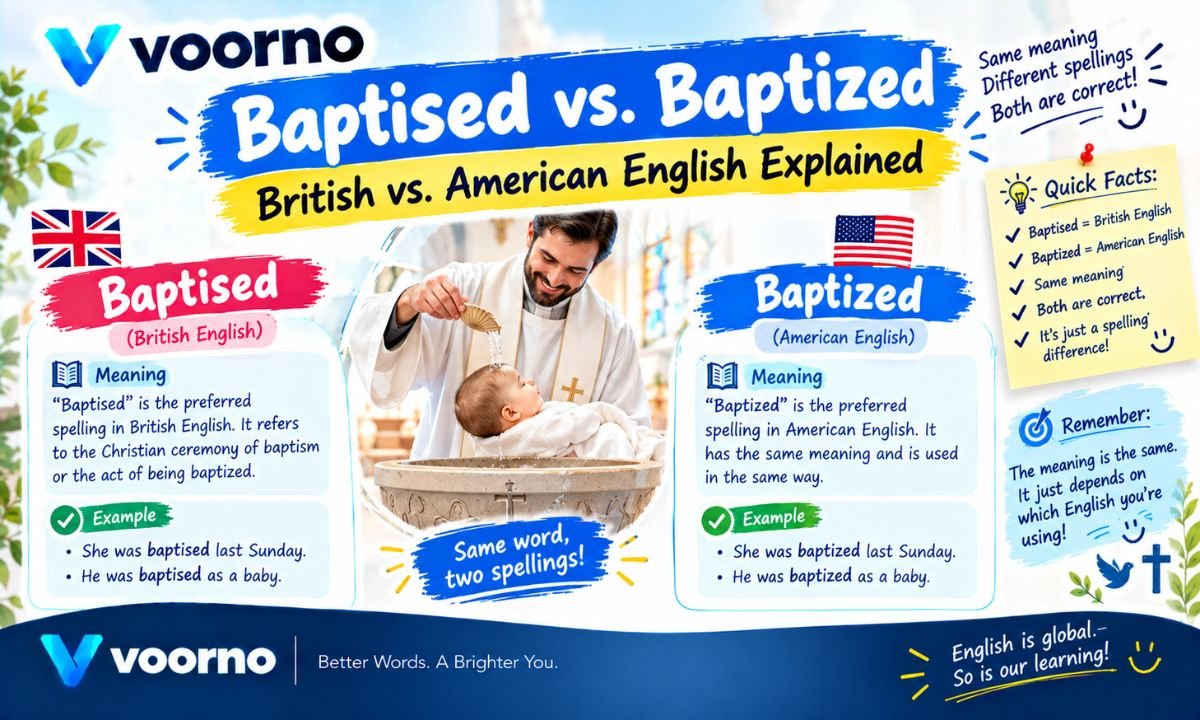
In short: baptised is the British English spelling, and baptized is the American English spelling. Both describe the exact same religious rite — there’s no difference in meaning, pronunciation, or theology. The only thing that changes is which side of the Atlantic (or which style guide) you’re writing for.
This guide breaks down where the spelling split comes from, how each version is used in real sentences, what baptism actually means beyond the spelling debate, and how to avoid the most common mistakes writers make with this word.
British vs. American English: Why Spellings Change
English didn’t split into “British” and “American” overnight. The divide traces back to the early 1800s, when American lexicographer Noah Webster set out to simplify and standardize spelling for American readers. Webster believed English spelling was needlessly complicated, so he trimmed silent letters, swapped endings, and pushed for a more phonetic, consistent system.
This is why American English favors -ize endings (organize, realize, baptize), while British English generally prefers -ise endings (organise, realise, baptise). A few related spelling patterns follow the same split:
- Color (US) vs. Colour (UK)
- Organize (US) vs. Organise (UK)
- Realize (US) vs. Realise (UK)
- Center (US) vs. Centre (UK)
Interestingly, this isn’t a purely “American invention.” The -ize ending is actually closer to the word’s original Greek root, and even the Oxford English Dictionary has historically preferred -ize in some British contexts. So the idea that “-ize is American and -ise is proper British” oversimplifies a more nuanced linguistic history. Still, in everyday modern usage, the regional pattern holds firm: Americans write baptized, and British, Australian, and most Commonwealth writers write baptised.
Read More:Chillin’: How to Relax, Recharge, and Enjoy the Moment
Baptised in the Holy Spirit
One phrase that comes up often in Christian writing and worship is being “baptised in the Holy Spirit” (or “baptized in the Holy Spirit” in American texts). This refers to a spiritual experience described in Christian scripture — particularly in Pentecostal and charismatic traditions — where a believer receives the Holy Spirit in a powerful, often transformative way, sometimes accompanied by spiritual gifts.
This is distinct from water baptism. Water baptism is the outward ritual; being baptised in the Holy Spirit is considered an inward, spiritual event. Depending on the denomination, believers may see the two as connected, sequential, or entirely separate experiences. Regardless of spelling, the underlying theological concept doesn’t change — only the regional spelling convention does.
Baptised vs. Baptized: The Core Difference Explained
Here’s the plain-English version: there is no difference in meaning between baptised and baptized. Both are the past tense and past participle forms of the verb meaning to perform (or undergo) the Christian rite of baptism, usually involving water, as a symbol of spiritual cleansing and initiation into the faith.
The only distinction is regional spelling:
- Baptized → American English (US)
- Baptised → British English (UK, Australia, New Zealand, South Africa, and most Commonwealth countries)
Neither spelling is “more correct” or “more formal” than the other. It’s purely a matter of which English-speaking audience you’re writing for — and staying consistent once you’ve picked one.
Read More:‘Ahead’ vs ‘A Head’: Definitions, Examples & Common Usage Errors
Quick Comparison Table
| Feature | Baptised | Baptized |
| Region | British English (UK, Australia, NZ) | American English (US) |
| Spelling pattern | -ise ending | -ize ending |
| Meaning | Same | Same |
| Pronunciation | Same | Same |
| Noun form | Baptism (unchanged) | Baptism (unchanged) |
| Common in | UK news, Commonwealth publishing, British church texts | US news, American publishing, US church texts |
| Style guide fit | Oxford (UK), Cambridge (UK) | AP Style, Chicago Manual (US) |
Real Usage Examples of Baptised vs. Baptized
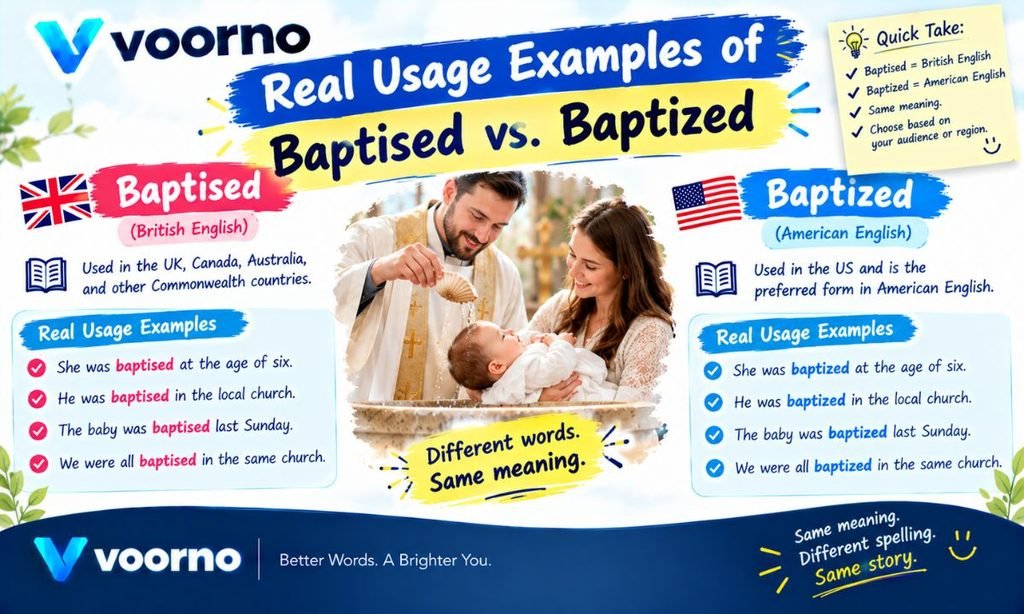
Seeing the words in context makes the distinction easier to remember than any rule ever could.
- The baby was baptised at the local parish in Manchester.
- The baby was baptized at the local church in Ohio.
- She was baptised as an infant in a small village church.
- She was baptized as an infant at her family’s church in Texas.
- Thousands of new believers were baptised during the revival in London.
- Thousands of new believers were baptized during the revival in Georgia.
Notice the pattern: identical sentence structure, identical meaning — only the spelling shifts with the region.
The Origin of the Word “Baptize”
The word traces back to the Greek verb baptizein, meaning “to dip,” “to immerse,” or “to wash.” This Greek root passed into Latin as baptizare, then into Old French, and eventually into Middle English. As English spelling standardized differently in Britain and America, the word settled into its two modern forms.
Because the original Greek ending is closer to “-izein,” some linguists argue that baptized is technically nearer to the word’s etymological roots. That said, etymology doesn’t determine correctness in modern usage — regional convention does.
Examples of “Baptised” in British English
- The vicar baptised three infants during Sunday’s service.
- He was baptised into the Anglican Church as a child.
- The dragon queen was symbolically baptised by fire (figurative use).
- To be baptised into the church, one must first profess belief.
- The pope baptised each infant during the annual ceremony.
Examples of “Baptized” in American English
- The pastor baptized the new church members in the river.
- He was baptized at a Baptist church in Alabama.
- The congregation watched as she was baptized by full immersion.
- Many converts were baptized during the summer revival.
- The infant was baptized on Sunday morning.
Baptism: Meaning Beyond Spelling
Spelling aside, it’s worth understanding what baptism actually is — because the ritual itself carries deep meaning across Christian traditions.
What Is Baptism?
Baptism is a Christian religious rite that symbolizes spiritual cleansing, rebirth, and initiation into the Christian faith and, typically, into a specific church community. It usually involves water — either through immersion, pouring, or sprinkling — and is considered one of the most significant sacraments or ordinances in Christianity.
Core Elements
Most Christian baptisms share a few common elements, regardless of denomination or spelling convention:
- Water — used to symbolize purification and spiritual washing.
- A declaration of faith — spoken by the person being baptized or, for infants, by parents/godparents on their behalf.
- An officiant — typically a priest, pastor, or minister who performs the rite.
- Community witness — baptism is usually a public act performed before a congregation.
- Symbolic naming or blessing — in many traditions, the person’s name is spoken as part of the ceremony.
Baptised or baptized Catholic
In Catholic teaching, baptism is one of the seven sacraments and is considered essential for full initiation into the Church. Catholic baptism typically happens in infancy, involves the pouring of holy water over the child’s head, and is performed by a priest or deacon. Whether you write “baptised Catholic” or “baptized Catholic” depends purely on regional spelling — a British Catholic publication would use the former, while an American Catholic publication would use the latter. The sacrament itself is identical either way.
How Baptism Is Practiced Across Denominations
Not every Christian tradition baptizes the same way, or at the same life stage. Here’s a breakdown.
Main Types of Baptism
- Infant baptism — practiced by Catholics, Anglicans/Episcopalians, Lutherans, and Methodists; babies are baptized shortly after birth.
- Believer’s baptism — practiced by Baptists, Pentecostals, and many evangelical churches; individuals are baptized after professing personal faith, often as teens or adults.
- Conditional baptism — performed when there’s uncertainty about whether a valid baptism already took place.
Methods of Baptism
- Full immersion — the entire body is submerged in water (common among Baptists and Pentecostals).
- Affusion (pouring) — water is poured over the head (common in Catholic and Anglican practice).
- Aspersion (sprinkling) — water is lightly sprinkled on the forehead (common in some Presbyterian and Reformed churches).
Figurative Use of “Baptised” and “Baptized”
Both spellings show up well outside religious contexts, used figuratively to describe an intense, transformative first experience.
- “She was baptized by fire on her first day as a trauma nurse.”
- “He was baptised into the world of professional football after one brutal match.”
- “The new hire was baptized into corporate life during a chaotic product launch.”
In figurative use, “baptized/baptised by fire” means learning something quickly under pressure — usually through a difficult or overwhelming first experience.
Common Mistakes to Avoid

Frequent Issues
- Mixing spellings in the same document. Switching between baptised and baptized within one piece of writing looks inconsistent and unprofessional.
- Assuming one spelling is “more correct.” Neither is superior — it’s a regional choice, not a grammar rule.
- Confusing baptism with denominational doctrine. The spelling has nothing to do with theology; it’s purely geographic.
- Forgetting the noun stays the same. “Baptism” doesn’t change regardless of which verb spelling you use.
Example of a Mistake
❌ “He was baptized in London, and later she was baptised in the same church.”
✅ “He was baptised in London, and later she was baptised in the same church.” (Consistent British spelling)
✅ “He was baptized in Boston, and later she was baptized in the same church.” (Consistent American spelling)
When to Use Baptised vs. Baptized in Your Writing
The rule of thumb is simple:
- Writing for a US audience, an American publication, or using AP Style/Chicago Manual? Use baptized.
- Writing for a UK, Australian, or Commonwealth audience, or using Oxford/Cambridge style? Use baptised.
- Writing for a global or mixed audience? Pick one spelling and stay consistent throughout the entire piece. Many international publications default to American spelling simply because it’s more widely recognized online.
If you’re ever unsure, check your document’s language settings — word processors like Microsoft Word will flag whichever spelling doesn’t match the selected regional dictionary.
Case Study: Real-World Usage in Content Writing
Content teams writing for global audiences run into this issue constantly. A US-based religious nonprofit publishing blog content for both American and UK donors, for example, often maintains two versions of key articles — one in American English, one in British English — rather than mixing spellings within a single piece. News agencies handle this the same way: Reuters and the BBC consistently use “baptised,” while AP News and most US outlets consistently use “baptized.” The lesson for writers is the same one style guides have preached for decades: consistency builds credibility, and inconsistency — even over a single letter — quietly undermines it.
Expert Insight
Editors and linguists generally agree on one point: readers rarely notice correct regional spelling, but they do notice when it’s inconsistent. A single stray “baptised” in an otherwise American-English article (or vice versa) can read as a typo, even though it’s technically valid in another dialect. The safest practice is to set your document’s language preference before you start writing, not after.
Baptized in Fear Music Video
Outside religious and academic contexts, “baptized” has also entered pop culture. The Weeknd released a track and accompanying music video titled “Baptized in Fear,” part of his 2025 album Hurry Up Tomorrow. The song uses baptism as a metaphor for confronting inner fear and guilt, with lyrics describing a frightening, almost drowning-like sleep paralysis experience. The music video, directed by Moosaje, is set in a dreamlike, purgatory-style environment featuring striking church imagery, and it visually reflects the singer’s inner struggle and search for renewal. It’s a strong example of how the word “baptized” has moved beyond strict religious usage into broader cultural and artistic symbolism — representing an intense, transformative ordeal rather than a literal religious rite.
Final Verdict: Baptised vs. Baptized
There’s no winner here — just two correct spellings serving two different audiences. If you’re writing for American readers, go with baptized. If you’re writing for British or Commonwealth readers, go with baptised. The meaning, the ritual, and the pronunciation stay exactly the same either way. What matters most is picking one spelling and using it consistently throughout your writing.
FAQs
Are Muslims baptised?
No. Baptism is a Christian rite. Islam has its own initiation practices, such as the declaration of faith (Shahada), but it does not include baptism.
Which is correct, baptized or baptised?
Both are correct. “Baptized” is American English, and “baptised” is British English — the choice depends on your audience.
What is Baptized in Fear about?
It’s a 2025 song and music video by The Weeknd from the album Hurry Up Tomorrow, using baptism imagery to symbolize confronting fear, guilt, and inner turmoil.
Why does British English use -ise while American English uses -ize?
The split largely traces back to Noah Webster’s 19th-century push to simplify American spelling, which favored the -ize ending over the British -ise convention.
What is the difference between “baptized” and “baptised”?
There is no difference in meaning — only regional spelling. “Baptized” is used in American English, and “baptised” is used in British English.
Conclusion
At the end of the day, baptised vs. baptized isn’t a grammar trap — it’s a geography choice. Both spellings describe the same meaningful ritual of spiritual initiation, and both are equally valid depending on where your readers are.
Whether you’re writing a school essay, a church bulletin, or a blog post for a global audience, the key takeaway is simple: know your audience, pick your spelling, and stay consistent from the first line to the last.










2 thoughts on “Baptised vs. Baptized: British vs. American English Explained”