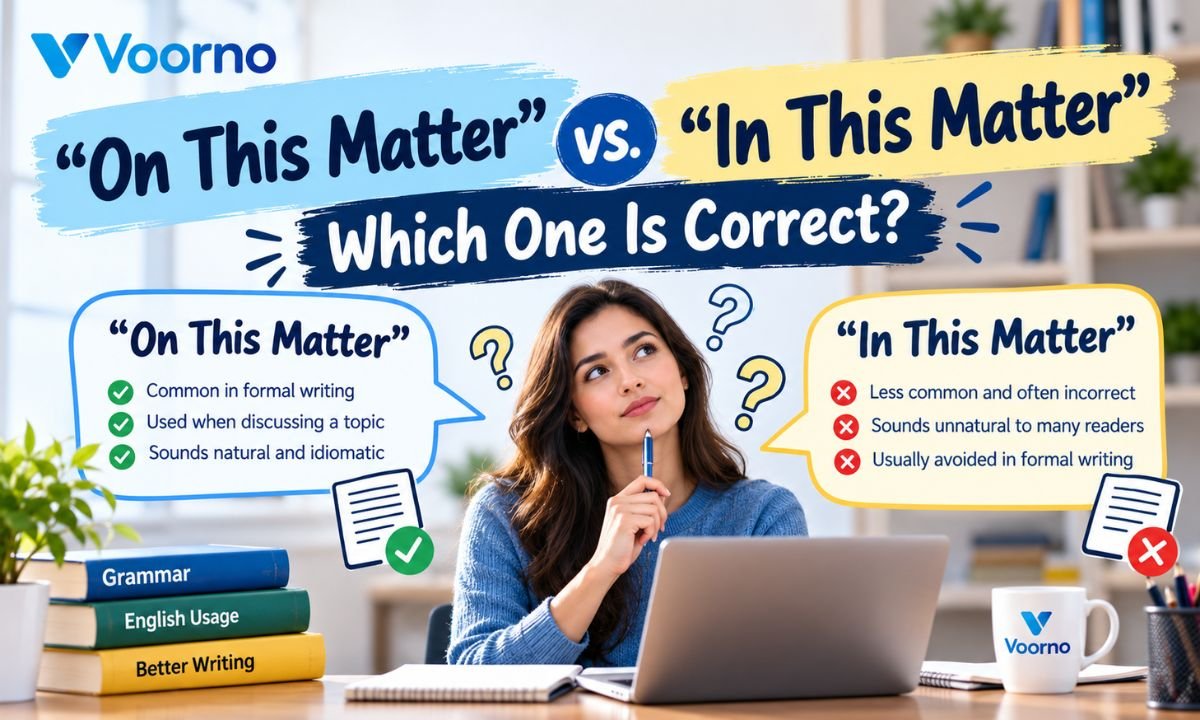
If you’ve ever paused mid-email wondering whether to write “I’d like your thoughts on this matter” or “we need your guidance in this matter,” you’re not alone. These two phrases look almost identical, show up constantly in professional writing, and yet they don’t mean quite the same thing.
The short answer: both phrases are grammatically correct, but they aren’t interchangeable. “On this matter” refers to a topic, opinion, or subject under discussion. “In this matter” refers to involvement, participation, or action within a specific case or situation. Swap them carelessly, and your sentence can sound off — or, in legal and business writing, actually change what you mean.
This guide breaks down the difference in plain English, with examples, a comparison table, and a quick decision trick you can use every time you’re unsure.
Why This Small Difference Creates Big Confusion
The confusion comes from the fact that “matter” itself is flexible. It can mean a topic (“a matter of opinion”) or a situation/case (“a legal matter”). Because the noun stays the same, many writers assume the preposition in front of it doesn’t matter much either. It does.
Add to that the fact that both phrases:
- Appear in formal and semi-formal writing
- Sound polished and professional
- Are used constantly in emails, legal letters, and business correspondence
…and it’s easy to see why even fluent English speakers mix them up. The good news is that once you understand the underlying logic, the choice becomes almost automatic.
Read More:Fair vs Good: What’s the Difference? A Simple Guide
On This Matter Synonym
If you want to avoid repeating “on this matter” in a piece of writing, natural alternatives include:
- About this topic
- Regarding this issue
- Concerning this subject
- With respect to this issue
- On this topic/point/question
These synonyms work well in emails, reports, and everyday professional communication because, like “on this matter,” they signal discussion rather than involvement.
Read More:Associated With vs Associated To: Examples, Rules & Tips
What “This Matter” Really Means in Modern English
In modern usage, “matter” typically refers to one of two things:
- A subject or topic being discussed, debated, or commented on.
- A case, issue, or situation someone is formally connected to, such as a legal proceeding, investigation, or business dispute.
This is the root of the entire “on” vs. “in” debate. When “matter” means topic, “on” fits naturally. When “matter” means situation or case, “in” fits naturally.
A common example that trips people up:
Thank you for your assistance in this matter.
This is correct — and very common in professional emails — because “assistance” implies active involvement in resolving a situation, not simply commenting on a topic. Compare that with:
Thank you for your thoughts on this matter.
Here, “thoughts” is an opinion about a topic, so “on” is correct.
“On This Matter”: Meaning, Intent, and Correct Usage
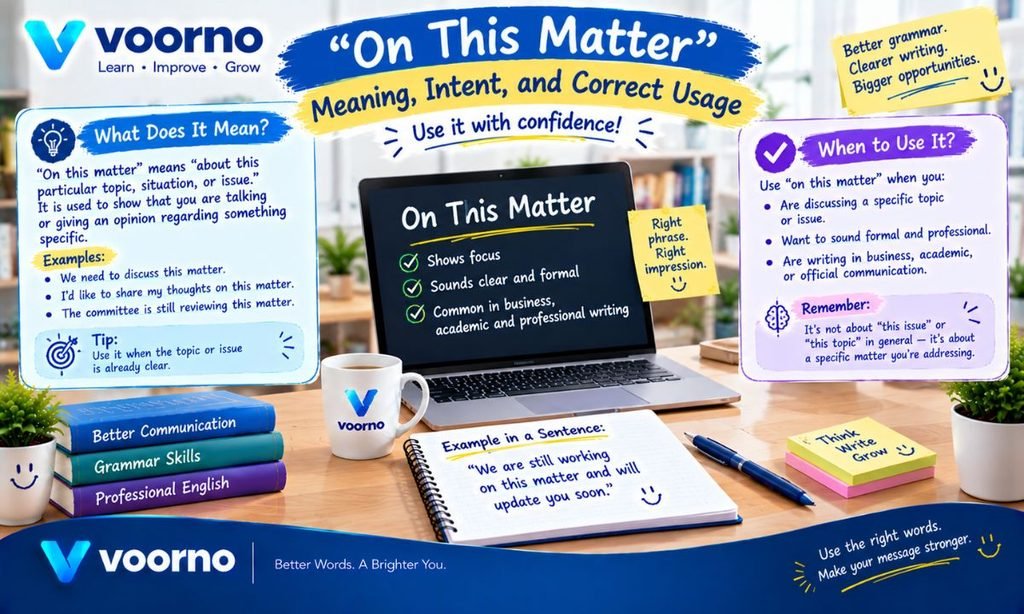
“On this matter” is used when someone is discussing, commenting on, or expressing a view about a topic or issue. It pairs naturally with verbs like comment, agree, advise, decide, speak, write, and elaborate.
Examples:
- We would appreciate your feedback on this matter.
- Please share your opinion on this matter before the meeting.
- The manager has not commented on this matter yet.
- Our position on this matter remains unchanged.
“On this matter” is the more common, more versatile phrase. It works comfortably in everyday conversation, business emails, academic writing, and general professional communication.
“In This Matter”: Meaning, Intent, and Correct Usage
“In this matter” is used when someone is involved, participating, or acting within a specific case, situation, or formal process. It pairs naturally with verbs like represent, assist, cooperate, intervene, investigate, and proceed.
Examples:
- Our legal team is representing the company in this matter.
- We appreciate your cooperation in this matter.
- The investigation in this matter is still ongoing.
- He has no prior experience in this matter.
“In this matter” carries a more formal, official, and often legal tone. It signals that someone has a role, responsibility, or stake in a situation — not just an opinion about it.
“In This Matter” at the Beginning of a Sentence
Starting a sentence with “In this matter” works well when you’re setting up context about involvement or a formal process before naming the action:
- In this matter, our office will act as the primary point of contact.
- In this matter, all correspondence must go through legal counsel.
This structure is common in legal letters, official notices, and formal reports, where you want to establish the “case” or “situation” up front.
“On This Matter” at the Beginning of a Sentence
Starting a sentence with “On this matter” works when you’re introducing an opinion, update, or point of discussion:
- On this matter, the committee has reached no conclusion.
- On this matter, we recommend further review before proceeding.
This structure feels natural in emails, memos, and reports where you’re steering the reader toward a topic rather than a formal case.
Side-by-Side Comparison: Meaning, Tone, and Impact
| Feature | “On This Matter” | “In This Matter” |
| Core meaning | Discussion of a topic or issue | Involvement in a case or situation |
| Typical verbs | comment, agree, advise, decide, share | represent, assist, cooperate, investigate |
| Tone | Conversational, professional | Formal, legal, official |
| Common setting | Emails, meetings, general writing | Legal documents, official notices, contracts |
| Focus | The subject itself | The role or action within a situation |
| Frequency in everyday English | More common | Less common, more specialized |
Quick Interpretation Trick
Whenever you’re unsure, ask one simple question:
Am I talking about a topic, or am I inside a situation?
- If you’re commenting, opining, or discussing → use on.
- If you’re acting, representing, or involved → use in.
A fast substitution test also works well:
- Try swapping in “about this issue” — if it fits, use on.
- Try swapping in “within this case” — if it fits, use in.
Why Prepositions Change Meaning So Drastically
English prepositions carry more grammatical weight than most people realize. “On” generally suggests surface contact or relation to a subject — you comment on something, you have an opinion on something. “In” suggests containment or position within something — you’re involved in a project, embedded in a process.
Applied to “matter,” that same logic holds:
- On a matter = relating to it, from the outside, as a topic.
- In a matter = positioned inside it, as a participant.
This is why swapping the two prepositions doesn’t just sound slightly odd — it can subtly shift who is speaking and what role they’re claiming in the sentence.
Legal and Professional Usage: Precision Over Preference

In legal, corporate, and official writing, prepositions aren’t stylistic — they’re functional. Courts, law firms, and regulators use “in this matter” specifically because it identifies a formal case or proceeding, not a general topic.
Why Lawyers Prefer “In This Matter”
Legal writing values precision above all else, and “in this matter” does three things “on this matter” cannot:
- It identifies a specific, bounded case or proceeding.
- It signals formal involvement, representation, or responsibility.
- It avoids ambiguity about whether someone is merely commenting or actually acting.
That’s why phrases like “counsel of record in this matter” or “our client in this matter” appear throughout legal correspondence, filings, and contracts.
Real-World Legal Example
“Our firm has been retained to represent the defendant in this matter. All future correspondence in this matter should be directed to this office.”
Notice how both instances of “in this matter” point to an active legal case — not a topic of discussion. Using “on this matter” here would weaken the sentence and blur the sense of formal representation.
Professional Consequences of the Wrong Choice
Using the wrong phrase in a professional context isn’t just a grammar slip — it can:
- Make a formal letter sound less authoritative
- Create ambiguity about someone’s actual role or involvement
- Signal a lack of attention to detail in legal or contractual writing
- Undermine credibility in client-facing communication
Historical Usage and Modern Trends
Both phrases have long histories in formal English, particularly in legal and administrative writing dating back centuries. Historically, “in this matter” was the dominant phrase in court documents and official correspondence, reflecting its emphasis on formal proceedings.
In modern English, “on this matter” has become far more common in everyday and business communication, largely because most day-to-day writing involves discussing topics rather than describing formal involvement. “In this matter” has stayed closely tied to legal, administrative, and highly formal contexts, where precision about roles and responsibilities still matters.
Common Mistakes Writers Make
Mistake One: Treating Them as Synonyms
The most frequent error is assuming the two phrases are interchangeable. They’re not. “On this matter” discusses; “in this matter” involves. Treating them as synonyms leads to sentences that are technically grammatical but subtly wrong in meaning.
Mistake Two: Overusing “In This Matter”
Some writers, trying to sound formal, default to “in this matter” even when discussing a simple opinion or update. This can make everyday writing feel unnecessarily stiff or legalistic.
- Overly formal: I’d like to share my thoughts in this matter.
- Natural: I’d like to share my thoughts on this matter.
Mistake Three: Ignoring Audience
The right phrase depends heavily on context. A casual internal email calls for a different tone than a legal notice. Using “in this matter” in a friendly team update, or “on this matter” in a formal legal filing, can feel mismatched to the audience and purpose.
Strong Alternatives That Sometimes Work Better
Depending on tone, these alternatives can replace either phrase without losing clarity:
- Regarding this issue
- Concerning this situation
- With respect to this case
- Pertaining to this matter
- Related to this topic
These work especially well when you want variety in longer documents, or when neither “on” nor “in” feels like a perfect fit.
Case Study: One Sentence, Two Outcomes
Consider this simple sentence with both versions:
- “She has no comment on this matter.” → She is choosing not to share an opinion about a topic.
- “She has no role in this matter.” → She is not involved in the situation at all.
Same subject, same structure, but a completely different message. This is exactly why the choice between “on” and “in” carries real weight in professional and legal writing — it can determine whether a reader understands someone as a commentator or a participant.
Quick Decision Guide You Can Use Every Time
- Ask: Am I discussing a topic, or describing involvement in a situation?
- Topic/opinion → use “on this matter.”
- Case/involvement/action → use “in this matter.”
- Check the verb: Opinion verbs (agree, advise, comment) pair with “on.” Action verbs (represent, assist, investigate) pair with “in.”
- Check the audience: Legal or official readers lean toward “in.” General or business readers lean toward “on.”
Quotes From Style Authorities
Style guides consistently emphasize that preposition choice should follow meaning, not habit. The general grammatical principle — that “on” relates to a subject of discussion while “in” relates to position or involvement within something — is a long-standing rule in English usage guides, and it applies directly to this phrase pair. When in doubt, style authorities recommend reading the sentence aloud and asking whether you’re describing a topic or a role.
FAQs
Which is correct: “on this matter” or “in this matter”?
Both are correct, but they mean different things. Use “on this matter” for topics and opinions, and “in this matter” for involvement in a case or situation.
What does the phrase “on this matter” mean?
It means discussing, commenting on, or expressing a view about a particular topic or issue.
What is another way to say “why it matters”?
You can say “why this is significant,” “why this is important,” or “the significance of this.”
Which is correct to use, in or on?
It depends on context: use “in” for involvement within a situation or case, and “on” for discussing or commenting on a topic.
Why do people say “in regards”?
“In regards to” is a common but technically incorrect variant; the grammatically correct forms are “in regard to” or “as regards,” both meaning “concerning” or “about.”
Conclusion
“On this matter” and “in this matter” may look like interchangeable filler phrases, but they carry distinct meanings rooted in how English prepositions work. “On this matter” belongs to discussion — opinions, comments, and topics. “In this matter” belongs to involvement — cases, roles, and formal situations.
The next time you’re unsure which to use, ask yourself one question: am I talking about something, or am I part of it? Get that right, and the correct preposition follows naturally — whether you’re writing a quick email or a formal legal letter.










2 thoughts on ““On This Matter” vs. “In This Matter”: Which One Is Correct?”