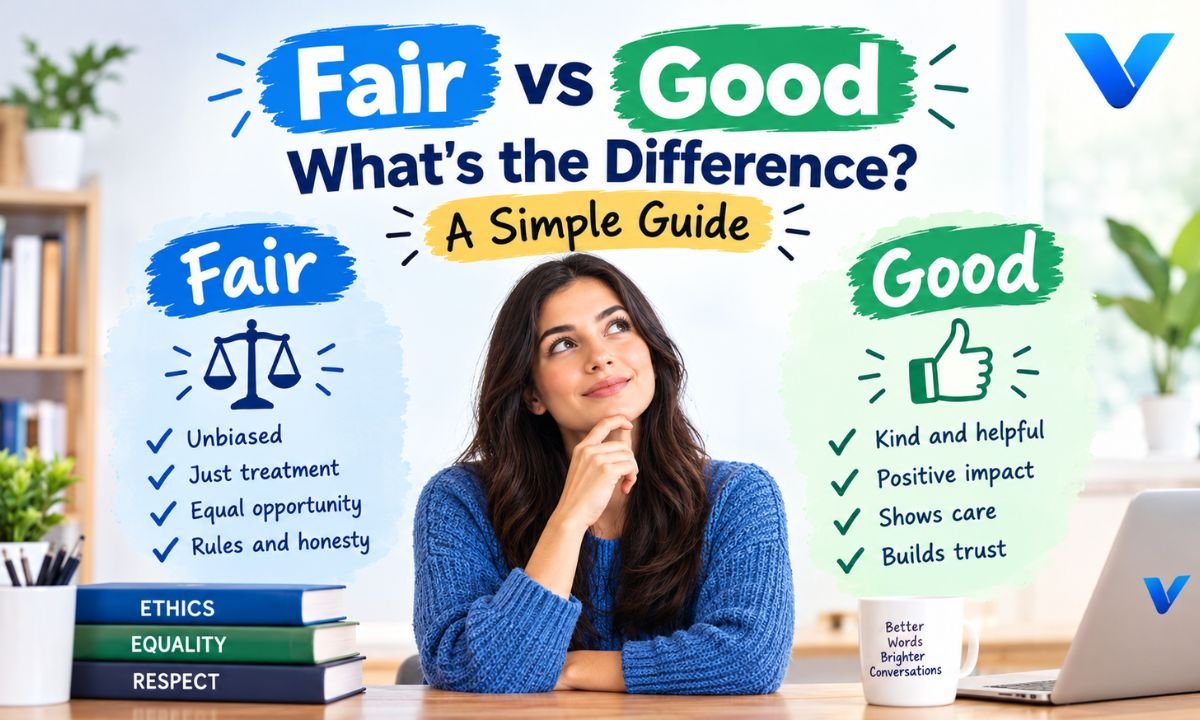
Two small words. One massive gap in meaning. Whether you’re reading a used car listing, checking a credit score, or reviewing an employee’s performance, “fair” and “good” get treated like they mean roughly the same thing. They don’t. That single-word swap can change how much you pay, how a lender treats you, and how someone feels about their own work.
This guide breaks down exactly what “fair” and “good” mean, how they’re used across different industries, and how to pick the right word every time.
Understanding the Real Meaning of “Fair vs Good”
Both words describe quality, condition, or performance — but they sit at very different points on the scale. Good is one notch above average. Fair is average, or slightly below it. That one-step difference shapes how a listener or reader reacts, often before they’ve even thought it through.
Read More:“On This Matter” vs. “In This Matter”: Which One Is Correct?
What “Fair” Really Means
“Fair” signals something that is acceptable but limited. It works, but it doesn’t impress. In quality ratings, fair usually means:
- Functional, but with noticeable flaws
- Meets the bare minimum requirement
- Room for improvement is expected
- Not broken, but not something to brag about
Outside of quality ratings, “fair” has a completely separate meaning: impartial, just, or unbiased — as in a “fair trial” or a “fair decision.” This sense has nothing to do with quality and shouldn’t be confused with it.
What “Good” Really Means
“Good” signals something reliable, solid, and above average. When someone calls a product, a score, or a piece of work “good,” they mean:
- It meets or exceeds expectations
- It’s dependable and consistent
- It has real, noticeable value
- It builds confidence rather than doubt
Good doesn’t mean perfect or exceptional — that’s usually reserved for “excellent” or “very good.” But it clears the bar comfortably, while fair barely reaches it.
Read More:Heartfelt Quotes: “You Are Missed” — About Missing Someone
Fair vs Good: Clear Side-by-Side Comparison
| Aspect | Fair | Good |
| General meaning | Acceptable, but limited | Reliable, above average |
| Emotional reaction | Mild hesitation or doubt | Confidence and trust |
| Used in reviews | Signals visible flaws | Signals genuine satisfaction |
| Used in grading | Meets minimum standard | Exceeds basic expectations |
| Used in health reports | Suggests monitoring needed | Suggests stability |
| Used in credit scores | 580–669 (FICO) | 670–739 (FICO) |
| Resale/condition listings | Visible wear, functional | Minimal wear, well-maintained |
How People Perceive “Fair vs Good”
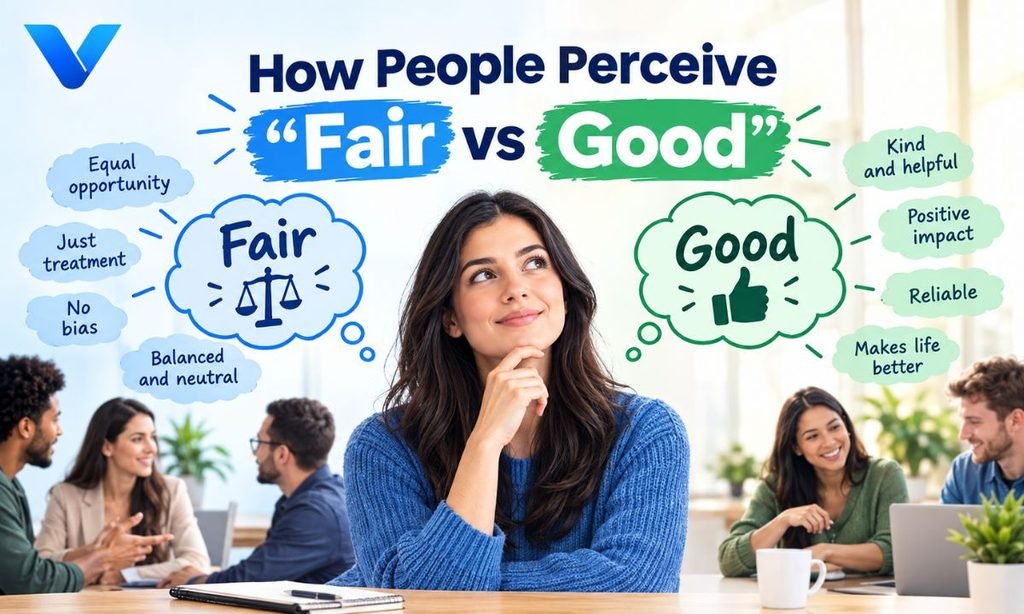
Words don’t just describe things — they shape how people feel about them. Psychologically, most people react to “fair” and “good” emotionally before they process the actual meaning. Three patterns explain why:
- Anchoring – Once someone learns “fair” means “just okay,” that impression sticks every time they hear it again.
- Negativity bias – People notice negative or lukewarm signals more strongly than neutral ones, so “fair” tends to stand out in a bad way.
- Expectation gap – If someone expects high quality and hears “fair” instead, the letdown feels bigger than the word itself intended.
Fair vs Good Synonym
Common alternatives help clarify the gap:
- Fair synonyms: average, adequate, so-so, passable, mediocre, okay
- Good synonyms: solid, reliable, satisfactory, above-average, dependable, well-done
Cultural Interpretation in the United States
In American English, “fair” in a review or report card carries a mildly disappointing tone — it suggests “acceptable, but you could do better.” “Good,” by contrast, is treated as genuine praise, especially in schools, workplaces, and consumer reviews. This cultural weighting is one reason marketers and reviewers are careful about which word they choose.
Where You See Fair vs Good in Action
- Restaurant and product reviews
- School report cards and grading rubrics
- Performance reviews at work
- Health and medical checkup summaries
- Used car, furniture, and electronics condition listings
- Credit scores and loan applications
Fair vs Good in Credit Scores: Real-World Stakes
Nowhere does the fair vs good gap matter more financially than credit scores. This isn’t just wording — it directly affects interest rates, loan approval, and how much you pay over time.
Where Fair and Good Fall in FICO Scores
| FICO Range | Rating | What It Generally Means |
| 300–579 | Poor | High risk; approval is difficult, costs are steep |
| 580–669 | Fair | Below average; approval possible but with higher APRs |
| 670–739 | Good | Near or above the U.S. average; mainstream approval |
| 740–799 | Very Good | Stronger approval odds and better pricing |
| 800–850 | Exceptional | Top tier; viewed as very low-risk |
The average FICO score in the U.S. sits around the low-to-mid 700s, which lands squarely in the “good” range. VantageScore uses a slightly different scale, generally treating scores from 661–780 as “good” or “prime.”
How Fair vs Good Credit Impacts Real Life
A jump from a fair score to a good score can mean:
- Lower interest rates on credit cards, auto loans, and mortgages
- Higher approval odds without needing a co-signer
- Access to better rewards programs and higher credit limits
- Less chance of being asked for a larger down payment
Even a 20–30 point difference — say, moving from 660 to 690 — can shift a borrower from “fair” into “good,” unlocking noticeably better loan terms.
Online vs In-Person Descriptions: Trust at Stake

The same word can carry different weight depending on where it’s used.
- Online listings: “Fair” condition often hides flaws that photos don’t fully show — scratches, wear, or missing accessories. Buyers should read full descriptions, not just the single word.
- In-person sales: Sales staff may lean on “good” more loosely to encourage a purchase, even when “fair” would be more accurate.
The safest approach is to always check detailed descriptions and photos rather than relying on the label alone.
Consumer Behavior: Anchoring, Expectations and Trust
Buyers consistently choose products labeled “good” over similar ones labeled “fair,” even when the price is higher for the “good” item. This happens because:
- “Fair” reduces buyer confidence, even when functionality is unaffected
- “Good” reassures buyers that the item was properly checked or maintained
- Trust, once anchored by a word, is hard to shift with facts alone
Fair vs Good vs Excellent
Think of these three as steps on a ladder:
- Fair – Acceptable, functional, minimum standard
- Good – Reliable, above average, solid value
- Excellent – Outstanding, exceeds expectations significantly
Each step up changes buyer confidence, pricing power, and perceived risk.
How to Choose the Right Word: With Clear Examples

Ask yourself: am I describing something barely acceptable, or something genuinely satisfying?
| Situation | Better Word | Example |
| A car with dents and high mileage | Fair | “Fair condition: minor dents, 120k miles” |
| A car with light wear, low mileage | Good | “Good condition: minimal wear, well-maintained” |
| An essay with basic structure only | Fair | “Fair work — organized but lacks depth” |
| A thoughtful, detailed essay | Good | “Good work — clear, insightful, well-argued” |
| A credit score of 620 | Fair | Below-average lending terms |
| A credit score of 700 | Good | Near-average, better lending terms |
Industry-Specific Usage of Fair vs Good
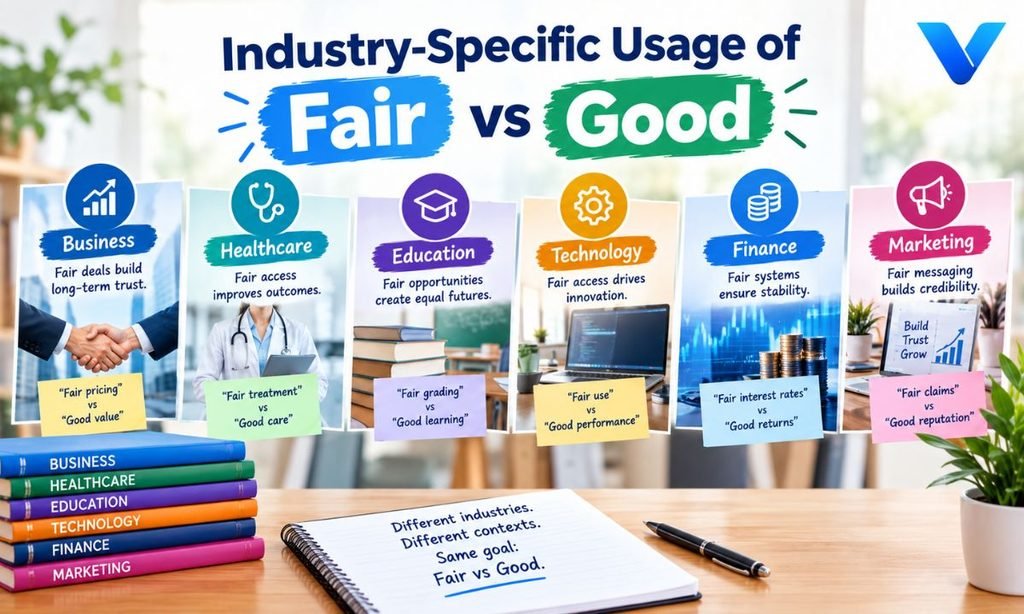
- Retail & e-commerce: Condition grading for used goods (fair, good, like new)
- Finance: Credit score tiers and loan risk assessment
- Education: Grading rubrics and report card comments
- Healthcare: Patient condition summaries after checkups or procedures
- Hospitality: Hotel and service reviews
- Employment: Performance review language
Real Case Studies: How Fair vs Good Changes Outcomes
Case 1 — Used Car Listings Two identical 2016 sedans were listed at different prices. The one marked “fair condition” (higher mileage, small dents) sold for roughly $9,500. The one marked “good condition” (lower mileage, well-maintained) sold for around $11,000 — a $1,500 gap driven largely by the condition label.
Case 2 — Credit Score Improvement A borrower raised their score from 640 (fair) to 690 (good). That single-tier jump opened access to a lower auto loan rate, saving hundreds of dollars over the loan term.
Case 3 — Workplace Reviews An employee rated “fair” on a review interpreted it as a warning sign, even though their output hadn’t changed much from the previous quarter. The word itself affected morale more than the actual performance data.
Everyday Speech: Nuance and Tone
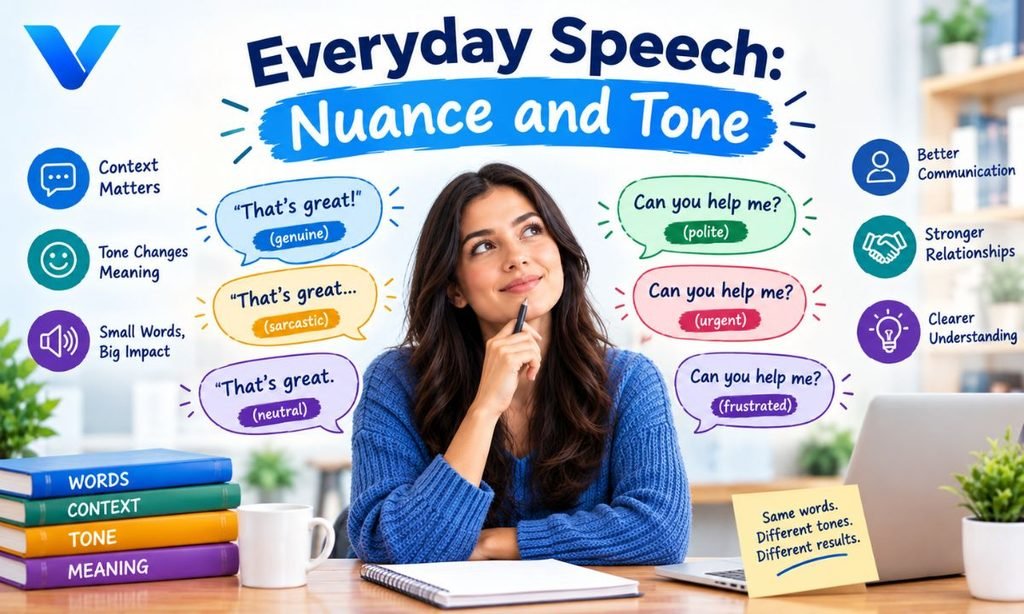
In casual conversation, “fair” often works as a soft, honest middle ground — not glowing, not negative, just neutral. “Good,” on the other hand, is the word people reach for when they genuinely want to express approval.
Fair Food vs Good Food
- Fair food: Edible, acceptable, gets the job done, but forgettable
- Good food: Well-prepared, flavorful, and something you’d order again
Quick Guide: When to Use Each Term
Use “Fair” When:
- The item, score, or work meets only the minimum standard
- There are visible flaws or limitations worth mentioning
- You want to signal honesty without discouragement
- Describing impartiality or justice (a separate meaning entirely)
Use “Good” When:
- The item, score, or work is reliable and above average
- You want to build confidence in the reader or buyer
- Minor imperfections exist but don’t affect overall value
- The result genuinely satisfies expectations
FAQs
Does fair mean good?
No. Fair means acceptable but limited, while good means reliable and above average. They sit at different points on the same quality scale.
What is better, fair or good condition?
Good condition is better. It indicates fewer flaws, better maintenance, and higher overall value than fair condition.
What does “fair” mean?
Fair means adequate or acceptable but with visible limitations. It can also mean impartial or just, depending on context.
What is the opposite of fair?
In the quality sense, the opposite of fair is often “poor.” In the justice sense, the opposite of fair is “biased” or “unjust.”
Does fair have two meanings?
Yes. Fair can describe quality (acceptable, average) or describe impartiality (just, unbiased, free from favoritism).
Conclusion
“Fair” and “good” may look like harmless, interchangeable words, but they carry very different weight — in credit scores, product listings, performance reviews, and everyday conversation. Fair signals “acceptable, with room to improve.
” Good signals “reliable, and worth trusting.” Knowing which one actually applies — and using it deliberately — helps you communicate more clearly, negotiate better deals, and avoid unnecessary confusion in reviews, ratings, and real-world decisions.










2 thoughts on “Fair vs Good: What’s the Difference? A Simple Guide”