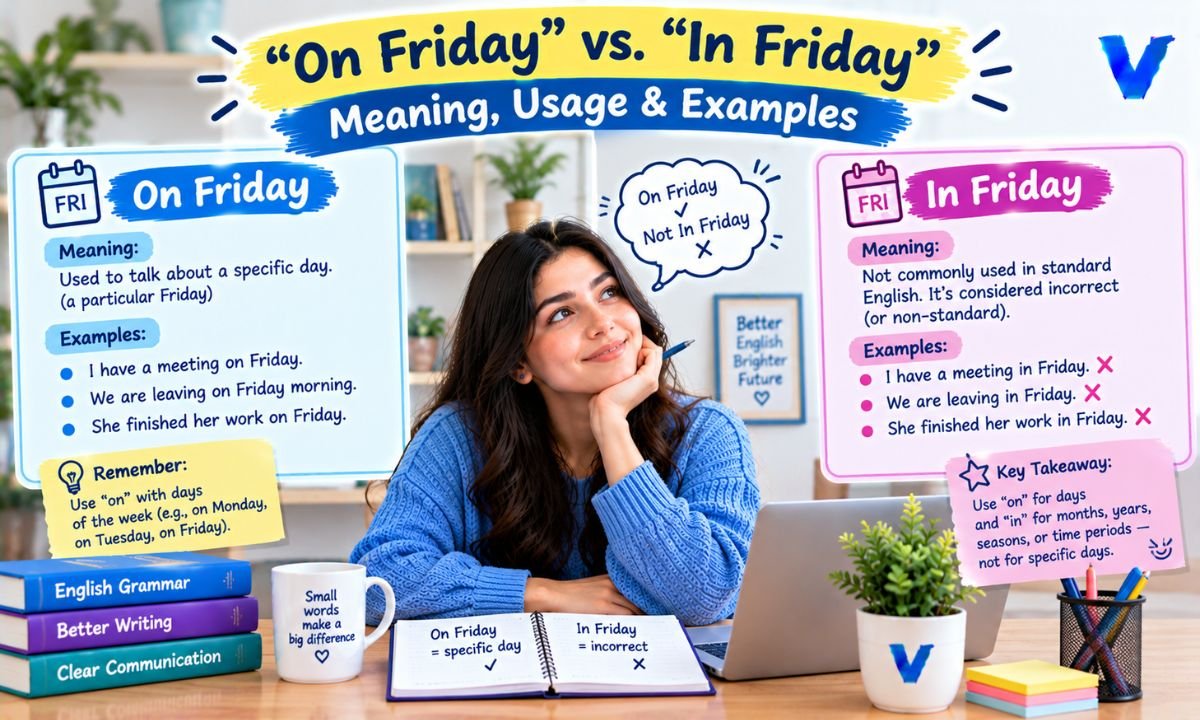
If you’ve ever paused mid-sentence wondering whether to write “on Friday” or “in Friday,” you’re not alone. This is one of the most common preposition mix-ups among English learners — and even a few native speakers second-guess themselves when typing quickly.
The short answer: “On Friday” is always correct. “In Friday” is not standard English in any context.
But the why behind this rule is what actually helps it stick. In this guide, you’ll learn how time prepositions work in American English, when “in” is genuinely appropriate near the word Friday, and how to avoid the small errors that make writing sound less fluent.
Why This Tiny Phrase Causes Big Confusion
Prepositions are tiny words, but they carry a lot of grammatical weight. Unlike vocabulary words, prepositions don’t always follow logic — they follow convention. That’s what makes them hard to memorize and easy to mix up.
Many learners assume that because “in” works for months, years, and seasons, it should also work for days. That assumption feels reasonable, but English simply doesn’t organize time that way. The confusion isn’t a sign of poor language skill — it’s a predictable result of how differently languages divide up time expressions.
Read more:Is “Happiest Birthday” Correct? Meaning & Proper Usage
How Time Prepositions Actually Work in American English
English uses three main prepositions of time — on, in, and at — and each one is tied to a specific “size” of time period:
| Preposition | Used For | Examples |
| On | Days and dates | on Friday, on May 5th, on my birthday |
| In | Months, years, seasons, centuries, parts of the day | in July, in 2027, in summer, in the morning |
| At | Precise clock times and certain fixed expressions | at 6 p.m., at noon, at night |
Think of it as a scale that moves from broad to narrow:
- Broadest periods (years, seasons, months) → in
- Specific single days (weekdays, dates, holidays) → on
- Exact moments (clock times) → at
Once you see this pattern, “on Friday” stops feeling like an exception and starts feeling like the obvious choice.
Read More:Input or Imput: Which Is Correct? Meaning, Spelling & Usage
Why “On” Is the Correct Preposition for Days
English treats each day of the week as a distinct, self-contained unit of time — not a container you step “into,” but a surface you place events “on.” That’s why native speakers naturally say on Monday, on Tuesday, and on Friday, without exception.
On Friday Meaning
“On Friday” simply means during the day known as Friday — whether that’s this coming Friday, a Friday in the past, or a recurring Friday. It points to a specific point on the calendar, not a general stretch of time.
- The meeting is on Friday at 10 a.m.
- I submitted the assignment on Friday.
- We usually order pizza on Fridays.
When “In” Is Correct Near Friday
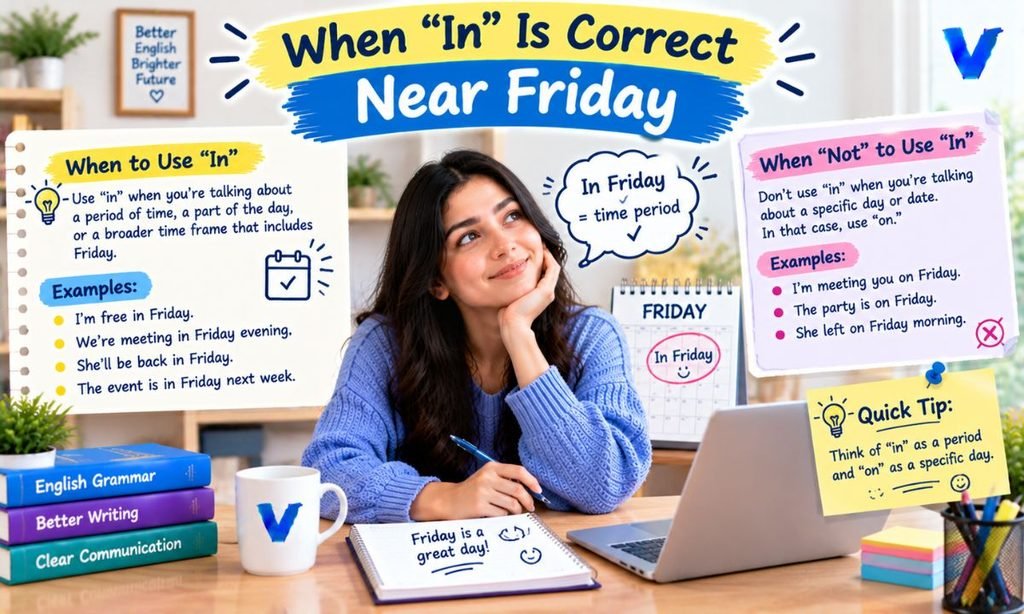
“In” can appear close to the word Friday — just not directly attached to it. It becomes correct when it’s paired with a larger time frame that happens to include Friday:
- In the last week of April, our meeting fell on Friday.
- In 2026, Christmas is on a Friday.
- In the mornings, our team meets on Friday.
Notice that “in” is always modifying something bigger — a month, a year, or a part of the day — never the word “Friday” itself.
Common Errors Learners Make With Days and Dates
Incorrect vs. Correct
| Incorrect | Correct |
| I will send it in Friday. | I will send it on Friday. |
| We met in Monday morning. | We met on Monday morning. |
| The exam is in the 5th of June. | The exam is on the 5th of June. |
| Call me in Friday evening. | Call me on Friday evening. |
Why These Errors Happen
- Direct translation: Many languages use one preposition for all time references, so learners transfer that pattern into English.
- Overgeneralization: Because “in” works for months and years, learners assume it should work for days too.
- Autocorrect gaps: Phone keyboards rarely flag preposition errors, so mistakes slip through unnoticed.
- Speed over accuracy: In fast typing or speech, the wrong preposition can slip out automatically.
On Friday vs. At Friday vs. By Friday
These three often get tangled together, but each one answers a different question:
| Phrase | What It Answers | Example |
| On Friday | Which day? | The report is due on Friday. |
| At Friday | Not standard usage — “at” doesn’t pair with day names | ❌ Not used |
| By Friday | What’s the deadline? | Please finish this by Friday. |
“At” is reserved for precise clock times (at 3 p.m.) or fixed phrases (at night), so it never attaches to a weekday. “By Friday” introduces a deadline — meaning “no later than Friday” — which is a different meaning entirely from “on Friday.”
Formal Writing vs. Casual Speech
“On Friday” is appropriate in every register — from a formal business email to a quick text message. The word “on” doesn’t shift between casual and formal English the way some phrases do.
- Formal: “The quarterly review is scheduled on Friday, March 6th.”
- Casual: “See you on Friday!”
The only real difference between formal and casual usage is sentence structure and tone, not the preposition itself.
Using “On Friday” Naturally in Planning and Scheduling

Because Fridays often mark the end of the workweek, “on Friday” shows up constantly in scheduling language:
- Let’s finalize the budget on Friday.
- The deadline falls on Friday this week.
- Our flight leaves on Friday morning.
- The store restocks on Fridays.
Consistency Across All Days of the Week
The rule never changes based on which day you’re naming. Every weekday follows the same pattern:
- on Monday
- on Tuesday
- on Wednesday
- on Thursday
- on Friday
- on Saturday
- on Sunday
If a sentence sounds correct with any other weekday substituted in, it’s grammatically sound with “on Friday” too.
Practice Sentence List
- I have a dentist appointment on Friday.
- She’s flying home on Friday night.
- The store closes early on Fridays.
- Let’s grab lunch on Friday if you’re free.
- The results will be announced on Friday.
Correct Usage of “On Friday” With Real Examples
- Workplace: “Please submit the timesheet on Friday before 5 p.m.”
- School: “The essay is due on Friday.”
- Social plans: “We’re meeting friends on Friday evening.”
- Travel: “Our train departs on Friday morning.”
- Recurring events: “Yoga class happens on Fridays.”
Why “In Friday” Sounds Wrong to Native Speakers
To a native ear, “in Friday” breaks an automatic pattern built up through years of exposure. It’s not that listeners consciously apply a grammar rule — it’s that the phrase simply doesn’t match anything they’ve ever heard. This is the same instinct that makes “in Monday” or “in Tuesday” sound equally off.
Compare These Two
- ❌ “I’ll finish the project in Friday.”
- ✅ “I’ll finish the project on Friday.”
The second sentence reads smoothly; the first creates a small mental stumble, even if the meaning is still understandable.
Quick Reference Table: Time Prepositions at a Glance
| Time Expression | Preposition | Example |
| Days of the week | on | on Friday, on Sunday |
| Dates | on | on July 4th |
| Specific holidays | on | on Christmas Day |
| Months | in | in December |
| Years | in | in 2025 |
| Seasons | in | in spring |
| Parts of the day (general) | in | in the afternoon |
| Night | at | at night |
| Clock times | at | at 9 a.m. |
| Weekend (US usage) | on | on the weekend |
Real Learner Case Studies
- A university applicant wrote, “I will attend the interview in Friday,” in an email to an admissions officer — a small slip that made the message look less polished than the rest of her writing.
- A non-native employee routinely said “in Friday” in team meetings until a colleague pointed out the pattern; after a week of conscious correction, it became automatic.
- An online learner reported that visualizing “on” as something you place events “on top of” — like placing a sticker on a calendar square — helped the rule finally click.
Quotes From Native Speakers
“You don’t go inside a day — you land on it. That’s the easiest way I explain this rule to my students.” — a private English tutor
“The moment someone says ‘in Friday,’ it stands out immediately, even in a long conversation. It’s one of those errors native speakers notice instantly.” — an ESL teacher
On Friday or Last Friday
“Last Friday” already includes its own reference point, so no preposition is needed at all:
- ✅ “I saw her last Friday.”
- ❌ “I saw her on last Friday.”
The same rule applies to “next Friday” and “this Friday” — the words “last,” “next,” and “this” replace the preposition entirely.
The Rule You’ll Never Forget
Days get “on.” Months, years, and seasons get “in.” Clock times get “at.”
If you remember nothing else from this guide, remember that single sentence — it covers the vast majority of time-preposition situations in English.
Practice Exercises
Fill in the blank with on, in, or at:
- The meeting starts ___ Friday ___ 10 a.m.
- We’re traveling ___ July, and the flight happens to land ___ a Friday.
- I’ll see you ___ the weekend.
- School begins again ___ September.
- Please call me back ___ Friday afternoon.
(Answers: 1. on / at, 2. in / on, 3. on, 4. in, 5. on)
FAQs
Q:Which is correct: “in Friday” or “on Friday”?
“On Friday” is the only correct form in standard English. “In Friday” is not used by native speakers in normal speech or writing.
Q:Where do I use “on”?
Use “on” with specific days of the week, calendar dates, and named single-day events, such as on Friday, on May 1st, or on Thanksgiving.
Q:What type of word is “on”?
“On” is a preposition — specifically a preposition of time when it’s used with days and dates.
Q:What does “in Friday” mean?
It doesn’t have a standard meaning in English grammar; it’s simply an incorrect substitution for “on Friday.”
Q:Is it “in” or “on” Saturday?
It’s “on Saturday” — the same rule that applies to Friday applies to every day of the week.
Conclusion
The difference between “on Friday” and “in Friday” comes down to one simple system: English pairs “on” with specific days and dates, “in” with broader time periods, and “at” with exact clock times. Once that pattern is clear, the choice stops being a guessing game.
Whether you’re writing a business email, planning a weekend trip, or just texting a friend, sticking to “on Friday” will always sound natural, professional, and correct — no exceptions, no translation shortcuts needed.










2 thoughts on ““On Friday” vs. “In Friday”: Meaning, Usage & Examples”