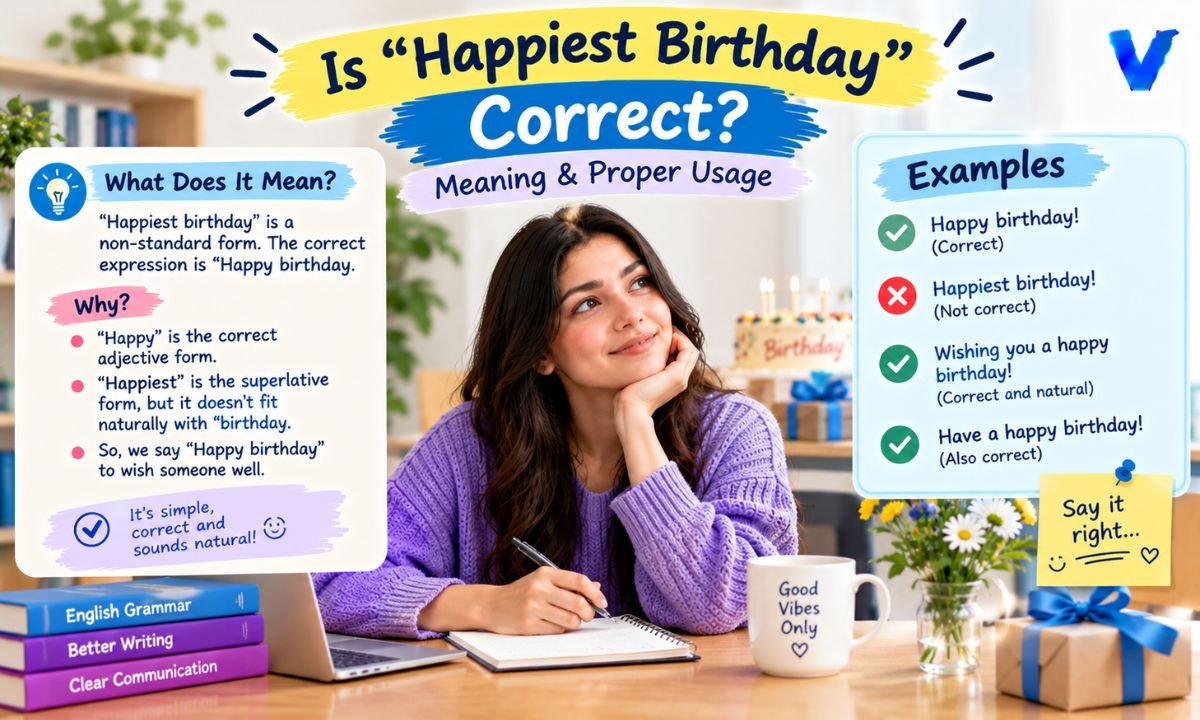
Birthdays bring out our best intentions, but sometimes our words trip over themselves. “Happiest Birthday” is one of those phrases — it sounds warm, it feels bigger than a plain “Happy Birthday,” yet something about it makes people pause and wonder if it’s actually correct.
This guide breaks down where the phrase comes from, whether it holds up grammatically, and how to use it (or skip it) with confidence. You’ll also find ready-to-use messages, quotes, and greeting ideas for every kind of birthday card, text, or social media post.
Understanding “Happiest Birthday” and Why It Confuses People
“Happiest” is the superlative form of “happy” — it sits at the top of the scale, above “happy” and “happier.” Normally, superlatives compare one thing against a group: the tallest building, the fastest car, the happiest birthday.
The confusion starts because “Happy Birthday” isn’t really a sentence built word by word — it’s a fixed greeting, almost like “Good morning” or “Thank you.” Swapping “happy” for “happiest” changes the grammar rules that apply, which is why the phrase can feel slightly off even though everyone understands what it means.
In everyday use, people reach for “Happiest Birthday” simply because they want to sound more enthusiastic than the standard greeting allows. The heart behind it is genuine, even when the grammar is a little shaky.
Read More:“Impatient” vs. “Inpatient”: Meaning, Examples & Common Usage
Happiest Birthday Quotes
If you like the spirit of “happiest birthday” but want wording that reads smoothly, these quotes strike that balance:
- “Wishing you the happiest birthday and a year filled with everything you’ve been hoping for.”
- “May this be the happiest birthday yet, with more laughter, love, and cake than ever before.”
- “Here’s to celebrating you today — may your happiest birthday memories start right now.”
- “Sending you the happiest birthday wishes filled with love, peace, and joy.”
- “May your birthday be as bright, bold, and happy as you are.”
Is It Correct to Say “Happiest Birthday”?
Strictly speaking, no — not on its own. Superlatives like “happiest” need a comparison or a supporting structure to make full grammatical sense. Saying “Happiest Birthday” without context leaves out the “of all birthdays” or “ever” that would complete the thought.
That said, language experts generally agree it isn’t wrong so much as incomplete. It works as a casual, feel-good expression rather than a textbook-correct sentence — similar to how “Best wishes” doesn’t spell out wishes for what, exactly.
Bottom line: it’s widely understood, commonly used, and rarely criticized in casual settings, but it isn’t the most polished choice for formal writing.
Read more:“On Friday” vs. “In Friday”: Meaning, Usage & Examples
What You Actually Mean When You Say “Happiest Birthday”
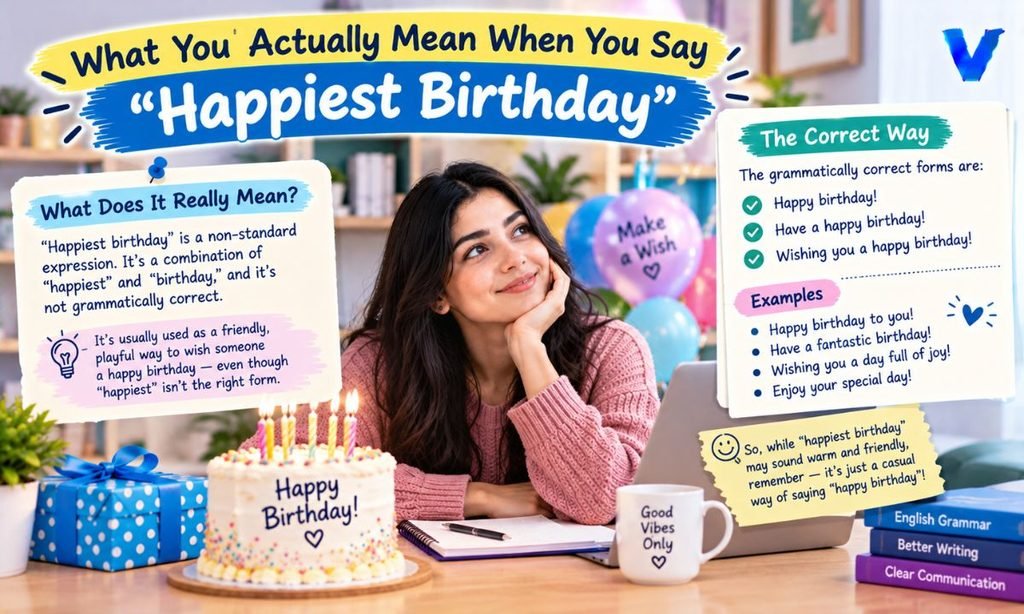
When someone writes “Happiest Birthday,” they’re usually trying to say one of these:
- I hope this is the best birthday you’ve ever had.
- I want you to feel more joy than any previous birthday.
- I’m wishing you extra happiness, beyond the usual greeting.
None of these meanings are wrong — they’re just compressed into two words instead of a full sentence. Understanding the intention behind the phrase makes it easier to choose a version that says exactly what you mean.
Natural Alternatives to “Happiest Birthday”
If you want the same warmth without the grammatical hiccup, try these:
| Instead of | Try |
| Happiest Birthday | Happiest of birthdays |
| Happiest Birthday | Wishing you the happiest birthday ever |
| Happiest Birthday | Have your happiest birthday yet |
| Happiest Birthday | Hope this is your best birthday so far |
| Happiest Birthday | Wishing you a joy-filled birthday |
Each of these keeps the enthusiasm while giving the superlative something to compare against — “ever,” “yet,” or “of” — so the sentence feels complete.
“Happiest Birthday” or “Happy Birthday”
Both are acceptable in casual, everyday communication, but they carry slightly different tones:
- “Happy Birthday” is the safe, universally correct choice for any occasion — cards, texts, formal messages, and workplace greetings.
- “Happiest Birthday” leans more personal and expressive, better suited for close friends and family who won’t mind (or notice) the grammatical shortcut.
If you’re unsure which to use, “Happy Birthday” is never a wrong answer. Save “Happiest Birthday” for informal, heartfelt messages where tone matters more than textbook grammar.
Why “Happiest of Birthdays” Works but “Happiest Birthday” Doesn’t
Adding “of” changes the structure entirely. “Happiest of birthdays” is what’s called an elliptical phrase — a shortened version of a longer sentence like “I wish you the happiest of all your birthdays.” Because “of” signals a comparison among a group (all your birthdays), the superlative finally has something to measure against.
“Happiest Birthday,” without that connector, drops the comparison entirely and pairs the superlative directly with a single noun — which is where the grammar breaks down.
Grammar Breakdown: Why “Happiest Birthday” Feels Wrong
A few grammar rules explain the discomfort many people feel:
- Superlatives need a group to compare against. “Happiest” implies there’s a full set of birthdays being ranked, but “Happiest Birthday” doesn’t name that set.
- “Happy Birthday” is a fixed expression, not a standard adjective-noun pair, so it doesn’t flex the way regular phrases do.
- Missing articles (like “the”) make superlative phrases feel incomplete, since English usually requires “the” before a superlative (“the happiest,” “the tallest”).
None of this makes the phrase offensive or embarrassing to use — it just explains why grammar-conscious readers might raise an eyebrow.
Role of Articles in Birthday Greetings
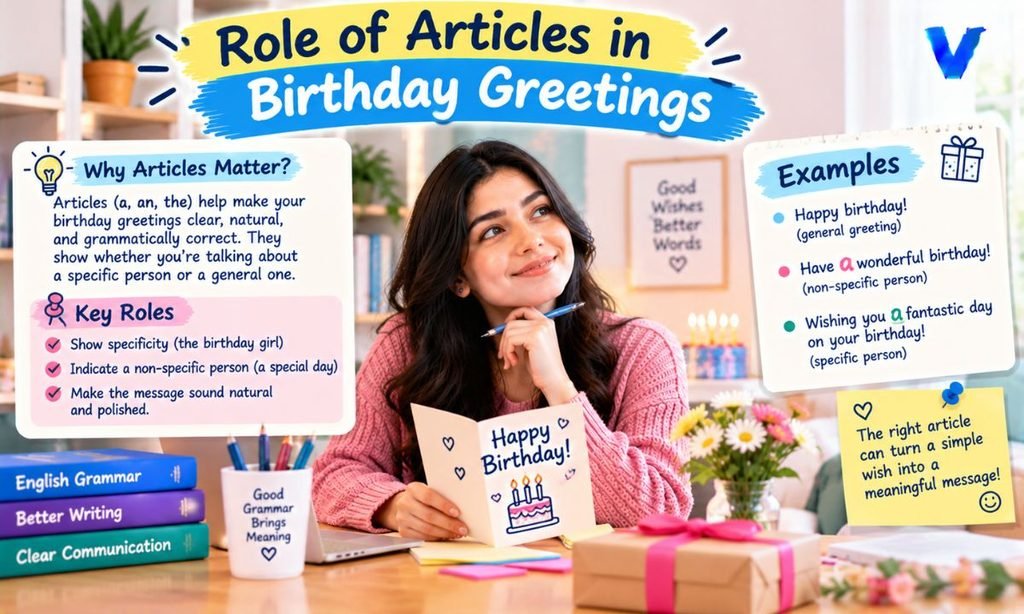
Articles (“a,” “an,” “the”) quietly do a lot of grammatical work. “The happiest birthday” sounds more complete than “happiest birthday” because “the” signals you’re talking about one specific birthday chosen from a group.
That’s why “Wishing you the happiest of birthdays” reads naturally, while “Wishing you happiest birthday” does not. When in doubt, adding “the” before a superlative is a simple fix that instantly makes the phrase sound more polished.
Cultural Differences in Birthday Greetings
Birthday customs — and the language around them — vary widely:
- In many English-speaking countries, short, cheerful phrases like “Happy Birthday” dominate cards and casual messages.
- In South Asian English (used widely in India, Pakistan, and neighboring countries), “Happiest Birthday” and “Happiest of Birthdays” are extremely common and rarely questioned, reflecting a more expressive, emotion-first style of English.
- In formal or professional contexts worldwide, simpler, grammatically safe phrasing is preferred, regardless of region.
Neither style is “wrong” — they simply reflect different conventions for how enthusiasm is expressed in English.
Happiest Birthday Dear Wishes
For a warmer, more personal tone — especially for close friends, partners, or family — try:
- “Happiest birthday, dear friend! May your year ahead be full of good news and better memories.”
- “Happiest birthday, dear sister. You make every celebration brighter just by being there.”
- “Happiest birthday, dear one. Here’s to another year of chasing dreams together.”
Common Mistakes People Make
- Using “happiest” without any supporting word (“of,” “ever,” “yet”) to complete the comparison.
- Pairing “very” with “happiest” — since “happiest” is already a superlative, “very happiest” is redundant, much like saying “very unique.”
- Forgetting the definite article “the” before “happiest” in longer sentences.
- Overusing superlatives in a single message, which can make heartfelt wishes feel exaggerated rather than sincere.
Special Cases in Birthday Greetings
Some situations call for bending the rules a little:
- Greeting cards and social media captions often prioritize catchy, punchy phrasing over grammatical precision.
- Milestone birthdays (18th, 30th, 50th, etc.) invite bigger, bolder language, where “happiest birthday” fits the celebratory mood.
- Multilingual or ESL speakers may use “happiest birthday” as a direct, emotionally accurate translation from their native language’s greeting style.
When Creative Variations Are Acceptable
Creative or informal writing — texts, memes, Instagram captions, birthday cake toppers — gives you more freedom to bend grammar rules for effect. In these spaces, “Happiest Birthday” works fine because the goal is warmth and personality, not grammatical precision.
Formal writing, professional emails, and printed materials are where it’s worth switching to a cleaner alternative.
Happiest Birthday Wishes
Ready-to-send lines that keep the “happiest” energy while sounding complete:
- Wishing you the happiest birthday and a year overflowing with good things.
- May today be the happiest birthday yet, and may this year top it.
- Sending you the happiest birthday wishes — you deserve every bit of joy.
- Here’s to your happiest birthday so far, with many more to come.
- Hope your birthday is filled with everything that makes you happiest.
Quick Guide to Choosing the Right Phrase
| Situation | Recommended Phrase |
| Formal card or workplace message | Happy Birthday |
| Close friend or family text | Happiest Birthday / Happiest of Birthdays |
| Social media caption | Happiest Birthday (creative freedom) |
| Milestone celebration | Happiest birthday ever / Happiest birthday yet |
| Written essay or professional content | Happiest of Birthdays (grammatically supported) |
Quick Tips for Writing Perfect Birthday Wishes
- Keep it personal — mention a shared memory or specific quality you admire.
- Match the tone to the relationship: playful for close friends, respectful for colleagues.
- Keep formal messages short and grammatically clean; save superlatives for casual ones.
- Add a wish for the year ahead, not just the day itself.
- Read it aloud before sending — if it sounds natural, it probably is.
FAQs
Q:Is “happiest” grammatically correct?
Yes, “happiest” is the correct superlative form of “happy.” It’s grammatically valid on its own, but it needs a comparison word like “of,” “ever,” or “yet” to sound complete in a sentence.
Q:Can I say “happiest birthday”?
Yes, you can — it’s widely understood and commonly used in casual messages, even though it’s grammatically incomplete without an added word like “of birthdays” or “ever.”
Q:How does Gen Z say happy birthday?
Gen Z often uses playful, casual phrasing like “happy bday,” “hbd,” or exaggerated superlatives such as “happiest birthday ever” alongside emojis and memes.
Q:What is the best message of birthday?
The best birthday message is personal and specific — one that mentions a shared memory or genuine quality, rather than a generic line copied from anywhere.
Q:What is a unique birthday wish?
A unique birthday wish avoids clichés and instead references an inside joke, a personal trait, or a hope for the person’s coming year that feels tailored to them.
Conclusion
“Happiest Birthday” isn’t a grammar crime — it’s an enthusiastic shortcut that most people instantly understand, even if it skips a few grammatical steps. For everyday texts, cards, and social posts, it works just fine. For formal or polished writing, small tweaks like “happiest of birthdays” or “happiest birthday ever” give you the same warmth with cleaner grammar.
Whichever version you choose, the words matter less than the intention behind them. A heartfelt, personal message — grammatically perfect or not — is what actually makes someone’s birthday feel special.







2 thoughts on “Is “Happiest Birthday” Correct? Meaning & Proper Usage ”