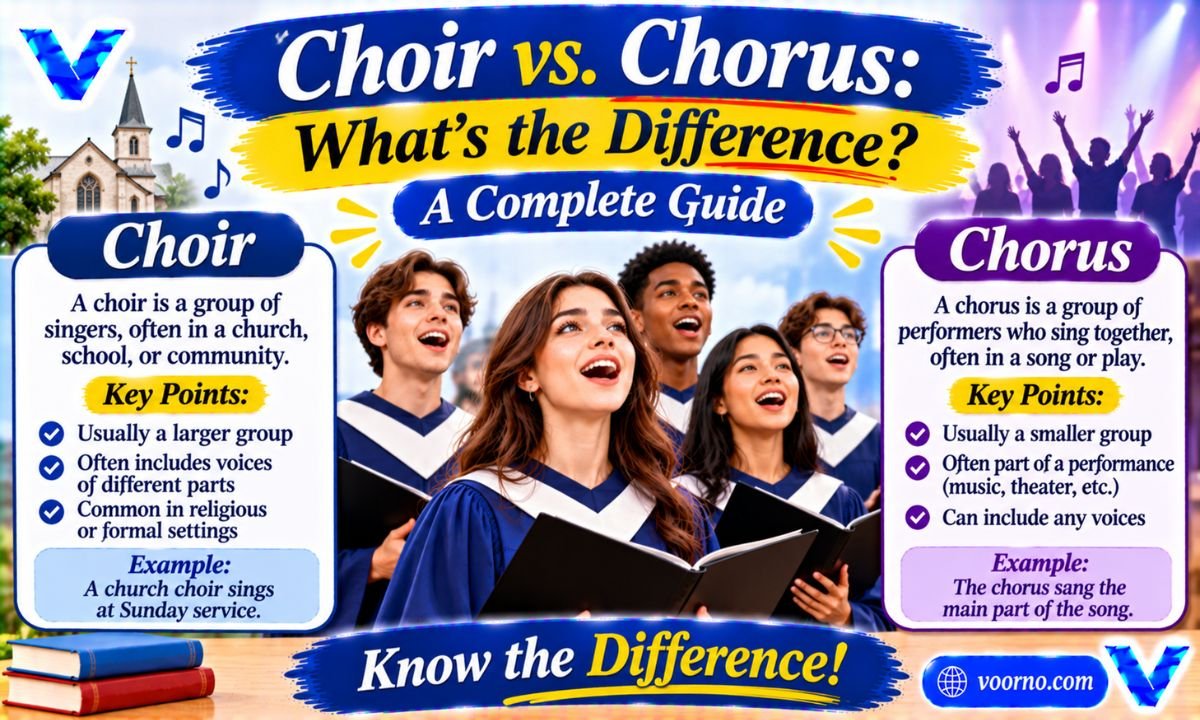
If you’ve ever wondered whether to say “school choir” or “school chorus,” you’re not alone. These two words get used interchangeably by most people, yet musicians, directors, and linguists all agree: they aren’t quite the same thing. This guide breaks down the real difference between a choir and a chorus, where the confusion comes from, and how to use each term correctly.
Why People Confuse Choir and Chorus
Both words describe groups of people singing together, so it’s easy to see why they blend in everyday speech. News reports, school programs, and even music teachers swap the terms constantly. Add in the fact that both words trace back to similar Latin and Greek roots related to group singing and dance, and the overlap starts to make sense.
The confusion also comes from regional habits. American schools often use “chorus” for their vocal music class, while a church down the street calls its singers a “choir.” Neither is wrong — they’re just following different traditions.
Read More: Mantel vs. Mantle: Definition, Difference, and Usage Explained
What Is a Choir? Definition Based on Actual Usage
A choir is an organized group of singers who perform vocal music together, typically under the direction of a conductor. The word carries a strong association with structured, harmony-focused singing — often in religious, academic, or classical settings.
In real-world usage, “choir” tends to describe:
- Church or cathedral singing groups
- School and community vocal ensembles
- Classical and choral concert groups
- Groups organized strictly by voice part (soprano, alto, tenor, bass)
Key Characteristics of a Choir
- Vocals only — no dancers or instrumentalists included as members
- Structured voice parts, usually arranged in rows or risers
- Conductor-led, with an emphasis on blend and harmony
- Repertoire often includes sacred music, classical works, and choral arrangements
Historical Roots of the Choir
The word “choir” comes from the Old French quer and Latin chorus, which itself borrowed from the Greek khoros — a group that sang and danced in Greek drama. Over centuries, “choir” narrowed in English to mean specifically a vocal group, and it also came to describe the physical area of a church where singers stood, known architecturally as the “choir” or “quire.”
Choir Structure and Organization
Choirs are typically arranged by vocal range, standing or sitting in sections. A conductor directs tempo, dynamics, and blend. Many choirs rehearse weekly and perform seasonally, especially in churches and schools, where the group’s identity is built around vocal precision rather than staging or movement.
Read More: Thank You Everyone or Thank You All: Meaning and Usage
What Is a Chorus? A Practical Definition
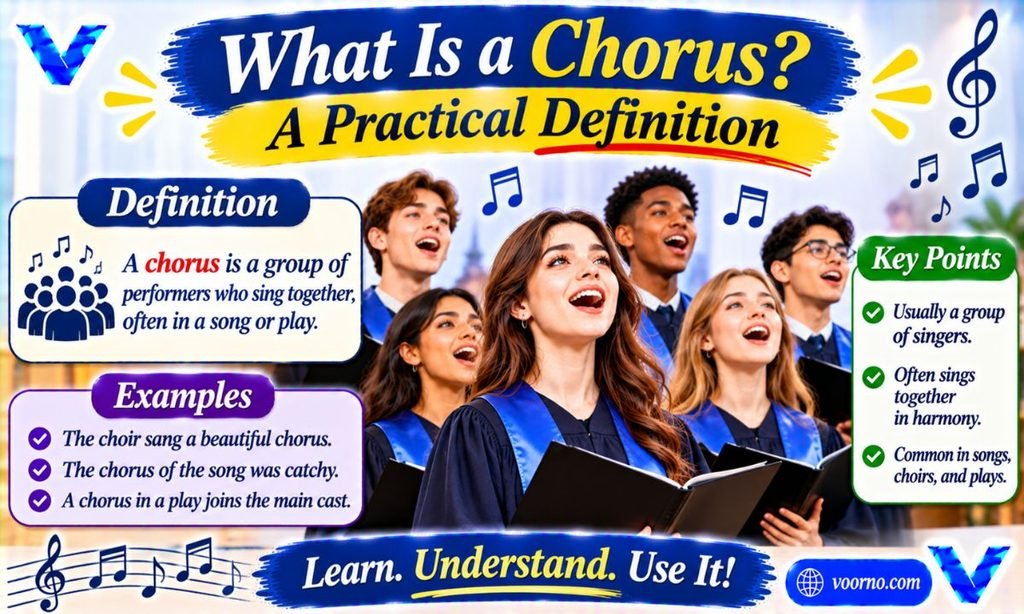
A chorus is a broader term. It can refer to a large group of singers, but it may also include dancers, actors, or other performers working together in a theatrical or musical production. “Chorus” leans toward performance and spectacle, not just harmony.
Chorus also has a second, completely different meaning in music: the repeated section of a song — the part that comes back after each verse, sometimes called the refrain.
The Chorus Beyond Singing
Outside of music, “chorus” shows up in phrases like:
- “A chorus of complaints” — meaning many voices raised at once
- “Greek chorus” — a group of performers commenting on the action in classical theater
- “Chorus line” — a group of dancers performing synchronized routines, as in musical theater
Chorus vs Choir in School
In American schools, “chorus” is often the official name of the vocal music class or ensemble, while “choir” tends to appear in church or community contexts. Some schools use both terms for the same group. There’s no universal rule — it usually comes down to the school district’s tradition and how the program was originally named.
Choir vs. Chorus: Side-by-Side Comparison
| Feature | Choir | Chorus |
| Members | Singers only | Singers, sometimes dancers or actors |
| Typical setting | Church, school, concert hall | Theater, musicals, opera, stage productions |
| Focus | Harmony and vocal blend | Performance, storytelling, staging |
| Organization | By voice part (SATB) | By role in production |
| Common phrase | “Church choir,” “school choir” | “Greek chorus,” “chorus line” |
| Alternate meaning | Angelic host; church architecture | Repeated part of a song (refrain) |
Can a Chorus Also Be a Choir?
Yes — in many cases, a chorus made up entirely of singers, arranged by voice part, functions exactly like a choir. Some organizations even use “chorus” and “choir” as official names for groups that are structurally identical (think of a “master chorale” versus a “master choir”). The overlap is real: a choir is essentially a chorus that sticks to singing alone, while a chorus can expand beyond that.
Cultural and Regional Usage Differences

United States vs. Abroad
In the U.S., “chorus” is common in schools and musical theater, while “choir” dominates in churches and formal choral music. In the United Kingdom and much of the Commonwealth, “choir” is used far more broadly — covering school groups, cathedral ensembles, and community singing groups alike — while “chorus” is reserved mainly for opera and theatrical contexts.
Choir vs Chorus Pronunciation
- Choir is pronounced “kwahyuhr” (rhymes with “fire”).
- Chorus is pronounced “kawr-uhs” (rhymes with “porous”).
Despite sharing a Latin ancestor, the two words are pronounced quite differently in modern English.
Chorus vs. Refrain: Clearing a Common Misunderstanding
Many people use “chorus” and “refrain” interchangeably, and in casual conversation, that’s fine. Technically, a refrain is a repeated line or phrase, while a chorus is the full repeated section of a song — often including music, harmony, and multiple lines. Every chorus contains a refrain, but not every refrain is a full chorus.
Different Uses of the Word “Chorus”
Because “chorus” has so many applications, it helps to separate its meanings:
- A group of singers — the vocal-performance sense
- The repeated part of a song — the musical structure sense
- A group of theatrical performers — dancers, actors, and singers combined
- A figurative expression — “a chorus of approval” or “a chorus of boos”
Choirs and Choruses in Modern Performance
Modern productions blur these lines constantly. Broadway shows use “chorus” for their ensemble of singer-dancers, while a symphony orchestra might bring in a “chorus” for a large choral work — even though that chorus is made up entirely of trained singers standing in rows, just like a choir. Meanwhile, community and touring vocal groups increasingly use “choir” as a brand name because it sounds more intimate and harmony-focused to modern audiences.
How to Choose the Right Ensemble for You
If you’re deciding which group to join, consider what you want out of the experience:
- Want to focus purely on vocal harmony and technique? A choir is likely the better fit.
- Interested in staging, movement, and theatrical performance alongside singing? Look for a chorus or musical theater ensemble.
- Prefer a faith-based or community setting? Choirs are more common in these spaces.
- Drawn to opera, musicals, or large-scale stage productions? Choruses are the standard there.
Chorus vs Choir vs Chorale
A chorale adds a third layer to this comparison. Traditionally, a chorale refers to a hymn tune (especially in the German Lutheran tradition) or, in modern usage, a vocal ensemble that specializes in choral and often sacred music. A chorale is essentially a specialized type of choir, usually smaller and more focused on a particular repertoire style, such as Renaissance or Baroque choral works.
Quick Summary: Choir vs. Chorus at a Glance
- A choir is singers only, organized by voice part, usually tied to church, school, or classical music.
- A chorus can include dancers and actors, is common in theater and musicals, and also refers to the repeated part of a song.
- A chorale is a specialized choir often associated with hymns or sacred repertoire.
- The three terms overlap heavily in real-world use, and context usually decides which one applies.
Understanding Choir vs. Chorus Without Overthinking It
At the end of the day, both words describe people singing together, and native speakers use them somewhat loosely. The clearest rule to keep in mind: if the group includes dancers or actors, or if you’re talking about the repeated part of a song, “chorus” is the safer choice. If you’re talking strictly about a group of vocalists organized by voice part, “choir” fits better. Beyond that, regional habit and tradition often decide which word feels natural.
FAQs
Q:How do we pronounce choir?
Choir is pronounced “kwahyuhr,” rhyming with the word “fire.”
Q:What’s the difference between a choir and a chorale?
A chorale is typically a smaller, specialized choir focused on hymns or sacred choral music, while “choir” is the broader, general term.
Q:Are a choir and chorus the same?
Not exactly — a choir is singers only, while a chorus can also include dancers and actors, plus it has a separate meaning as a song’s repeated section.
Q:Do we say a choir of singers?
Yes, though it’s slightly redundant since a choir is already made up of singers; “choir” alone is usually sufficient.
Q:What are the three levels of choir?
Many school and community programs use a tiered system such as beginner (or concert) choir, intermediate (or chamber) choir, and advanced (or select/honors) choir, though naming varies by organization.
Conclusion
Choir and chorus will likely keep overlapping in everyday conversation, and that’s okay — even musicians use them loosely. But now you know the real distinctions: choirs are vocal-only and structured by voice part, choruses can include dancers and actors and also describe a song’s repeated section, and chorales sit somewhere in between as a specialized type of choir.
Whether you’re picking a group to join or just want to use the right word in conversation, you’re now equipped to tell the difference with confidence.










2 thoughts on “Choir vs. Chorus: What’s the Difference? A Complete Guide”