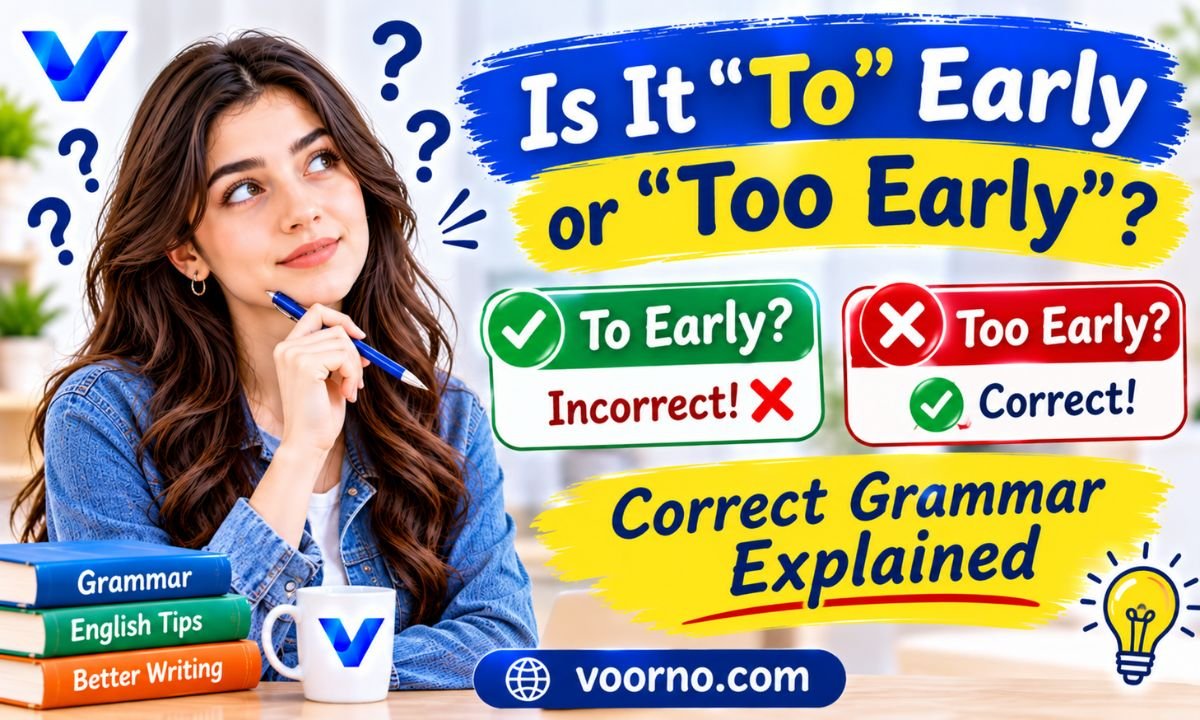
You’re typing a text. You want to say you got somewhere before you should have. Your fingers hover over the keyboard, and suddenly you’re not sure: is it “to early” or “too early”?
It’s one of the most common typing slips in English — right up there with “your” and “you’re.” The good news is that once you understand why one version works and the other doesn’t, you’ll never second-guess yourself again.
This guide breaks down the grammar rule in plain language, shows you real examples, and gives you memory tricks that actually stick.
Why “To” vs “Too” Causes So Much Confusion
“To” and “too” are homophones — they sound identical when spoken but do completely different jobs in a sentence. Since English relies on spelling (not sound) to carry meaning in writing, this is where the trouble starts.
Add in autocorrect, fast typing, and voice-to-text tools, and it’s easy to see why even confident writers occasionally slip. Spoken conversation gives you zero clues about which spelling is correct — only the written word forces the choice.
To Early or Too Early Meaning
Here’s the short answer before we go further:
- Too early = the correct phrase. It means something happened, or is happening, sooner than expected, needed, or appropriate.
- To early = not standard English. “Early” is an adjective or adverb, and “to” cannot attach to it the way “too” can.
So if you’re asking which one to use in a sentence, the answer is almost always “too early.”
Read More: It’s Called vs It Called: How to Use Them Correctly
The Core Difference Between “To” and “Too”
The easiest way to keep these straight is to remember what each word actually does:
| Word | Function | Example |
| To | Preposition (shows direction, destination) or infinitive marker (comes before a verb) | She drove to the airport. I want to leave. |
| Too | Adverb of degree (means “excessively” or “also”) | It’s too cold outside. I’m coming too. |
“To” points somewhere or introduces an action. “Too” adds intensity or excess. They’re not interchangeable, even though they sound the same out loud.
Read More: “Let’s Blow This Popsicle Stand” Meaning: Origin, Definition & Examples
Is It Ever Correct to Say “To Early”?
In everyday usage, no. “To early” doesn’t follow any recognized grammar rule. “Early” is an adjective or adverb, and “to” — as a preposition or infinitive marker — has no grammatical role to play in front of it.
The only place you might technically see “to” followed by “early” is in an unrelated sentence structure, such as: “I look forward to early mornings.” Here, “to” is part of the phrase “look forward to,” and “early” simply modifies “mornings.” That’s not the same construction people mean when they ask about “to early vs too early” — it’s a coincidence of word order, not an exception to the rule.
When “Too Early” Is the Only Correct Choice

If your sentence is describing something happening before the right, expected, or ideal time, “too early” is the phrase you need — every time. There’s no formal or informal context where “to early” becomes acceptable.
To Early or Too Early Examples
- ✅ We arrived too early for the meeting.
- ✅ It’s too early to tell how this will turn out.
- ✅ He woke up too early and couldn’t fall back asleep.
- ❌ We arrived to early for the meeting.
- ❌ It’s to early to tell how this will turn out.
Notice how “too” always sits directly in front of “early,” intensifying it. That pairing is the giveaway that you need the double-O spelling.
Understanding “Too” as an Intensifier, Not Just “Also”
Many people learn “too” only as a substitute for “also” (“I’m hungry too”). But “too” has a second, equally important job: it works as an intensifier meaning “more than necessary” or “excessively.”
- Too loud, too expensive, too late, too early — in every case, “too” is signaling excess, not addition.
This dual function is exactly why “too early” makes sense grammatically: “too” is intensifying “early,” telling the reader that the timing has gone past what’s appropriate.
Why “Very Early” Is Not the Same as “Too Early”
These two phrases often get mixed up because they both describe an early time — but they carry different implications.
| Phrase | Implication | Example |
| Very early | Early, but still acceptable or fine | We left very early to beat traffic. |
| Too early | Early to the point of being a problem | We left too early and had to wait an hour. |
“Very early” is neutral or even positive. “Too early” always implies a mismatch between the timing and what was actually needed.
The Role of “To” in English and Why It Fails Here

To fully understand why “to early” doesn’t work, it helps to see what “to” is actually built for.
Correct Uses of “To”
- As a preposition showing direction or destination: She walked to the store.
- As an infinitive marker before a verb: I want to learn English.
- Indicating a recipient: Give the book to me.
- Showing a range or limit: The offer runs Monday to Friday.
In every one of these, “to” connects to a noun, pronoun, or verb — never directly to an adjective like “early” in a way that modifies its intensity.
Why “To Early” Breaks Grammar Rules
“Early” is functioning as an adjective or adverb in the sentences people usually mean (“I woke up early,” “It’s an early flight”). Adjectives and adverbs that express degree need an intensifier — a word like “too,” “very,” “so,” or “extremely” — not a preposition. Since “to” isn’t built to intensify anything, pairing it with “early” leaves the sentence structurally broken, even if it reads fine at a glance.
Common Mistakes Writers Actually Make
- Typing “to” out of habit because it’s used far more often in everyday writing than “too.”
- Relying on autocorrect, which doesn’t always catch homophone errors.
- Writing quickly on mobile devices, where a single missed keystroke changes the whole word.
- Assuming that because a sentence “sounds right” out loud, the spelling must be correct.
To Early or Too Early in a Sentence
A simple test: read your sentence and ask, “Does this word mean excessively or more than needed?” If yes, you need “too.” If the word is instead showing direction or introducing a verb, “to” is correct. In the phrase discussed here, the meaning is always excess — so “too early” wins.
Memory Tricks That Actually Work
- The Extra-O Trick: “Too” has an extra O, just like it means an extra amount. If the sentence implies “more than enough,” add the second O.
- Substitution Test: Try swapping in “also” or “excessively.” If either word fits the sentence’s meaning, use “too.” (“I’m too tired” → “I’m excessively tired” ✅)
- Direction Check: If you can replace the word with “toward” or an action verb and the sentence still makes sense, use “to.”
These small habits take seconds to apply but prevent the mistake for good.
Wrong vs Right: Side-by-Side Examples
| Incorrect | Correct |
| I got to the party to early. | I got to the party too early. |
| It’s to early to decide. | It’s too early to decide. |
| She called to early in the morning. | She called too early in the morning. |
| We started to early for the project. | We started too early for the project. |
Style and Tone: Is “Too Early” Formal Enough?
Yes. “Too early” isn’t casual or slang — it’s standard, grammatically correct English suitable for emails, reports, essays, and professional communication. There’s no more formal alternative needed; the phrase itself is already precise and appropriate across writing styles.
To Early or Too Early Synonym
If you want variety in your writing, consider these alternatives depending on context:
- Premature
- Ahead of schedule
- Before time
- Prematurely
- Not yet the right moment
Each carries a slightly different tone, so choose based on how formal or conversational your writing needs to be.
What Grammar Authorities Agree On
Major dictionaries and style guides are unanimous here. Reference sources define “too” as an adverb meaning “excessively” or “more than is acceptable,” while “to” is classified strictly as a preposition or infinitive marker. There’s no disagreement or gray area across grammar authorities — the rule is settled and hasn’t shifted with modern usage.
A Quick Checklist Before You Hit Send
- [ ] Does the word describe excess or degree? → Use too.
- [ ] Does the word show direction or come before a verb? → Use to.
- [ ] Would “also” or “excessively” fit in its place? → Use too.
- [ ] Reading it aloud won’t help — check the spelling, not the sound.
FAQs
Q:When should I use too or to?
Use “too” when the word means “excessively” or “also.” Use “to” when showing direction, destination, or before a verb.
Q:Is it to or too early?
It’s “too early.” “To early” is not standard English in this meaning.
Q:What is another way to say “too early”?
You can say “premature,” “ahead of schedule,” or “before time.”
Q:What does the phrase “it is too early to say” mean?
It means there isn’t enough information yet to give a definite answer or conclusion.
Q:How to know when to use to or too in a sentence?
Check the meaning: if it signals excess or “also,” use “too.” If it shows direction or precedes a verb, use “to.”
Conclusion
The rule behind “to early” vs “too early” is simple once you see it clearly: “too” intensifies, “to” directs. Since “early” needs a word that shows excess, “too early” is the only correct choice in standard English.
Next time you pause mid-sentence, remember the extra-O trick, run the substitution test, and trust the grammar — not the sound. With a little practice, this mistake disappears from your writing for good.










2 thoughts on “Is It “To” Early or “Too Early”? Correct Grammar Explained”