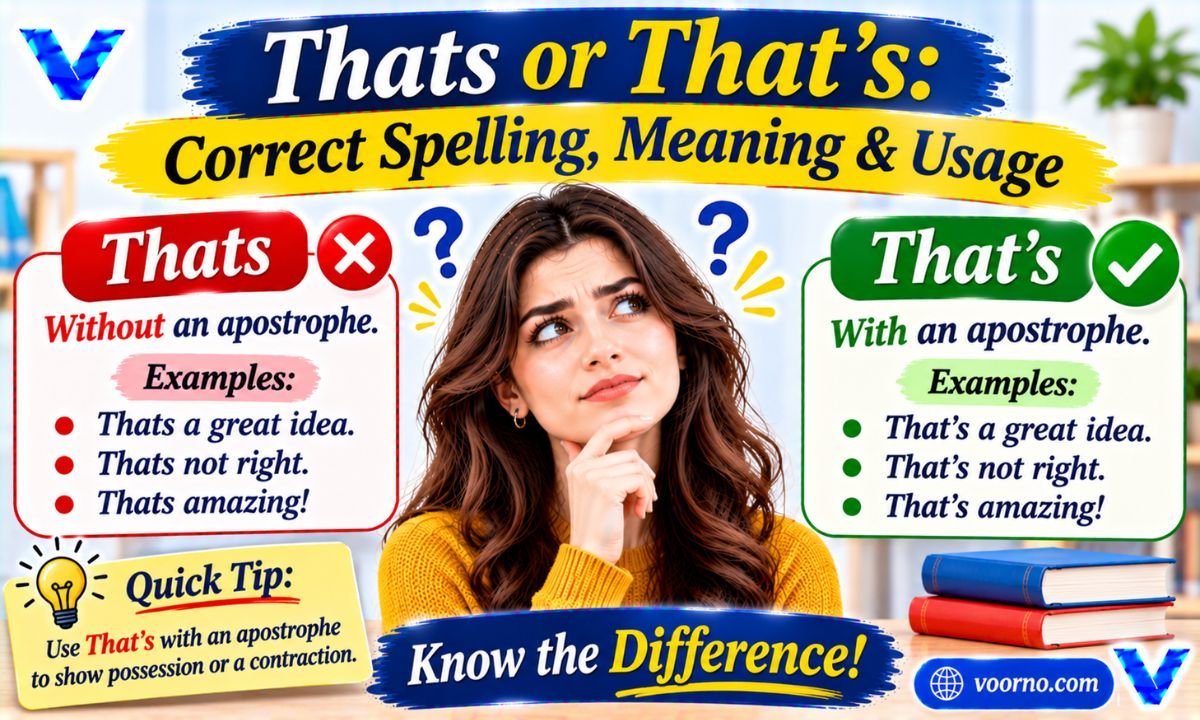
If you’ve ever paused mid-sentence wondering whether to type thats or that’s, you’re not alone. This tiny apostrophe trips up even experienced writers — and getting it wrong can make otherwise polished writing look careless.
The short answer: That’s is the correct form in standard English. Thats is a misspelling and has no place in formal or informal writing.
Let’s break down exactly why, how to use it correctly, and how to avoid this mistake for good.
Thats or That’s: Meaning
That’s is a contraction — a shortened form of two words joined together with an apostrophe replacing missing letters. It stands for two different phrases depending on context:
- That’s = That is — “That’s my favorite song.”
- That’s = That has — “That’s been a long day.”
Thats, on the other hand, isn’t a word at all. It’s simply that’s with the apostrophe dropped — an error, not an alternate spelling. English doesn’t have a non-contracted version of “thats” the way it does with, say, “cant” versus “can’t” being equally wrong; there’s no legitimate use case for “thats” anywhere in the language.
Read More: “Say Your Piece” vs. “Say Your Peace”: Which Is Correct? Meaning & Usage
Examples That Show the Difference Clearly
| Sentence | Meaning | Correct? |
| That’s a great idea. | That is a great idea. | ✅ |
| Thats a great idea. | (misspelling) | ❌ |
| That’s been sitting there for weeks. | That has been sitting there for weeks. | ✅ |
| I think thats wrong. | (misspelling) | ❌ |
Writing Examples: Emails, Essays, and Social Media
Context changes tone, but it never changes correctness. The apostrophe stays no matter where you’re writing.
In emails:
“That’s exactly the update I needed — thank you for sending it over.”
In essays:
“That’s precisely the argument the author makes in the third chapter.”
On social media:
“That’s the energy we need this week 🔥”
Even in casual texting or quick social captions, dropping the apostrophe reads as a typo rather than a stylistic choice — so it’s worth the extra half-second to get it right.
Read More: Mantel vs. Mantle: Definition, Difference, and Usage Explained
Tables of Common Contractions and What They Omit
| Contraction | Full Form | Omitted Letter(s) |
| That’s | That is / That has | i (in “is”) or ha (in “has”) |
| It’s | It is / It has | i or ha |
| Who’s | Who is / Who has | i or ha |
| Don’t | Do not | o |
| Can’t | Cannot | no (informal contraction) |
| I’m | I am | a |
| They’re | They are | a |
Notice the pattern: the apostrophe always marks where letters have been removed. Thats removes a letter without marking it — that’s the core error.
Thats or That’s: Grammar
Grammatically, that’s is a contraction that can function as:
- Subject + verb (“That’s true.”) — that is the subject, ‘s stands in for “is.”
- Subject + auxiliary verb (“That’s happened before.”) — here ‘s stands in for “has,” supporting the past participle “happened.”
Thats has no grammatical function whatsoever — it’s not recognized in any dictionary, style guide, or grammar reference as a word.
Practical Rules and Memory Tricks
- Expansion test: If you can expand it to “that is” or “that has” and the sentence still makes sense, you need the apostrophe.
- No apostrophe, no word: Unlike some contractions that get debated (like “ain’t”), thats isn’t even in that gray area — it’s a flat-out spelling mistake.
- Autocorrect isn’t foolproof: Many keyboards will flag “thats,” but don’t rely on it alone, especially in fast typing or messaging apps.
- Read it aloud: If you can hear two words hiding inside it (“that IS” or “that HAS”), the apostrophe belongs there.
Common Errors and How to Fix Them
| Error | Quick Fix |
| “Thats not fair.” | “That’s not fair.” |
| “I heard thats true.” | “I heard that’s true.” |
| “Thats been decided already.” | “That’s been decided already.” |
| “Whats thats supposed to mean?” | “What’s that’s supposed to mean?” → better: “What’s that supposed to mean?” |
A quick habit that helps: before hitting send, scan for any “that” followed directly by an “s” with no apostrophe — it almost always needs one.
Quotes from Authorities
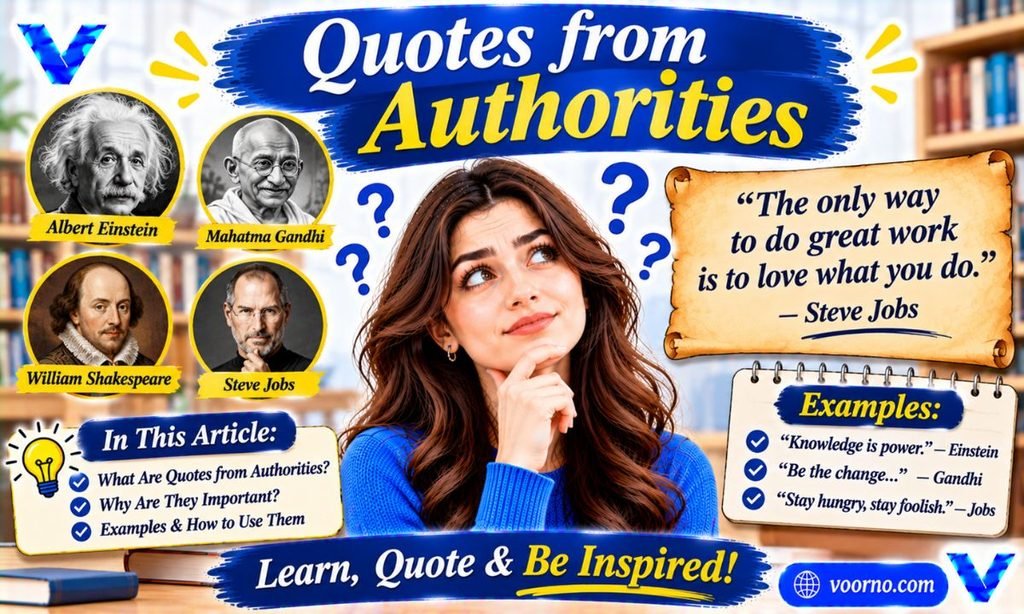
Major style and grammar authorities consistently confirm that contractions require apostrophes to mark omitted letters. Merriam-Webster lists that’s explicitly as the standard contracted form of “that is” or “that has,” while grammar guides across the board treat the unmarked spelling as a simple typographical error rather than an accepted variant. No recognized dictionary — American or British — lists “thats” as a valid entry.
Thats or That’s in a Sentence
Here’s how that’s looks in real, natural sentences:
- “That’s the restaurant I told you about.”
- “That’s why I left early.”
- “That’s odd — the lights were on a minute ago.”
- “I think that’s the best option we have.”
- “That’s all folks!”
In every case, swapping “thats” in would be flagged by a spell-checker, a teacher, or an editor — because it simply isn’t a word.
The Role of Style Guides: When to Use or Avoid That’s

Even though that’s is grammatically correct, contractions in general are treated differently depending on the writing context:
- Academic and formal writing: Style guides like APA and Chicago generally advise against contractions, including that’s, in favor of the fully spelled-out “that is” or “that has.” This keeps tone formal and precise.
- Business and professional emails: Contractions are usually fine and even preferred, since they sound natural and less stiff.
- Creative writing, blogs, and social media: Contractions like that’s are standard and help writing feel conversational.
- Journalism: Style guides such as AP generally allow contractions, especially in quotes or conversational pieces.
So the real question usually isn’t “that’s vs. thats” (that’s always settled) — it’s whether to use that’s or spell out “that is” depending on formality.
A Short Checklist Editors and Writers Should Use
- Does the sentence contain “that” immediately followed by “s”? Check for the apostrophe.
- Can you expand it into “that is” or “that has”? If yes, the apostrophe is required.
- Is this formal academic writing? Consider spelling out “that is” instead of using the contraction.
- Did autocorrect or a spell-checker flag it? Don’t ignore the warning.
- Read the sentence aloud — does it sound like two words are being combined?
Thats or That’s: Examples in Everyday Use
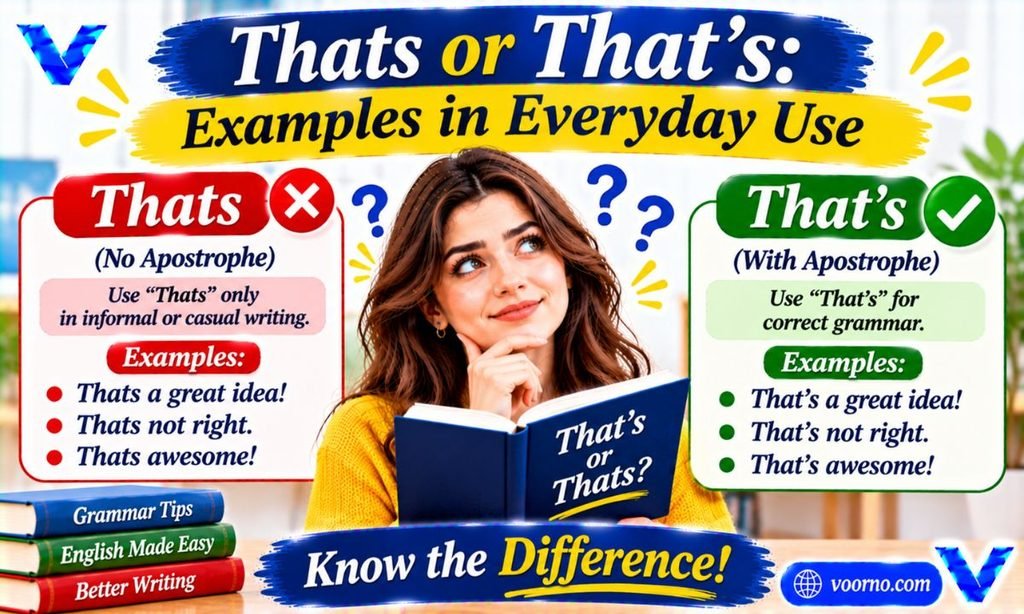
- Text message: “That’s hilarious 😂”
- Work email: “That’s a great point — let’s revisit it in Monday’s meeting.”
- Essay: “That’s the central conflict driving the novel’s plot.”
- Casual conversation: “That’s not what I meant.”
- Headline: “That’s One Small Step for Man…”
Closing: Small Punctuation, Big Difference
A single apostrophe might look insignificant, but it’s the difference between writing that reads as polished and writing that reads as careless. That’s is correct. Thats is not — and never has been. Once you internalize the “expand it to two words” trick, you’ll never second-guess this one again.
References and Further Reading
- Merriam-Webster Dictionary — entries for “that” and common contractions
- The Associated Press Stylebook — guidance on contractions in journalism
- APA and Chicago Manual of Style — guidance on formality and contractions in academic writing
FAQs
Q:When to use “thats” and “that’s”?
Always use that’s — “thats” is never correct in any context. Use that’s whenever you mean “that is” or “that has.”
Q:Which is correct: “thats it” or “that’s it”?
“That’s it” is correct. It’s short for “that is it,” so the apostrophe is required.
Q:What is the definition of “thats”?
There is no definition — “thats” is not a recognized word in any dictionary; it’s simply a misspelling of that’s.
Q:Can you start a sentence with “thats”?
No. You can start a sentence with That’s (capitalized, with the apostrophe), but never with the unmarked “Thats.”
Q:What type of word is “that’s”?
That’s is a contraction — combining the pronoun “that” with the verb “is” or “has” into one word.
Conclusion
The rule here is refreshingly simple: that’s is always right, and thats is always wrong. Whether you’re writing a casual text, a professional email, or a formal essay, remembering the “expand it” trick — that is / that has — will keep your writing accurate and confident every time.


2 thoughts on “Thats or That’s: Correct Spelling, Meaning & Usage”