Few word pairs trip up writers as often as mantel and mantle. They sound identical, share a common ancestor, and even show up in overlapping contexts — yet using the wrong one in a sentence can make your writing look careless.
If you’ve ever paused mid-sentence wondering whether to write “the photo sits on the mantel” or “the photo sits on the mantle,” you’re not alone. This guide breaks down exactly what each word means, where it comes from, and how to use it correctly every time — whether you’re decorating a living room, writing about geology, or describing a leadership transition.
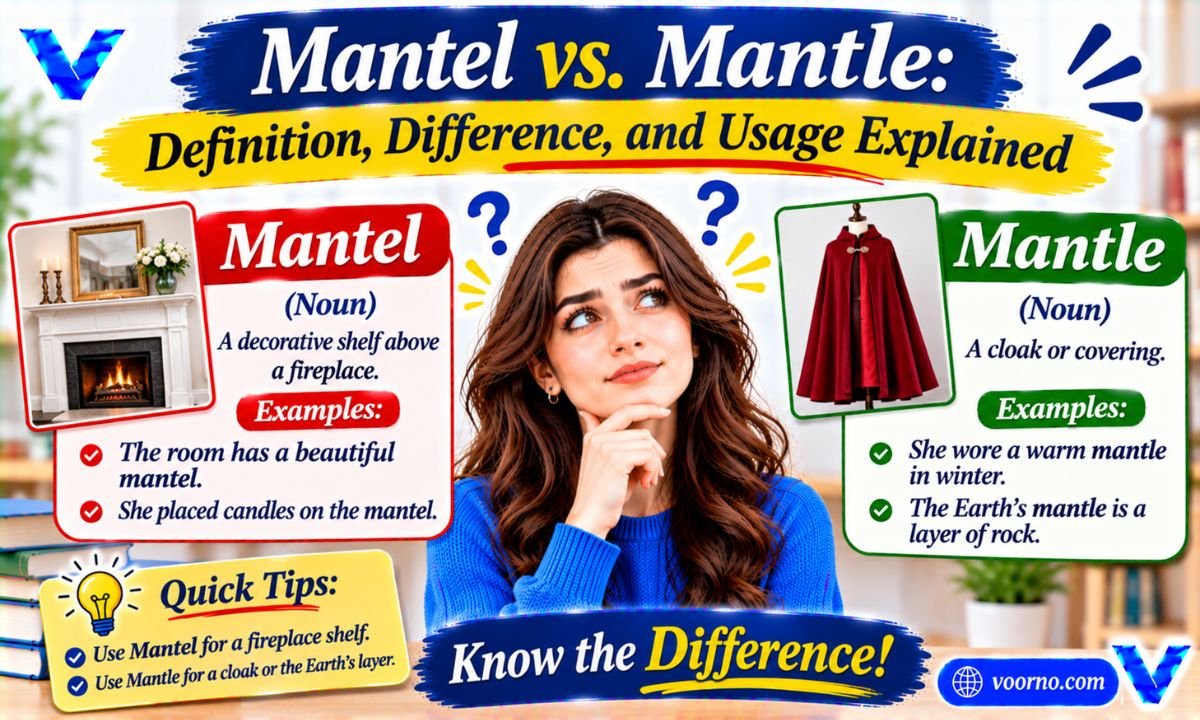
Mantel vs. Mantle: The Quick Difference
Here’s the short version before we go deeper:
| Word | Part of Speech | Core Meaning | Example |
| Mantel | Noun only | The shelf or structure above a fireplace | “She placed candles on the mantel.” |
| Mantle | Noun or verb | A cloak; a covering; a position of responsibility; the Earth’s layer between crust and core; a climbing move | “He accepted the mantle of leadership.” |
If you remember only one rule, remember this: mantel has exactly one job — it’s the shelf above your fireplace. Mantle does everything else.
Read More: Thats or That’s: Correct Spelling, Meaning & Usage
What Does “Mantel” Mean?
A mantel (sometimes spelled “mantelpiece”) is the decorative shelf or framework that surrounds and sits above a fireplace opening. It’s a purely architectural and interior-design term with no other common usage in modern English.
The History of the Word “Mantel”
Both “mantel” and “mantle” trace back to the Latin word mantellum, meaning cloak. Centuries ago, the two spellings were used interchangeably. Over time, English speakers began reserving “mantel” specifically for the fireplace structure, while “mantle” absorbed every other meaning — clothing, coverings, and figurative uses. The split wasn’t instant; some older texts and even a few modern dictionaries still treat “mantle” as an acceptable variant for the fireplace shelf, though “mantel” remains the standard, expected spelling today.
Why “Mantel” Matters in Interior Design
In home renovation and interior design writing, getting this word right matters because it’s a frequently searched, frequently misspelled term. A mantel isn’t just a shelf — it’s often the visual centerpiece of a living room, anchoring furniture layout, holiday decor, and family photos.
Types of Fireplace Mantels
Mantels come in several common styles:
- Wood mantels — classic, warm, easy to customize with paint or stain
- Stone or marble mantels — formal, durable, often found in traditional homes
- Floating mantels — minimalist shelves with no visible support brackets
- Cast concrete mantels — modern, industrial-inspired designs
- Prefabricated mantel surrounds — budget-friendly kits for quick installation
Read More: Choir vs. Chorus: What’s the Difference? A Complete Guide
Mantel vs Mantle Climbing
Interestingly, the climbing world uses the mantle spelling for a specific move: pushing down on a ledge to lift your body over it, similar to climbing out of a swimming pool. The technique’s name actually originated from climbers scaling rock ledges that resembled fireplace mantels — early climbing manuals even spelled it “mantel.” Modern usage has settled on “mantle” or “mantling” for the sport.
What Does “Mantle” Mean?
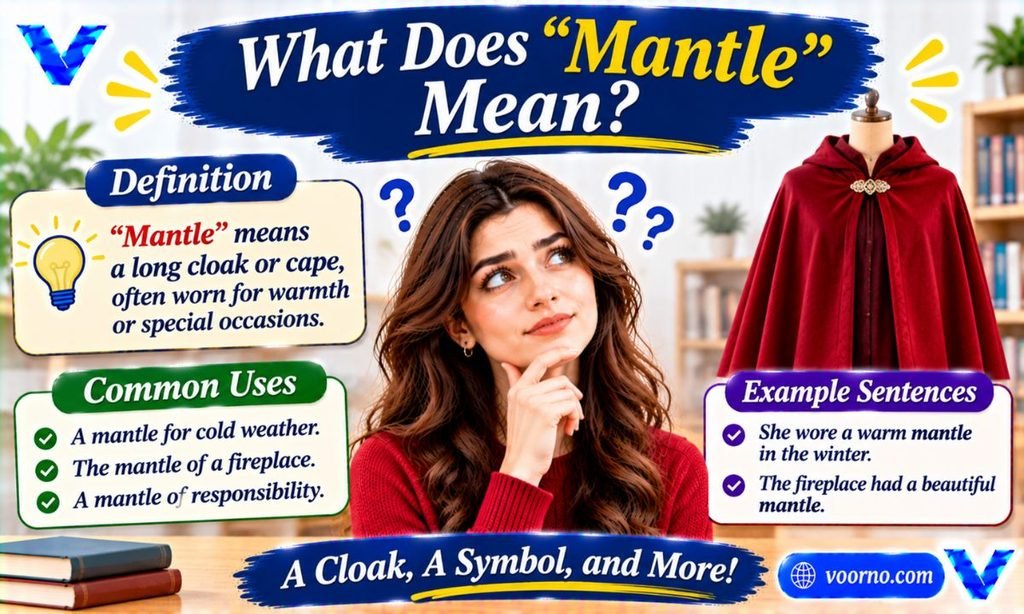
Unlike its narrow cousin, mantle carries several distinct meanings across clothing, science, literature, and everyday metaphor.
Mantle as Clothing
Historically, a mantle was a loose, sleeveless cloak worn over other garments, often associated with royalty, clergy, or ceremonial dress. You’ll still see this usage in historical fiction, fantasy writing, and formal or religious contexts.
Mantle as a Symbol of Responsibility
One of the most common modern uses of “mantle” is figurative: taking on a mantle of responsibility, leadership, or authority. When someone “takes up the mantle” after a predecessor, they’re symbolically wearing that person’s cloak of duty. This idiom appears constantly in political speeches, business writing, and biographies.
Mantle in Science: The Earth’s Mantle
In geology, the mantle is the thick layer of the Earth located between the crust and the outer core. It makes up the largest portion of Earth’s volume and is composed primarily of hot, semi-solid rock that moves slowly over geological timescales, driving plate tectonics.
Earth’s Structure Explained Simply
Earth is generally divided into four main layers:
- Crust — the thin, solid outer layer we live on
- Mantle — a thick, mostly solid but slowly flowing rock layer
- Outer core — liquid metal, mainly iron and nickel
- Inner core — solid metal under extreme pressure and heat
Understanding this structure makes the scientific use of “mantle” easy to remember: it’s a layer that covers the Earth’s core, much like a cloak covers a person.
Why People Confuse Mantel and Mantle
The confusion isn’t accidental — it’s built into the language itself. Both words:
- Sound exactly the same when spoken aloud
- Share the same Latin root
- Were historically used as interchangeable spellings
- Appear in similar visual or spatial contexts (something sitting “on” or “over” something else)
Add autocorrect and spellcheck tools that don’t always catch homophone errors, and it’s easy to see why even experienced writers slip up.
Memory Tricks That Actually Work

Fireplace Trick for Mantel
Think: “mantEL” and “shELf” both contain “el.” If you’re talking about the shelf above a fire, use mantel.
Leadership Trick for Mantle
Picture a cloak being draped over someone’s shoulders as they step into a new role. A cloak is a mantle, and so is the responsibility it represents.
Earth Science Trick
Remember that the Earth’s mantle covers the core, the same way a cloak (mantle) covers a person’s body.
Visual Memory Trick
Visualize a fireplace mantel as a flat, straight shelf (like the flat “el” ending), while a mantle billows and drapes like fabric (like the flowing “le” ending).
Common Mistakes With Mantel and Mantle
Mistake: Using “Mantle” for a Fireplace
Incorrect: She hung the stockings on the mantle. Correct: She hung the stockings on the mantel.
Mistake: Using “Mantel” in Leadership Writing
Incorrect: He accepted the mantel of leadership. Correct: He accepted the mantle of leadership.
Mistake: Confusing Scientific Usage
Incorrect: Scientists study the Earth’s mantel layer. Correct: Scientists study the Earth’s mantle layer.
Real-Life Examples That Clarify the Difference
Mantel Examples
- The wedding photos lined the marble mantel.
- A vintage clock sat proudly on the wooden mantel.
- The contractor rebuilt the fireplace mantel using reclaimed oak.
Mantle Examples
- The queen’s mantle trailed behind her as she walked.
- Fresh snow formed a white mantle over the fields.
- She inherited the mantle of the family business at twenty-five.
- Volcanic activity is linked to movement in the Earth’s mantle.
A Mini Writing Case Study
Imagine editing this sentence: “After his father’s passing, James took up the mantel of the company, placing a photo of him on the mantle in the office.”
Both instances are backwards. The corrected version reads: “After his father’s passing, James took up the mantle of the company, placing a photo of him on the mantel in the office.” One small swap, and the sentence is now grammatically accurate.
Mantel vs. Mantle in Search Engines
Which Word Is More Common?
“Mantle” is used far more frequently overall because of its many meanings — clothing, geology, leadership, and climbing all rely on it. However, “mantel” dominates search volume specifically within home improvement and interior design queries, since it has no competing definitions to dilute its usage.
Mantle in Home Decor Trends
Confusingly, some retailers and even interior design blogs use “mantle” when discussing fireplace shelving, largely due to the historical spelling overlap mentioned earlier. Style guides and major dictionaries still recommend “mantel” for accuracy and clarity in this context.
Mantle in Literature and Media
Writers frequently use “mantle” metaphorically to describe characters inheriting power, legacy, or duty — a common device in fantasy novels, historical dramas, and political commentary.
Mantle in Religion and Symbolism
In religious texts, a mantle often symbolizes spiritual authority being passed from one figure to another, reinforcing the word’s long-standing association with responsibility and transition.
How Teachers Explain Mantel vs. Mantle
Why Context Matters More Than Spelling Rules
English teachers often emphasize that homophones like these aren’t solved through memorizing spelling rules alone — context is the real key. Ask: is this sentence about a fireplace shelf, or about anything else (clothing, Earth science, responsibility, climbing)? If it’s the shelf, it’s mantel. Everything else is mantle.
Quick Practice Quiz
Test yourself: Which word fits each sentence?
- The trophy sits on the fireplace ___.
- She wrapped a velvet ___ around her shoulders.
- Geologists drilled into the Earth’s ___.
- He took on the ___ of team captain.
(Answers: 1. mantel, 2. mantle, 3. mantle, 4. mantle)
Expert Writing Tips to Avoid Mistakes
Picture the Scene
Before typing either word, visualize what you’re describing. A physical fireplace shelf? Mantel. Anything else? Mantle.
Slow Down During Editing
Homophone errors slip past writers precisely because the words sound right when read aloud. Read your draft slowly and specifically flag every instance of “mantel” or “mantle.”
Don’t Trust Spellcheck Alone
Spellcheck tools confirm correct spelling, not correct word choice. Since both words are spelled correctly on their own, spellcheck won’t catch a swapped usage.
Learn Through Repetition
Write out a few practice sentences using both words correctly. Repetition builds the automatic recall that eliminates second-guessing.
The Psychology Behind Word Confusion
Homophone confusion happens because our brains often process language by sound first, spelling second — especially when writing quickly. Since “mantel” and “mantle” are pronounced identically, the brain reaches for whichever spelling is more familiar in that moment, regardless of context. This is why even skilled writers benefit from a dedicated proofreading pass focused solely on commonly confused words.
Why Precision in Writing Matters
Small word mix-ups like this one might seem minor, but they affect credibility — especially in professional, academic, or published content. Precise word choice signals attention to detail and strengthens reader trust.
FAQs
Q:What does “mantle” mean in slang?
In casual or figurative slang, “mantle” usually refers to taking on a role, responsibility, or identity — such as “stepping into the mantle” of a job or title.
Q:What is the difference between mantle and mantel?
A mantel is strictly the shelf above a fireplace, while mantle covers everything else: cloaks, coverings, Earth’s interior layer, and figurative responsibility.
Q:What is a synonym for mantel?
Common synonyms include “mantelpiece,” “fireplace shelf,” and “hearth surround.”
Q:What does the idiom “I will take the mantle” mean?
It means accepting a position of leadership, responsibility, or duty, often after someone else has stepped down or passed it on.
Q:What is another word for “mantle”?
Depending on context, synonyms include “cloak,” “cover,” “covering,” “robe,” or “layer” (in geology).
Conclusion
The mantel vs. mantle debate boils down to one simple rule: mantel is only ever the shelf above your fireplace, while mantle handles every other meaning — from royal cloaks and Earth’s molten layers to leadership and climbing technique.
Once you anchor “mantel” to its single, narrow definition, the rest falls into place naturally. Keep this guide handy, run through the memory tricks a few times, and you’ll never second-guess this word pair again.










2 thoughts on “Mantel vs. Mantle: Definition, Difference, and Usage Explained”