Some phrases just stick. “Stick a fork in it” is one of them — a punchy little idiom that pops up in kitchens, offices, sports broadcasts, and group chats alike. If you’ve ever heard someone say a project is “done, stick a fork in it,” you already have a gut sense of what it means. This guide breaks down the exact definition, where the phrase came from, how people use it today, and what to say instead when you want a fresh way to signal something’s over.
What “Stick a Fork in It” Means in Modern English
At its core, “stick a fork in it” means something has reached the end — it’s finished, complete, or beyond saving. There’s no more work to do, no more play left in the game, and no reason to keep going.
The phrase carries a little built-in humor because it borrows from a kitchen test: when a fork slides into meat or a baked potato without resistance, the food is cooked through. Say the idiom out loud, and that same idea gets applied to almost anything — a task, a deal, a relationship, a losing team.
Read More:Passerby vs Passersby or Passerbyers: Meaning, Plural Form & Correct Usage
Meaning Connected to Task Completion
When people use this idiom in a work or project context, they’re almost always talking about finality, not just progress. It’s not “we’re close” — it’s “we’re done, full stop.” That’s what separates it from softer phrases like “almost there” or “wrapping up.”
A few core shades of meaning show up again and again:
- Total completion — a task, report, or project has nothing left to do.
- Exhaustion — a person is worn out and has no energy left to give.
- Failure or defeat — a situation, team, or effort has no chance of recovering.
- Irreversible ending — a relationship, trend, or era has genuinely run its course.
Illustrative Examples in Sentences
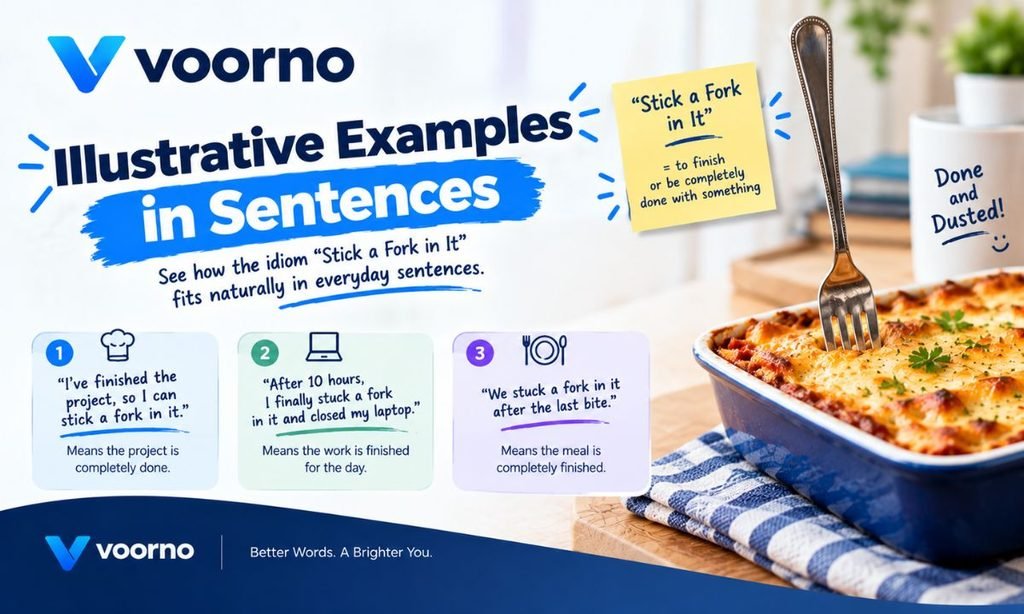
Seeing the phrase in context makes the meaning click faster than any definition alone.
Completion Examples
- “The quarterly report is finalized — stick a fork in it.”
- “We just signed off on the last invoice. Stick a fork in this project.”
- “After the third rewrite, the manuscript was finally done. Stick a fork in it.”
- “Stick a fork in me — I’ve been up since 4 a.m. and I’m running on empty.”
- “The renovation is finished; stick a fork in the whole thing.”
Stick a Fork in It Synonym
Looking for a different way to say the same thing? English has plenty of close cousins for this idiom, though each one carries a slightly different flavor.
| Synonym Phrase | Closest Meaning | Typical Tone |
| Call it a day | Stop working for now | Neutral, everyday |
| Done and dusted | Fully completed | Casual, satisfied |
| That’s a wrap | Finished (often creative work) | Light, celebratory |
| Over and out | Communication or effort has ended | Informal, radio-style |
| Game over | No chance of continuing or winning | Blunt, competitive |
| Curtains for it | It’s finished, especially in defeat | Dramatic |
None of these are exact one-to-one swaps — “stick a fork in it” leans more visual and slightly more final than “call it a day,” for example — but they all land in the same neighborhood of meaning.
Read More:“As Per Your Request” Meaning: How to Use It Correctly
Common Usage and Contexts
This idiom moves comfortably between casual chats and more structured settings, though it always keeps its informal edge.
Workplace Communication
In offices, the phrase shows up when a task, initiative, or even a difficult quarter has genuinely concluded. It’s common in team chats, stand-up meetings, and casual emails rather than formal reports.
- “The client finally approved the design — stick a fork in this campaign.”
- “Budget season is officially over; stick a fork in it.”
- “I’ve reviewed the contract three times. Stick a fork in it and send it out.”
Because it’s informal, most style guides would flag it as too casual for a polished business document, but it fits naturally in Slack messages, quick check-ins, and spoken updates.
Sports and Competition
Sports commentary is where this idiom really took off, and it’s still one of its most natural homes. Announcers use it the moment a game’s outcome is no longer in doubt.
- “Down by 30 with two minutes left — stick a fork in this one, folks.”
- “That home run put the game out of reach. Stick a fork in it.”
- “Once their star player fouled out, you could stick a fork in their championship hopes.”
Origins of “Stick a Fork in It”
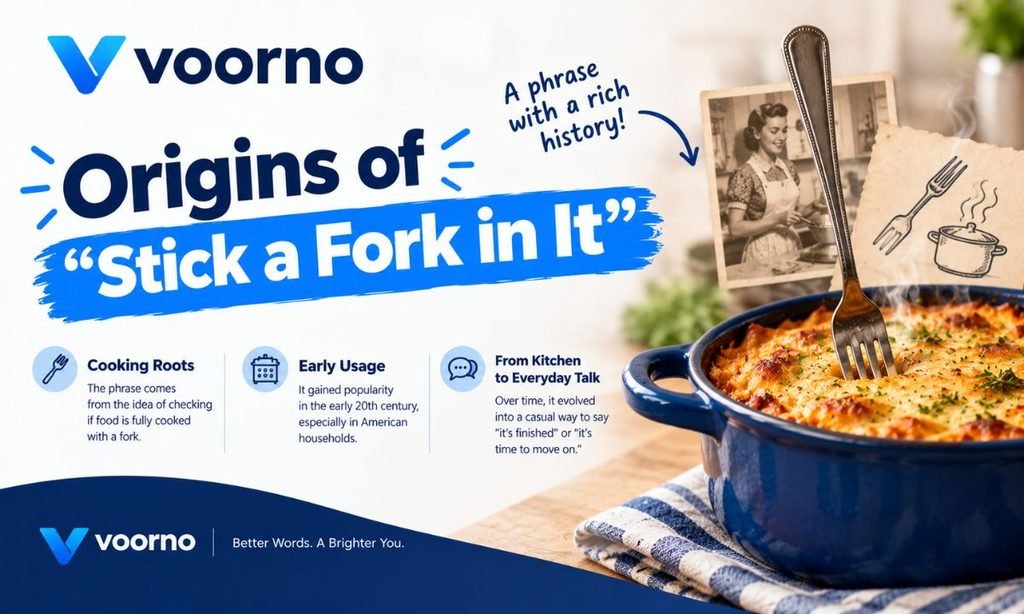
The kitchen logic behind this idiom is simple: cooks have long tested meat, potatoes, and baked goods by poking them with a fork. If the fork slides in cleanly, the food is done. That everyday habit gave English speakers a ready-made metaphor for “finished.”
The earliest documented use in this figurative sense traces back to baseball. Hall of Fame pitcher-turned-broadcaster Dizzy Dean is widely credited with popularizing the line “you can stick a fork in him, folks — he’s done” during radio broadcasts in the 1940s, describing a struggling pitcher who was about to be pulled from the game. From there, the phrase spread through sports commentary, then into general conversation, office language, and pop culture over the following decades.
Media, Pop Culture, and Literature Usage
Because it’s so visual and quick to say, “stick a fork in it” has become a favorite in scripted TV, movies, and online content whenever a writer wants a punchy way to signal an ending.
- Television and film — characters often use it for comedic timing when declaring a plan, relationship, or scheme dead.
- Sports broadcasting — commentators still lean on it heavily during blowouts or when a comeback becomes mathematically impossible.
- Social media — it shows up in captions and comments to mark something as officially over, often with a wink of humor.
Stick a Fork in It Restaurant
Interestingly, the phrase’s food origins have inspired its literal use as a name — several diners, food trucks, and casual eateries around the world have borrowed “Stick a Fork in It” as a branded name, playing on the idea of digging into a finished, ready-to-eat meal. It’s a clever bit of wordplay that turns an idiom about “done” cooking back into an invitation to eat.
Related Idioms and What They Convey

Idioms about endings cluster together because people constantly need new, colorful ways to say “it’s over.” Here’s how a few compare:
| Idiom | Core Meaning | Best Used For |
| Stick a fork in it | Completely finished, no more effort possible | Tasks, games, exhaustion |
| Call it a day | Stop for now, resume later | Workdays, casual breaks |
| That’s all she wrote | The end, nothing more to add | Stories, situations, endings |
| Down for the count | Defeated, unable to recover | Sports, competitions |
| Water under the bridge | Past events no longer matter | Conflicts, disagreements |
Why Idioms Like “Stick a Fork in It” Matter in Communication
Idioms compress a lot of meaning into a short, memorable package. Instead of saying “this project has reached a definitive and irreversible state of completion,” you just say “stick a fork in it,” and everyone gets it instantly. That efficiency, combined with a vivid mental image, is exactly why idioms survive for generations and cross over from one context — like a kitchen or a ballgame — into everyday speech.
They also add personality. A flat “the task is complete” reads like a status update; “stick a fork in it” reads like a person talking.
Case Study: Workplace Use of the Idiom

Picture a marketing team wrapping up a months-long product launch. After the final press release goes out, the team lead posts in the group chat: “That’s the last deliverable — stick a fork in this launch, everyone.” The phrase does double duty here: it confirms the work is finished, and it gives the team a small, informal moment of celebration without needing a lengthy announcement.
Stick a Fork in It Meme
Online, the phrase has taken on a life of its own as a meme format, often paired with images of a fork stuck into anything from a losing sports team’s logo to a wilted houseplant. The humor comes from applying the “it’s done” idea to increasingly random or exaggerated situations, which keeps the idiom feeling current even decades after it entered mainstream English.
Case Study: Sports Commentary Use
During a lopsided championship game, a broadcaster might say, “They’re down 40 points with a minute left — you can stick a fork in this one.” The phrase instantly tells viewers the outcome is settled, without needing to spell out the score differential or explain the math. It’s shorthand for “stop watching for suspense; the result is locked in.”
FAQs
Q:What does “stick a fork in it” mean?
It means something is completely finished, done, or can’t continue any further — often used with a touch of humor.
Q:What does the phrase “stick a fork in me I’m done” mean?
It’s a playful way of saying you’re personally exhausted and have no energy left to keep going.
Q:What does the idiom “stick a fork in it” mean?
It signals total completion or finality, comparing the situation to meat that’s fully cooked and ready.
Q:What does the saying “stick a fork in me” mean?
It means the speaker feels utterly drained, spent, or unable to do any more.
Q:What does “fork it” mean?
“Fork it” isn’t a standard idiom on its own; it’s sometimes used loosely as shorthand for the same “it’s finished” idea behind “stick a fork in it,” though usage varies informally.
Conclusion
“Stick a fork in it” has traveled a long way from its literal roots in home kitchens — through baseball broadcasts, office chats, and internet memes — while holding onto the same core idea: something has reached its true, final end. Whether you’re closing out a work project, watching a lopsided game, or just describing how tired you feel after a long day, this idiom offers a quick, vivid way to say there’s nothing left to do. Next time something truly wraps up, you’ll know exactly when — and how — to use it.










2 thoughts on “Stick a Fork in It Meaning: Definition, Origin & Examples”