You’ve typed it a hundred times. “As per your request, please find the attached report.” It feels safe. It feels professional. But somewhere in the back of your mind, a small voice asks: does this actually sound good, or does it just sound like every other email in my inbox?
That question is worth answering, because word choice in business writing isn’t just about grammar — it shapes how competent, warm, or robotic you come across. This guide breaks down the meaning, grammar, tone, and real-world usage of “as per your request,” compares it with close alternatives, and helps you decide when to use it and when to skip it.
Why “As per Your Request” Matters in Professional Communication
Business writing runs on trust and clarity. When you tell someone “as per your request,” you’re doing two things at once: confirming you listened, and showing that your action is tied directly to their instruction. That small signal builds accountability into everyday correspondence — emails, reports, contracts, and client updates.
The phrase matters because it removes ambiguity. It tells the reader, in three words, this isn’t random — this is what you asked for. That’s useful in customer service, legal writing, and any workplace where a paper trail of requests and responses matters.
Read More:Stick a Fork in It Meaning: Definition, Origin & Examples
Meaning of “As per Your Request”
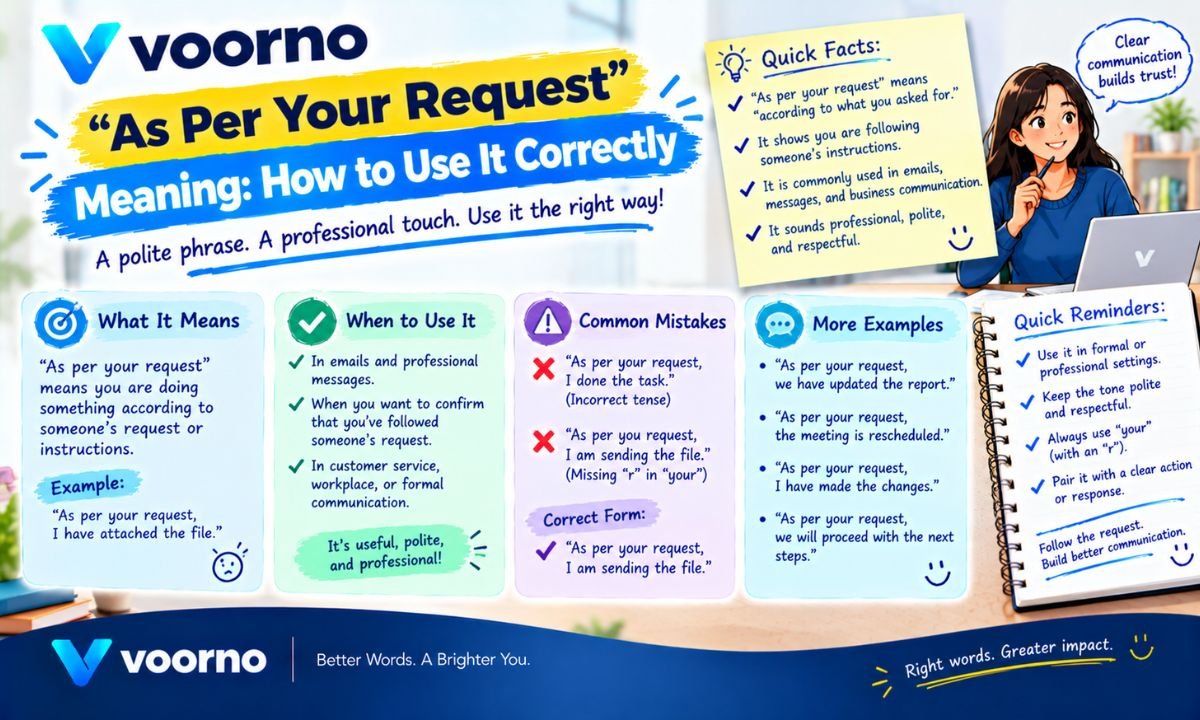
“As per your request” means “in accordance with what you asked for” or “following your instructions.” It signals that the sender is completing a task, sharing information, or taking an action specifically because the recipient requested it.
Breaking the phrase down:
- As — in the manner that
- Per — according to, by way of
- Your request — the instruction or ask made by the recipient
Together, it reads as: “in the manner you asked for.” It’s essentially a formal way of saying “as you asked.”
As per your request in a sentence
Here are a few natural examples of the phrase in use:
- “As per your request, I’ve attached the updated invoice.”
- “As per your request, the meeting has been rescheduled to Thursday.”
- “Please find the revised contract as per your request“
- “As per your request, our team has completed the site inspection.”
Grammar Breakdown of “As per Your Request”
Grammatically, the phrase is correct, though it’s often criticized for being slightly redundant. “As” and “per” both point toward “according to,” so pairing them together technically repeats the same idea twice.
| Element | Function | Meaning |
| As | Preposition/conjunction | In the way that |
| Per | Preposition | According to |
| Your request | Noun phrase | The specific ask made |
Because “as” and “per” overlap in meaning, many style guides and editors suggest trimming the phrase to either “per your request” or “as you requested” for cleaner writing. Neither version is wrong — it’s a matter of style, not correctness.
Read More:Where Are You Headed or Where Are You Heading? Meaning, Difference & Correct Usage
Why Professionals Still Use “As per Your Request”

Despite the redundancy critique, the phrase hasn’t disappeared from offices, law firms, or customer service scripts. A few reasons why:
- Habit and tradition — It’s been standard business vocabulary for decades, especially in legal, administrative, and corporate correspondence.
- Perceived formality — It signals seriousness and professionalism in contexts like contracts or official notices.
- Clarity in documentation — It explicitly ties an action to a specific instruction, which is useful for record-keeping.
- Industry norms — Some sectors (finance, law, government) still favor formal, traditional phrasing over conversational alternatives.
In short, the phrase persists because it works — even if it’s not the most modern-sounding option available.
Tone Analysis of “As per Your Request”
Tone is where this phrase gets debated most. It reads as:
- Formal — appropriate for official letters, legal notices, and client-facing documents.
- Neutral to slightly distant — it doesn’t carry warmth or personality.
- Efficient — it gets the point across without extra words.
If your goal is to sound approachable and personable, “as per your request” can feel cold or overly rigid. If your goal is precision and formality, it does the job well.
“As per Your Request” vs “Per Your Request” vs “As You Requested”
These three phrases are often used interchangeably, but they carry slightly different weight.
| Phrase | Formality | Best Used For | Tone |
| As per your request | High | Legal docs, official letters, formal client emails | Formal, slightly stiff |
| Per your request | High | Business emails, internal memos | Formal, slightly more concise |
| As you requested | Medium | Everyday professional emails | Warm, natural, clear |
“Per your request” trims the redundant “as,” making it a leaner formal option. “As you requested” swaps the prepositional phrase for a full clause, which tends to sound more conversational and human.
Best Alternatives to “As per Your Request”

If you want variety in your writing (and you should — repeating the same phrase across every email gets stale), here are strong alternatives:
- As you requested
- At your request
- Following your request
- In accordance with your request
- According to your instructions
- As you asked
- Per your instructions
- Based on your request
Each carries a slightly different formality level, so choose based on your audience and context.
Communication Psychology Behind Simpler Alternatives
Research on workplace communication consistently shows that plain, direct language builds trust faster than dense, formal phrasing. When readers process a sentence quickly and effortlessly, they associate that ease with the sender’s competence and sincerity — this is sometimes called the “processing fluency” effect.
Phrases like “as you asked” or “at your request” reduce cognitive load. The reader doesn’t have to mentally translate formal business-speak into plain meaning — they simply understand it instantly. That’s why many communication coaches now recommend simpler alternatives for client-facing emails, especially outside legal or highly formal industries.
Case Study: Email Style Comparison
Before (formal, traditional): “As per your request, please find attached the revised proposal for your review. Kindly revert with your feedback at your earliest convenience.”
After (simplified, modern): “As you asked, I’ve attached the revised proposal. Let me know what you think whenever you get a chance.”
Both emails communicate the same message. The first sounds like it came from a corporate template. The second sounds like it came from a person — and in most modern workplaces, that’s the tone that builds better relationships.
Decision Guide: Should You Use “As per Your Request”?
Ask yourself these quick questions:
- Is this a legal, contractual, or highly formal document? → Use “as per your request.”
- Is this a routine client or coworker email? → Consider “as you requested” or “at your request.”
- Do you want to sound warmer and more personal? → Skip it and use a simpler alternative.
- Is your company style guide formal by default? → Stick with the traditional phrase.
Related Language Confusions
As per your request synonym
Common synonyms include “as you requested,” “at your request,” “following your instructions,” and “in line with your request.” Each works well as a direct substitute depending on tone.
Why Word Choice Affects Professional Image
The words you choose in email and documentation shape how colleagues and clients perceive your competence, approachability, and attention to detail. Overly formal or repetitive phrasing can make writing feel impersonal or dated, while overly casual language can undercut authority in serious contexts. Striking the right balance — clear, respectful, and appropriately formal — is part of building a strong professional reputation.
Why This Phrase Gets Searched Often
People search this phrase constantly because it sits in a gray area: it’s grammatically valid, widely used, yet frequently flagged as redundant or old-fashioned by grammar checkers and style guides. Writers want to know whether it’s still acceptable, whether it sounds outdated, and what to use instead — which is exactly what this guide addresses.
When You Should Use “As per Your Request”
- Legal letters and contracts
- Formal client correspondence
- Government or institutional communication
- Situations requiring a clear, documented link between request and action
When You Should Avoid It
- Casual internal emails
- Chat-based workplace communication (Slack, Teams)
- Customer service replies aiming for a friendly tone
- Creative or marketing copy
Common Mistakes with “As per Your Request”
- Using “per request” alone — this is grammatically incomplete without a determiner like “your” or “the.”
- Overusing it in every email — repetition makes writing feel robotic.
- Pairing it with overly stiff language — combining it with phrases like “kindly revert” compounds the formal, dated tone.
- Using it in casual conversation — it can sound sarcastic or pompous when spoken aloud in informal settings.
Real Email Examples: Before vs After
| Situation | Before | After |
| Sending a report | “As per your request, the report is attached.” | “As you asked, I’ve attached the report.” |
| Confirming a change | “As per your request, the schedule has been updated.” | “I’ve updated the schedule as requested.” |
| Responding to a client | “As per your request, kindly find the quotation enclosed.” | “Here’s the quotation you asked for.” |
Why Experts Criticize the Phrase
Grammar and business-writing experts often flag “as per your request” for two reasons: redundancy (as + per both mean “according to”) and datedness — it echoes older corporate-speak that modern communication trends have moved away from. Plain-language advocates argue that simpler phrasing improves readability without sacrificing professionalism.
As per your request in spanish
A natural Spanish equivalent is “según lo solicitado” or “conforme a su solicitud,” both of which translate to “according to your request” and carry the same formal tone in Spanish business writing.
Quick Reference Table
| Phrase | Formality | Common Use Case |
| As per your request | High | Legal, formal letters |
| Per your request | High | Business memos |
| As you requested | Medium | Everyday emails |
| At your request | Medium | Client communication |
| As you asked | Low-Medium | Casual professional tone |
FAQs
Which is correct: “as per request” or “as requested”?
“As requested” is the correct, natural phrasing. “As per request” is grammatically incomplete without a determiner like “your” or “the.”
Is it correct to say “as per my understanding”?
Yes, it’s grammatically acceptable and commonly used to mean “based on what I understand.”
What is another way to say “as per”?
You can use “according to,” “in accordance with,” or simply “based on” instead of “as per.”
What is a synonym for “as per my knowledge”?
“To my knowledge,” “as far as I know,” or “based on what I understand” all work as natural substitutes.
Can we say “as per your request”?
Yes, it’s grammatically correct and widely used in formal and business writing, though simpler alternatives often read more naturally.
Conclusion
“As per your request” isn’t wrong — it’s a formal, grammatically valid phrase with a long history in business writing. But formal doesn’t always mean better. In legal documents and official correspondence, it still earns its place.
In everyday emails and client communication, simpler alternatives like “as you requested” or “at your request” often land better, sounding more human without losing professionalism.
The real skill isn’t memorizing one phrase — it’s knowing which version fits the moment. Match your language to your audience, and your writing will always sound intentional rather than templated.










2 thoughts on ““As Per Your Request” Meaning: How to Use It Correctly”