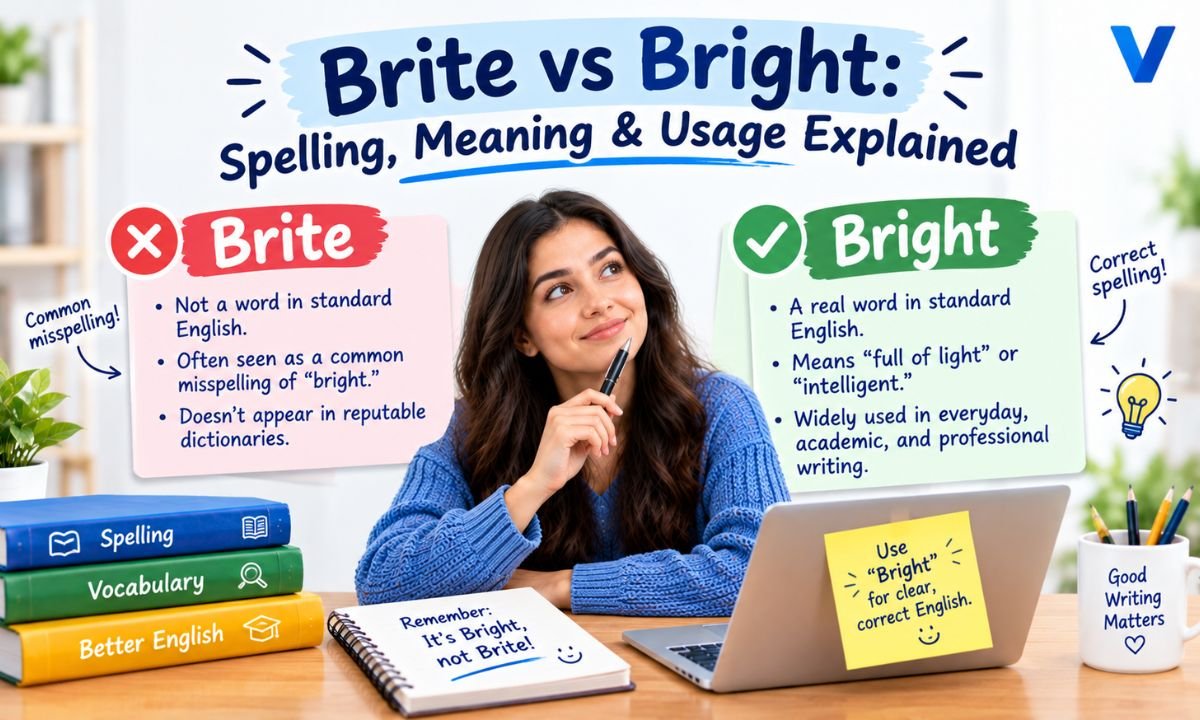
If you’ve ever paused mid-sentence wondering whether to type “brite” or “bright,” you’re not alone. These two words sound exactly the same when spoken, which is exactly why so many people mix them up in writing. But only one of them belongs in your emails, essays, and everyday sentences.
This guide breaks down the real difference between brite and bright — covering spelling, meaning, pronunciation, history, and the situations where each one actually belongs.
The Core Difference at a Glance (Brite vs Bright)
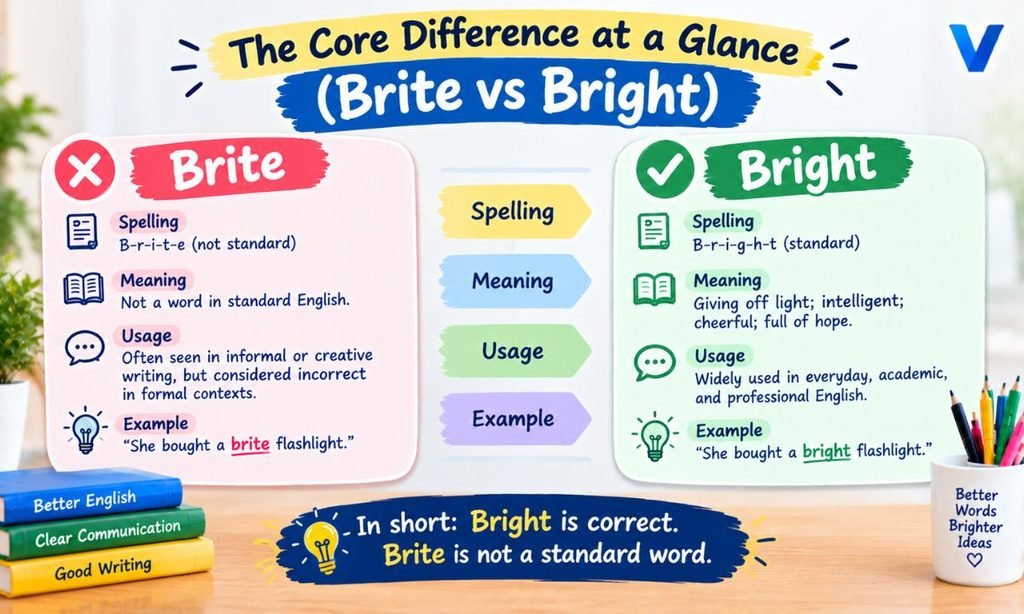
In short: bright is the correct, dictionary-recognized English word. Brite is a stylized spelling that shows up almost exclusively in brand names, product labels, and casual marketing copy — not in standard writing.
They’re homophones, meaning they’re pronounced identically but spelled differently and used in different situations.
Read More:“Thanks for Asking” Explained: Meaning, Examples & Responses
Quick Comparison Table
| Feature | Bright | Brite |
| Standard spelling | Yes | No |
| Found in dictionaries | Yes | Rarely, as informal/variant only |
| Common use | Everyday writing, speech, literature | Brand names, product labels, slogans |
| Part of speech | Adjective | Not a true part of speech; stylistic variant |
| Pronunciation | /braɪt/ | /braɪt/ (identical) |
| Example | “The room is bright.” | “Scotch-Brite,” “Lite-Brite” |
Is BRITE a Scrabble Word
No. “Brite” is not an accepted word in official Scrabble dictionaries, including both the Scrabble Players Dictionary and the Collins Scrabble Words list. Since Scrabble only allows recognized dictionary words, and “brite” hasn’t earned a stable place in standard dictionaries, it won’t score you any points at the board. “Bright,” on the other hand, is completely valid.
Read More:Receiver vs Reciever: How to Spell It Correctly
Brite vs Bright
At its heart, this comparison isn’t really about two competing words with different meanings — it’s about one correct word (bright) and one branding shortcut (brite) that borrowed its sound. Understanding that distinction clears up almost every point of confusion people run into.
Etymology and Historical Development of “Brite” and “Bright”

The Early Roots of “Bright”
“Bright” has deep roots in the English language. It traces back to the Old English word beorht (also written as briht), meaning shining, radiant, or splendid. That word, in turn, descends from the Proto-Germanic root berhtaz, which carried the same sense of light and radiance. Go back even further, and the trail leads to a Proto-Indo-European root associated with shining, gleaming, or whiteness.
In other words, “bright” isn’t a modern invention — it’s a word with more than a thousand years of continuous use behind it.
Meaning Evolution of “Bright”
Over the centuries, “bright” grew beyond describing physical light. In early poetry and literature, it often symbolized purity, divinity, or moral goodness. By the time modern English took shape, “bright” had picked up its now-familiar secondary meaning: intelligence or mental sharpness. Today, it comfortably covers everything from sunlight to smart students to cheerful moods.
How “Brite” Emerged
“Brite” is a much newer creation. It’s a phonetic respelling of “bright” — dropping the silent “gh” to make the word look simpler and punchier. This simplified version started appearing in branding and product names in the early 1900s, with examples like polish and cleaning products using “brite” to suggest shine and simplicity in a memorable, trademark-friendly way. Over time, it became a go-to spelling trick for marketers who wanted a word that looked fresh without changing how it sounded.
Brite Meaning Slang
Outside of branding, “brite” occasionally shows up in casual or slang contexts as an informal, phonetic stand-in for “bright” — think text messages, social captions, or stylized usernames. In some niche communities, it has also been used loosely to describe something impressive, vivid, or eye-catching, though this usage isn’t standardized or widely recognized. It’s worth noting that “brite” also has a narrow technical meaning in brewing and malting, where it can refer to a stage of processing barley — a completely separate use from the branding sense most people encounter.
Pronunciation in the “Brite vs Bright” Debate
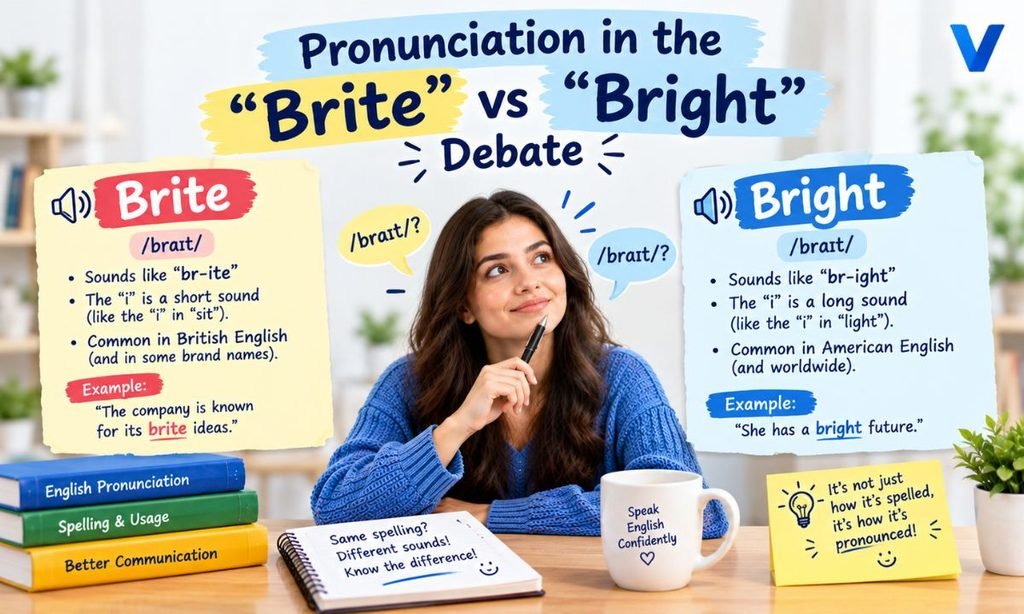
Do “Brite” and “Bright” Sound the Same?
Yes — completely. Both words are pronounced /braɪt/, rhyming with “kite,” “night,” and “light.” There’s no difference in stress, vowel sound, or syllable count. This identical pronunciation is exactly why “brite” gets mistaken for a legitimate alternative spelling so often.
Bright Meaning and Sentence
“Bright” functions as an adjective with a few related meanings:
- Full of light: “The bright morning sun woke us up early.”
- Vivid in color: “She wore a bright yellow jacket.”
- Intelligent: “He’s one of the brightest students in the class.”
- Cheerful or hopeful: “She gave a bright smile despite the bad news.”
Each sentence uses the same spelling, just applied to a different shade of meaning.
Spelling Differences: Why “Bright” Is Correct and “Brite” Is Not
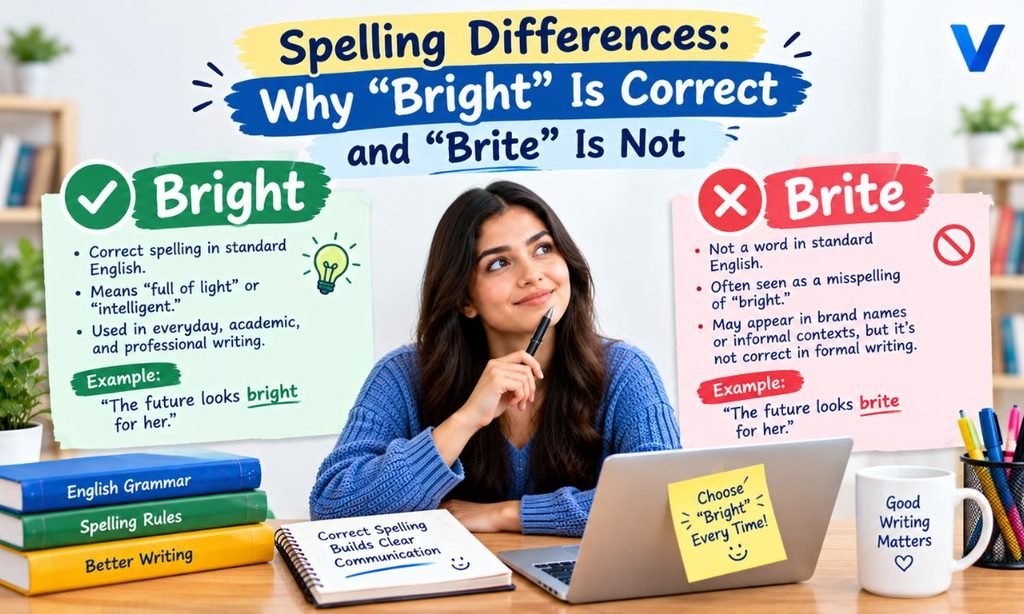
The spelling gap comes down to standardization. English dictionaries, style guides, and academic institutions have consistently recognized “bright” (b-r-i-g-h-t) as the correct form for over a thousand years. “Brite” (b-r-i-t-e) never went through that same process of formal adoption — it exists almost entirely as a marketing convention, not a grammatical one.
Because dictionaries define what counts as “correct” spelling in formal English, and “brite” isn’t treated as a standard entry in the way “bright” is, using it outside of branding contexts reads as a spelling mistake rather than a stylistic choice.
When and Where “Brite” Appears in Modern English

“Brite” isn’t meaningless — it just lives in a specific lane. You’ll typically spot it in:
- Brand and product names — Scotch-Brite, Lite-Brite, Star-Brite
- Marketing slogans — where a punchy, simplified spelling stands out
- Toy and entertainment names — like the character Rainbow Brite
- Casual, stylized writing — texts, usernames, or playful headlines
Outside of these contexts, “brite” doesn’t belong in formal writing, academic work, or professional communication.
Understanding the Meaning of “Brite”

When “brite” is used, it’s almost always meant to evoke the same idea as “bright” — shine, clarity, or freshness — but packaged in a shorter, more visually distinctive form. It’s not really a separate word with its own definition; it’s a stylistic reflection of “bright,” built for memorability rather than grammar.
Brite Pronunciation
Just like “bright,” “brite” is pronounced /braɪt/. There is no pronunciation guide that treats it differently — the spelling changes, but the sound never does.
Understanding the Meaning of “Bright”
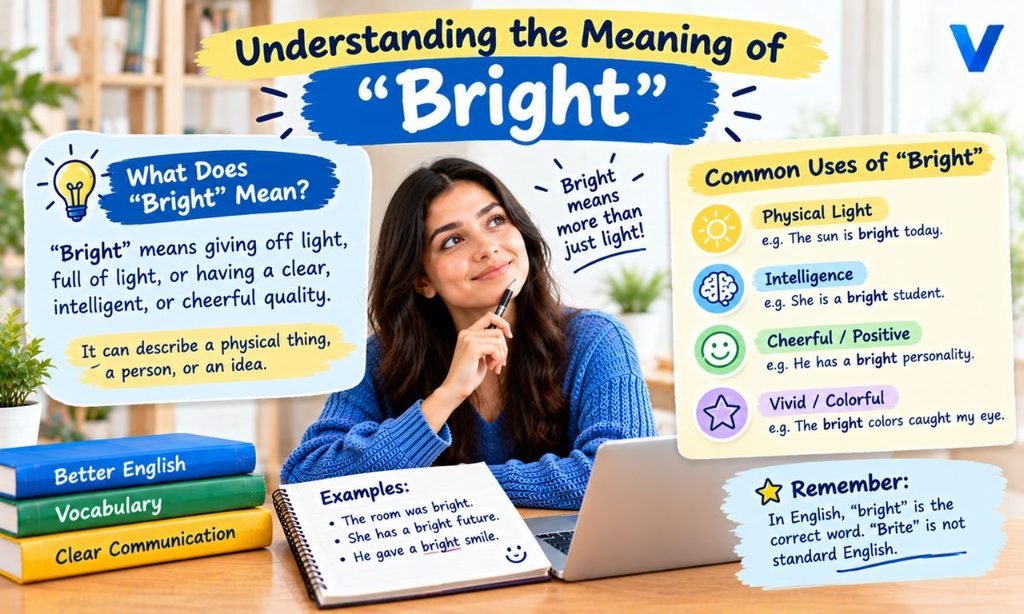
“Bright” is a flexible, well-established adjective. Its core meanings include:
- Emitting or reflecting a strong amount of light
- Having vivid, strong color
- Showing intelligence or quick understanding
- Conveying cheerfulness, optimism, or a positive outlook
Because of this range, “bright” can describe a lamp, a shirt, a student, or a personality — all correctly.
Case Studies: How the Two Words Work in Real Contexts

Case 1 — Academic writing: A student writes, “The professor’s explanation made everything brite.” This is incorrect. The correct sentence is: “The professor’s explanation made everything bright.”
Case 2 — Branding: A cleaning brand names its product “SparkleBrite.” This works because branding allows creative, trademark-style spelling that standard prose doesn’t.
Case 3 — Casual texting: A friend types, “that outfit is so brite.” While understandable in an informal chat, this would still be flagged as a misspelling in any formal document.
These examples show the same pattern: “bright” works everywhere; “brite” only works in a narrow, branding-driven lane.
Common Mistakes & How to Avoid Them

| Mistake | Why It’s Wrong | Correction |
| “The brite sun hurt my eyes.” | “Brite” isn’t standard English | “The bright sun hurt my eyes.” |
| Using “brite” in a resume or essay | Looks like a spelling error to readers | Use “bright” |
| Assuming “brite” is a slang synonym for smart | Not a widely recognized meaning | Use “bright” for intelligence |
| Thinking “brite” is valid in Scrabble | Not in official word lists | Use “bright” only |
Quick fix: If you’re writing a sentence rather than naming a product, default to “bright” every time.
Quick Reference Guide: Brite vs Bright
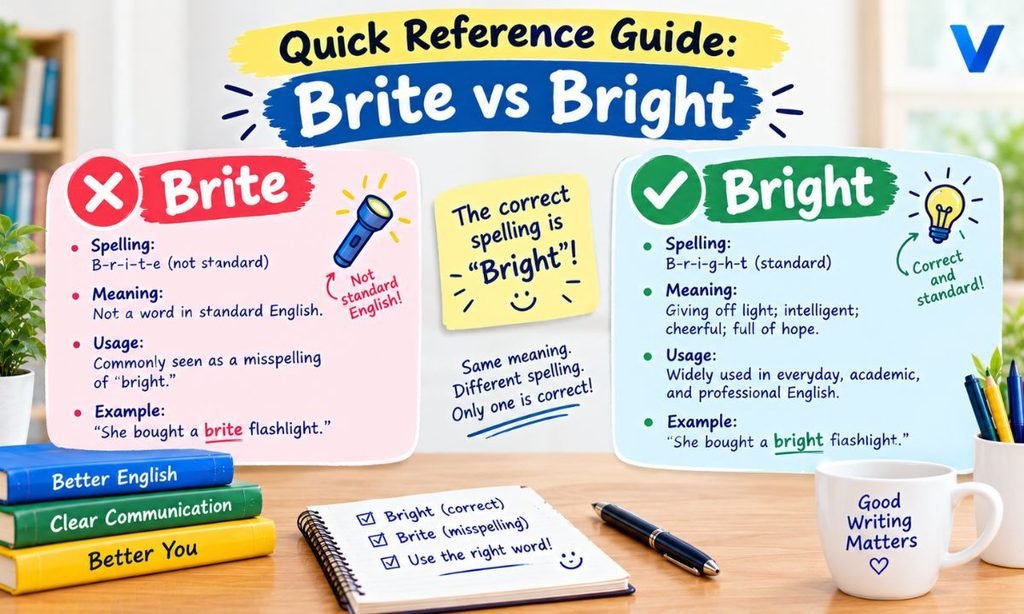
- Use bright for light, color, intelligence, and mood in everyday writing.
- Use brite only for brand names, product labels, or intentional stylization.
- Both are pronounced the same way — spelling is where the difference lives.
- When unsure, “bright” is always the safer, correct choice.
Fast Summary Table
| Question | Answer |
| Which is grammatically correct? | Bright |
| Which is used in branding? | Brite |
| Do they sound alike? | Yes, identical pronunciation |
| Is brite in the dictionary? | Rarely, and only as informal/variant |
| Which should you use in school or work? | Bright |
Final Verdict: Should You Use Brite or Bright?
For everyday writing — emails, essays, articles, reports, or conversation — always use bright. It’s the version recognized by dictionaries, taught in schools, and expected by readers. Reserve brite for the narrow cases where you’re naming a product, crafting a brand, or intentionally going for a stylized, catchy look. Outside of that lane, “brite” will simply read as a typo.
FAQs
Q:Is it brite or bright?
“Bright” is the correct spelling for standard English writing. “Brite” is only appropriate in brand names or stylized contexts.
Q:What is the opposite of bright?
Common opposites include dim, dull, dark, or gloomy, depending on whether you mean light, color, or mood.
Q:Is “brite” a valid word?
It’s not a standard dictionary word for everyday use, though it appears in some informal or brand-related entries.
Q:What does “yuh bright” mean?
It’s a casual, phonetic way of saying “you’re bright,” typically used to compliment someone’s intelligence or cleverness.
Q:What’s a fancy word for bright?
Words like radiant, luminous, brilliant, or vivid can serve as more elevated alternatives to “bright.”
Conclusion:
The “brite vs bright” debate really isn’t much of a debate once you know the rule: bright is the correct English word for everyday use, while brite is a stylistic spelling reserved for brands and creative labeling. They sound identical, but their roles couldn’t be more different. Stick with “bright” whenever you’re writing normally, and save “brite” for the rare moments when style — not grammar — is the goal.










2 thoughts on “Brite vs Bright: Spelling, Meaning & Usage Explained”