If someone asks how you’re doing, how do you respond without sounding stiff or scripted? Chances are, you’ve reached for the phrase “thanks for asking” more times than you can count. It’s short, warm, and instantly makes a conversation feel more personal.
But is it always the right choice? Does it ever sound sarcastic, awkward, or even rude? This guide breaks down everything you need to know about “thanks for asking” — its meaning, grammar, tone, alternatives, and how to use it naturally in real conversations.
What Does “Thanks for Asking” Really Mean?
At its core, “thanks for asking” is a polite acknowledgment. It tells the other person that you noticed their question and appreciate that they cared enough to ask it in the first place.
The phrase usually carries one of three meanings, depending on context:
- Genuine gratitude — you’re truly happy someone checked in on you.
- Polite acknowledgment — you’re simply recognizing the question before answering.
- Sarcastic dismissal — in the wrong tone, it can sound passive-aggressive or dismissive.
In most everyday situations, it’s a small courtesy that makes conversation feel warmer and more human, whether you’re chatting with a friend, replying to a coworker, or answering a customer’s question.
Thanks for Asking Synonyms
If you want to mix things up, here are some natural alternatives:
- I appreciate you asking
- I’m glad you asked
- That’s kind of you to ask
- Thank you for checking in
- I appreciate your concern
- Thanks for reaching out
- It’s nice of you to ask
Each of these carries a slightly different tone, so picking the right one depends on how formal or personal the conversation is.
Read More:Question About vs Question On vs Question Regarding: What’s the Difference?
Is “Thanks for Asking” Grammatically Correct?
Yes — “thanks for asking” is completely correct English. It follows a simple structure: thanks + for + gerund (asking). This is the same pattern used in phrases like “thanks for coming” or “thanks for waiting.”
It works as a standalone sentence or as part of a longer reply, and it fits comfortably in both spoken and written English.
“Thanks for Asking” vs. “Thank You for Asking”
Both versions are grammatically fine, but they differ slightly in tone:
| Phrase | Tone | Best Used In |
| Thanks for asking | Casual, friendly | Texts, everyday chats, social media |
| Thank you for asking | Slightly more formal | Emails, workplace conversations, customer service |
Neither is “more correct” than the other — the choice simply depends on how formal your setting is.
Read More:Brite vs Bright: Spelling, Meaning & Usage Explained
When to Use “Thanks for Asking” (Real Situations That Work)

This phrase shines in situations where someone shows genuine interest in you or your wellbeing:
- Answering “How are you?” — “I’m doing great, thanks for asking!”
- Responding to a health check-in — “I’m feeling much better, thanks for asking.”
- Replying to a work update request — “The project is on track, thanks for asking.”
- Acknowledging someone’s curiosity — “Thanks for asking — here’s how it works.”
- Thanking someone for checking on your family or plans — “They’re doing well, thanks for asking.”
In each case, the phrase softens the reply and shows that you value the other person’s attention.
When “Thanks for Asking” Sounds Awkward or Wrong
Despite being versatile, this phrase doesn’t always fit. Avoid it when:
- The question was forced, obligatory, or clearly disinterested.
- You’re delivering serious or sad news (it can feel oddly cheerful).
- The setting is highly formal, like a legal document or official report.
- It’s repeated too often in one conversation, which can feel scripted or insincere.
Thanks for Asking Is Correct Sentence
Yes, “thanks for asking” is a complete, grammatically valid sentence. It works as a standalone reply or paired with additional details, such as “Thanks for asking — I’ve been busy but doing well.”
Tone Matters: Polite vs. Sarcastic Use
The words themselves don’t change, but tone can completely flip the meaning. Said warmly, it sounds appreciative. Said flatly or with emphasis on certain words, it can sound dismissive — think of a reply like, “Oh, thanks for asking, now you care?”
Tone Comparison Table
| Style | Example | Feeling Conveyed |
| Polite | “I’m doing well, thanks for asking!” | Warm, genuine |
| Neutral | “Thanks for asking. It’s going fine.” | Simple acknowledgment |
| Sarcastic | “Oh, thanks for asking. Finally.” | Passive-aggressive, dismissive |
Spoken vs. Written Tone
In speech, tone of voice, pacing, and facial expressions clarify intent instantly. In writing, that nuance disappears, so punctuation and word choice carry more weight:
- Use an exclamation point to sound enthusiastic: “Thanks for asking!”
- Use a period for a calm, neutral tone: “Thanks for asking.”
- Add context to prevent misreadings: “Thanks for asking — I’d love to explain.”
How to Say Thanks for Asking About Your Health
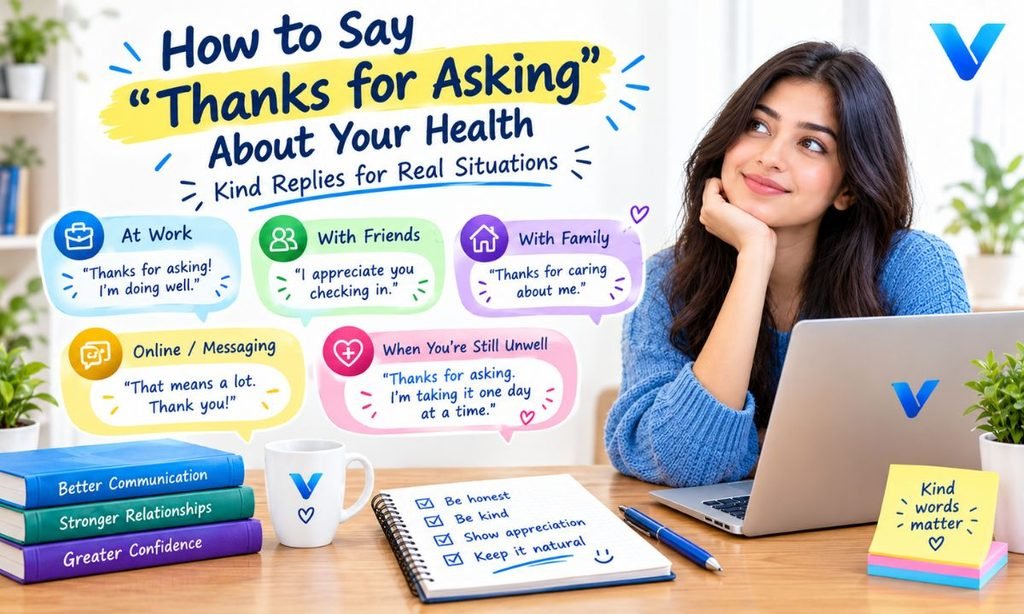
When someone checks in on your health, a warm and specific response feels more genuine than a generic one. Try:
- “I’m feeling much better, thanks for asking.”
- “Still recovering, but improving daily — thanks for checking on me.”
- “I really appreciate you asking about my health.”
- “That means a lot, thank you for asking.”
These responses combine gratitude with a brief update, which keeps the conversation flowing naturally.
Common Mistakes People Make
Even a simple phrase like this one trips people up sometimes. Watch out for:
- Overusing it — repeating it in every reply can sound robotic.
- Using it in serious contexts — it can feel out of place during bad news.
- Pairing it with a flat tone — this can unintentionally sound sarcastic.
- Skipping the follow-up — saying only “thanks for asking” without any detail can feel abrupt.
Confusing Similar Phrases
People often mix up “thanks for asking” with related expressions that mean slightly different things:
- “Thanks for checking in” — implies ongoing concern, often used after a gap in contact.
- “Thanks for reaching out” — used when someone contacts you, not necessarily asking a question.
- “I appreciate your concern” — more formal, often used in health-related replies.
How to Say Thanks for Asking About Your Health Quotes
If you like short, quotable lines for texts or cards, consider:
- “Your concern means more than you know — thank you.”
- “Grateful for friends who check in when it matters most.”
- “Thanks for asking — kindness like yours speeds up recovery.”
Best Alternatives to “Thanks for Asking”
Depending on the situation, these alternatives can add variety to your replies:
- I’m glad you asked
- I appreciate you checking in
- That’s thoughtful of you to ask
- Thanks for your concern
- I appreciate the question
Quick Comparison Table
| Alternative | Formality | Best Context |
| I’m glad you asked | Casual | Friends, informal chats |
| I appreciate you checking in | Neutral | Coworkers, acquaintances |
| Thanks for your concern | Formal | Health updates, serious topics |
| I appreciate the question | Formal | Professional or customer settings |
How to Respond After Saying “Thanks for Asking”
Saying the phrase alone can feel incomplete. Add a short follow-up to keep the conversation natural:
- Give a brief update: “Thanks for asking — things are going well.”
- Ask something back: “Thanks for asking! How about you?”
- Add context: “Thanks for asking. I’ve been swamped, but I’m managing.”
Cultural Differences You Should Know
Politeness norms vary across cultures. In many English-speaking countries, phrases like “thanks for asking” are common and expected in everyday small talk. In other cultures, direct answers without extra pleasantries are more typical, and adding “thanks for asking” might feel unnecessary or overly formal. When communicating across cultures, it helps to observe how others respond before deciding how much warmth to add to your own replies.
Real-Life Examples You Can Copy
Friends Conversation
Friend: “Hey, how’ve you been?” You: “Pretty good, thanks for asking! Work’s been busy, but I can’t complain.”
Friend: “I heard you were sick. Feeling okay now?” You: “Much better, thanks for asking. Appreciate you checking in.”
Coworker: “How’s the new project coming along?” You: “It’s on track, thanks for asking — should be done by Friday.”
Expert Tips to Use “Thanks for Asking” Naturally
- Match your tone to the setting: casual for friends, polished for work.
- Don’t force it if it doesn’t feel natural in the moment.
- Add a small detail after the phrase to avoid sounding scripted.
- Save it for genuine check-ins, not routine small talk you want to end quickly.
Quick Do’s and Don’ts Cheat Sheet
| Do | Don’t |
| Use it when someone shows real interest | Use it after bad news or serious topics |
| Add a short follow-up detail | Repeat it in every single reply |
| Adjust tone for formal vs. casual settings | Use a flat tone that could sound sarcastic |
| Pair it with a smile or warm punctuation | Overthink it — simplicity works |
FAQs
Q:How to say thanks in unique ways?
Try phrases like “I owe you one,” “You’ve made my day,” or “I can’t thank you enough” to add variety beyond a simple “thanks.”
Q:What is another way to say “thanks for asking”?
“I appreciate you asking,” “I’m glad you asked,” or “That’s kind of you to ask” all work as natural substitutes.
Q:What is a slang word for “thanks”?
Common casual options include “thanks a bunch,” “much appreciated,” and simply “thanks a ton.”
Q:What is a better way of saying thanks?
“I really appreciate it” or “I’m truly grateful” often sound more heartfelt than a plain “thanks.”
Q:How to reply thank you for asking?
You can simply say “You’re welcome” or “Of course — happy to share,” keeping the exchange warm and natural.
Conclusion
“Thanks for asking” is a small phrase with a big impact on how conversations feel. It’s grammatically correct, versatile, and works beautifully in everyday chats, health check-ins, and even professional replies — as long as the tone matches the moment. The key is using it naturally, backing it up with a genuine detail, and knowing when a different phrase might fit better. Once you get a feel for the tone and timing, this simple expression becomes an easy way to make every conversation a little warmer.










2 thoughts on ““Thanks for Asking” Explained: Meaning, Examples & Responses”