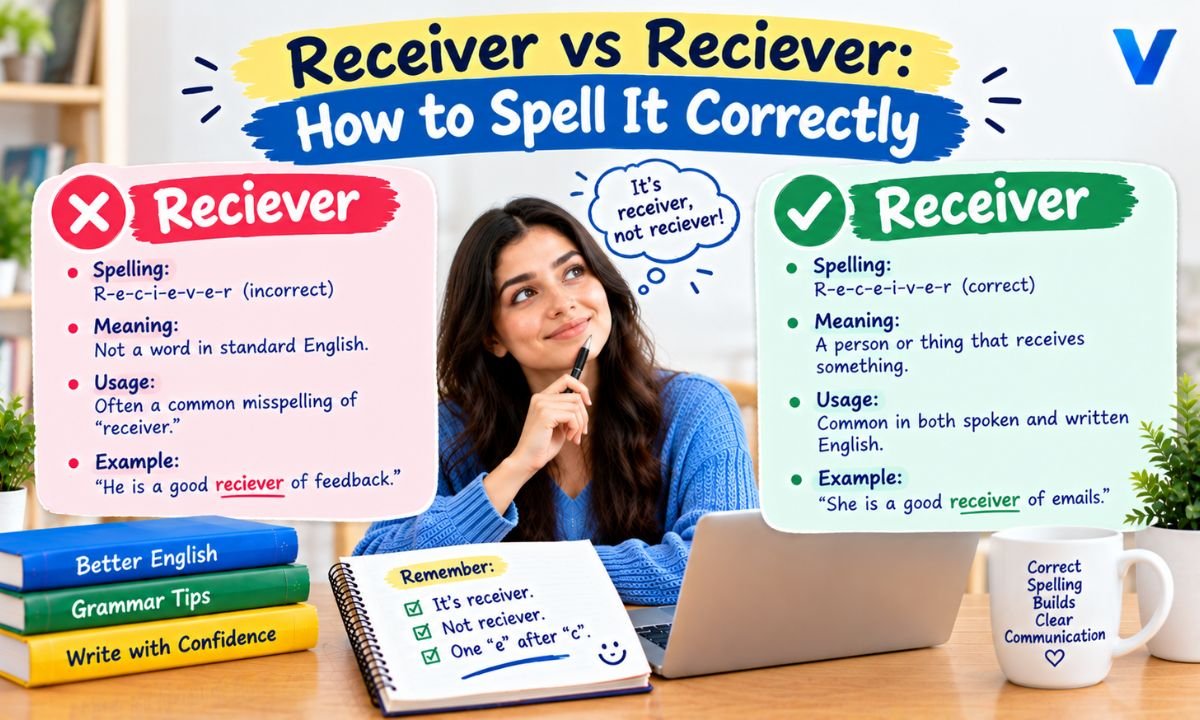
If you’ve ever paused mid-sentence wondering whether it’s “receiver” or “reciever,” you’re not alone. This is one of the most commonly misspelled words in the English language, and it trips up students, professionals, and even native speakers who type quickly.
The short answer: receiver is correct. Reciever is always wrong — no exceptions, no regional variations, no informal shortcuts.
But knowing the right answer isn’t enough. In this guide, you’ll learn why this mix-up happens so often, the spelling rule behind it, real-world usage examples, and simple tricks to make sure you never second-guess yourself again.
Why This Spelling Mix-Up Confuses So Many Writers
The confusion isn’t really about vocabulary — it’s about a spelling pattern that English speakers learn early and then misapply.
Most of us grow up learning the rhyme “i before e, except after c.” That rule works fine for words like believe, achieve, and friend. But when a word actually contains a “c” right before the vowel sound, writers often forget the exception and default to the more familiar i-e pattern out of habit.
A few other factors make it worse:
- Identical pronunciation. “Receiver” and “reciever” sound exactly the same when spoken, so your ear gives you no clue about which spelling is correct.
- Fast typing. Muscle memory often types “ie” automatically because that pattern appears in far more English words than “ei.”
- Autocorrect gaps. Not every keyboard or app catches the error instantly, so the wrong spelling can slip through unnoticed.
- Repeated exposure to the error. The more often people see “reciever” in casual writing, texts, or social media, the more normal it starts to look — even though it’s still incorrect.
Read More: Brite vs Bright: Spelling, Meaning & Usage Explained
Correct Spelling: Receiver vs Reciever
There’s no ambiguity here. Every major dictionary, including Merriam-Webster and Oxford, lists only one accepted spelling.
| Spelling | Status | Notes |
| Receiver | ✅ Correct | The only accepted spelling in all contexts |
| Reciever | ❌ Incorrect | A common misspelling; never appears in dictionaries |
If you can spell the base word “receive” correctly, spelling “receiver” becomes automatic — just add “r” to the end.
Read More: Spoilt vs Spoiled: Which Is Correct? A Complete Guide
What “Receiver” Actually Means
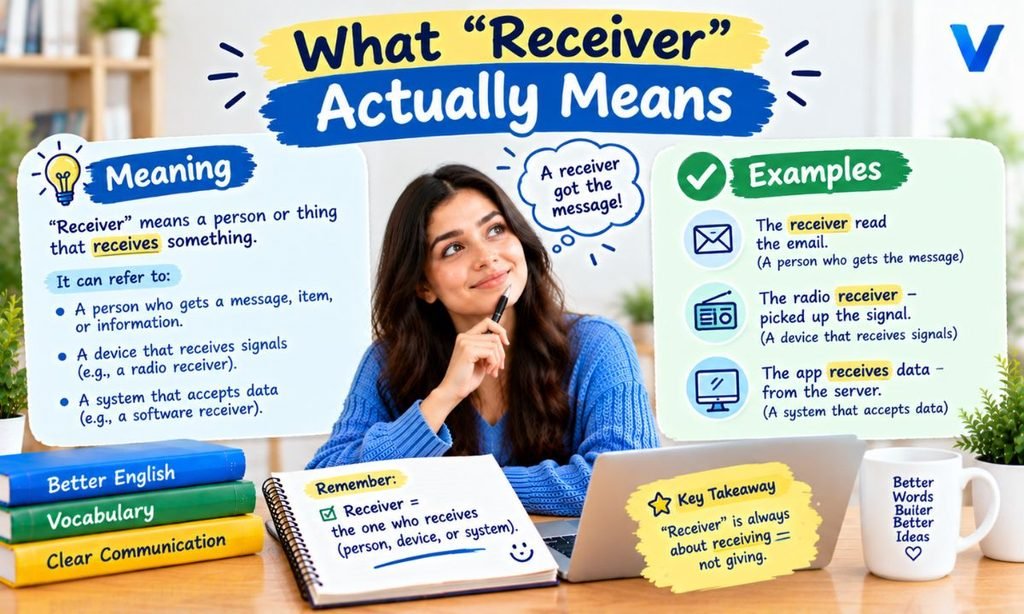
“Receiver” is a noun that generally refers to a person, device, or entity that takes in or accepts something. Its meaning shifts slightly depending on context, but the core idea — accepting or getting something — stays the same across every field.
Technology
In electronics, a receiver is a device that picks up signals, such as a radio, television, satellite, or home theater receiver. It converts incoming signals (audio, video, or data) into a usable output.
Finance and Business
In business and legal contexts, a receiver is a person appointed to manage the assets of a company or individual going through bankruptcy or financial distress. This is often referred to as being placed “into receivership.”
Everyday Use
In daily conversation, a receiver is simply anyone who receives something — a gift, a message, a package, or an award. If someone hands you something, you are the receiver in that exchange.
Key Contexts Where “Receiver” Is Commonly Used

Electronics and Communication Systems
Receivers are central to how modern communication works. Common examples include:
- Radio receivers that pick up broadcast signals
- Television receivers (tuners) that decode incoming channels
- Home theater and AV receivers that manage audio and video sources
- Telephone receivers, the part of a phone you hold to your ear
Sports and Training
In American football, a “wide receiver” is a position dedicated to catching passes thrown by the quarterback. This is one of the most searched contexts for the word, since sports fans and writers frequently reference player positions, stats, and training routines.
Why Writers Misspell It as “Reciever”
The mistake almost always comes down to one of these habits:
- Relying on how the word sounds rather than how it’s spelled
- Applying the general “i before e” rule without remembering the “except after c” clause
- Typing quickly without reviewing the word afterward
- Repeating a mistake seen elsewhere without double-checking it
None of these reasons make the spelling acceptable in formal writing — resumes, emails, articles, or official documents should always use “receiver.”
Receiver Meaning in Business
In a business or legal setting, a receiver takes on a very specific role. When a company cannot pay its debts, a court may appoint a receiver to take control of its assets, manage operations, and work toward repaying creditors. This process is common in bankruptcy proceedings and is referred to as “receivership.”
Using the correct spelling matters even more here, since legal and financial documents are held to a higher standard of precision. A misspelled term in a contract or court filing can raise questions about the writer’s attention to detail.
The Linguistic Rule Behind the Correct Spelling

The word “receiver” follows the classic English spelling guideline: i before e, except after c.
Here’s how it plays out:
- The letter “c” appears in the word, immediately followed by the “ei” sound.
- Because “c” comes right before this vowel pair, the order flips from the usual “ie” to “ei.”
- That gives us r-e-c-e-i-v-e-r, not r-e-c-i-e-v-e-r.
This same pattern applies to related words like receive, deceive, conceive, and perceive. If you remember that “receive” always uses “ei” after the “c,” “receiver” follows the exact same structure.
Receiver in Communication
Beyond electronics, “receiver” also plays a key role in communication theory. In the classic sender-receiver model, a message travels from a sender to a receiver through a chosen channel. The receiver’s job is to interpret and understand the message, making them just as important to successful communication as the person sending it.
This concept applies to everything from face-to-face conversations to digital messaging systems, where the “receiver” could be a person, a server, or a device.
Memory Tricks to Lock in the Correct Spelling

If you still find yourself hesitating, try one of these simple tricks:
- Anchor it to “receive.” If you can spell “receive,” just add an “r.” The letter order never changes.
- Say the rule out loud. “I before E, except after C” — and remind yourself this word is the textbook example of the exception.
- Picture the “cei” cluster. Train your eye to expect “c-e-i” together, not “c-i-e.”
- Check with spellcheck. Most word processors and browsers will flag “reciever” instantly — use that as a quick confirmation, not a replacement for actually learning the rule.
Examples of Correct Usage in Real Sentences
- The radio receiver picked up the signal clearly, even during the storm.
- She was the receiver of the company’s annual excellence award.
- The wide receiver sprinted twenty yards downfield before catching the pass.
- A court-appointed receiver took over the company’s finances.
- Please connect the Bluetooth receiver to your laptop before starting the call.
Common Mistakes and Incorrect Sentence Examples
Below are examples of the error in context, along with the corrected version.
- ❌ “Install the reciever near your television.”
- ✅ “Install the receiver near your television.”
- ❌ “The bankruptcy reciever filed the final report.”
- ✅ “The bankruptcy receiver filed the final report.”
- ❌ “He was the reciever of numerous complaints.”
- ✅ “He was the receiver of numerous complaints.”
Incorrect vs Correct Comparison Table
| Context | Incorrect | Correct |
| Electronics | “reciever” for TV/radio | “receiver” for TV/radio |
| Sports | “wide reciever” | “wide receiver” |
| Business/Legal | “court-appointed reciever” | “court-appointed receiver” |
| Everyday use | “reciever of the gift” | “receiver of the gift” |
| Communication | “message reciever” | “message receiver” |
Quick Self-Check Guide for Writers

Use this short checklist before hitting send or publish:
- Does the word contain “cei” (correct) or “cie” (incorrect)?
- Can you confirm you know how to spell “receive” first?
- Has your spellchecker flagged the word with a red underline?
- Are you typing quickly without proofreading? Slow down and check.
If you answer these honestly, you’ll catch the mistake almost every time.
Receiver Spelling in Grammar
From a grammar standpoint, “receiver” is a common noun formed by adding the agent suffix “-er” to the verb “receive,” turning an action into a person or thing that performs it (similar to teach → teacher or write → writer). Because the base verb “receive” already follows the “ei after c” pattern, that spelling carries over directly into “receiver” without any changes.
Practice Exercises to Reinforce Correct Spelling
Fill in the blanks with the correct spelling:
- The satellite ______ lost signal during the thunderstorm.
- The star ______ caught the winning touchdown pass.
- The package ______ signed for the delivery.
- The company appointed a financial ______ to handle the audit.
- She connected the wireless ______ to her sound system.
(Answer: all blanks should be filled with “receiver.”)
Related Terms You Should Know
- Receive — the verb form, meaning to accept or get something
- Reception — the act or process of receiving something
- Receipt — written proof that something was received
- Recipient — another word for someone who receives something
- Sender — the opposite role in a communication exchange
Recap: Fast Takeaways You Can Remember Easily
- “Receiver” is the only correct spelling — “reciever” is never accepted.
- The word follows the “i before e, except after c” rule.
- It’s used across electronics, sports, business, law, and everyday communication.
- The easiest memory trick is linking it to “receive,” which follows the same letter pattern.
- Spellcheck tools will flag “reciever,” but understanding the rule helps you avoid the mistake entirely.
FAQs
Q:Is it receiver or reciever?
“Receiver” is correct. “Reciever” is a common misspelling and is never accepted in standard English.
Q:What are the types of receivers?
Common types include radio receivers, television receivers, AV/home theater receivers, satellite receivers, and telephone receivers.
Q:What does “receiver” mean in English?
It refers to a person, device, or entity that takes in or accepts something, such as a signal, message, item, or role.
Q:Who is called a receiver?
Anyone or anything that gets or accepts something can be called a receiver — from a football player catching a pass to a device picking up a signal.
Q:Who is the sender and receiver?
In communication, the sender is the person who originates a message, and the receiver is the person or system that gets and interprets it.
Conclusion
The difference between “receiver” and “reciever” comes down to one small but important spelling rule: i before e, except after c. Once that rule clicks, the correct spelling becomes second nature.
Whether you’re writing about sports, technology, business, or everyday communication, remembering that “receiver” always follows “receive” in structure will keep your writing accurate and professional. Small details like this may seem minor, but they add up to clearer, more credible writing every time you sit down to type.










2 thoughts on “Receiver vs Reciever: How to Spell It Correctly”