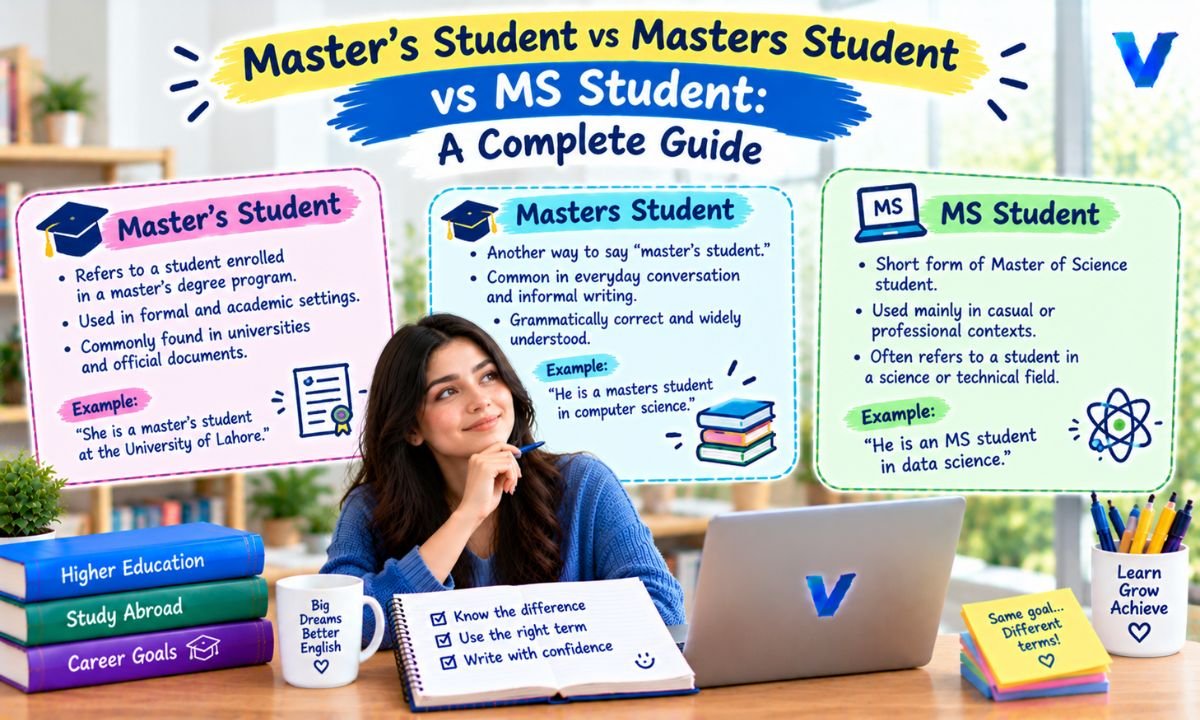
If you’ve ever paused mid-sentence wondering whether to type “master’s student,” “masters student,” or “MS student,” you’re not alone. This one tiny apostrophe trips up college applicants, LinkedIn profile writers, and even seasoned academics. The good news? Once you understand the logic behind it, you’ll never second-guess it again.
This guide breaks down the grammar, the style-guide rules, and the real-world usage so you can write with confidence in resumes, emails, research papers, and everyday conversation.
Why “Master’s Student” vs “Masters Student” Actually Matters
It might look like a minor typo, but punctuation choices like this shape how readers perceive your writing. A missing apostrophe can make a polished resume or academic bio look careless — and in competitive settings like grad school applications or job hunting, small details count.
Masters Student or Masters Student
Here’s the short answer: “master’s student” is correct, and “masters student” is incorrect. The confusion happens because the wrong version has become so common online that it looks normal. But grammatically, it breaks the possessive rule that governs how we talk about academic degrees.
Read More:24 Hours’ Notice or 24 Hour’s Notice or 24 Hours Notice: Which Is Correct?
What Does “Master’s Degree” Really Mean?
The phrase “master’s degree” is a possessive construction. It literally means “the degree of a master” — someone who has mastered a subject or field of study. The apostrophe + “s” shows ownership, the same way you’d write “a bird’s nest” or “a child’s toy.”
Drop the apostrophe, and “masters” becomes a plural noun instead of a possessive one. That changes the meaning entirely — and not in a way that makes sense in this context.
Quick Examples You’ll Actually Use
- ✅ She is pursuing her master’s degree in psychology.
- ✅ He just finished his master’s at NYU.
- ❌ She is pursuing her masters degree in psychology
Masters Student Meaning
When people write “masters student,” they usually mean exactly what “master’s student” means — someone enrolled in a graduate program working toward a master’s degree. The intended meaning is the same; only the spelling is off. Search engines and casual writers use both versions interchangeably, but only one is grammatically defensible in formal writing.
Read More:Bad Rap vs Bad Rep: What’s the Difference?
Master’s Student: The Correct Standard Form
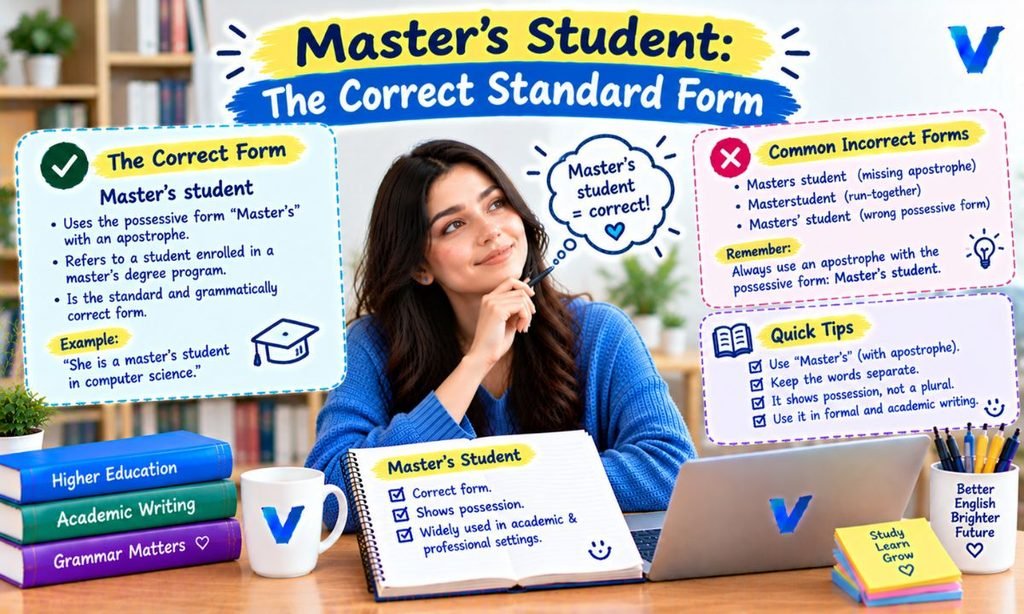
“Master’s student” is the standard, grammatically accurate term for anyone currently enrolled in a master’s degree program. It works in every context — academic writing, resumes, LinkedIn bios, emails to professors, and everyday conversation.
Example sentences:
- “I am a master’s student in computer science at the University of Michigan.”
- “As a first-year master’s student, she’s still adjusting to graduate-level coursework.”
- “He’s a master’s student researching renewable energy policy.”
Because it follows standard possessive grammar, this is the version style guides, universities, and professional editors recommend.
Masters Student: Why It’s Incorrect (But Common)
“Masters student” shows up everywhere — in casual writing, social media, and even some university web pages — but that popularity doesn’t make it correct. Without the apostrophe, “masters” reads as a plural noun, which doesn’t logically describe a single degree or a single program.
The Core Grammar Problem
Think about the test: if you can swap “master’s” for “bachelor’s” and the sentence still makes sense, you’re using the right possessive form.
| Phrase | Grammatically Correct? |
| Master’s student | ✅ Yes |
| Masters student | ❌ No |
| Bachelor’s student | ✅ Yes (for comparison) |
| Bachelors student | ❌ No |
If “bachelors student” looks obviously wrong to you, “masters student” should too — they follow the exact same rule.
MS Student: Meaning, Context, and Usage
“MS student” is shorthand for someone pursuing a Master of Science degree specifically. This is different from “master’s student,” which is a general umbrella term covering any type of master’s degree — MA, MBA, MFA, M.Ed, and more.
Use “MS student” when:
- The degree is explicitly a Master of Science (e.g., MS in Data Science, MS in Engineering).
- You’re writing in a technical, STEM, or research-heavy context where the abbreviation is standard.
- You want a concise, resume-friendly way to state your program.
Example: “She is an MS student in Computer Science at Georgia Tech.”
If your degree isn’t a Master of Science, calling yourself an “MS student” is technically inaccurate — you’d instead say MA student, MBA student, or simply master’s student.
Master’s Student vs Masters Student vs MS Student: Comparison Table
| Term | Correct? | When to Use | Example |
| Master’s student | ✅ Always correct | General term for anyone in a master’s program | “I’m a master’s student studying public health.” |
| Masters student | ❌ Grammatically incorrect | Should be avoided in formal writing | Not recommended |
| MS student | ✅ Correct in context | Specifically for Master of Science programs | “He’s an MS student in mechanical engineering.” |
Is “Masters Student” Capitalized?
Capitalization depends on placement, not the apostrophe debate. As a common noun in the middle of a sentence, it stays lowercase: “she is a master’s student.” It’s only capitalized when it starts a sentence, appears in a title or heading, or is part of a formal degree title (like “Master of Science”).
Style Guide Rules: APA, MLA, and Chicago

All three major style guides agree on the core rule: use the apostrophe for generic references to a master’s degree.
- APA Style treats “master’s degree” and “master’s student” as standard possessive terms, lowercase unless starting a sentence.
- MLA Style follows the same possessive convention and recommends consistency throughout a paper.
- Chicago Manual of Style confirms that generic degree references (“a master’s degree,” “a bachelor’s degree”) take the apostrophe, while formal degree titles (Master of Arts, Master of Science) do not use an apostrophe at all, since they aren’t possessive constructions.
Capitalization Rules You Should Know
- Lowercase for generic mentions: “she’s a master’s student.”
- Capitalize full formal titles: “Master of Science in Data Analytics.”
- Capitalize abbreviations: MS, MA, MBA, MFA.
- Don’t capitalize “master’s” alone unless it starts a sentence or heading.
Master’s vs Master of Science
“Master’s” is the informal, generic umbrella term for any graduate degree of this level. “Master of Science” (MS) is one specific type of master’s degree, typically awarded in STEM, business analytics, or research-based fields. Other specific types include Master of Arts (MA), Master of Business Administration (MBA), and Master of Fine Arts (MFA).
Simple Rules to Remember
- Use “master’s” for general references.
- Use the full degree name (Master of Science, Master of Arts) in formal or official documents.
- Use the abbreviation (MS, MA, MBA) on resumes and shorter bios once the full term has been introduced.
- Never use an apostrophe with the abbreviation — it’s “MS,” not “M’s.”
Master’s Student vs Master’s Candidate
These two terms often get used interchangeably, but there’s a subtle timing difference worth knowing.
Key Difference Explained
A master’s student is anyone currently enrolled in a master’s program, from day one through graduation. A master’s candidate typically refers to someone further along — often after completing coursework requirements and moving into thesis, capstone, or comprehensive exam stages. In other words, every candidate is a student, but not every student has reached candidacy yet.
Common Master’s Degree Abbreviations
| Abbreviation | Full Name |
| MS / M.S. | Master of Science |
| MA / M.A. | Master of Arts |
| MBA | Master of Business Administration |
| M.Ed | Master of Education |
| MFA | Master of Fine Arts |
| MPH | Master of Public Health |
| LLM | Master of Laws |
When to Use Them
Use the full degree name in formal documents like diplomas, transcripts, and official correspondence. Switch to the abbreviation in resumes, email signatures, and social media bios where space and readability matter more.
Real Examples You Can Copy
- “I’m currently a master’s student at UCLA, pursuing an MS in Data Science.”
- “As an MBA student, my coursework focuses on strategy and finance.”
- “She recently advanced from master’s student to master’s candidate after passing her qualifying exam.”
- “He completed his master’s degree in 2025 and now works as a data analyst.”
Quick Proofreading Checklist
- [ ] Did you include the apostrophe in “master’s degree” and “master’s student”?
- [ ] Did you avoid an apostrophe in abbreviations like MS, MA, or MBA?
- [ ] Is the full degree title capitalized correctly (Master of Science, not master of science)?
- [ ] Have you used “MS student” only when the degree is genuinely a Master of Science?
- [ ] Is your usage consistent throughout the entire document?
Master’s Students Plural
When referring to more than one student, the plural goes on “student,” not “master’s.” The correct plural form is “master’s students” — the apostrophe stays exactly where it is because it’s still describing degrees belonging to a master, just for multiple people.
- ✅ “All master’s students must register by Friday.”
- ❌ “All masters’ students must register by Friday.”
Final Summary Table
Use your left or right arrow keys or drag and drop with the mouse to change the gradient position. Press the button to change the color or remove the control point.
| Term | Status | Best Use Case |
| Master’s student | Correct | General, all-purpose reference |
| Masters student | Incorrect | Avoid in formal writing |
| MS student | Correct (context-specific) | Master of Science programs only |
| Master’s candidate | Correct | Later-stage graduate students |
| Master’s students (plural) | Correct | Referring to multiple students |
Key Takeaways
- “Master’s student” is the grammatically correct, universally accepted term.
- “Masters student” is a common but incorrect variation — the apostrophe is non-negotiable.
- “MS student” is accurate only for Master of Science programs, not master’s degrees in general.
- Style guides (APA, MLA, Chicago) all support the possessive apostrophe for generic degree references.
- A master’s candidate is typically further along than a master’s student, closer to thesis or exam stages.
FAQs
Q:Are MS and masters the same?
Not exactly. MS refers specifically to a Master of Science degree, while “master’s” is a general term covering any type of master’s-level degree.
Q:What is a Master’s student called?
They’re simply called a “master’s student,” or more specifically an MS, MA, or MBA student depending on their exact program.
Q:Is it correct to say “masters student” or “master’s student”?
“Master’s student” is correct. “Masters student” is a common but grammatically incorrect variation.
Q:Is Master’s called graduate?
Yes, a master’s degree is a type of graduate degree, and someone pursuing one is often called a graduate student.
Q:Do Master’s degrees have a title?
Yes, common formal titles include Master of Science, Master of Arts, and Master of Business Administration, depending on the field of study.
Conclusion
The difference between “master’s student,” “masters student,” and “MS student” comes down to grammar and context, not opinion. “Master’s student” is always safe and correct. “MS student” works only when the degree is specifically a Master of Science.
And “masters student,” despite its popularity online, remains a grammatical error worth fixing in your resume, LinkedIn profile, and academic writing. Get the apostrophe right, and your writing instantly reads as more polished, professional, and precise.










2 thoughts on “Master’s Student vs Masters Student vs MS Student: A Complete Guide”